‘Godspell’ coming to theater at LTCC

Lake Tahoe Community College will present the iconic hit musical “Godspell” from June 16-25 in the Duke Theatre.

It is one of the biggest off-Broadway successes of all time. 

“GodspellL first took the world by storm in 1972, then went on to enjoy successful productions around the world, including a recent Broadway revival in 2012.

A rock musical based on the Gospel according to St. Matthew, “Godspell” follows a group of people as they help Jesus Christ tell different parables by using a variety of games, storytelling techniques, and perfect comic timing. The show offers an eclectic blend of songs ranging in style from pop to vaudeville, bringing the parables of the New Testament to life on stage.

LTCC’s production of “Godspell” includes cast members Molly DeLallo, John Friedrich, Sharon Kerrigan, Thomas Lopez, Ellen Martin, Amanda Sanderson, Richard Sargent, Chris Taylor, Pam Taylor, Ashley Wallick, Saundra Whitt, and Jeff Whitt.

Performances are June 16-17 at 8pm, June 22-24 at 8pm, and June 18 and June 25 at 2pm. Tickets are $15 general admission, $12 for seniors, students with a valid ID and children under the age of 13.


Essay contest aims to promote Nevada travel

By Richard N. Velotta, Las Vegas Review-Journal

The Nevada Division of Tourism and the Nevada Department of Education are collaborating again on TravelNevada’s “Discover Your Nevada” campaign encouraging state residents to visit attractions within the state.

Nationally, 51 percent of state residents take trips to attractions within their own states, but in Nevada, the rate is just 6.7 percent, meaning most Nevada residents go out of state for weekend getaways and vacations.

To encourage more instate travel, TravelNevada — the brand for the state’s tourism division — is working with the education department to conduct an essay contest among the next school year’s eighth-grade students on destinations within the state.

Read the whole story


Placer looking to repurpose old firehouse

Placer County is trying to figure out what to do with the firehouse near Commons Beach that was vacated by the North Tahoe Fire Protection District in 2011.

The county started a public process for the site in 2011, but elected to wait for other planning efforts that would affect the potential uses for the structure.

Placer County began working with stakeholders in April to solicit opinions and expert input on what could be the best use of the site, whether that means reusing the existing buildings, taking them down for a park or plaza, or some combination thereof. The firehouse, along with the adjoining Tahoe Community Center structure, is on the lake side.

The community will have a number of opportunities to participate:

  • Community workshop: June 5, 5:30-7pm at the old firehouse
  • Community workshop: July 1, 10am-noon at the old firehouse
  • North Tahoe Regional Advisory Council: July 13, 6pm at the Tahoe City Public Utility District building conference room
  • Staff will present the workshop findings to the Placer County Board of Supervisors at their Tahoe board meeting scheduled for July 25 (Tahoe location TBD).

To find out more, to offer input on potential uses of the site, or to get involved, contact Suzy Vose at svose@placer.ca.gov or 530.886.4962.


Lessons from the devastating Angora Fire

Publisher’s note: Lake Tahoe News this month will be running several stories leading up to the 10th anniversary of the Angora Fire on June 24, 2007.

By Kathryn Reed

It will happen again – another devastating fire in the Lake Tahoe Basin.

But next time could be different based on the lessons learned from the destructive 2007 Angora Fire, as well as the changes that have taken place in the last 10 years.

“Really, there was nothing that could have been done differently to change the outcome based on the conditions we faced that day,” Kit Bailey, with the U.S. Forest Service, told Lake Tahoe News. Bailey was the initial incident commander for Angora.
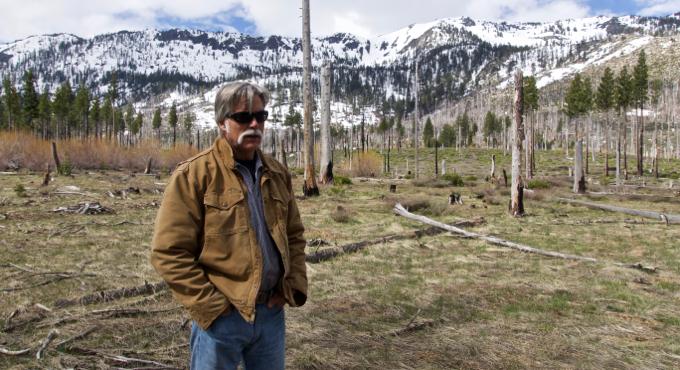
Kit Bailey, LTBMU’s fire chief, surveys what the landscape looks like today. Photo/Kathryn Reed

The humidity, temperature and wind created a perfect scenario for a wildland fire. Fuels treatment were not as robust then. “Extreme fire behavior” is a common refrain when fire officials talk about Angora.

Walking near where the fire started at Seneca Pond, the landscape looks like two worlds. It’s clear to see where the forest had been treated and where it wasn’t. To this day the scar on the forest is prominent and will be for decades to come.

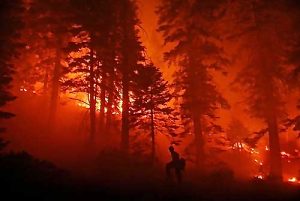
It was a hot, fast fire. Flames were in the canopy, jumping from one tree to the next as though it were a race to destroy as much as possible.

“You can almost draw a line where it was treated,” Bailey said as he looked out onto the forest. “It gave the firefighters an opportunity to engage and retreat when they needed to.”
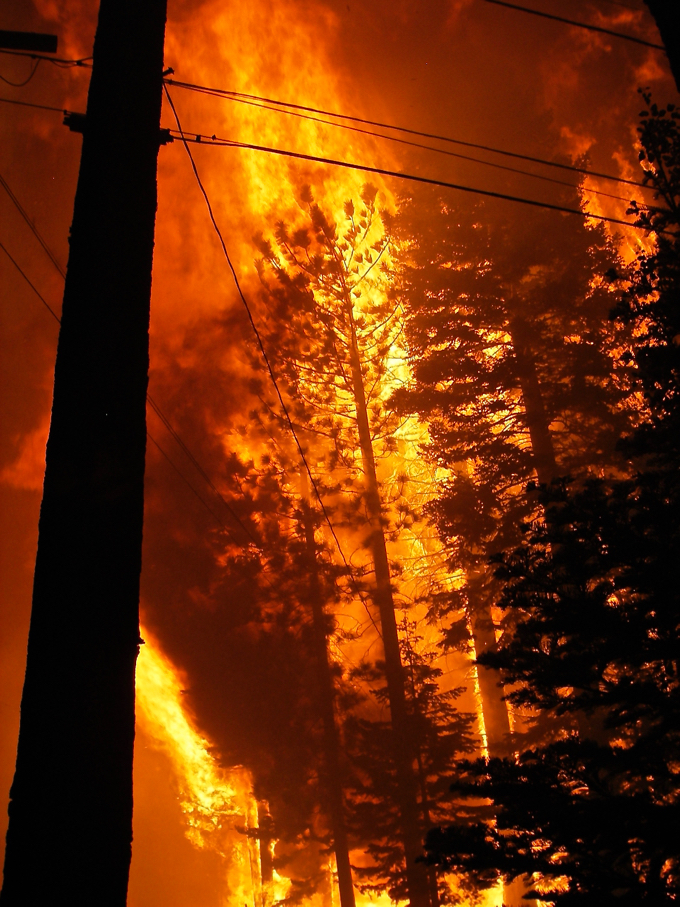
The Angora Fire burned hot and intense in the tree canopy. Photo/LVFPD

Fire behavior is very different between treated and untreated terrain. If it’s been thinned, then the fire tends to say in the understory where it is more easily suppressed. Fighting a running crown fire, even with air support, is a difficult, near impossible endeavor.

The fuels work on Tahoe Mountain and below Angora Highlands prior to that fateful day contributed enormously to only one house in that area being lost.

It has been proven that more prescribed fire means fewer wildland fires.
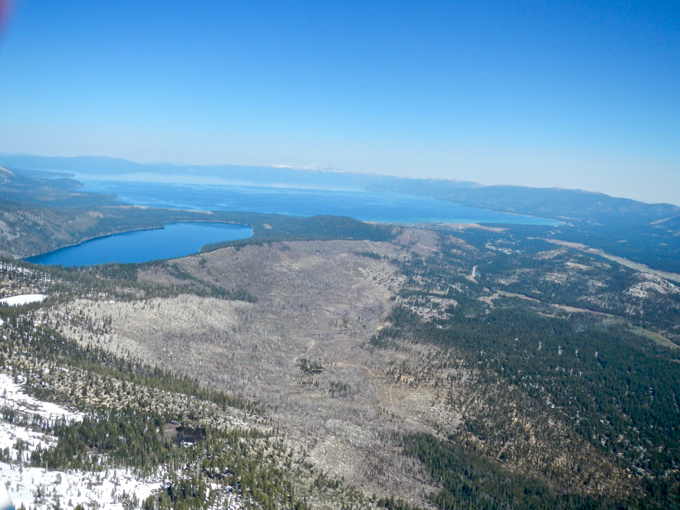
The scar from the Angora Fire will be visible for years to come. Photo/LTN file

“Some post fire studies showed homes with better defensible space had a better likelihood to survive. This was not new news, but it helped solidify that need in the Lake Tahoe Basin,” CalFire Division Chief Chris Anthony told Lake Tahoe News.

Equipment and manpower were quick to arrive that Sunday afternoon. But not before 254 houses were reduced to ash. Most of the damage to structures and land happened in the first eight hours.

Three significant tools are now available that weren’t during Angora. Lake Tahoe Basin Management Unit now has a hot shot crew. The Super Scooper plane is another tool that is new. Alert Tahoe, the camera system, is quick to spot puffs of smoke.

Another change since Angora is that CalFire now has a year-round presence in the basin. Personnel had always been here, but not equipment. Now there are engines at Lake Valley and North Tahoe fire stations. Then-Gov. Arnold Schwarzenegger’s emergency funding for the rigs became a permanent line item in the budget.
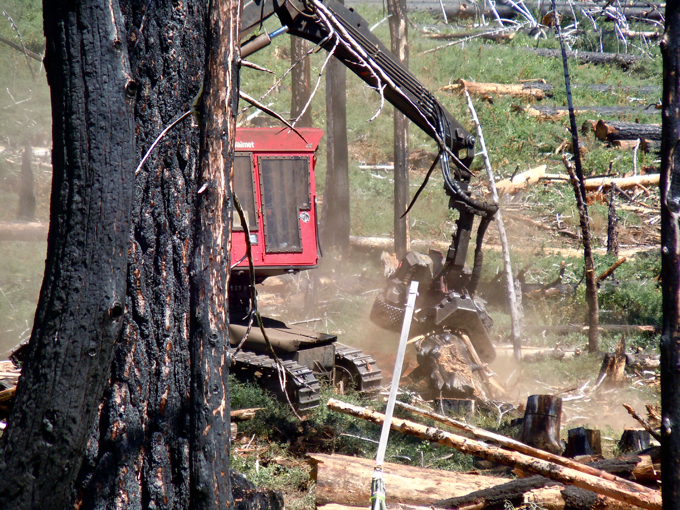
It was four years after the Angora Fire before many of the charred trees were removed. Photo/LTN file

Anthony, who was here for Angora, says the relationship between the fire agencies has been a significant change.

“One of the biggest lessons was the need for the increased collaboration between different agencies in the Lake Tahoe Basin,” Anthony said. “It’s very clear in the commission report that the local fire protection districts, land managers and regulatory agencies needed to do a better job working together.”

The report he speaks of is the bi-state Blue Ribbon Commission that was tasked with analyzing what needed to change to help prevent another Angora.

It is still a tool. Both states and TRPA annually monitor progress being made based on recommendations in the report.

“There was a lot of work that went into the commission hearings and lot of public input. It’s important we continue that legacy established by the commission,” Anthony said.
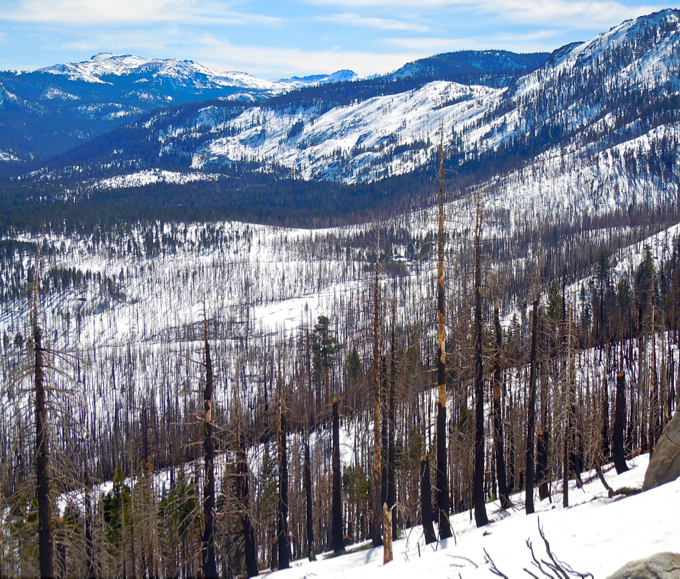
Looking toward the neighborhood off North Upper Truckee Road from Angora Ridge. Photo/LTN file

A formal, comprehensive report detailing the last 10 years is expected to be completed by the end of the month.

The Tahoe Fire and Fuels Team came out of Angora. It includes all the fire departments in the basin and other agencies. They work on getting grants for fuels reduction projects for the greater good of the community. They essentially have each other’s back in a more formalized structure when an emergency occurs. The wildland protection plan, which encompasses the basin, has been developed. A multi-jurisdictional approach to managing public lands is in place.

A sub-geographical operating plan has been established that goes into more detail when it comes to moving local, state and federal resources.

“I think there are a lot of lessons, not on suppression, but on the land regulations side of the house,” Bailey said. “We’ve streamlined the permit process with TRPA and somewhat with Lahontan. Lahontan has the biggest impact on what we can do on the ground and the timeliness. It’s like pulling teeth to get a permit. It costs a lot of time and money.”
Angora Fire facts:
• June 24, 2007, Angora Fire started at Seneca Pond
• Cause: Illegal campfire
• No arrests ever made; investigation considered cold case
• July 2, 2007, fire fully contained
• More than 3,100 acres burned; mostly U.S. Forest Service land
• 80 percent of the terrain burned in the first eight hours
• 254 houses destroyed
• Fire caused more than $150 million in damage
• It cost about $23 million to fight the fire
• July 5, 2007, bi-state commission formed
• 56,317 tons of ash and rubble were removed and transported for disposal (2,823 truckloads); 6,134 tons of concrete (352 truckloads) and 2,001 tons of metal were recycled (90 truckloads); and 8,511 tons of trees were recycled for lumber (405 truckloads)
• May 27, 2008, governors declare state of emergency in Lake Tahoe Basin. Fire commission’s 247-page report’s six categories are: Environmental Protection, Issues of Governance, Community and Homeowner Fire Prevention, Forest and Fuels Management, Fire Suppression, and Funding.
• June 2008, 63 percent of the homeowners had filed building plans with the county
• June 2017, 63 lots remain vacant.
Photo/Dennis Cocking

Shortly after the fire there was a community meeting at South Tahoe Middle School where it was almost a mob mentality. The audience shouted down John Singlaub who was the director of the Tahoe Regional Planning Agency. While TRPA has some arbitrary rules in place that affect homeowners, they were not a huge impediment to what large landowners wanted to do in regards to fire safety.

The same cannot be said for the Lahontan Regional Water Quality Control Board. To this day it is still a stumbling block for the U.S. Forest Service and others on the California side. The difference with Lahontan and TRPA is that the former doesn’t have much to do with individual residents, so the anger toward that state agency has never risen to the level that it still can with the federal regulatory organization.

TRPA now allows the fire agencies to decide if trees should be removed from an individual parcel. People may cut trees of 14 diameters or less without a permit; it was 6 inches pre-Angora. And no longer are piles of pine needles recommended as mulch or for erosion prevention.

“When you look at fire statistics since 1990, California has had 15 of its 20 largest fires. We are seeing more damaging fires,” Anthony said. “We can’t totally prevent large and damaging fires in the state, but we can change the landscape where they burn. Again, out of the commission report was the need to accelerate the pace of fuels reduction work in wildland urban interface, to increase the number of defensible space inspections around the lake and to prioritize where those are going to occur based on the greatest need.”

Fire officials worry that people have become complacent in the last 10 years and don’t necessarily take the threat of fire as seriously as they did immediately after Angora.



Opinion: Growing retirement costs hit Calif. state budget hard

By Dan Walters, Sacramento Bee

California’s rapidly growing public employee retirement costs weigh heavily on the 2017-18 state budget now being fashioned, but their impact is only partially revealed in budget documents.

Dan Walters

Gov. Jerry Brown’s proposed budget does tell us that the state has $205.9 billion in “unfunded liabilities” for pensions and health care for state and University of California employees and adds, “These retirement liabilities have grown by $51 billion in the last year alone due to poor investment returns and the adoption of more realistic assumptions about future earnings.”

The budget also reveals that the state’s mandatory “contributions” to the California Public Employees’ Retirement System “are on track to nearly double from $5.8 billion … in 2017-18 to $9.2 billion … in 2023-24.”

Read the whole story


From bushlands of Africa to college graduation

By Tim Prudente, Baltimore Sun
 
The bushlands of West Africa are far in many ways from the Johns Hopkins University, and the path was neither sure nor straight for the boy whose name meant “beloved by his ancestors.” They called him Kpimenongme Mwinnyaa.

Only now as he graduates — having been baptized George, having earned semester after semester of straight A’s despite grades once too poor for college — does he dare believe it’s more than a dream.

George Mwinnyaa, 29, received a bachelor’s degree in public health with academic honors at Hopkins’ commencement last month. Mwinnyaa was named the outstanding senior researcher in the prestigious public health program and wore the honorary cords.

His formal education in the United States started in Reno.

Read the whole story


U.S. forests shifting with climate change

By Seth Borenstein, AP

A warmer, wetter climate is helping push dozens of Eastern U.S. trees to the north and, surprisingly, west, a study finds.

The eastern white pine is going west, more than 80 miles since the early 1980s. The eastern cottonwood has been heading 77 miles north, according to the research based on about three decades of forest data.

The northward shift to get to cooler weather was expected, but lead author Songlin Fei of Purdue University and several outside experts were surprised by the move to the west, which was larger and in a majority of the species.

Read the whole story


What will happen to medical marijuana in Nevada?

By Chris Kudialis, Las Vegas Sun

The Denver dispensary is called Medicine Man and was founded on serving medical marijuana patients. Yet, since Colorado legalized recreational marijuana sales three years ago, few of the store’s patrons have been making medicinal purchases.

“There’s less need for medical inventory because we have less medical customers,” said Andy Williams, owner and CEO of Medicine Man, one of Colorado’s largest legal marijuana stores selling both recreational and medical marijuana. “People don’t want to go through the hurdles to get their cards anymore.”

A similar scenario will likely play out for Nevada’s pot dispensaries when recreational marijuana sales begin July 1. The first four states to legalize recreational marijuana sales — Oregon, Alaska, Washington and Colorado — have all seen a dip in the number of active medical card-holding patients.

For nearly two years since Nevada’s first dispensary opened in July 2015, medical marijuana has been the only source of legal weed. Nearly 28,000 Nevadans currently have medical cards, and thousands of other purchases come from out-of-state buyers through the state’s reciprocity program, which honors medical cards from other weed legal states.

Read the whole story


Letter: Homeless coalition appreciative of support

To the community,

On behalf of the Tahoe Coalition for the Homeless (TCH), I would like to thank our community for your support through the second winter of the South Lake Tahoe warm oom project.  Our organization received donations from over 200 different individuals and businesses, and benefited from over 60 volunteers who provided over 1,600 volunteer hours.

In our second winter, we were open every night from Dec. 15 through April 30. We provided 3,741 shelter bed nights and averaged 27 guests per night. The majority of our guests are local – 87 percent reported living or working in the South Lake Tahoe area prior to becoming homeless. Twenty-six percent of our guests were employed at the time they entered the warm room.

The success of this program is reliant on the collaboration of donations from our generous community. Special thanks to El Dorado Community Foundation, Reliapro Painters, Caesars Foundation, South Lake Tahoe Endowment, and many more for their financial support. We are grateful for partnerships with the South Lake Tahoe City Council, South Lake Tahoe Police Department, Barton Health, Darke Marketing, El Dorado County Services, Live Violence Free, Naji Raad & Family, Only Kindness, South Tahoe Refuse, St. Theresa Catholic Church, Tahoe Youth & Family Services, Temple Bat Yam, and Unity at the Lake. Our supporters are too numerous to name ,but we do appreciate all of your support in opening and operating our area’s first overnight emergency winter shelter.

In order to promote more awareness about individuals experiencing homelessness, Tahoe Coalition for the Homeless is planning an educational event, Faces of Homelessness, on Oct. 26 at Valhalla Tahoe.

TCH is a 501(c)3 charitable organization. Our mission is to meet the needs of our neighbors experiencing homelessness by providing warm beds and promoting community awareness. Donations are welcomed to aid in funding the warm room 2017-18 season. Checks can be made payable Tahoe Coalition for the Homeless and mailed to PO Box 13514, South Lake Tahoe, CA 96151. Donations can also be made on our website.

Marissa Muscat, TCH


Placer County rejiggering health care options

Starting in July, Western Sierra Medical Clinic will provide medical and dental services to low-income North Lake Tahoe residents in place of Placer County’s current health clinic in Kings Beach.

Most of the existing county medical staff will join the nonprofit Western Sierra, and several Placer County nurses will remain onsite.

The county will no longer operate health clinics directly, having transitioned operations of a clinic in Auburn to Western Sierra last fall.

The idea is this change will save money and allow for more flexibility.

Western Sierra will treat patients from Nevada and Placer counties, and initially offer primary care and dental services for newborns to seniors at the Kings Beach health center, though additional services such as pediatrics and women’s health may eventually also be offered.