
Future tennis stars learn at ZCTC

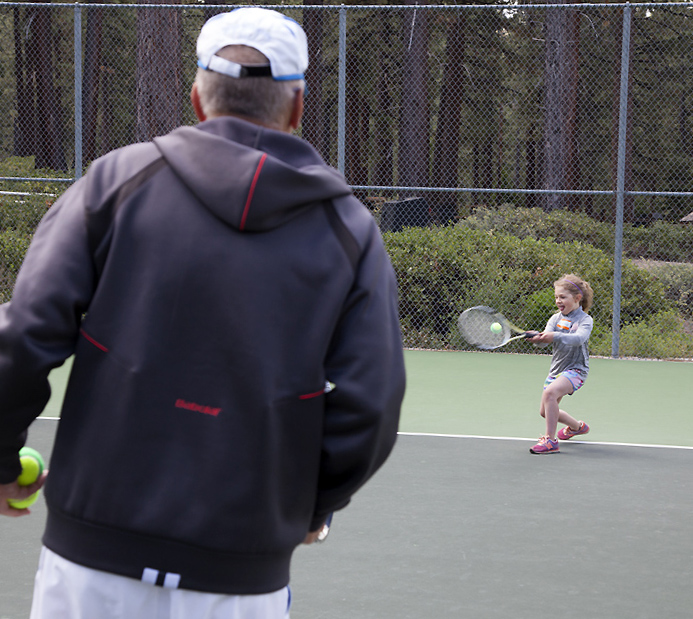
Volunteer Hersh Herschman helps Emma Stewart learn ground strokes. Photo/Provided

It didn’t take much imagination to envision a decade from now the next Simona Halep or Rafa Nadal being at the trophy ceremony of the French Open and saying how their days at Zephyr Cove Tennis Club laid the foundation for their success.

Hours after Halep won her first grand slam title on June 9, more than 30 youngsters were scattered about the courts at Zephyr Cove receiving two hours of free instruction from head pro Dave Nostrant and his cadre of volunteers from the club.

Divided into age groups, the youngest had an array of obstacle-course like apparatuses to use to get them acquainted with the various aspects of the sport.

On other courts the older kids were learning to volley with the simple reminder that the racket should high-five the ball. Ball control, forehands and backhands were taught on other courts. The youngsters switched from court-to-court to get a taste of each station.

This event was co-sponsored by Douglas County Parks and Recreation Department and the nonprofit Zephyr Cove Tennis Club Foundation.

Nostrant will be conducting youth clinics in June and July. For more information or to register, go online. Nostrant may be reached at 702.496.6277or zctennisclub@gmail.com.


California drinking water tax dies

By Dale Kasler and Adam Ashton, Sacramento Bee

A proposed tax on California’s drinking water, designed to clean up contaminated water for thousands of Californians, was abandoned by Gov. Jerry Brown and legislative leaders Friday as part of the compromise on the state budget.

Lawmakers and Brown’s office scrapped the “Safe and Affordable Drinking Water Act,” which would have taxed residents 95 cents a month to raise millions for cleaning toxic wells. Instead, legislative leaders agreed to spend $5 million from the general fund to deal with lead in drinking water at child care centers. They also plan to allocate $23.5 million from the general fund for “safe drinking water actions later in this legislative session,” according to a Legislative Budget Conference Committee report released Friday.

Read the whole story


AAUW provides scholarships to LTCC grads

The American Association of University Women, South Lake Tahoe branch recently awarded two $1,500 scholarships to women graduating from Lake Tahoe Community College and going on to further their education at the college or university level.

Both winners are from South Lake Tahoe. Hannah Brown attained an associate’s degree in math and Spanish from LTCC and will be attending UC Davis to major in computer science. Kat Spence, who has already attained several associate’s degrees is graduating from LTCC with a degree in math application, will be attending UC Davis to major in civil engineering.

AAUW is dedicated to advancing equity for women and girls through advocacy, education, philanthropy and research.


Small wildland fire burning on East Shore

A small fire is burning near Genoa Peak on the East Shore.

About one-quarter acre had been consumed by 2:30pm June 11.

According to the U.S. Forest Service, it first started about Memorial Day when the basin experienced a number of thunder and lightning storms. It is believed a single tree was struck and that Saturday’s wind whipped it into a full-fledged fire.

Aircraft are being used to suppress the fire.

— Lake Tahoe News staff report


Dotty’s casino chain settles ADA suit for $3.5M

By Associated Press

RENO — A Nevada company that operates the Dotty’s casino chain has agreed to pay $3.5 million to settle a disability discrimination suit.

The U.S. Equal Employment Opportunity Commission filed the lawsuit earlier this year accusing the Las Vegas-based Nevada Restaurant Services of violating the Americans with Disabilities Act.

There is a Dotty’s in Stateline.

Read the whole story


Experts: N. Nev. may be hurt by lax pollution rules

By Benjamin Spillman, Reno Gazette-Journal

Republican President Trump’s efforts to loosen vehicle pollution standards at the federal level could mean less healthy air and more local regulations in Northern Nevada.

That’s according to air quality experts who say communities in Nevada and around the U.S. would face pressure to offset increased pollution from cars with regulations on other sources of pollution.

Additional pollution from tailpipes and other sources would also put people at greater risk of health problems associated with breathing polluted air.

Read the whole story


Photo contest all about state parks in U.S.

The second annual America’s State Parks 2018 photo contest has a focus on highlighting real-life moments and celebrating the essence of state parks.

The contest encourages amateur photographers to submit photos taken at a state park within the five categories of camping, wildlife, activities, friends and family, and scenic and seasons.

From now until July 31, participants may submit entries online.

Of the more than 8,000 entries submitted nationwide during last year, the winning photo featured Nevada’s Ward Charcoal Ovens State Historic Park. 


Tahoe Tails — Adoptable Pets in South Lake Tahoe

Chola

Chola is a 2-year-old beautiful blue brindle purebred Cane Corso. She is a large dog, but she is a gentle soul and loves to be with her people. She has lived with dogs, cats and poultry.

Chola is a low to medium energy girl who is very sweet, loves to go for walks, and takes treats very gently.

Chola will be spayed soon, and is microchipped, tested for heart worm, and vaccinated. She is at the El Dorado County Animal Services shelter in Meyers, along with other dogs and cats who are waiting for their new homes. Go to the Tahoe animal shelter’s Facebook page to see photos and descriptions of all pets at the shelter. 

Call 530.573.7925 for directions, hours, and other information on adopting a pet. For spay-neuter assistance for South Tahoe residents, go online

— Karen Kuentz


Equipment changing landscape of fire prevention


The Spider looks like a Transformer ready to tromp through the forest. Photo/Susan Wood

By Susan Wood

POLLOCK PINES – Relying heavily on prescribed burns as fuel reduction among forest officials may be steeped in tradition – but the practice isn’t enough to fight the types of raging infernos the West is seeing year after year.

Much of the challenge often lies in fire prevention over steep terrain requiring a cross between the old and the new. It takes oversized Tonka trucks and Transformer-type heavy equipment.

California is coming off a series of drought years, then one of the worst seasons ever for wildland blazes on the 25th anniversary of the Cleveland Fire. The mega blaze burned more than 24,000 acres in 30 hours, closed a 50-mile stretch of Highway 50, killed two people and injured 72. The hot fire that roared eight miles east of Pollock Pines along the Peavine Ridge north of Riverton at Ice House Road presents a painful reminder of what could be.  

Another more recent blaze nearby — the King Fire of 2014 — scorched more than 97,000 acres in El Dorado County and destroyed 80 structures. The fire’s cause was arson, but the damage is still visible from the highway and restoration is ongoing.

The terrain is thick, steep and unforgiving to get to off the roads.
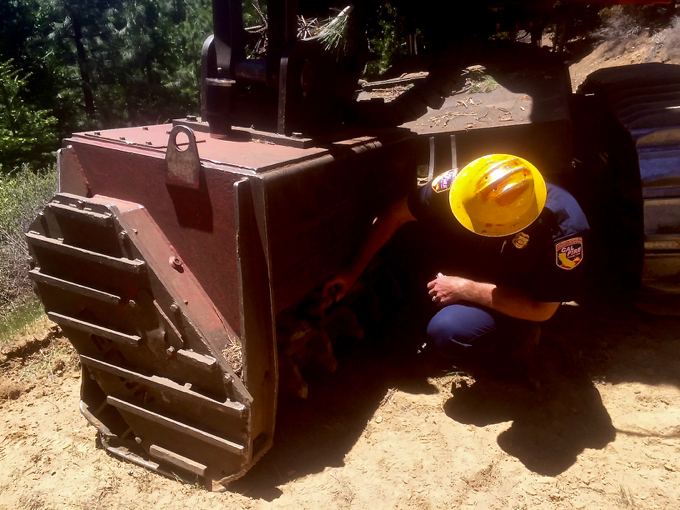
CalFire Deputy Chief Stewart McMorrow looks at the chewing teeth of the TimberPro attachment. Photo/Susan Wood

“We’ve spent $6 million to restore 11 Pines Road, and it’s still closed,” Eldorado National Forest Supervisor Laurence Crabtree told Lake Tahoe News preceding a tour last week from the Ice House Resort 10 miles up from Riverton.

The U.S. Forest Service spends over half its budget on fighting fires, knowing prevention is where the emphasis needs to be. 

Forest managers were joined to view the equipment and results up close by small groups of residents, Sierra Pacific Industries and CalFire officials, who declared a suspension to burning starting today in El Dorado, Amador and Alpine counties. Some see the declaration as the official start of fire season. Others would agree fire season has turned into a yearlong event.

Crabtree estimated at least 35 percent of the burn area with a mix of conifer trees such as fir, pine and cedar from the King Fire is steep, posing a hazard to property owners – especially as more build in the wildland interface. In the last five years, Forest Service officials have negotiated agreements with private property owners to establish firebreaks on their land.

Among them is Sierra Pacific Industries – which manages the resources on 1.8 million acres in California.

The excavation machine made by Pacific Tech handles the steep terrain of the Eldorado Forest. Photo/Susan Wood

“We need to manage fire; we don’t need it to manage us,” Sierra Pacific spokesman Mark Luster summarized about the tree-clearing demonstration. 

Take an overgrown forest with mass pockets of dead trees in timber-dry conditions, an excess of fuel following wet winters while throwing in windy conditions, and California is ripe for a no-win perfect storm of fire capable of producing the kind of huge complexes that ripped through the Wine Country last year.

Firefighters regionwide are quite aware of how vulnerable the rugged, woody Sierra Nevada Mountain Range is – especially in hard-to-get-to, steep terrain.

Fire science proves flames burn faster up steep slopes. Unfortunately, this terrain makes it difficult for firefighters to cover the ground necessary to build a perimeter to contain and control fires that hop from low-lying brush, to ladder fuels up to the crown.

That’s one reason managing the resources ahead of the worst time of year in fire season may seem like a never-ending task when other forces like drought and bark beetle stack on the obstacles.

Sometimes it’s just as hard to manage the people doing the work of clearing the debris. 

Contractor Jeff Holland quipped that his company of 30 machines and 25 people said his company has grown increasingly busy since 1983 since the forest has been “mismanaged.”

To that, Luster countered that the job is overwhelming anyway.

“If you look at how much acreage, there’s so much volume, it’s hard to keep up with the amount of volume,” he said.

CalFire Deputy Chief Steward McMorrow, who works out of Sacramento, agreed. 

“What we’re doing here is rearranging the fuels on the lower forest floor,” McMorrow said as he glanced over a cleared segment of acreage where the Timberpro harvester had gone through. He contends that environmentally chewing the trees and leveling the land also helps to stimulate the fungal process. 

The goal of the equipment demonstration: To witness how the latest and greatest in excavating, skidding, moving and mulching equipment can clear a fire prone region in steep terrain by digesting woody debris in ways unheard of decades ago. The key is in the equipment attachments assembled to address the job, the level of fineness and the terrain. 

Some of these heavy-equipment machines look like something out of an animated space film – such as one called the “spider.”  The walking excavator made by Menzi of Switzerland essentially crawls down the hills with the use of four independently-operated mega wheels, front stabilizers and a loader appendage that helps it crawl up and down a slope of at least 40 degrees with ease. The 30,000-pound machine looks like a living thing when it lays flat or arches its back.

“It can collapse down to 7-feet wide,” said equipment operator Eric Monson, whose Atascadero-based Stroles Tri Service company contracts with Sierra Pacific and the U.S. Forest Service to clear the thick forest in hard-to-treat fuel reduction regions.  
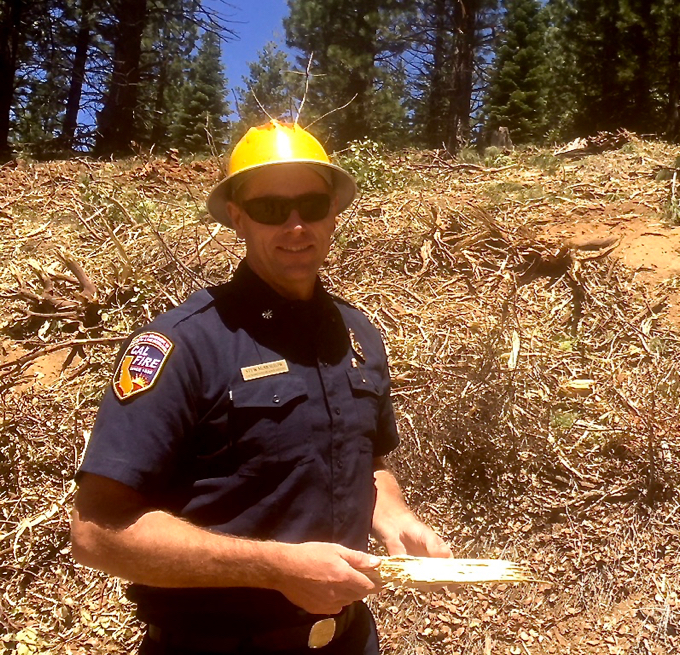
CalFire Deputy Chief Stewart McMorrow surveys the land cleared by a tree harvester. Photo/Susan Wood

Down the road, Brian Kile, the western regional manager of Fecon, explained how his agile track mulcher can handle steep slopes of 45 degrees. The finished byproduct looked like something homeowners might be happy with in their own back yard. The mulcher was put to the test during the West Yellowstone fires, serving as an emergency fire break.

“This thing can blow dirt and can (at times) put a low-ground fire out,” Kile said with pride.

Bruce Jackson, displaying ASV’s skid steers and track loaders, noted to the tour group how pleased he is with the performance of his equipment in the steep terrain of the Eldorado Forest.

 “You have to do something drastic to flip it,” he said.

Jackson also insisted the cooling system makes his machine superior in that it can work for prolonged periods without overheating.

All in all, the heavy equipment of today isn’t your grandfather’s and plays a more important role in human survival than dirt excavation.

This is a video the Sacramento Bee shared with LTN showing the equipment in action.


Letter: Understanding the 2 VHR initiatives

To the community,

I attended the VHR community forum on June 9, organized by the SLT Republican Women. The topic of this forum was the future of vacation home rentals (VHR) in our community. Both sides were well represented.

Bruce Grego

Peggy Bourland lead the Neighbors for Neighbors group, whose initiative has been approved by the city clerk and El Dorado County elections as having sufficient signatures for election, and which provides elimination in three years of all VHRs in residential areas in our city with some limited exceptions for home occupied owners.

The Sustainable Community Alliance is the sponsor of a second VHR initiative with Mark Salmon leading this group. This second initiative seeks to basically accept current city ordinances permitting VHRs in residential areas with additional requirements of advisory committees to address problems and problems of enforcement connected with VHRs.

Additionally, besides the two groups, made up of three speakers each, there were six other speakers that provided additional information concerning this issue. This was a two-hour discussion and was well attended by the public.

As expected, there are divisions between the two groups as to the facts and the impacts of having VHRs in our community. Neighbors for Neighbors felt that housing for middle and lower income groups have been substantially reduced due to the 1,400 VHRs in our community; Sustainable Community Alliance disagreed and claimed that VHRs have no measurable effect upon housing. Sustainable Community Alliance felt that the reduction of VHRs will have seriously economic consequences upon TOT collection and the income of people that work to support this industry. Neighbors for Neighbors claimed that the impacts would not be substantial effecting only 12 percent of TOT tax revenue for the city. Neighbors for Neighbors complained about poor enforcement and the fact that in all the years of enforcement no one’s VHR permits has been revoked. Sustainable Community Alliance agreed that the city was slow to react to these problems of noise and parking, but indicated that other groups that live in the residential areas, owners and renters have caused similar problems. Neighbors for Neighbors felt that local employers can’t find employees because of the lack of available housing and high rents. Sustainable Community Alliance felt that the reduction of VHRs will result in the loss of employment for those that support this industry. Both groups claimed that they have made compromises on this issue, but there was no agreement as to that issue either.

The character of the residential areas, the right to use one’s property, quiet possession, this enforcement of zoning, what is permitted in the residential zone, the economy, housing and more were discussed. I have not attempted in this letter to fully or with detail describe the approved and proposed initiatives or to fully describe the positions and arguments on both sides. My point in this letter is to identify the one clear area of agreement.

These opposing groups and even those that attended this forum, all agreed that our City Council has seriously failed to adequately address the VHR issue and this failure has resulted in the current conflict heading for a November vote with these opposing groups. This council’s failure to act, failure to seek balanced and fair compromise, failure to act timely, and failure to bring these groups together on the VHRs is why we now have strongly opposing groups ready to “go for broke” in the upcoming election in November.

Tom Davis, as business owner (not as a council member) was one of the six informational speakers at the forum. Wendy David, our mayor, attended for a period of time and left. It’s a sad state of affairs when our council has failed to engage the Citizens and Voters of this Community to obtain an amiable resolution of this controversy. In speaking to some of the people present at the forum, there is still a desire for compromise, but there is no one in authority to act upon this opportunity.

Bruce Grego, South Lake Tahoe