Snippets about Lake Tahoe

·      The El Dorado County Fair is June 15-18. For details, go online.

·      One Grass Two Grass Bluegrass band will be playing at Moe’s BBQ in Tahoe City on June 24. Doors at 8:30pm, music at 9:30pm. Must be 21. Tickets are $10 in advance and if available $12 at the door.

·      A Reading Paws therapy dog will be at the Douglas County Public Library in Minden every Thursday from June 15-July 27 between 10:30am-noon.

·      The League to Save Lake Tahoe is looking for volunteers to help clean South Shore beaches July 5 from 8:30am-noon. Sign up online.

·      There will be a community bike path cleanup event on June 17 from 9:30am-noon. All ages are welcome and all supplies will be provided. For details, call Catherine at Clean Tahoe, 530.544.4210.


Stockholder drops lawsuit over Aspen ski company merger

By Scott Condon, Denver Post
 
A stockholder who filed a lawsuit June 2 to challenge the acquisition of Intrawest Resort Holdings Inc. by affiliates of Aspen Skiing Co. and KSL Capital Partners voluntarily dropped the litigation Wednesday.

A law firm for stockholder Edward Hyden filed a notice of dismissal in U.S. District Court in Denver. No explanation for the abrupt change of direction was provided.

The case was dismissed without prejudice, which means it can be filed again. That suggests no out-of-court settlement was reached.

Read the whole story


Road Beat: Lancer SEL-AWC, an underappreciated ride

Mitsubishi is back in the game with the 2017 Lancer SEL-AWC. Photos/Larry Weitzman

By Larry Weitzman

Since the heyday of Mitsubishi when the 3000 GT and Eclipse were halos to a great line of imported automobiles (actually the popular Eclipse was built in Normal, Ill.), it has had some hard times when it was almost “overrun” by the competition and sales fell dramatically. Now Mitsu is in comeback mode, selling more than 100,000 cars in the last two years and climbing by selling value and competence.

Just today as I write this Road Beat, Mitsubishi is introducing a new model CUV, bringing back the Eclipse name combined with “Cross” taking the name “Eclipse Cross.”

Eclipse Cross is an all-new small very aggressive and sporty CUV. It will be powered by a turbocharged 1.5L GDI inline four or a 2.2L turbocharged common rail diesel both with 8-speed trannies, except the gas engine eight-speed is a CVT designed to act like an eight speeder. Dimensions are 173 x 71 x 66-inches length, width and height with emphasis in its very manageable length and muscular wide stance.  Mitsu’s AWD system, a trick new interior and other features make this ride look very exciting. It should be on the market hopefully later this year.

This leads us to the AWC Mitsubishi Lancer, my test vehicle for the week which uses the same All Wheel Control (AWD) system of the new Eclipse Cross. It does perform beautifully, offering front wheel drive, automatic all-wheel drive. You can lock them up as well, all done with a simple rocker switch in the center of the console. Having made an excursion from Placerville to Carson City with snow on the ground, the AWC provided the grip and drivability almost to make the little Lancer feel invincible in such conditions with superb grip and traction.

Specifications
Price $21,995 plus $810 for the boat ride from Japan
Engine
2.4L DOHC, 16 valve inline four cylinder 168 hp @ 6,000 rpm
167 ft.-lbs. of torque @ 4,100 rpm
Transmission
CVT
Configuration
Transverse mounted front engine/AWD
Dimensions
Wheelbase 103.7 inches
Length 180 inches
Width 69.4 inches
Height 58.7 inches
Track (f/r) 60.2/60.2 inches
Ground clearance 5.8 inches
Weight 3,142 pounds
Weight distribution (f/r) 59/41percent
Fuel tank 14.5 gallons
Trunk capacity 12.3 cubic feet
Wheels 18X7 inch alloys
Tires 215/45X18 all season
Steering lock to lock 3.16 turns
Turning circle 32.8 feet
Performance
0-60 mph 7.28 seconds
50-70 mph 4.43 seconds
50-70 mph uphill 7.28 seconds
Top speed: Don’t even consider finding out unless on a race track.
Fuel economy EPA rated at 23/30/26 mpg city/highway combined. Expect 33 mpg on the highway at legal speeds and about 27-28 mpg overall.

The Lancer’s design while still quite pleasant is in need of a makeover. The original shark nose has become less aggressive, but it is still quite contemporary and non-offensive. I have seen some images of new ideas and some of them are quite stunning as Mitsu remakes its image, especially with a large infusion from Nissan which recently bought a significant interest in the company.

But let’s go to the basics, the engine/transmission. Lancer is powered by its version of a World engine, the 2.4L DOHC, 16 valve inline four that cranks out a respectable 168 hp at 6,000 rpm along with 167 pounds of twist at a low 4,100 meaning that while the engine may not have high peak power, it emphasizes is on mid-range where most people do their driving. The power is sent to the front wheels or all wheels if AWC is selected via a silky CVT tranny.

Performance is a bit improved over my last Lancer AWC review with 0-60 mph happening in a quick (for a compact car) 7.28  seconds and a sprint from 50-70 mph (a simulated pass) required 4.43 seconds and the same run up a steep grade (6-7 percent) slowed that time to 7.28 seconds all quick times for a compact car and close to the performance leader of compacts, the FWD Mazda 3. A year ago, the same AWC Lancer had times of 7.39, 4.59 and 7.77 seconds, respectively. There is no explanation for the slight improvement, the vehicles have identical specs except for the 2017 getting slightly bigger (wider and lower aspect ratio) tires. Both vehicles recorded a low 2,100 rpm at 70 mph.

Throttle response is excellent at all speeds and if you get hard into the throttle, you can really feel the thrust on your backside, making the Lancer a bit of a pocket rocket and fun to drive, like the prior turbo Eclipse or 3000 GT. Nice.

EPA fuel economy is rated at 23/30/26 mpg city/highway/combined. The Lancer averaged 27-28 mpg overall in rural, suburban driving. Not the best for a compact car. In my run over the Sierra to Carson City, which is about a 200-mile round trip with some stop and go and errand running in Carson City, the little Lancer averaged 30.1 mpg for the entire trip. On a level highway with the cruise control set at 70 mph the Lancer averaged 32.8 mpg. These numbers are virtually identical to the Lancer AWC in my prior review. Acceptable, but not great.

But great comes next. This Lancer does corners like water in a hose. First is the state of the art suspension, Mac struts up front and a multilink system holding up the rear, suspension not found in most other compacts. It even has stabilizer bars at both ends. New for 2017 are 18 inch alloys shod with some real meats, 215/45 series tires. Weight balance of its 3,142 pounds is 59/41 front to rear, also better than most other small cars. It has no torque steer either.

Another big difference between Mitsu and the competition is the hydraulic rack and pinion steering (most other cars have an electric power rack). It’s not exactly quick at 3.16 turns lock to lock, but it has the best feel and feedback with respect to the steering of any small car. When you add up the creds, the Mitsu flat out gets it done in the twisties with perfect steering feel on and off center. There is no numbness so characteristic with the competition. Cornering attitude remains reasonably flat and those wide, low profile tires hang on like a vice-grip. And when you combine this with all-wheel drive, the Mitsu flat out performs in the dry, wet and even with some snow. On top of all this is the super-tight 32.8 foot turning circle. Very impressive.

While the ride quality is good and like most other small cars, maybe even a bit suppler, Mitsu suffers from more road noise especially on coarse roads. The engine is quiet enough and the wind noise is de minimus, but the road noise issue could use some work. Mind you it is not obtrusive, I drove the Mitsu 500 miles and enjoyed every mile, it could just be quieter. Maybe adding 10 or 20 pounds of sound deadening would do wonders.

Safety doesn’t take a back seat neither. It has most of the acronyms, ABS, TCS, VSC, TPMS, seven airbags, back up camera and more. Real safety is in the driver’s hands anyway by driving well ahead of your vehicle. Headlights are very good on low and high beam.

Inside is a leather interior, seats, steering wheel and, shift knob. The doors have some soft touch materials but while the IP has all the requisite gauges, big tach and speedo with a center info display for the trip computer and other functions, the twin cowl binnacle is looking a bit dated, although extremely functional. Seats are on the firm side, but do a decent job of holding you in place while tangoing in the twisties. Rear seating is adequate for three as long as I am not in the middle. At 12.3 cubes the trunk is of average size but well-shaped.

Now here is the deal. This top of the line loaded Lancer SEL AWC (AWD) lists for just $22,095 (only a $100 increase from 2016) plus $835 for the boat ride from Kurashiki, Japan. My tester had a $1,500 Sun and Sound package meaning a moon roof and some wazoo 710 watt Rockford Fosgate sound system with a huge subwoofer in the trunk. I still have my hearing. With that sound system and 710 watts, that is almost a horse power of sound (746 watts = a hp). Total Monrony is $24,430. Quite the deal for an AWD loaded compact. I would pass on the sun and sound package and keep my skin and hearing intact. If handling and AWD is your deal, this is your ride.

Larry Weitzman has been into cars since he was 5 years old. At 8 he could recite from memory the hp of every car made in the U.S. He has put in thousands of laps on racetracks all over the Western United States.


Property owners, developers may be mandated to pay for affordable housing in Placer County

Publisher’s note: This is one in a series of stories about affordable housing in the Lake Tahoe-Truckee region. All articles may be accessed via the home page under Special Projects, 2017 Affordable Housing.

By Kathryn Reed

KINGS BEACH – Placer County knows it needs more housing that the “average” worker can afford to buy or rent. Getting more inventory is the problem.

In the last 10 years 400 new housing units have been built in eastern Placer County. The need is for 2,000 units in the North Lake Tahoe-Truckee area, according to officials.

The county is contemplating restructuring fees for those who build in the county. It could be that the eastern and western sides of the county would have different programs.

“The purpose of the studies is to establish the reasonable relationship – nexus – between new residential and non-residential development and the demand created for additional affordable housing, and to determine the maximum justifiable affordable housing fees and present options for possible adoption of fees,” according to the county.

Consultants looked at adding a 2 percent fee to all residential property that changes hands. Commercial property could face a fee too.

Cathy Donovan, housing specialist with the county, last week went over the draft of the Nexus-based Workforce Housing Fee Study that was prepared by MintierHarnish and Hansford, two consulting firms.

The Board of Supervisors in July is scheduled to hear a presentation on the report. Board action is possible in the fall. Right now staff does not know what it will recommend to the electeds.

What is being looked at is fees for market rate properties, but not those wanting to build work force-affordable housing.

“Right now only certain projects are required to pay for affordable housing,” Jennifer Merchant, Placer County deputy CEO based in Tahoe, said.

The Domus development is the newest affordable housing development in Kings Beach. Photo/LTN

People at the meeting expressed frustration with some projects that were built, but neglected to construct the mandated work force housing.

Consultants are trying to make a case that any new development impacts workforce housing.

Fees collected in the past were able to be used to help build the 77-unit Domus affordable housing complex on Highway 28.

In lieu fees have been part of the county’s culture for at least a dozen years. The current requirement on new development mandates building on-site or off-site employee housing, dedicating land for future affordable housing, or paying an in lieu fee.

What the study looked it is how there is an affordability gap between what people can pay and what it costs to build market rate housing. The gap equals the subsidy that would be required to build the project.

“The fee (charged to developers) would go to a housing trust fund and the county can leverage that,” Donovan said at the meeting in Kings Beach.

In this region the stats for the number of units sold in 2015 that were built in the last five years show there were zero at $500,000 or less, 13 in the $500,000-$1 million range, 30 in the $1 million-$2 million category, and 53 were greater than $2 million.

Clearly, housing for the worker making minimum wage or thereabouts is not part of the mix.

A real estate agent at the meeting said Kings Beach will lose about 100 affordable units in the next year because an investor is coming in to eliminate what exists and doesn’t plan to replace it with the same type of housing.

—-

Notes:

·      Comments on the study may be sent to Shawna Purvines at spurvine@placer.ca.gov.


Opinion: EDC faces lawsuit over mitigation fees

By Larry Weitzman

A new and different challenge has been brought against El Dorado County’s road financing plan, again for failure to follow the law. In this case the Mitigation Fee Act under which the county requires home builders, large, small and singular to pay what are called Traffic Impact Mitigation fees to the county for the issuance of a building permit.  

The lawsuit, filed in El Dorado County Superior Court on June 5 demands a refund of the Traffic Impact Mitigation (TIM) fees paid by a homeowner who obtained a building permit to construct a 1,854-square foot house on Fort Jim Road, located in Zone 6 of El Dorado County’s TIM Fee program. According to the complaint that was filed, George Sheetz, the plaintiff, claims that he was required to pay $23,420 in TIM fees, $2,260 for Highway 50 improvements and $21,160 for local road improvements.

Larry Weitzman

Paragraph 10 of the complaint states, “The agency also must determine that both ‘the fee’s use’ and ‘the need for the public facility’ are reasonably related to ‘the type of development project on which the fee is imposed’.” The complaint cited this requirement as part of the Mitigation Fee Act section 66001(a).

Paragraph 11 said, “To impose a development fee as the condition of approval for a specific development project, a local agency must determine how there is a reasonable relationship between the amount of the fee and the cost of the public facility or portion of the public facility attributable to the development on which the fee is imposed’’ pursuant to section 66001(b) of the Mitigation Fee Act.

The complaint in paragraph 21 claims that the “county did not make, nor has not ever made, an individual determination that the public impacts of Mr. Sheetz’s manufactured house bears any relationship, let alone an essential nexus and rough proportionality, to the need for improvements to state and local roads. Nor can it. Mr. Sheetz’s construction of one manufactured house on his property did not cause public impacts that justify imposition of the $23,420 fee demanded by and paid to the county.”

A plaintiff’s right to protest the fee and sue for a refund is detailed in Section 66020, which was added to the MFA in 1990. This newer section provides that the county must give notice to the fee payer, in this case, plaintiff Sheetz that he has 90 days to protest the fee and 180 days to file suit for a refund. It appears that the county never gave the statutorily required notice. Plaintiff Sheetz filed a protest, notwithstanding, on Dec. 7, 2016, and the case was filed in the statutory 180-day time period provided by Section 66020.

Section 66020 of the Mitigation Fee Act in paragraph (d)(2) provides that, “Any proceeding brought pursuant to this subdivision shall take precedence over all matters of the calendar except criminal, probate, eminent domain, forcible entry, and unlawful detainer proceedings.” In other words, this matter should be litigated quickly because of the precedence provided by the statute.

A nonprofit group Friends of El Dorado County have joined in the action with Sheetz.

Larry Weitzman is a resident of Rescue.


Child’s play is good for everyone

By Gretchen Reynolds, New York Times

If all of the children who currently are sedentary started exercising every day, societies could save enormous amounts of money in the coming decades and have healthier citizens as a whole, according to a remarkable new study. In the United States alone, we could expect to save more than $120 billion every year in health care and associated expenses.

The study is the first to use sophisticated computer simulations to arrive at a literal and sobering societal price tag for allowing our children to be sedentary.

Inactivity is, of course, widespread among young people today. Recent research shows that in the United States and Europe, physical activity tends to peak at about age 7 for both boys and girls and tail off continually throughout adolescence. More than two-thirds of children in the United States rarely exercise at all.

Read the whole story


Timber Cove Pier improvements in the works

Timber Cove Pier should be open this summer. Photo/LTN

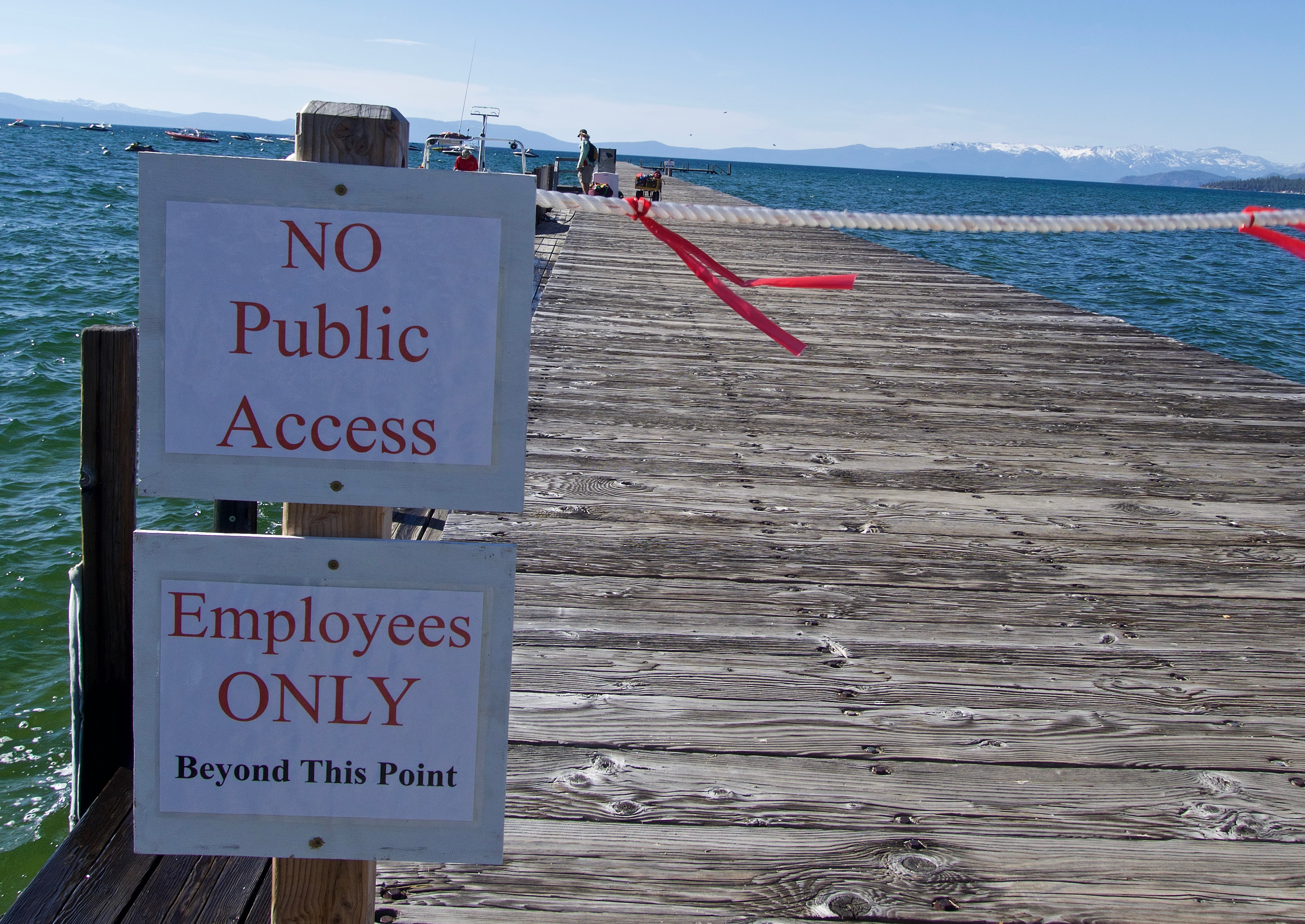
Timber Cove Pier in South Lake Tahoe is off limits to the public until owners can stabilize the pilings under the Boathouse restaurant.

“It basically involves installing a fiberglass sheathing to strengthen the existing pilings. It would normally be a qualified exempt activity, but we’ve never approved this technique to strengthen pilings before so we wanted to be able to attach a security to the project and inspections,” Tom Lotshaw, Tahoe Regional Planing Agency spokesman, told Lake Tahoe News.

A decision about the permit is expected to be made this month.Tahoe Beach Retreat owns the pier and restaurant. A spokesman said the improvements are being made to ensure the public’s safety. For now, only employees are allowed on much of the pier that extends into Lake Tahoe. The restaurant will remain closed until the improvements are made.— Lake Tahoe News staff report


Measuring the snowpack goes high-tech

By Joseph Serna, San Diego Union Tribune

Every year for almost half a century, California snow surveyor Pat Armstrong has trekked the rugged Sierra Nevada with three simple tools: a snow core tube, a scale and a notebook.

For as long as he can remember, state water officials have relied on the accuracy of those tools to deliver crucial data on the size of the Sierra snowpack and its ability to sustain a growing population.

“It hasn’t changed in a hundred years,” Armstrong said of the survey.

But there is a growing belief that this low-tech process alone is becoming too unreliable to accurately manage California’s water needs.

Read the whole story


Series of events to commemorate Angora anniversary

A variety of events related to the 10th anniversary of the Angora Fire are taking place this month.

They include:

June 17 — Wildfire Safety Expo

Community gathering for wildfire prevention and preparedness education. Multiple public agencies and community groups participating. It will be at the TJ Maxx parking lot in South Lake Tahoe from noon-3pm.

June 22-23 — Angora Science Symposium

Updates and presentations on research and science related to the Angora Fire for land managers, scientists, and public representatives to increase understanding about the Angora Fire, the research and management done there after the fire, and lessons learned that can and are being applied in the Tahoe Basin and throughout the Sierra Nevada. Field trips Thursday, symposium Friday. It will be at Lake Tahoe Community College. For more info or to RSVP, email sdkocher@ucanr.edu.

June 24 — Angora Fire First Responder Remembrance Ceremony

Lake Valley Fire Protection District will recognize its firefighters and other agencies and first responders who responded to the Angora Fire. This will be at Station 7, 2211 Keetak St. in Meyers from 8:30-9:30am.

June 24 — Angora Commemoration

Local, state, and federal agency executives, fire chiefs, elected officials, and others will discuss the Angora Fire, the impact the fire had, the resilience and recovery of the Meyers community, lessons learned from the fire, and actions that have been taken and are under way to improve fire prevention and preparedness at Lake Tahoe. This will be at the Grand Hall at Valhalla from 10:30m-noon.

June 25 — Angora Fire Meyers Community Gathering

Lake Valley Fire Protection District and other public agencies and community groups will gather to celebrate the recovery and resilience of the Meyers community at Tahoe Paradise Park from 11am-3pm.


Snippets about Lake Tahoe

·      The reservation fee for Desolation Wilderness overnight permits increased from $6 to $10 per permit.

·      According to Kiplinger, Gardnerville Ranchos and Truckee-Grass Valley are in the top 10 for small towns with the most number of millionaires. Gardnerville has 1,445 and Truckee-Grass Valley 3,007.

·      At the meeting June 13 in Auburn, the Placer County Board of Supervisors will consider adoption of a draft $796 million budget for the next fiscal year starting July 1.

·      El Dorado County District Attorney’s Office has a website dedicated to the unsolved homicides in the county dating back to the 1960s. It includes a tip line and email address for the public to call in any information they may have regarding any of these cases. All information can be confidential.

·      The Barbera Festival is Sept. 16 from 11am-4pm in Plymouth. More than 70 wineries from all over California and beyond will pour their Barbera. Top area chefs prepare gourmet food. Italian varietal white wines will also be poured. Cost is $50. For more info, email infoe@barberafestival.com.