Angora Fire: Life altering tragedy
Publisher’s note: Lake Tahoe News this month will be running several stories leading up to the 10th anniversary of the Angora Fire on June 24, 2007.
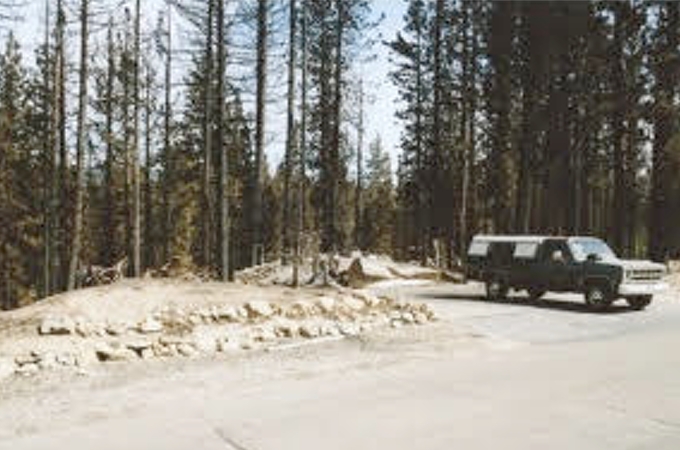
Ken Herrmann’s lot after the Angora Fire leveled his house in 2007. Photos/Ken Herrmann
By Ken Herrmann
First Wednesday
It had been a tough day. Actually, the last few days had been stressful and I had not been sleeping well. I am thinking again that it might be time to change my 25-year career to something new. But this evening I just want to go home and read a book, put on some CDs, turn on the idiot box, or do something else to relax.
I drive up the main drag and turn onto my street. A neighbors’ dog, a big Saint Bernard, is out on the front lawn, as usual, looking very contented with its place in the sun.
I pull into the driveway and step out of my truck. As my feet touch the ground the layer of pine pollen on the driveway puffs up around them. The pollen had been falling for about a week and gives a slightly yellow tinge to everything.
I set my lunch box on the front steps and open the side door to the garage.
One of my kayaks is just inside the door. Maybe this next Sunday I would get out on the lake for a while. I might even meet someone to paddle with in the future, and if she’s cute and single, all the better.
A stack of boxes against the back wall holds a collection of “The World’s Best Reading” from the magazine company. With the built-in shelves in this house, I can unbox them and start reading again. Other boxes hold remaining texts, work from college (both degrees) and general references that I have picked up through the years.
Also boxed are thousands of photographs documenting people, places, events, vacations and photo-logs including the bridge at Cal Poly and other work projects I’m proud of. I also have mementoes of driving athlete buses for the ’84 Olympics, raising a guide dog, clogging in parades and being a parent in two years of the “Nutcracker” for Central Coast Dance.
Two two-drawer file cabinets hold documents and personal history papers including the “as your kid grows” binder of school papers, pictures, accomplishments and growth measurements that mom passed to me a few years ago. Now if I ever want to know who my third-grade teacher was, what my interests were, or how tall I was, I can look it up. But some of that stuff must be made up. Haven’t I always been able to see the top of the refrigerator?
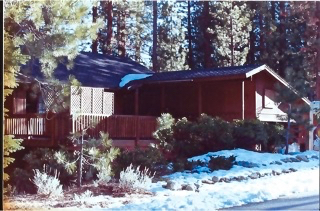
Not all the boxes were unpacked before Ken Herrmann’s house burned to the ground.
A few other cabinets and corners of the garage hold tools or various parts of assorted things that I want to try to turn into something else. Parts to make unique fountains, or lamps, or a combination of the two. There is also the stack of irreplaceable old-growth heart redwood siding recovered from an early1960s vintage sauna that I dismantled a few years back. Beautiful wood grain patterns ready to be turned into … something.
On the workbench is the magazine with plans for deck chairs. As with making additions for my existing furniture to make it all taller, I would alter these plans to make taller furniture from scratch. I have gotten tired of “fitting” into “normal” sized (short) furniture. From now on, find it or make it. It would also be nice to have furniture on the front and back decks for the summer.
The plan, now that my year of ceramics classes at the college is over, is to spend the equivalent time per week, (probably end up being much more) in the garage. My tools, which have been in storage for three years, finally have their proper places. The last thing to finish is that the new, still boxed, Delta drill press gets a rolling platform and its own corner.
With combination chop saw, table saw, drill press and the multitude of other tools now arranged on steel shelves and in drawers I can get back to my fountain designing, make furniture that fits, and what else? It’s time to play!
Hand testing my off-road bike tires, I find that the rear tire is low again from a persistent slow leak. I’ll have to remember to fix that before I get the desire to go riding the trails up the hill toward the ridge.
I pull out my plumbing toolbox to take into the house. There is a leak in one of the bathroom sinks that needs attention and this box has any tool I need to repair just about any plumbing fixture I might come across. It even has some standard replacement parts.
Going in the house I set my toolbox in the hall, and lunch box and mail on the counter.
The dishwasher is partly open to remind me to empty it. What luxury! This is the largest most comfortable kitchen I have ever had. Four months ago when I moved in I wasn’t sure what to do with the space. But it has worked out and although the cabinets are not full by any means, I find that not being limited to four feet of counter space is wonderful. The dining counter is also a very comfortable place to work or eat a meal.
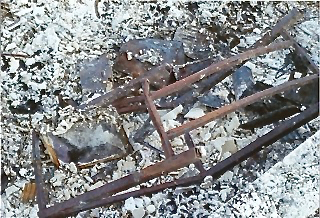
The upside down drafting table with G5 monitor, inside to the left.
Thirsty for some good old H2O, I take down the mug sister gave me about 20 years ago, it’s shaped like part of a saggy pair of jeans with my name written on a pant pocket. Always cute. Not her, the mug. Well, … her sometimes too.
Boots off, I sit down to watch the last 20 minutes of a sci-fi show on the box. With no cable service and questionable satellite capability (trees) for the last three years, the swimmer TV (resurrected from a pool, by buddy Andy, 10 years ago) is finally getting to re-exercise its multiple channels capability, instead of the 2½ off the local airwaves.
Four months living here and my DVDs and CDs are still mostly boxed.
I’ve been enjoying the tree-based entertainment across the back deck or the many TV channels.
But the home-made “entertainment center” given to me by a friend on the coast some 12 years ago also might look better with DVDs and CDs in it rather than in boxes on it. Have to work on that as I might as well look as if I live here rather than just squatting.
Show over, I change into running shoes, shorts and T-shirt. The shirt is one of a collection of race shirts and fleece vests acquired from over 20 years of running benefit races, mostly 10Ks down in San Luis Obispo County.
On the way to the back deck for a pre-run stretch I notice that my Djembe, sitting on the fireplace hearth, and the tube-type amp and five-CD changer, just inside the door, are dusty. But also noticing that the window nearby is partially open I suspect that most of the “dust” is pine pollen. The stuff is everywhere.
Facing southeast the deck is mostly shaded this time of day. The garage is street level, the main house floor partly above that, with the lot sloping down to the back that puts me about mid-tree height. Even my downstairs neighbors deck is 10 feet above the ground. My deck is a very nice place to hang out (deck chairs please!).
A chickadee is running up a tree beside the house. He stops on a branch to look at me (maybe he’s just resting from the climb) then flicks his tail and continues up into the branches. The local Steller’s jay has landed down the deck rail and is yelling at me for intruding on “his” deck, I’m stretched and not willing to argue, so out the front deck doors, down to the walk and off running I go.
Turning left down the street away from town I reconnect with the main drag and turn right toward the stub street of the Creek Road to connect with a single-track forest trail.
While the forest is green with grasses and new shoots on the fir trees, it is drying fast. The 28 percent, or there about, snowload this last winter was not good. Last year at this time the basin mountains had snow on them. Today, in mid-June, there is less snow in the highest protected areas than there was in late August of last year. Not good.
After a time of crossing gullies, a small stream and following old logging roads, I arrive at the pond and take a break to stretch. Mr. and Mrs. Mallard, unconcerned with my presence, are having a spirited discussion about something while cruising in the direction of the small island. The tree caressing mountain breeze in a clear blue sky is very refreshing.
Running again, I retrace my steps down the trail and turn left at the fork to take a longer route home, uphill from the neighborhood. This area still has its slash piles from the thinning operation of some seasons back. Judging by the condition of these piles, they are overdue for burning. The acres of piles burned around my previous solitary residence this last fall were evidence that these will also go to smoke hot and fast.
I see the water tank. If not looking, distracted by nature, it’s easy to miss it. From the street below it is practically invisible, hidden by the trees of the forest. The many hard switchbacks going up the hill turn easier as the trail eases downhill. I cut down across the easy switchbacks and join a side trail down to my road, turning right up toward the house.
The white Shepard-cross-whatever-he-is from across the street comes to say hello and walk with me as I cool down. This dog really has it made. He surveys his realm from an elevated driveway, gets attention nearly whenever he wants it, and though he could have a lot to say, he just smiles, wags his tail and wanders around. After I’ve cooled, he really wants to come in the house, but I give him another good scratch and rub, tell him to go home, and go inside.
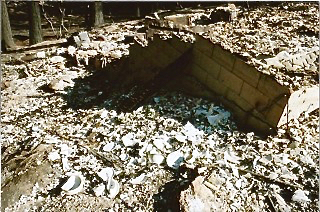
What had been boxed family China became rubble.
More H2O from the mug and I grab my toolbox to fix the leak. I find that the seal retaining screw is loose, but the seal is also worn so it is best to replace it. It turns out that I have a seal that fits, so in less than 10 minutes and no more leak. Magic!
Toolbox back to the front hall, I go to my office to check email. This “office” contains my 20-year-old queen-size futon couch (3-year-old mattress), and the seven-wood slope-top desk that was someone’s woodshop senior project. The desk is on blocks because it is of course, too short, but also so I can use one of the bar stools, (that I assembled and finished years back) for it and the drafting table (in flat position) that my G5 sits on.
The room also contains the solid red oak two-drawer/two shelf nightstand that I made for a lady but never had a chance to deliver (funny how people move on.). My ’95 PowerMac is also here. Still as useful as the day it came off the line; its only failing is that it couldn’t keep up with Internet speeds and software. If technology were only less shortsighted and money hungry, we could save a lot of energy and landfill space.
Against the wall, still not hung, is the tall bulletin board containing; lapel pins from events that I helped organize or attended (La Fiesta, Poly Royal, a parade or three), pinned birth announcements of nieces and nephews (six now) plus wedding invites and memorial notices (Uncle Bob, Mother Wood). Also pinned are pictures of me with a large boa constrictor around my neck and one of a nasal polyp. (Uh huh, next!)
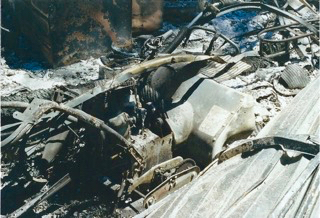
Remnants of the snowblower and other items in the garage.
The less than 3-year-old G5 pulls a few notes and jokes written by friends from my ISP.
“Did you hear the one about the guy from Biloxi that found his hollering cat in the toilet with the top down? No? Me neither.”
Here’s another candidate for the Darwin Awards, seems he couldn’t wait for his ship to make landfall.
“Waaas uuuup?”
Going online there are no interesting/available jobs with the parks, or any of the normal “Favorites list” places to check for options. How to find another place to take care of…?
The camp was perfect. Flexible schedule, a certain autonomy, but also long hours and a fair amount of responsibility. If the owners had not failed to support it or the staff, camp might have been a long time gig for me.
Well, I was on my own way out (in disgust) long before the Forest Service threw their wrench in the works and ended the job. It still bugs me though. (Phhhptttz and sputter). Maybe I really should consider a total career change, just as long as it’s a creative trade.
Cooled from the run beyond the point of comfortable, I sign off and take a quick hot shower. I think the large, thick, colorful beach towel idea for bath mat/bathroom rug looks good. The four I have, in rotation, will keep the room lively and bright throughout the year.
Food! I whip up a cubed steak with my spices, a large salad with avocado and tomato, toast some thick raisin bread with butter, add a large milk and sit to eat. I decide to watch the TV news while eating so I pull out the “history” tray to balance the meal on.
Some 20 years previous I had worked at a student-housing complex in San Luis. The complex closed to become senior housing a year or so after I was there. About 14 years later at a new job for the county schools I found, behind a refrigerator, a near mint-condition serving tray from the complex. Others that I know from that time were tickled to hear I had found the tray. It is a good reminder of college years to sit down with a Tropicana Village tray for a meal.
And as history goes, I still need to repack family China and crystal ware that are in boxes against the wall in the dinning room. That’s eight boxes of cool old stuff. The crystal glasses are items I have enjoyed the look of as long as I can remember. It’s also fun, when using the leaded crystal, to make them “sing” with a wet finger on the edge.
Dinner over and cleaned up (I’m tired of doing everything myself but the plants will not raise a leaf to help) I decide to take an evening walk.
Turning right out of the driveway I’ll walk a route down to cross the boulevard, go through the meadow neighborhood reconnecting with the boulevard again a mile or so away for the loop back to the other end of my street. Nice houses in that area, and great views of the mountains and the wooded ridge above where I ran earlier.
As I leave the house I notice the white Shepard-cross-whatever-he-is on his driveway across the street. I call to him but, as is his want, he chooses not to respond and just sits and watches with a grin as I walk away.
As the sun lowers toward the mountains a few people are out enjoying the evening in yards or on the streets, some are still tending a barbecued meal. The cooler air encountered when the road crosses a draw leading down from the ridge and mountains is one reason this area of the basin is so pleasant.
Just before turning up my street, I notice the new house on the boulevard is progressing with floor joists going in and stacks of lumber on the driveway. A petrified deer stands not far away in a front yard. It’s actually fake, but it always catches the eye. Hunter instinct I guess.
The white Shepard-whatever-he-is finds me two lots from home. He trots up with a smile for a good rub and scratch before taking off again to rejoin his boys that are playing on the street.
Back inside I go through the mail and then TV channel surf to finally settle on a crime show for a while.
Show over and nearly time to hit the hay. I move out to the back deck for a breath of cool night air. This pollen is really covering everything.
This is a great house. It’s winter warm and in a quiet, wooded residential area. Looking through the trees there are good views of Twin Peaks east, the mountains to the south, and the summit and highway pass southwest. I have all my stuff with me, and room to play as a counteractive activity to the job and the type of work I’ve burned out on over the last years.
I think I can do this for a while … though the 28-year-old GMC truck may not last to the winter.
Well, …just another beautiful day in the mountains.
Tomorrow would be another day.
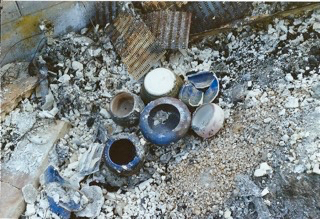
A few ceramics were able to be salvaged from the burn pile.
Next Wednesday
It had been a tough day. Actually the last days had been stressful and I had not been sleeping well. Too much to think about (or try not to think about) and do, and not enough daylight/ business hours to do it all. And then there is still (maybe more now) this job thing that I keep doing. It floats my boat but fails to put any wind in my sails. But this evening I just want to go home and read a book, put on some CDs, turn on the idiot box, or do something else to relax.
The checkpoint officer, finished with my ID, hands it back issuing a further safety warning (like I need one!) and lets me go.
I drive up the main drag and turn onto my street. The neighbors have an American flag flying. Just another thing, of many lately, that tugs at my heartstrings.
I pull into the driveway and step out of my truck. As my feet touch the ground the layer of ash on the driveway puffs up around them. It covers most everything within sight, making the neighborhood either black or gray.
I figure I would spend an hour or two here, then go find another hotel for the next few days. Maybe by that time I will have found a new place to hang my hat (the 16-year-old hat that I no longer have). Oh, and I need to eat dinner somewhere too.
I open the back of the truck that now holds everything I own, it barely fills half the bed, (including the Schwinn Frontier with low tire pressure) and pull out the rake I recently got from dad and my folding military shovel, one of the very few tools I have left.
Today, maybe some of my ceramics from the hallway and my collection of belt buckles.
I walk past the garage with its collapsed/deformed metal door that is draped over the exploded snow blower and what remains of my 36-year-old Schwinn Varsity. The twisted skeletons of tool shelves and cabinets are witness to the heat of that fateful Sunday afternoon.
I’m putting off spending time in the garage, I’m trying to work up the courage.
Down the hill, below the garage, I enter the house through my housemate’s front door. Well, at least where it would have been. I step into the foot of ash and rubble with its protruding charred appliances that is all that remains of an over two-story house that contained evidence of my near 47 years, and what was once my best home, to start looking.
The neighborhood of destroyed homes, charred trees and lack of wildlife stands quietly around me.
The quiet is occasionally lessened by a passing car with the people inside, usually behind raised windows to keep out the smell, wearing shocked or disbelieving looks on their faces.
Life is different now. I really don’t know what to do next. My side of the fence is bare ground and ash. Is there green grass on the other side?
Tomorrow would be another day. Maybe … a better one.
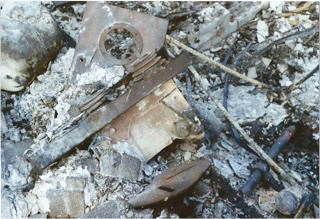
The brand new drill press that never got out of the box.
Epilogue…
I was one of the victim/survivors of the Angora Fire that occurred on a very windy Sunday afternoon, June 24, 2007.
The wildfire, started by an illegal campfire, swept through 3,100 acres of forested land, destroying 254 human and thousands of wildlife homes, and killed or injured (some to die, or be euthanized later) hundreds, possibly thousands, of animals.
The fire left a portion of the Lake Tahoe Basin and its inhabitants with a scar to be seen, and felt, for years to come.
In January 2008, I moved out of the Lake Tahoe Basin to continue my recovery, trying to rediscover, and rebuild a life, in the warmer climate of San Luis Obispo. I was mostly using my heels and toes natural affinity for each other … to keep moving. I miss Tahoe, and still visit every year to run the Kokanee 10K through the forest where I lived for three years.
Today, 10 years on, I am looking for a move and new opportunity to creatively enjoy life. I’m kind of burned out again, (figuratively) with what I’m doing.
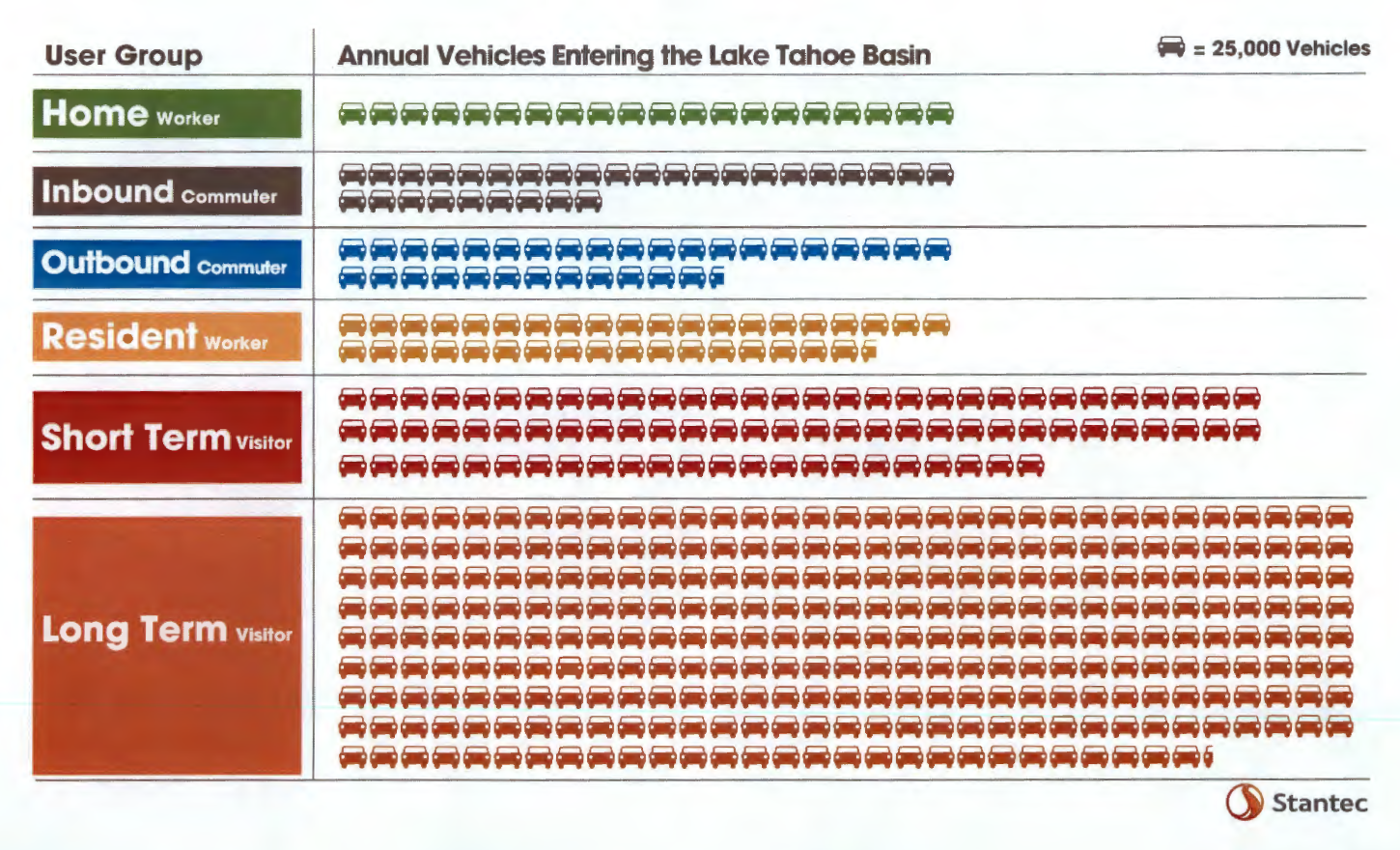 The above graphic shows the annualized vehicle trips by different groups in 2014. Visitors are making up more than twice the number of local trips. The South Shore is the No. 1 place they are traveling to.