Evan Menchel — 1991-2017

Evan Allan Menchel

Evan Allan Menchel of South Lake Tahoe died June 20, 2017. He was 25.

He was born Dec. 30, 1991.

If you had ever met Evan, you remembered him. His time on this earth was short, but glorious. He had a different outlook on life that very few could conceive. He lived for experiences.

His love for humanity was embraceable. His joys were: hiking, skiing, cooking, biking, driving, swimming, cars, motorcycles and crafting.

He is survived by his mom and stepdad Lora Menchel and Todd Shewbridge; dad and stepmom Richard Menchel and Debra Menchel; sister Christine Menchel (Sky); and his beloved fur baby Audee; along with extended Menchel/Saunders family.

A celebration of life to be June 26, 3pm at Lake Tahoe Golf Course in Meyers.


Nevada spending money on rural tourism endeavors

New special events are slated for rural Nevada, including a quirky cooking festival that involves steam engines, as well as an event celebrating the 20th anniversary of the land-speed record.

Both are among projects funded by the Nevada Division of Tourism through its rural marketing grants program. TravelNevada distributed $983,400 to 159 projects promoting tourism in rural Nevada. Grants were approved Wednesday by the Nevada Commission on Tourism, the advisory group for TravelNevada. TravelNevada is part of the Nevada Department of Tourism and Cultural Affairs.

Among the funded projects:

·    Lake Tahoe Incline Village Crystal Bay Visitors Bureau was granted $10,000 for the North Lake Tahoe Luminaries social media campaign, which will promote area events in December. Funding will cover video production, drone footage, still imagery, content development and social media advertising costs.    

·    NCOT also awarded $10,000 to the Carson City Visitors Bureau for a statewide project, Nevada’s Singletrack Mountain Bike Adventure campaign, which targets mountain bike enthusiasts as they travel across the state. Funds also will support two media familiarization tours.

·   The Pyramid Lake Paiute Tribe received $8,000 to design, produce and host a new website that will be compatible with smart phones and will include an events page, contact form and links to the tribe’s social media networks. Tribal staff will be able to update and add content to the site, hosted by WordPress.


Letter: Elks take turn at Bread & Broth

To the community,

The Tahoe Douglas Elks Lodge No. 2670, an on-going supporter of the Bread & Broth Adopt A Day of Nourishment program, hosted Bread & Broth’s Monday meal on June 12. 

The Elks Lodge is a service organization whose members work together on national and local levels to help the needy through community service. The Tahoe Douglas Elks Lodge exemplifies their mission through the many serve projects they perform for the South Lake Tahoe community and the Bread & Broth organization.

“Tahoe Douglas Elks are always available to help Bread & Broth,” stated Steve Kurek. 

Generally, this local Elk Lodge will sponsor two to three AAD sponsorships annually. As the sponsor crew members were leaving for the evening, they were requesting to sign up for another Adopt A Day this year.  

Roger Barragan, chairman trustee Elk, along with Steve Lannen, joined Kurek for the evening’s setup, serving and cleanup activities. These three Elk Lodge members were a big help and warmly welcomed and served the evening’s dinner guests.

Thanks to our wonderful and generous AAD sponsors and donors, B&B is able to ease hunger for seniors living on fixed incomes, struggling families, the working poor, as well as those who are homeless. B&B not only brings food to those in need, but offers fellowship and dignity to those experiencing hunger and difficult life situations.  B&B would like to salute the Tahoe Douglas Elk Lodge No. 2670 members for their commitment to bettering the lives of our community members.

Carol Gerard, Bread & Broth


SNC faculty may not have a job this fall

By Carole Jablon-Bernardi

INCLINE VILLAGE – When a college is competing to maintain enrollment, even grow it, and is faced with rising tuition costs to offset expenses, faculty can become the target.

Such is the case at Sierra Nevada College.

The administration of the four-year liberal arts institution in Incline Village announced to faculty members that no contracts would be renewed for the 2017-18 school year. SNC intends to award faculty agreements by August, but urged instructors that “no reliance should be made on this time line nor should the statement of the intended dates create an expectation or guarantee of future employment with SNC.”

For several years there has been a downward enrollment pressure on small, private liberal arts-oriented colleges that survive on small endowments. While SNC has experienced steady, modest enrollment growth over the last several years (primarily due to its graduate programs in teacher education which are primarily delivered in Reno, Henderson and online) the main SNC Tahoe campus and its undergraduate programs have been subject to this pattern being felt by many colleges across the country.

Changing demographics and less general demand for traditional liberal arts programs around the country, as well as competition for students, has intensified. SNC Tahoe competes with many better resourced liberal arts colleges for what has been identified as a “shrinking pool of students.”

“These are challenging times,” Atam Lalchandani, chair of the SNC board of trustees, told Lake Tahoe News. “Higher education in our country is undergoing a seismic shift. Many institutions like SNC Tahoe are finding ways to reduce the cost of higher education and improve accessibility.”

The college is aligning its annual contracting procedure to time better with its enrollment calendar. Historically, the college has become contractually obligated to a major expense before having good visibility of its revenues for the coming year. The change for 2017 is intended to be more fiscally responsible because it allows the college to budget, and spend, in line with enrollment.

A significant portion of the entering class at SNC Tahoe comes in later than other institutions (beyond the traditional May-early June period). This year, registrations are coming in at a slower rate than usual. SNC Tahoe is still in the process of gauging the most likely level of enrollment that can be expected for the 2017-18 academic year. The fall semester starts Aug. 21

SNC Tahoe anticipates growth in its enrollments at its Lake Tahoe Community College location, which was launched last fall. It’s even expanding offerings.

As of June 9, the board of regents for the Nevada State System of Higher Education approved a partnership between SNC Tahoe and Truckee Meadows Community College for this coming fall, similar to the SNC center in South Lake Tahoe.

These expansions help the long-term sustainability of the college by optimizing enrollment with options.

The shift in contract renewal timing does not suspend faculty pay or benefits. Faculty will continue to be paid during the summer. Many of the faculty work in summer and the college is proceeding business as usual as it relates to summer. No rehiring, or interviewing process applies to this shift and there are no unions involved. The college is shifting faculty contract renewals (some faculty are on 12-month contracts and others nine-month) from May to August.

When Rick Parsons, associate professor of art at SNC received his letter from President Alan Walker on May 24, he read the words “to provide written notice of non-renewal per Section 11 of the Handbook,” and admits it caused concern. Although the announcement also included a statement from Walker saying, “SNC is taking this action in order to have more time to better gauge the level of enrollment that can be expected for the 2017-18 academic year and the impact on the college’s ability to develop a balanced budget based on this decision, and other budget factors,” Parsons says it makes sense, but does little to alleviate the anxiety.

“SNC is a tuition driven Institution. The faculty understands this, but it’s not easy being put in this situation. As a faculty member, I believe admissions and recruitment should be the No. 1 priority for SNC,” Parsons told Lake Tahoe News. “Students are the heartbeat of this institution and they are the critical component that makes the college run on many levels. The highly qualified dedicated faculty and an active engaging curriculum, coupled with the location of the institution, is what attracts students. I think all members of SNC’s faculty, staff and administration should focus on enrollment to help stabilize the institution.”

Contract non-renewal comes on the heels of more than $2.1 million in budget cuts at SNC Tahoe since August 2015. That doesn’t stall the vision of Walker.

“A prosperous future awaits SNC Tahoe and to realize the promise of such a future it will need to be re-imagined, and reinvented, as a comprehensive university that is skilled at embedding the fundamental skills and knowledge areas at the heart of the liberal arts programs. We are well on the way to that vision,” Walker told Lake Tahoe News.

Some would argue that taking free or inexpensive courses online offers the same value. But others would argue being in a room with a teacher, and students is a much richer experience.


Opinion: Lahontan expedites projects post-Angora

Publisher’s note: Lake Tahoe News this month will be running several stories leading up to the 10th anniversary of the Angora Fire on June 24, 2007.

Patty Kouyoumdjian and the Lahontan staff work to make forest health a priority. Photo/Provided

By Patty Kouyoumdjian

As the 10-year anniversary of the Angora Fire approaches, many of us in the government agencies charged with environmental protection are reflecting on the lessons learned from that natural disaster and what we’ve done since then to ensure we don’t see a repeat of the tragic destruction that ravaged our community.

The devastating results of the Angora Fire touched many lives as hundreds of residences were destroyed and families found themselves evacuated from their homes as others unfortunately lost everything and became homeless — including members of our staff. With these thoughts still with us, the Lahontan Regional Water Quality Board has taken actions to help facilitate forest health, create defensible space and protect water quality.

Prior to the Angora Fire, the Lahontan Water Board’s members directed staff to speed up the necessary permitting process to thin our forests, as forest health and defensible space are necessary to protect the public. This action was significant since the Lahontan Water Board’s rules adopted in 1980 to protect Lake Tahoe’s exceptional water clarity prohibited land disturbance in sensitive stream zones unless the Lahontan Water Board granted exemptions. Projects that related to public health and safety, or environmental protection, fall under these exemptions.  

Following the Angora Fire, the Lahontan Water Board took additional steps to further simplify and expedite the permitting process for forest thinning and defensible space projects. The Water Board’s regulatory tool to complete these projects is the Timber Waiver – a permit with performance expectations that ensures water quality protection while allowing tree removal and vegetation management to occur. The Timber Waiver was updated in 2009 and 2014, and with each change the Lahontan Water Board increased flexibility in the permit to expedite projects.

The Timber Waiver describes several tiers based on the threat to water quality. Vegetation clearing on private lots for construction or to create defensible space, and hand crew operations on any size project do not require notification to the Water Board. Larger projects using existing roads and meeting some conditions require the project’s managers to submit applications to the Water Board, but they can begin work without immediate Water Board response.

Only projects with a high risk to water quality, such as new road construction, require the Lahontan Water Board to review a permit application before work can begin. During the last update of the Timber Waiver in 2014, the U.S. Forest Service sent its appreciation and support to the Lahontan Water Board for the changes made to simplify and expedite permitting. Since these changes in 2014, Water Board staff has seen increased levels of compliance and water quality protection from the U.S. Forest Service.

The Lahontan Water Board participates in the multi-agency Tahoe Fire and Fuels Team meetings where priorities are set, lessons learned are shared, and successes are tracked. Because of our increased level of participation and cooperation with fire districts and the U.S. Forest Service, the Water Board incorporated the results of demonstration projects and research into the Timber Waiver. The waiver allows for some earth-moving equipment in sensitive stream environment zones, and it allows pile burning in stream zones. We have made improvements while ensuring water quality is not harmed, and now more projects are being completed to reduce the risk of severe wildfire in our communities and watersheds.

Water quality impacts and the destruction of vital watershed functions from severe wildfires continue to pose a significant threat in the Lake Tahoe Basin. Fortunately, following the Angora Fire, multiple agencies, including the Lahontan Water Board staff, quickly mobilized and cooperated to ensure erosion control measures were installed. The Water Board also secured funds to support post-fire water quality monitoring and continues to support watershed restoration efforts. 

Because of these quick actions water quality impacts to Lake Tahoe were considered minor. Watershed recovery and restoration is evident — streams and meadows are doing the work of enhancing water quality. The greatest impacts to Lake Tahoe came — and continue to come — from our man-made environment. We can continue to improve our water quality and safety by maintaining defensible spaces, protecting soils from erosion and infiltrating runoff.

Patty Kouyoumdjian is executive officer of Lahontan Regional Water Quality Control Board.


Old-school typewriters attract new fans

By Russell Contreras, AP

ALBUQUERQUE, N.M. — Typewriter enthusiasts gather at an Albuquerque restaurant to experiment with vintage Smith Coronas. Fans in Boston kneel in a city square and type stories about their lives during a pro-immigration demonstration. A documentary on typewriters featuring Tom Hanks and musician John Mayer is set for release this summer.

In the age of smartphones, social media and cyber hacking fears, vintage typewriters that once gathered dust in attics and basements are attracting a new generation of fans across the U.S.

From public “type-ins” at bars to street poets selling personalized, typewritten poems on the spot, typewriters have emerged as popular items with aficionados hunting for them in thrift stores, online auction sites and antique shops. Some buy antique Underwoods to add to a growing collection. Others search for a midcentury Royal Quiet De Luxe — like a model author Ernest Hemingway used — to work on that simmering novel.

Read the whole story


Fencing at Nev. waterfront properties still an issue

Debris from fences on June 21 at a property near Cave Rock. Photos/Anthony Spatucci

By Kathryn Reed

Fences in the water and along the beach on the Nevada side of Lake Tahoe continue to be an issue.

The Tahoe Regional Planning Agency was able to get the Tahoe Beach Club to remove its temporary fence, as well as the illegal fence at a property north of Cave Rock and at a home in Elks Point Country Club.

No fines were issued.

TRPA spokesman Tom Lotshaw told Lake Tahoe News this was “because they were cooperative and agreed to do the right thing and remove the fences.”

However, remnants of the Cave Rock fencing still could be seen this week. Debris was underwater on June 21. TRPA compliance folks were notified and headed back out to the site.

Tahoe Beach Club, the high-end development going in at the end of Kahle Drive where the mobile home park used to be, wants to put in a permanent fence.

Owners Tom Castaneda and Bob Mecay said historically a fence has been at that location, but others would continually tear it down. They told Lake Tahoe News the plan is to have the barrier look like the fence on the other side of the property separating the 4-H camp.

TRPA code allows fencing on private property that abuts public access sites. It must be lakeward of the high water line. A hearing officer would review it, which is a public meeting of sorts.


Road Beat: Miata MX-5 RF, a true sports car

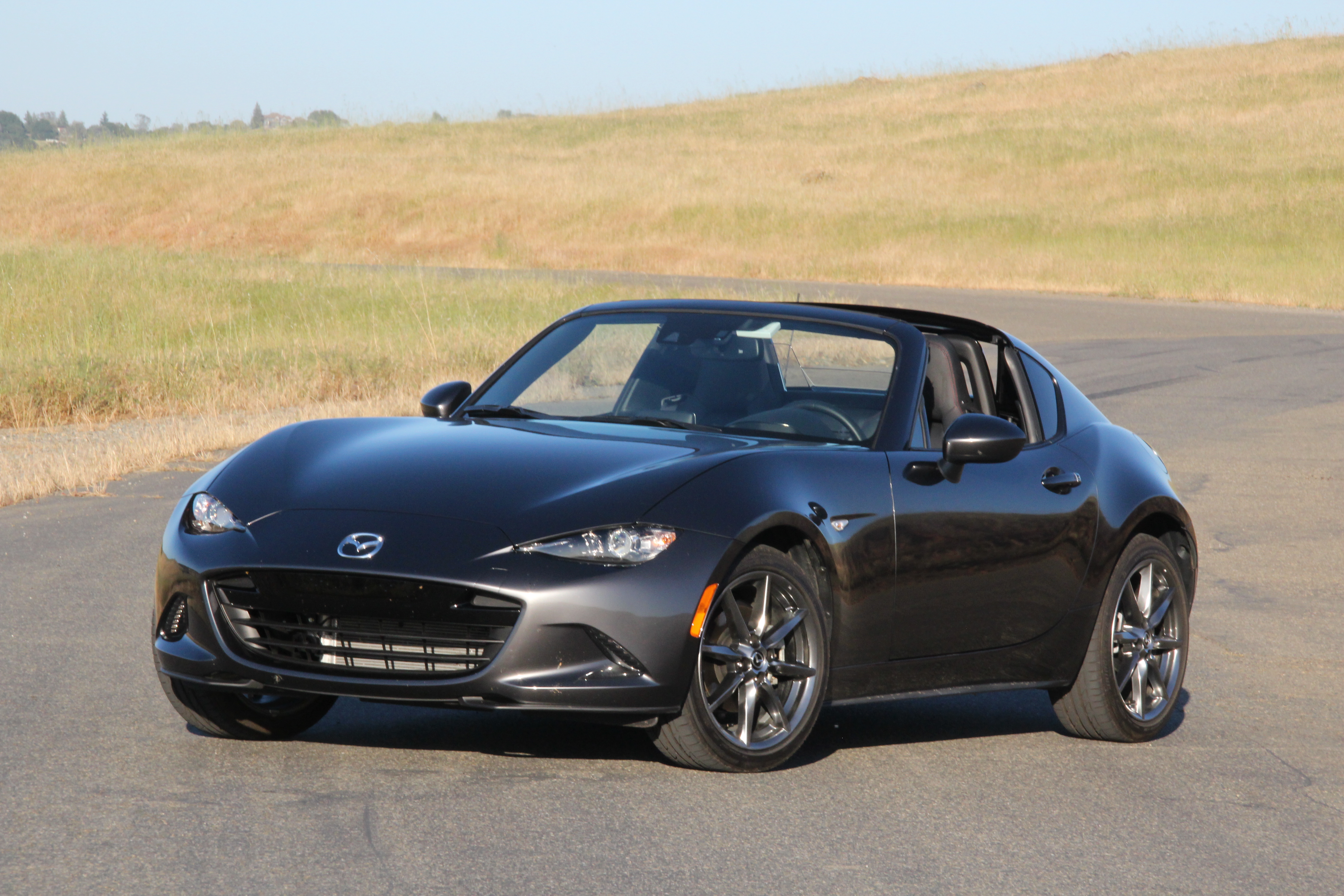
The MX-5 Miata will not disappoint. Photos/Larry Weitzman

By Larry Weitzman

Mazda’s new fourth generation MX-5 Miata combines tradition with the contemporary. Tradition in the sense of a raw sports car of yesteryear and contemporary in the sense of being built with high tech, state of the art components wrapped in a chiseled, sensuous body as if carved by a Samurai sword.

While rippling with bulging muscles and deeply flared fenders, its flanks are sharply trimmed and defined. It is the best Miata design yet in the KODO-Soul in Motion design philosophy of Mazda which has brought us the best looking compact car in the Mazda 3 and mid-size car in the Mazda 6. If it were produced, the RX-9 would blow people’s minds.

My RF (retractable fastback) model is more targa top than open air convertible as the flying buttresses won’t come down without a hacksaw. The power top system and extra metal adds about 100 pounds.

Going back to its traditional roots, the new Miata is trimmer and a bit smaller paring weight by nearly 150 pounds, only sacrificing mass, but not safety, structure and/or ability. Riding on a 91-inch wheelbase the Miata stretches out less than 13 feet at 154 inches while width is a trim 68 inches. It stands an inch over four feet.
Specifications
Price $24,915 to about $34,000
Engine
2.0L DOHC, 16 valve, direct injected inline four 155 hp @ 6,000 rpm
148 lbs.-ft. of torque @ 4,600 rpm
Transmission
Six-speed manual
Six speed torque converter automatic
Configuration
Longitudinal front engine/rear wheel drive
Dimensions
Wheelbase 90.9 inches
Length 154.1 inches
Weight 68.3 inches
Height 49.0 inches
Track (f/r) 58.9/59.2 inches
Ground clearance 5.32 inches
Weight 2,485 pounds (RF/automatic)
GVWR 2,892 (RF/automatic)
Fuel capacity 11.89 gallons
Trunk capacity 4.48 cubic feet
Wheels 17X7 inch alloys
Tires 205/45X17
Steering 2.7 turns lock to lock
Turning circle (wall to wall) 32.9 feet
Performance
0-60 mph 7.08 seconds
50-70 mph 3.48 seconds
50-70 mph uphill 5.54 seconds
Top speed plenty fast
Fuel economy EPA rated 26/35/29 mpg city/highway/combined. Expect 33-34 mpg in rural country driving. 44 mpg on the highway at legal speeds.

Powering the new Miata is Mazda’s Skyactiv 2.0L inline four used in many of its other models. Stomping out 155 hp at 6,000 rpm and 148 pounds of twist at 4,600 rpm, this somewhat long stroker is still a screamer, red lining and pulling strong to 6,800 rpm. But instead of the “mandatory” manual, my ride was outfitted with their quick paddle shifting automatic which adds 150 pounds along with the RF model and its 13 second folding power top over the base convertible.        

Acceleration quickness with the auto cog swapper is slightly reduced, not only from the extra few pounds but more important, taller gear ratios. Consequently 0-60 mph times go from 5.75 seconds to 7.08 seconds. Passing times are less changed with a level 50-70 mph run taking 3.48 second, almost identical to the manual but climbing a grade that time slows to 5.54 seconds, an excellent time but a second slower than the manual as well.

But don’t give up on the auto just because it’s a second slower to 60 mph, if feels great and responsive, better than the performance times reflect. In actuality this Miata is still very quick equaling the manual in level passing and is easier to drive than the manual system. With the paddles or the floor shifter, it responds lightning quick and holds the gear selected and will not downshift or upshift under throttle pressure like other “manual autos,” a great feature.

Most of the performance differences are due to the taller gearing of the automatic. The auto turns just 2000 rpm at 70 mph while the manual spins the engine at 2,900 rpm. That translates to improved fuel economy. At 70 mph in a two-way run the auto averaged 43.9 mpg a six-mpg improvement over the manual. In most situations, less rpm means improved fuel economy. In my Highway 50 run to Carson City and back, Miata averaged an excellent 38.7 mpg, better than most economy cars. The EPA rates the Miata auto at 26/35/29 mpg city/highway/combined although my fuel economy for 400 miles of mostly hilly, rural driving averaged 35.4 mpg. With only 11.9 gallons of max fuel, range is over 400 miles, probably most drivers’ limits anyway.

Miata’s forte is when the road bends. Most every car can go straight, but changing directions is where we separate the men from the boys and in the Miata’s case, it’s about the biggest guy on the block and probably the neighborhood. In racing circles, more people race Miatas by huge numbers and one of the biggest winners lives right here in El Dorado County, Marc Hoover. His car, a race prepared Miata.

Having incredible credentials makes Miata what it is. Trick double wishbones up front and a multilink system in the rear with a stiff backbone frame. Track is a wide 59 inches and the electric power steering rack is a perfect 2.7 turns lock to lock while turning circle is a scant 33 feet, wall to wall. Not overtiring the car (205/45 rubber on 17X7 alloys) gives the Miata a playful attitude, still requiring driver skill and attention. You can rotate the car with throttle getting into a bit of oversteer and then use a “dab of oppo” all with total control and a huge smile on your face. This is what driving is all about and with the Miata’s ability to communicate, it’s almost telepathy. It doesn’t get any better.

Ride quality is firm, not harsh mind you, but a muted, firm and very well controlled. Attitude remains pancake flat while noise is somewhat quiet, even with the top down. The tires do make some noise, especially on coarse surfaces.

Safety was all there including blind stop detection and lane departure warning. Miata’s four wheel discs (front ventilated) are astounding, arresting forward progress in 36 feet from 40 mph. Of course, all the acronyms are standard. LED headlights are excellent as well.

Miata’s new generation is a travel light interior. Seats are bathed in leather and offer great support and comfort. There are cupholders but must be attached to the inside kick panels. The good news is once attached they are located conveniently. There is no glove box, the center console is tiny and the rear vertical storage glove box between the seats requires a contortionist to access once seated. The trunk is limited to 4½ cubic feet.

Instrumentation is lean and mean with a big tach and speedo plus an info center which includes a full trip computer and above the center stack is even more relevant info on the radio/nav screen. The system is easy to use but requires several steps with the center control knob, sort of like a mouse. But there probably isn’t room for all the buttons and knobs that would be required otherwise. Considering the limited space, Mazda’s system gets it done and works well.

Pricing for the new Miata RF starts at $31,555 for a Club manual to $33,825 for the Grand Touring Automatic. Everything else was standard including the seven-inch color touch screen. It was loaded, only the special paint called machine gray metallic was an extra $300 bucks plus the $835 for the boat from Hiroshima, Japan. It’s the ultimate sports car for the buck.

Larry Weitzman has been into cars since he was 5 years old. At 8 he could recite from memory the hp of every car made in the U.S. He has put in thousands of laps on racetracks all over the Western United States.



Burning Man becomes museum exhibit

By Jenny Kane, Reno Gazette-Journal

Walking into the Nevada Museum of Art’s newest exhibition is like walking into a Burning Man time capsule. 

A pair of dusty boots. A 1986 sketch of the man. Several jars of ash and melted glass collected from torched effigies over the years. 

City of Dust, open to the public from July 1 through Jan. 7, 2018, is a more than 300-piece collection of Burning Man relics, just a sliver of the more than 6,000 items that the museum has collected for its Burning Man archive at the Center for Art and Environment in Reno. 

Read the whole story


Nev. tourism leaders’ trip part of effort Trump wants to eliminate

By Richard N. Velotta, Las Vegas Review-Journal

Representatives of the Nevada Commission on Tourism plan to join a trade mission to India in September that’s part of a program President Trump wants to eliminate.

Lt. Gov. Mark Hutchison, who chairs the commission, told the board Wednesday that he would be participating in a Brand USA mission Sept. 10-15 to Mumbai, Chennai and New Delhi.

Hutchison views India as a market to generate tourism to Nevada the same way the state viewed China in the early 2000s and was an early entrant to that market.

Read the whole story