Publisher’s note: This editorial is from the June 9, 2017, Sacramento Bee.
In the 16 years since the Sept. 11 attacks, we have grown accustomed to taking off our belts and shoes, among other indignities as we follow the dictates of surly Transportation Security Administration guards for the privilege of stepping aboard cramped airplanes.
As UC Davis professor and inveterate reader Julie Sze learned, TSA agents are asking at least some air travelers to place their reading material in bins before boarding. We guess The Sacramento Bee, National Geographic and “Goodnight Moon” would pass inspection. We’re not sure about “The Satanic Verses,” anything written in Arabic, or something truly radical such as The Bible, or the Koran.
We understand that security experts say liquids in containers larger than 3.4 ounces in our carry-on bags constitute security threats. So we discard them, unless we don’t, which happened at the Wichita airport named for President Dwight D. Eisenhower.
In recent years, traffic has gotten bad in the tony Silicon Valley town of Los Altos Hills.
The big-picture problem is that the San Francisco Peninsula has become a global business hub but hasn’t adapted its road and rail network (or its housing supply, for that matter) to accommodate that. So there’s traffic in places like Los Altos Hills, which straddles Interstate 280 west of Mountain View.
As a result, mobile navigation apps, and especially Waze, the Israeli mapping software owned by Google, have maximized the utility of the local road network by sending drivers off the highway and arterial streets and through residential areas like Los Altos Hills. (Users of the app report traffic patterns and obstructions in real time.)
First, Los Altos Hills asked Waze to remove three roads from its map. Waze does not entertain such requests. So Los Alto Hills came up with a Plan B: Close the streets to people who don’t live there. In May, the city erected “No Thru Traffic” signs on three roads where they crossed the city limit. Waze complied, according to a report from the Los Altos Hills manager, which means it will no longer direct users to drive on those streets.
You can put away the flashlights and candles for now. California is surviving the worst heat wave in 11 years without any major blackouts, and with megawatts to spare.
Billions of dollars in new power plants, and an explosion in solar and wind farms, have made the state’s electricity supply network – once a national laughingstock – remarkably robust. Today’s market has far more capacity than it did during the energy crisis of 2001. Back then, supply shortages and rampant market manipulation produced three days of rolling blackouts during winter, when electricity demand was well below this week’s.
Californians are paying a price for not having to worry about sweltering in the dark. Although their monthly bills are below the U.S. average, the amount Californians pay for each kilowatt hour of electricity is among the highest in the nation. That’s partly because of the mega-dollars that utilities have spent since the energy crisis on new plants, sturdier transmission lines and the like.
A circuit was tripped in South Lake Tahoe, causing 3,845 customers to be without power on Saturday afternoon.
Power may not be restored until late June 24. Two Liberty Utilities crew members are trying to locate the problem.
“This is the season where we are bound to have longer outages because we have to make sure we don’t have any wires on the ground so we don’t start a fire,” Liberty spokesman Randy Kelly told Lake Tahoe News.
In wet weather a tripped circuit will automatically try to reconnect twice before linemen need to be called in. Often times it’s an animal that has caused the problem.
Customers near the Y, including the Tahoe Keys and Barton Memorial Hospital are without electricity. The hospital has generators to handle situations like this.
— Lake Tahoe News staff report
Angora Fire anniversary — a time of reflection
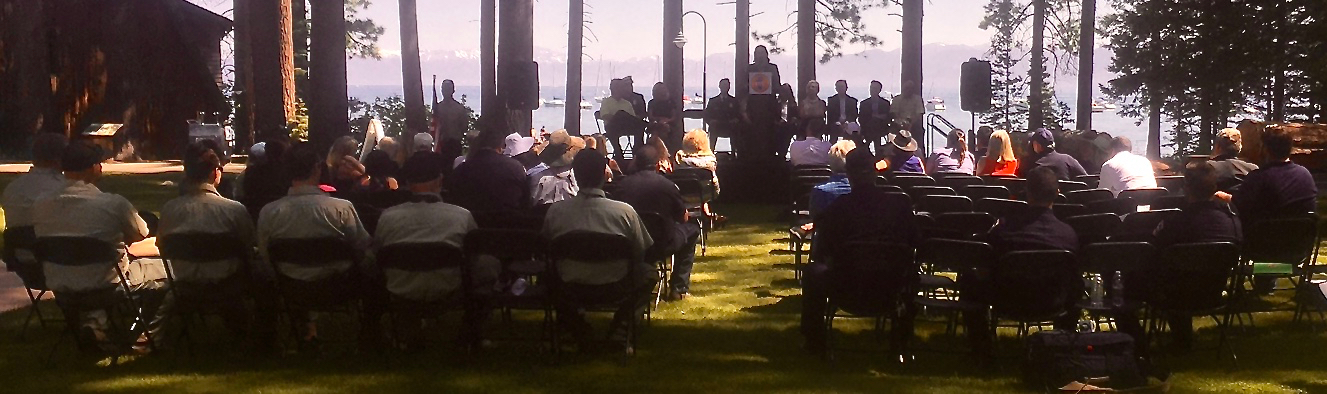
Speakers at the June 24 10-year Angora Fire anniversary reflect on the changes since 2007. Photo/Susan Wood
By Susan Wood
CAMP RICHARDSON – In what could have been the safest place to be in the event of a wildland blaze, about 30 Lake Tahoe fire and forest management dignitaries and community stakeholders came out to commemorate the 10-year anniversary of the Angora Fire outside the Valhalla Grand Hall on Saturday.
It was a picture perfect, serene setting to reflect back on the devastating fire that consumed 254 homes and 3,100 acres in the Upper Truckee and Tahoe Mountain neighborhoods.
For some in attendance, it was an emotional time – a time to heal and note the tremendous progress the Tahoe Fire & Fuels Team has made over the last decade.
The slogan of the day could have been “stronger together” as speaker after speaker on the panel pointed out the collective collaboration Lake Tahoe agencies made for the common good of the community.
The scar of the Angora Fire will be a reminder for decades of that 2007 tragedy. Photo/Kathryn Reed
Elwood Miller, the Nevada Network of Fire Adapted Communities Coordinator, became poetic when describing ripe fire conditions.
“And into the fire-prone (conditions) comes people,” he said, in explaining how homes built in the forest are fuel for fire.
Despite tons of equipment, super aircraft and thousands of firefighters, major fires are costing more than $1 billion to fight.
The era of the mega fire overwhelms fire resources, echoed Miller. He received an encased hatchet in honor of his retirement next week after years of service as the “consummate woodsman,” according to Tahoe Fire and Fuel Team Chairman Forest Schafer.
Leona Allen pays respects to her father at the 10-year Angora commemoration by wearing his belt. Photo/Susan Wood
Schafer, former Lake Valley Fire Chief Brian Schafer’s son, explained the fire ax is a traditional retirement gift. The hatchet serves as a sign of prevention – a method of firefighting forest management agencies focus on.
Partnerships, partnerships, partnerships represent the underlying goal, Schafer emphasized.
And with the successful ones come goals met, as noted by Kate Dargan, who as California fire marshal at the time served on the Bi-State Fire Commission that spawned the Angora Protocol of forest management practices going forward. The commission was formed shortly after the fire by then California Gov. Arnold Schwarzenegger and former Nevada Gov. Jim Gibbons in response to the need for an action plan to quell future Angoras.
Dargan commended the fire agencies and political organizations in succeeding to meet 90 percent of the 90 recommendations made by the commission. The efforts required 19 public hearings over a seven-month period.
“This needs to be shouted around the world,” she said, calling the efforts “solutions that make a difference in your community.”
After all, community – which is people centric – places people first and politics last to effect lasting, civically-minded change.
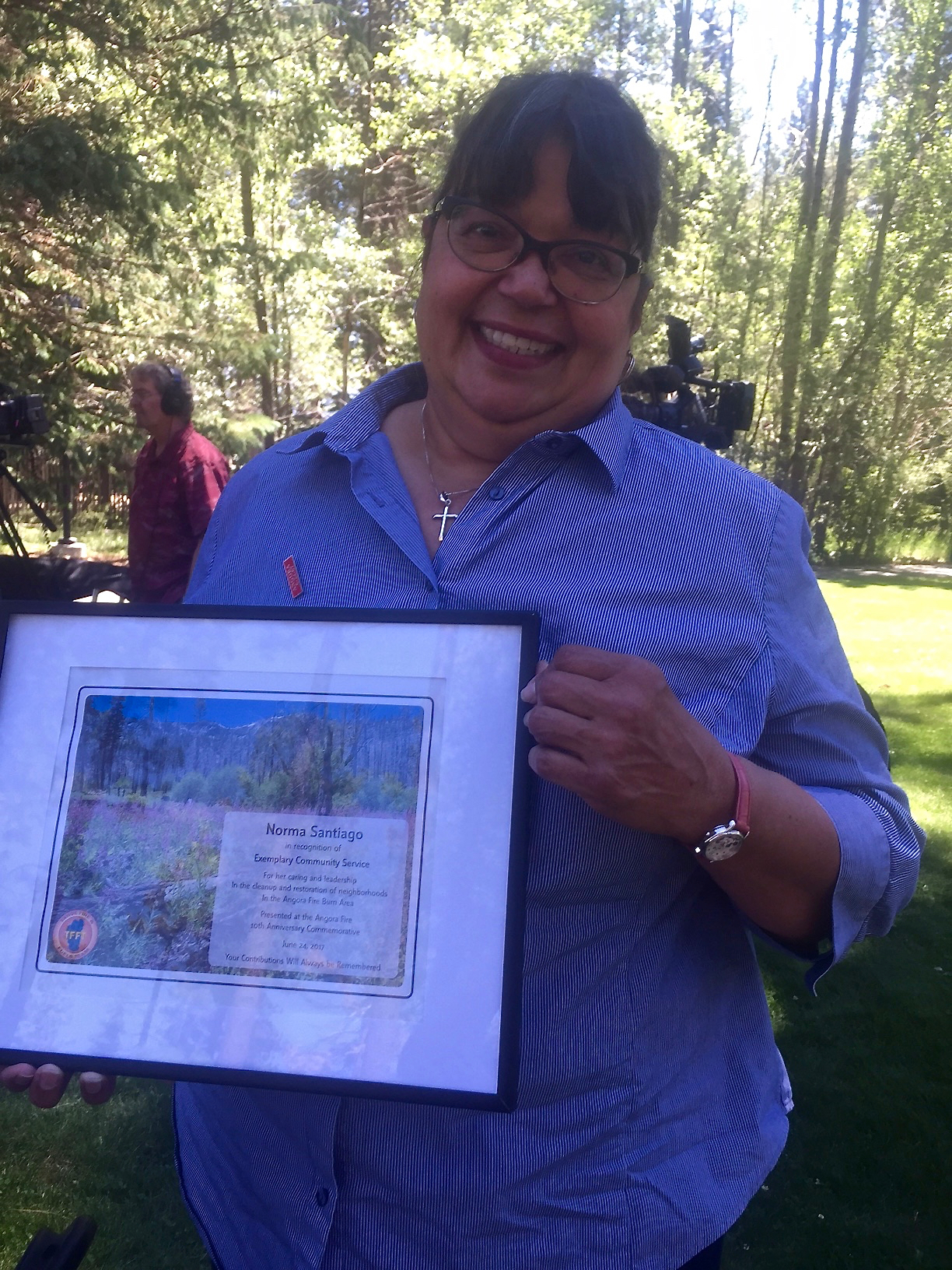
Norma Santiago as El Dorado County supervisor during the Angora Fire was instrumental in helping people recover. Photo/Susan Wood
“It’s our resilience as a community that moves us forward,” a teary former El Dorado County Supervisor Norma Santiago told the attentive crowd. Santiago, who was a newly elected supervisor at the time, was thrown into a fire of competing goals and an angry mob of citizens in wanting change for protecting property.
“We live in divisive times,” she said, while commending county staff and agency personnel for “making sure everyone was OK.”
A visibly moved Santiago received a plaque of recognition for her efforts.
She was not alone in feeling the commemoration represented a poignant time.
Leona Allen, a former police dispatch supervisor who runs the Lake Tahoe Fire Academy and serves on the Lake Valley Fire Protection District board of directors, lost her home and her parents’ home. The lifelong Tahoe resident made June 24 about her father who at 90 years old lost everything, but healed by creating a community garden on his lot.
She told the attendees her father pledged: “We got our community after that day,” in a show of unity that became a synergistic force for change and care.
“I’m wearing his belt today,” Allen said in a touching tribute to her late father, Owen Evans.
“What did we learn?” she asked.
Allen cited evacuation preparedness as huge, along with how implementing defensible space works and that resiliency makes for a community of survivors.
And survival was the order of the day and the time.
Remarkably, no one was killed or critically injured June 24, 2007, but the fire’s impact was lasting.
Nevada Department of Conservation and Natural Resources Deputy Director Jim Lawrence recalled the day like it was yesterday.
“I remember where I was,” the Tahoe Regional Planning Agency board chairman said like it was the day President John F. Kennedy was shot and killed.
Homes to this day continue to be built on the 254 lots where a house burned to the ground. Photo/Kathryn Reed
Lawrence came up from Carson City for a hike up to Snow Valley Peak. At the top, he saw a wisp of smoke that soon got immensely large by the time he got back to his vehicle at Spooner Summit. A bad feeling set in the pit of his stomach.
Lawrence’s sinking feeling turned into a grave reality for Eli Ilano, who recounted the fire’s aftermath as “a scene from Armageddon.” He was the deputy forest supervisor for the Lake Tahoe Basin Management Unit at the time and is currently forest supervisor for the Tahoe National Forest.
“It was a scary sight – like nothing I’ve ever seen before,” Ilano said of the tour he took to witness the landscape.
Still, the community rose like a Phoenix from the ashes, Ilano pointed out. The crossroads of a divided, angry community was clear.
“Are we going to stop blaming each other and start to come together?” was the question the community needed to answer.
Yes, was the response.
The collective of agencies developed an action plan that has ultimately led to more than 16,000 acres of land treated for fuel reduction on both sides of the state line. Abandoned slash piles due for burning made the Angora Fire particularly hot as it roared through the county.
Within the fire area, 1,100 acres have been reforested and about 2,000 feet of stream channel restored.
The Fire & Fuels Team, consisting of 20 agencies, has done as much to work with the public as it has to create a healthy forest. Consequently, the community has learned how to adapt to the risk of wildland blazes; because there will be other fires.
And no longer will a report with so much at stake be considered a document to collect dust on the shelf. To that, TRPA government affairs staffer Julie Regan nodded.
We’re not perfect, but we’ve come a long way, many reiterated.
Rapid response to South Tahoe roof fire
South Lake Tahoe firefighters on the afternoon of June 24 were able to keep a structure fire from causing much damage.
The Springwood Drive fire was on the roof where pine needles were ignited by heat tape.
It was quickly extinguished.
Pine needles should be removed regularly from roofs and gutters, and heat tape only used when there is snow and/or ice.
— Lake Tahoe News staff report
Snippets about Lake Tahoe
· The 36th annual Lights on the Lake fireworks show on the South Shore begins at 9:45pm July 4.
· “Beautiful Anarchy” featuring live music by Reno’s Los Pistoleros plus a burlesque show hosted by Sheeba Queen of the Night and the Whiskey Sirens will be at Whiskey Dicks Saloon in South Lake Tahoe on June 30. Doors open at 8pm. Must be 21; $10 cover at the door.
· Douglas County Citizens Patrol is looking for members. They assist the sheriff’s office. For more info, call 775.783.6466.
· Liberty Utilities has Angora Fire photos on its website.
· The 2014 HGTV Dream Home outside in Schaffer’s Mill in the Martis Valley is on the market for $2.5 million.
Letter: El Dorado County and its seniors
To the community,
There have been several articles regarding the method in which El Dorado County has proposed to balance the 2017-18 budget. Some people have chosen to take it upon themselves to be an activist for seniors in El Dorado County. The articles for the most part appear to have some straightforward quality information, but look as if to have “fluffed” some of the facts.
The one piece of information saying the Board of Supervisors wants to eliminate senior legal services is misleading. This entire fiasco was started from two sources, one is a memorandum to the BOS from HHS Director Patricia Charles-Heathers, and was followed by CAO Don Ashton’s recommended budget, where he quite simply says, “The CAO office is recommending the elimination of the senior legal services program.”
He touted it carries a certain “risk and liability” to the county. Can’t get much clearer than that. Unfortunately, he was unable to provide any evidence to substantiate his statement; neither did BOS legal counsel.
The CAO has presented a recommended budget for over 1,800 employees in the county, but it seems odd that he would suggest to eliminate the one service in the county which probably has the lowest percent of financial impact on the General Fund. The proposed budget for Human Services is recommended at $73,449,969, the budget for senior legal services is roughly $267,778, plus “… a reduction in force of 3.5 positions….” In layman’s term they are fired.
El Dorado County is going through a momentous change which will impact services for seniors for generations to come. El Dorado County is getting older, much older. El Dorado County is now at the point where half of the populace is age 50 or older, making EDC the oldest it has ever been. The 60-plus population has shown dramatic increases over the last 10 years. According to 2015 Census statistics, communities such as El Dorado Hills, Cameron Park, Placerville, Pollock Pines, Georgetown and South Lake Tahoe and many others, the population of seniors age 60-plus has doubled since 2010.
The county must start to focus on how this population change is going to impact county services. Seniors come to El Dorado County to relax, spend their retirement checks at local businesses, away from all the congestion and noise of urban living. They want affordable housing and an infrastructure giving them easy access to dining, shopping and adequate health care.
I praise Marshall Hospital for its service to the community, but they too should adjust to the bulging aging population. Perhaps the board of directors should take a more proactive position now and open a specialized geriatric unit staffed with physicians whose specialty is only geriatric medicine. Barrier free structures and ease of mobility within health care facilities is important for seniors. Of most importance is the attitude of health service providers, and the community, toward older people which is nationally recognized as ageism.
Our seniors are a valuable asset and resource for their families and communities, and especially local economics. An age friendly community encourages active ageing by optimizing opportunities for the entire population and will enhance quality of life as people age.
Roger Berger, Diamond Springs
What you need to know before buying that vacation home
By Jeff Brown, MarketWatch
It’s that time of year, when legions of vacationers decide they want to take the plunge and buy a second home. And this year, perhaps, it may be especially true: The economy is firming up, interest rates are still relatively low and investment accounts are brimming.
So consider this a reality check. Whether people are looking for a spot to enjoy themselves, rent to others or resell for a big profit, there are many mistakes that could bring them big headaches or cost them a lot of money.
Experts and homeowners warn newbies, for instance, that they may end up putting in a lot more work than they expect—and taking on a lot of frustration—to keep renters happy. They can easily run afoul of rules laid down by local governments or homeowners’ association, or find themselves facing unexpected costs. And there’s no guarantee the rental or resale market will stay strong enough to justify the expense.
A record number of U.S. travelers will venture beyond their homes by 50 miles or more this Fourth of July, according to a forecast released Thursday from auto club AAA.
A total of 44.2 million people will take to the roads, skies, rails and waterways to celebrate Independence Day, AAA says.
That’s an increase of 1.25 million travelers over last year, making it the most traveled Independence Day weekend since AAA has been counting. That is a 2.9 percent increase over last year this time.