Nev. oddsmakers cheer top-court review of N.J. sports betting case

By Thomas Moore, Las Vegas Sun

Nevada gaming lawyers, lobbyists and handicappers applauded the Supreme Court’s decision Tuesday to hear a case against a law preventing legalizing sports gambling in New Jersey.

The Professional and Amateur Sports Protection Act prohibited sports betting across the country, except for Nevada, Montana and Delaware. The law, passed in 1992, made an exemption for New Jersey too, if it offered sports betting within a year of the law’s passage. It failed to do so.

In recent years, New Jersey politicians changed their minds and began working to legalize sports betting, hoping it would help the state’s economy and gaming industry, which has recently struggled.

Nevada bookmakers were also happy with the development. They aren’t worried about losing business to other states.

Read the whole story


Letter: Diaper drive a success

To the community,

Choices for Children’s Healthy Bottom Line Diaper Distribution Program sponsored the third annual Mother’s Day Diaper Drive throughout the month of May. We were pleased to receive donations of diapers in all sizes.

These diapers will go directly to our community’s youngest and most vulnerable residents to help ensure that they can stay clean, dry, and healthy. Families receiving diapers through the Healthy Bottom Line program can get a small packet of diapers and wipes once per month.

Thank you to the following businesses and agencies for your support: El Dorado County Library, South Lake Tahoe branch; Boys & Girls Club of Lake Tahoe; Under the Magic Pine Tree; South Lake Tahoe Recreation Center/Pool Complex; Bright Beginnings Inc.; Tahoe Tot Spot; Lake Tahoe Preschool; South Lake Tahoe Senior Center; Pequenos Rascals Learning Center; South Tahoe Association of Realtors; LTCC Child Development Center; Jubilee Kids Academy; Appleseeds Academy; Lake Tahoe Child Development Center; Nicole Gordon, DDS; Tahoe Parents Nursery School; and Ross Dress for Less.

For more information on the Healthy Bottom Line program at Choices for Children, you can call 530.541.5848, ext. 104 or come to the Choices for Children office located at 1029 Takela Drive, Suite 1.

Thank you!

Heather Della Ripa, Choices for Children


People still don’t believe shooting causes wildfires

By Benjamin Spillman, Reno Gazette-Journal

Fire investigator Ryan Elliott is happy to talk about how shooting targets can lead to wildfires.

Unfortunately, the conversation often happens after the fire has already started.

“Almost every individual that has started a fire shooting has said to us, ‘I didn’t think I could start a fire shooting’,” said Elliott, an investigator for the Bureau of Land Management. “Most people don’t think it can happen until it happens to them.”

Read the whole story


Brace for congestion in Incline Village

The following traffic and parking controls are planned for July 1-4 in the Incline Village area.

Road closures for Saturday’s parade:

Highway 28 will be closed from just east of the Mt. Rose Highway roundabout to Country Club Drive from 8:30am-noon.

Parking restrictions:

There will be no parking on Village Boulevard (Southwood Boulevard to Lakeshore Boulevard) and Lakeshore Boulevard (Village to Country Club) beginning from July 1-4. There will be limited handicap parking available on Lakeshore Boulevard in front of Incline Beach gate.

Road closures July 4:

Lakeshore Boulevard will be closed on July 4 (between Village and Country Club) from 8pm until after the fireworks display. 

There will be one-way traffic July 4 from 5am-11pm on Lakeshore Boulevard from Village Boulevard to Country Club Drive.

Bus:

Ride the free shuttle to the IVGID beaches. July 3-4 there will be extended hours from 10:30am-10:30pm. Must have valid beach access to use the shuttle service.


Snippets about Lake Tahoe

·      California and Nevada are among the states with the highest fatalities on rural roads. Fatalities were measured as a rate for every 100 million miles traveled on rural, non-interstate roads by the research group TRIP: 1. South Carolina, with a rate of 3.82 fatalities, 2. California, 3.19 fatalities, 3. Kentucky, 2.98, 4. Mississippi, 2.93. 5. Montana, 2.81 and 6: Nevada, with a rate of 2.77 fatalities.

·      The Minden Library is showing family movies every Saturday in July at 2pm in the meeting room. The movies and fresh popcorn are free. Movies include: July 1: “The Wild Life” (Rated PG), July 8: “Stuart Little” (Rated PG), July 15: “Surf’s Up 2: Wave Mania” (Rated PG), July 22: “Kubo and the Two Strings” (Rated PG), and “July 29: The Spongebob Movie: Sponge Out of Water” (Rated PG).

·      Game wardens in Nevada, along with boating law enforcement officers across the country, will be on the lookout for drunken and stoned” oaters during the annual Operation Dry Water program June 30-July 2.

·      El Dorado County Senior Nutrition Program is looking for volunteers for the home delivered meal program. For more info, call 530.621.6160.

·      Mike Goar, current vice president and chief operating officer of Keystone Resort in Colorado, will be coming on board this summer to run Heavenly, Kirkwood and Northstar ski resorts.


Supreme Court rules against CalPERS

By Dale Kasler, Sacramento Bee

CalPERS lost a big case at the U.S. Supreme Court this week. The decision will cost California government retirees a shot at recovering tens of millions of dollars.

The court voted 5-4 to dismiss a lawsuit CalPERS filed against a slew of investment banks over the notorious collapse of Lehman Brothers, whose 2008 bankruptcy triggered the stock market crash.

CalPERS blamed the banks for duping the big pension fund into buying more than $700 million worth of Lehman stock, bonds and other securities in 2007 and 2008. However, a spokesman for CalPERS later estimated the pension fund’s actual losses at around $300 million.

Read the whole story


Expect heavy boat traffic during week of Fourth

Boat Owners Association of The United States says July 4th is shaping up to be the busiest time of the year on the water for the nation’s recreational boaters, with boating traffic potentially surpassing last year’s levels. This also means boaters will face additional safety concerns with waterway congestion and nighttime operation.

BoatUS is the nation’s largest advocacy, services and safety group for recreational boaters.

In a recent survey of more than a half million BoatUS members, 88 percent of respondents say they are “very-to-extremely likely” to go boating during the July 4 holiday period (June 30-July 9). That compares to 73 percent who went boating over the similar period last year.

The BoatUS member survey also shows that about 1 in 3 (36 percent) of respondents are “very-to-extremely likely” to operate a boat at night to view fireworks display from the water. Three percent said that fireworks displays are the only reason they will venture out after dark all year.

There are nearly 12 million registered boats on the water.

The BoatUS Foundation has these holiday boating tips:

  • Wait to celebrate with alcohol. It could be a long day on the water, but waiting until after you’ve returned to home port for the night before celebrating with alcohol is a wise move. Added to the effects of sun, wind and waves, alcohol lowers situational awareness and increases reaction times.
  • The more lookouts at night, the better. Having extra sets of eyes – family members or guests – can help prevent accidents.
  • Go slow after the fireworks. After viewing fireworks from the water and pulling up anchor, you may have the urge to rush home. Don’t. Slow down. Be cautious, and the odds for a safe return increase.
  • Get kids’ life jackets for free. Everyone has extra guests this time of year, but they don’t always have properly-sized life jackets for everyone on board. The BoatUS Foundation’s free Kids Life Jacket Loaner program gives boaters a chance to borrow child-size life jackets for the day, afternoon, or weekend.
  • Don’t overload the boat. Everyone should have a seat inside the boat, and be careful about adding extra coolers and gear. It’s also a bad idea to allow to passengers to ride on the top of a boat with an enclosed bow while under way.
  • Be a safe paddler. Kayak, canoe or standup paddlers should understand all of the nautical rules of the road, practice defensive paddling and assume no one can see you. At night, paddlers are required to show a white light – colored glow sticks around the paddler’s neck don’t cut it. Avoid crowded anchorages and congested ramp areas.
  • Never swim near a dock with electricity or in a marina or yacht club.
  • Avoid the two biggest hassles. The nationwide TowBoatUS on-water towing fleet traditionally reports hundreds of battery jumps and anchor-line disentanglements over the holiday. 


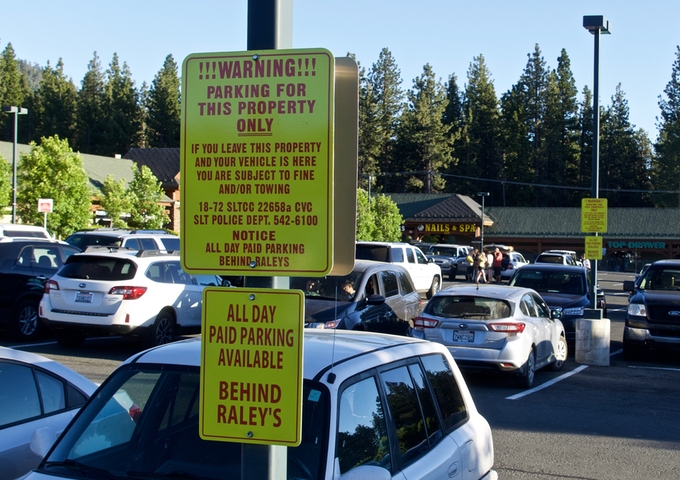
Parking battle at SLT shopping venues escalates

Poaching parking at the Village Center will no longer be tolerated. Photo/LTN

By Kathryn Reed

Yellow and red signs went up this week in the Village Center in South Lake Tahoe warning people if they leave the premises, their car will be ticketed or towed.

“What has happened is my tenants have been taken advantage of by the general public and employees of the (Heavenly) Village. In the winter we can have skiers and snowboarders parking in our lot,” Terry Hackett, owner of the center, told Lake Tahoe News.

All of this means less parking for people who actually want to patronize businesses in what was the old Crescent V Center.

Hackett said workers from across the street will park at his lot all day to avoid having to pay at the city-owned garage in Heavenly Village. Some employers reportedly allow their staff time to move their vehicles every two-hours to avoid a ticket.

Hackett is having the two-hour signs removed and replacing them with the brighter, more threatening signs.

“The two-hour limit will still be invoked, but the key is you will not be able to use my lot to walk across the street to the gondola or village,” Hackett said.

Because this is private property he has a right to make these kinds of rules. What he or those he pays cannot do is harass or accost someone who chooses to violate those rules. People have a right to come and go as they please. But there are consequences for doing so.

The fine is $55. Towing would be more. The signs say violators will be fined and/or towed.

This is not a new problem. The issue seems to escalate about every 18 months. (The gondola opened in 2000, the Marriott properties in 2002, and Heavenly Village just keeps getting busier — as does Hackett’s center.)

“Stateline is a victim of its own success,” Hackett said.

When the Heavenly Village area was redeveloped the agreement was that each side of the street would provide parking for its respective patrons. The city garage costs money, Hackett’s place doesn’t. People tend to go for the freebie.

The first parking agreement was signed in August 2000. At that time there was supposed to be attendant controlled access to then called Crescent V Center, with the city responsible for oversight of the 478 spots.

The agreement was amended in 2002. The 2011 revision calls for a two-hour parking limit at Crescent V, with the city getting revenue from fines and Hackett responsible for cost of enforcement. It says, “No citations shall be issued for any other reason.”

Part of the 2017 agreement between the city and Hackett is for the South Lake Tahoe parking authority to subsidize the parking enforcement. The latest iteration of the contract that the City Council agreed to this month gives Hackett $50,000 for enforcement; that money comes from the parking authority. At one time the city paid  $100,000/year out of the General Fund to enforce parking there.

These payments are ongoing until the city pays off the debt on the parking garage in about a dozen years.

The garage is bringing in about $800,000 a year, with roughly half going to pay the debt. (The other half is set aside for maintenance, improvements and Hackett. All money collected from parking issues has to be reinvested into parking related matters in that area. The city technically does not own the garage.)

Revenue from any tickets issued by the private enforcement firm Hackett hires goes to the city’s parking authority. Less than 100 tickets have been written in the last six months. If the parking gurus were to truly enforce the parking rules and based on the size of problem Hackett says there is, that many tickets could probably be written in a day.

Tires will still be chalked to mark two hours. Businesses have placards patrons can put in their vehicle if they are staying longer. This will ensure they don’t get a ticket.

Paid parking is available in the same center behind Raley’s. The price changes with demand. There is also the parking garage at Heavenly Village. The casinos are a possibility, but they are starting to charge on select days/nights.


Opinion: Can art save California?

By Joe Mathews

Can the arts save California?

On every public policy challenge other than climate change regulations, the state seems stuck. We can’t transform our education system to match our diverse population’s needs, expand our universities fast enough to meet future economic demands, or build enough affordable housing. Silicon Valley, once billed as a savior, is more interested in grabbing our data and selling us ads than making society better. The vast majority of Californians don’t bother to vote, much less engage in civic life.

Joe Mathews

The state’s arts sector is wrestling with the same challenges: invasive technology, diversifying demography, fading engagement, stagnant education, scarce economic inequality. Over the last 18 months (after being assigned to edit a series on arts and society), I embarked on a crash course in how arts organizations seek to engage people. The experience left me uncharacteristically optimistic. While the arts can mirror the state’s larger dysfunction, they also may be the part of California best positioned to lead us out of this dark time.

Today, the arts retain credibility that other human pursuits such as mass media, politics, and business have lost. In surveys, the biggest complaint that Californians voice about the arts is that they don’t have time to enjoy them.

So I’d like to propose that the arts could be the secret sauce of a revival in California’s civic culture. While technology can leave us feeling isolated, the arts connect us, and provide a sense of meaning, accomplishment, and even happiness. Researchers have shown that people who participate in arts and culture are more likely to vote, belong to civic organizations, know their neighbors, and do charitable work. The arts, in short, encourage us to be sociable. And sociability is becoming a lost, and thus valuable, art.

What’s the secret of the arts’ success?

The answer starts with healthy self-criticism: Arts leaders express urgent concern that their organizations aren’t meeting the many needs of today’s communities. In response, many California organizations has been aggressively experimenting and taking risks. Take the Cornerstone Theater’s six-year series of nine plays on food and equity, “The Hunger Cycle.” Or witness the Oakland Museum of California’s exhibit All Power to the People: Black Panthers at 50, which risked criticism of cultural appropriation and of celebrating a movement associated with violence. (The risk paid off, with the exhibition drawing large—and young—audiences.)

California is home to many powerful efforts to break down walls between the arts and people. The Riverside Art Museum sends staffers to block parties and neighborhood festivals, curating work it supports and conducting surveys on local arts needs. The Santa Cruz Museum of Art and History has prioritized the work of “social bridging” —intentionally bringing together people from different walks of life at exhibits and events. Museum Executive Director Nina Simon writes that this involves matching “unlikely partners—opera singers and ukulele players, welders and knitters, Guggenheim winners and backyard artists. Our goal in doing this work is to bring people together across differences and build a more cohesive community.”

When is the last time you saw institutions outside the arts promote that kind of outreach?

These days, businesses, interest groups and politicians rarely try to make converts—they instead focus their resources on turning out their core customers and monetizing their contacts. But many of California’s top arts institutions make their events and exhibits free, especially for kids.

The arts could do even more for California.

So many organizations try to reach the young, but the arts actually do it; when it comes to making art, 18- to 24-year-olds are most likely to participate. And, amidst a stressful deluge of digital information, arts organizations are models of curation and filtering out distractions. (It helps that you have to silence your cellphone while attending a play.)

The arts also are a case study in the importance of giving people what they need, and the folly of giving them what they want. Scholars have shown how websites that give us what we want give us too much of the same thing, thus constraining creativity and artistry, and ultimately disappointing audiences. The arts stand as a direct rebuttal to Silicon Valley’s data obsession because great art’s value is undeniable but can’t be quantified by audience numbers or economic studies alone.

All this asks an awful lot of the arts, particularly when President Trump seeks to zero out the budget for the National Endowment for the Arts. But our arts organizations provide us with a rare template for pulling together broad networks of people and imagining very different realities in California. We need the arts more than ever.

Joe Mathews, Connecting California columnist for Zócalo Public Square, wrote this for a Zocalo inquiry on arts engagement, produced with support from the James Irvine Foundation.


Walgreens merger with Rite Aid falls apart

By David Goldman, CNN
 
A $10 billion mega-merger between two of the nation’s largest drug stores is no more.

Walgreens and Rite Aid announced Thursday that they are no longer combining forces. Not entirely, at least.

Instead, Walgreens agreed to buy 2,186 Rite Aid stores for $5.2 billion. That will essentially cut Rite Aid in half, leaving it with 2,350 stores after the deal is done.

Read the whole story