Without U.S. play, World Cup betting expected to dip

By Case Keefer, Las Vegas Sun

The thrill of gambling can’t quite compensate for the lack of rooting interest in the World Cup.

With the United States failing to qualify for this year’s tournament, betting handle on the event may decrease locally for the first time in decades.

That doesn’t mean the World Cup won’t be the focus at sports books as the 32 competing teams play their opening matches over the next six days in Russia. It’s still expected to carry betting action over the next month during an otherwise slow period.

Read the whole story


Co-housing project planned for Truckee

By Sage Sauerbrey, Moonshine Ink

When a system is put under pressure, it must evolve or falter. Such is the case with the local housing market. Thanks to an innovative community, current pressure has led to evolution. One concept gaining steam in Truckee involves a new way of living with your neighbors. Enter the Truckee River Village, a proposed co-housing center.

“The vibrant community life is really the draw at the end of the day,” project manager Jan Holan said of the development. The project currently plans for 30 to 35 housing units to be built on West River Street at the current location of Unique Boutique.

Co-housing is a relatively new idea; the term was coined in 1988. The loose criteria for co-housing is that it is co-developed, co-designed, and co-organized by the residents, has extensive common facilities that supplement and facilitate daily living, is designed to encourage community interactions, and is resident-managed (in this case in the form of a homeowners association).

Read the whole story


100+ pounds trash plucked from SLT bike trails

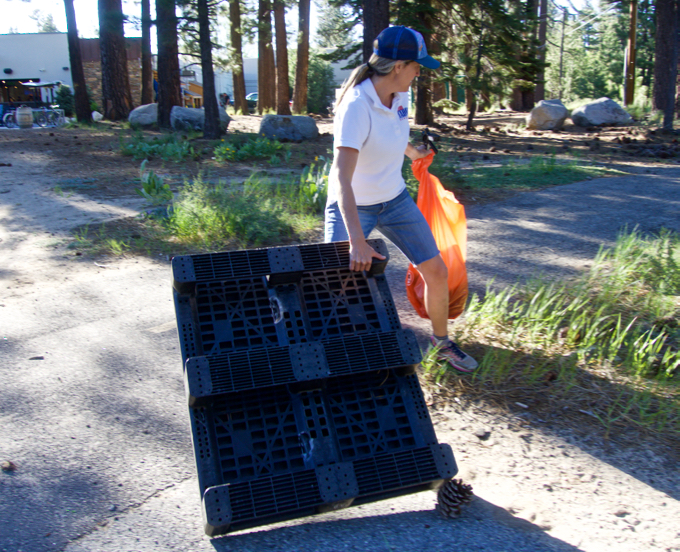
Catherine Cecchi with Clean Tahoe moves a heavy pallet out of the way for her crew to retrieve. Photo/Kathryn Reed

By Kathryn Reed

How long has it been since there was a Burger King in South Lake Tahoe or even on the South Shore?

The answer is years. The question is relevant because a wrapper from that fast food restaurant was picked up this week along a bike trail here. It’s either been there a long time or someone brought it in from outside of the area and instead of tossing it in a garbage bin, discarded outside as litter.

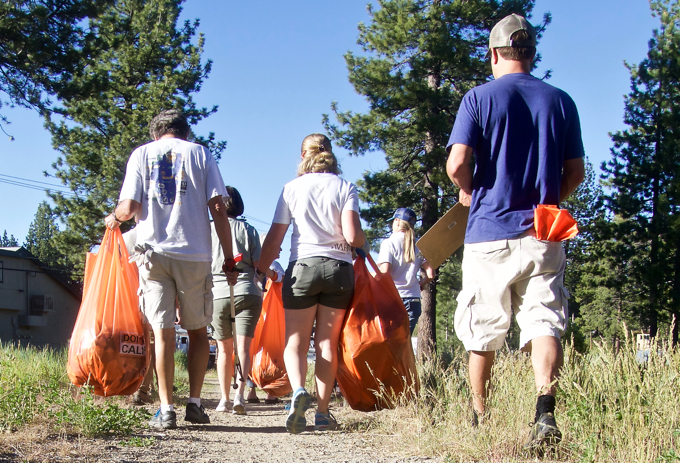
About 50 people volunteered an hour or so of their time on June 12 to help clean up sections of the bike paths, all under the guidance of Clean Tahoe and League to Save Lake Tahoe leaders, with support from Tahoe Regional Planning Agency and the Bike Coalition.

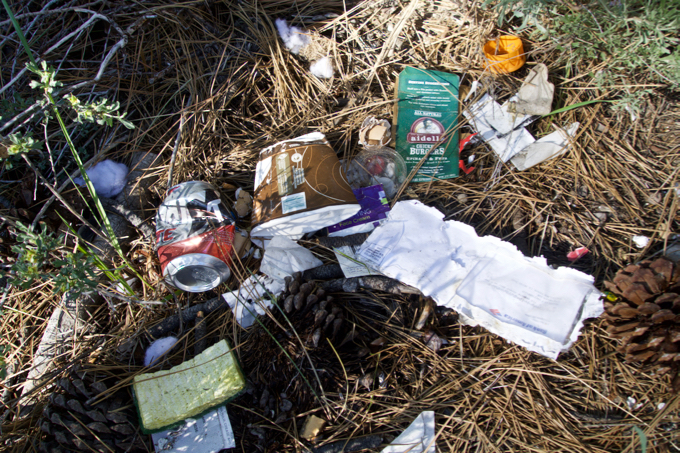
A pile of household trash just off the bike trail near the Y in South Lake Tahoe. Photo/Kathryn Reed
Items collected June 12:
• Band-Aids – 2
• Grocery bags – 22
• Other bags – 47
• Balloons – 2
• Batteries – 2
• Bottles – 32
• Bottle caps – 171
• Cans – 34
• Car parts – 15
• Cigarette butts – 1,117
• Cigarette lighters – 3
• Clothing – 19
• Construction material – 26
• Cups – 41
• Dog poop bags – 19
• Dog poop without bags – 5
• Fishing line/net – 5
• Food waste – 20
• Food wrappers – 120
• Glass bottles – 20
• Glass oil lamp – 1
• Glass pieces – 187
• Gum – 31
• Historic metal – 2
• Lids – 71
• Metal pieces – 55
• Paper pieces – 346
• Plastic pieces – 420
• Plates – 22
• Pull tabs – 12
• Q-Tip – 3
• Receipts – 35
• Reflectors – 3
• Rope – 20
• Rubber bands/hair ties – 6
• Six-pack holder – 4
• Straws/stirrers – 76
• Syringes – 1
• Styrofoam cups – 22
• Styrofoam pieces – 130
• Styrofoam plates – 3
• Styrofoam take-out containers – 5
• Take-out containers – 6
• Tampons – 2
• Tobacco packing – 22
• Toys – 4
• Utensils – 28
• Zip ties – 10

In the short amount of time the crew collected 101.5 pounds or 73 gallons of debris.

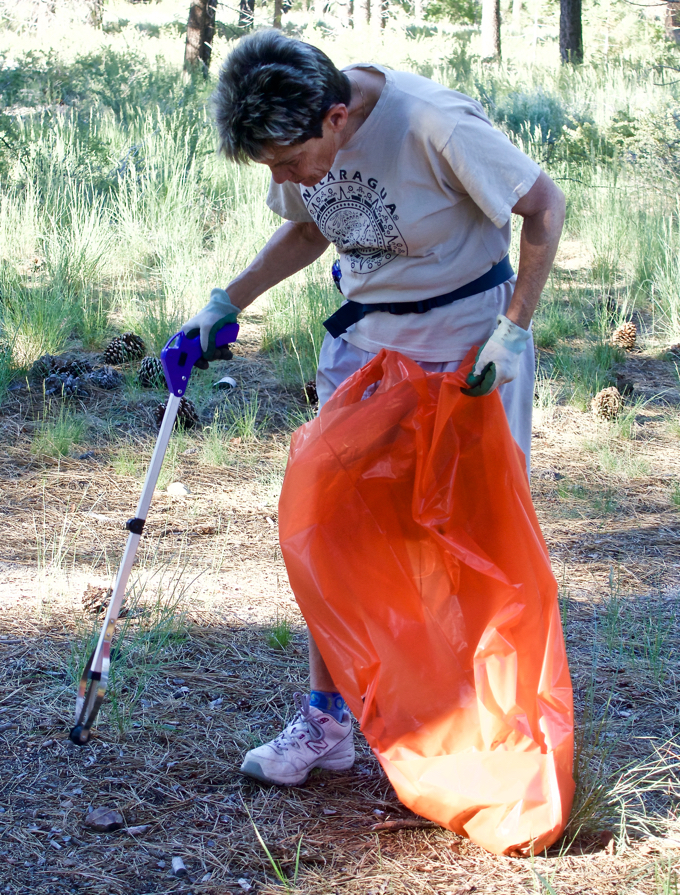
Fortunately gloves were handed out to those who did not bring them, and grabbers were provided to those who didn’t want to get that close. When you are picking up people’s hygiene products and sex prevention devices, it’s best to have your own protection.

There were three starting locations: 1. Clean Tahoe office near the Tahoe Valley Pharmacy, with people then going to the trail from Helen Avenue to behind the Crossing center; 2. behind Motel 6; and 3. Highway 50-Los Angeles Avenue. The latter two met up in the Rubicon area.

Volunteer Rosemary Manning picks debris. Photo/Kathryn Reed

This cleanup has been going on for several years, with most being on a Saturday. The was the first to be on a Tuesday night. The hope was to get a different group.

Catherine Cecchi, who runs Clean Tahoe, told Lake Tahoe News the trash found along the bike trails and in neighborhoods is different than what is found on beach cleanup days.

“There are a lot more food wrappers and a lot more to-go cups,” she said of the bike path as she filled her large orange bag that had “Don’t Trash California” written on it. “At the beach there is more recreation stuff; alcohol and cigarette butts.”

Still, there were plenty of cigarette butts picked between the three groups – 1,117. So many were found embedded in dry pine needles.

Volunteers with their full bags. Photo/Kathryn Reed

A pile of household trash was found across the path not far from a residence. A guess is that it was brought there by a critter. An envelope was still part of the mess; something Cecchi took a photo of with the hope of tracking down the owner of the contents. Leaving trash out for animals – intentional or otherwise – can come with a fine.

Someone’s unexpired permanent residence card was salvaged. A plastic pallet was left to be picked up by the Clean Tahoe crew later in the week. Christmas decorations had seen better days.

It was the itty-bitty pieces of Styrofoam that were so annoying to pick up. Some looked like they may have once been bigger pieces of packing material.

One thing veteran volunteers have noticed is the decline of plastic bags. An assumption could be the bag ban in the city limits means there aren’t as many out there.


Opinion: Lessons from Honolulu’s homeless project

By Duane Kurisu

My father always said that you get out of life what you put into it. But I believe that people like me, who grew up in a sugar plantation town, were blessed with a whole lot more. The plantation era was a special time in a special place.

Our lives back then shaped who we are today: It was about how we conduct ourselves and how we care for others, rather than how much money we make. Trust and responsibility weren’t just virtues that we strived for; they were a way of life.

While the plantation days and plantation towns are now long gone, we built Kahauiki Village to try to rekindle the spirit of those times and the soul of those towns to help solve one of our most difficult issues: homelessness.

Whether you’re a successful executive or someone without a roof over your head, you still share the need for dignity and a sense of community. As a community of single-family dwellings and duplexes, each with their own kitchens and bathrooms for homeless families with children, Kahauiki Village aspires to have that as its core. With an outpouring of support from people throughout Oahu, we broke ground on July 7, 2017.

Upon completion on Jan. 12, 2018, as we gathered to welcome Kahauiki Village’s first families, I noticed a mother holding her son nearby. Instinctively I reached out and asked him to “come to uncle.” As I held the boy in my arms and looked into his eyes, I saw myself. And I saw my brothers and sisters, my mother and father, my friends and all the others who grew up in the plantation towns of yesteryear. Our homes may have seemed shabby even by local standards, but they were our castles and we lived in our communities with pride. We had hope and we had the opportunity to dream big.

That kind of upbringing was the inspiration for Kahauiki Village. At Kahauiki, we, the many stakeholders in the project, including contractors, supply houses, engineers, the state and city governments, and the homeless themselves, believe that a sense of community should be the starting point in addressing the day-to-day needs of those seeking comfort and shelter, and for providing long-term solutions for homelessness. This too can be a special place, fostering a sense of self-worth, self-reliance, and responsibility, where respect and civility are cherished values.

In imagining and designing Kahauiki Village, we created a community reminiscent of the plantation towns. We built a child care center and a preschool allowing parents to go to work. We built a convenience store operated by a trusted local market. We built a police rest station, a laundry facility, an onsite management and social services office, and community gardens for parents and children to grow their own vegetables. And as we complete our second and final phase, we will build a community recreation center and a playground. When we’re done, Kahauiki will house 54 percent of the homeless families on Oahu who currently are in transitional homes, according to projections by the Institute of Human Services.

It wasn’t easy getting Kahauiki Village off the ground. In the beginning while we were still in the design stages of the project, we intended to do our diligence work under the radar. Our plan was to anticipate any obstacles and risks, design the village concept, and have a solid plan to pay for everything before we moved any further. Yet we also knew that all of this would be academic unless we removed the cost of the land from the equation. So with the support of the state Department of Land and Natural Resources, we petitioned the state’s Land Board for a dollar-a-year lease on an 11-acre surplus parcel at Keehi Lagoon. When our request was included on the docket for its scheduled hearing, the curtain was lifted. Our activities became public. Now we were open to public comment and media inquiries. There was no turning back.

Once Kahauiki Village went public, our path was clear: We had to stand together to see the project through to completion. In a close community like Hawaii, character and reputation are everything. Our state has long suffered fast talkers who bring in big ideas and leave behind nothing but lost dreams, bruised egos, and empty pockets. All talk and no follow-through—certainly we didn’t want to be tarred with the same brush, and so we committed to move forward together, at all costs.

We had started as a group of friends who wanted to build a housing project for homeless families, pro bono. But as our dream grew bigger, the time frame for execution grew shorter. Our project quickly became a design/build initiative, which means that we were designing and building the project at the same time.

Gov. David Ige’s emergency proclamation in 2015, which allowed for building without permits to address the growing homeless population, included Kahauiki Village, its first non-government entity, as an exempt project. Armed with this untested executive order, we moved ahead, still uncertain of the development’s ultimate price tag. As the project’s leader, I accepted personal financial responsibility for building and completing Kahauiki Village and, as a result, I now felt the burden of the other participants’ reputations as well. It was a lonely and scary time.

But I soon realized that I was hardly alone. Every member of our founding team unselfishly invested inordinate amounts of energy and resources and enthusiastically bore a share of the burden. We were all in—together.

For me personally, it was a deeply emotional time. Life became a mix of great anxiety and tears of gratitude, as more and more people embraced our vision and joined our cause. Clearly, we were onto something. As the keeper of that vision and convener of stakeholders, I fought to overcome my fears of inadequacy, while following the compass of my heart to do the right thing regardless of cost. Together, unified in action, we found we trusted each other to the point where everyone could call their own shots. Miraculously, even as we worked independently on the many moving parts, we rarely stepped on each other’s toes.

But the “miracles” were just beginning, as many critical pieces began falling into place. From the beginning when we initially sat down to negotiate the terms of the ground lease with the city, we set up an informal partnership with key members of the city and county administration and continued to meet regularly to help navigate bureaucracy, interpret building code issues and state and city laws on the fly, and coordinate our responsibilities. This team enabled the design/build process to move so quickly that we sometimes had to ask the city to slow down! Still, as transparency and integrity became the hallmarks of this partnership, it seemed that nothing could slow us down for long.

When we determined that millions of dollars would be required to bring sewer and water services onto the property from nearby Sand Island, Mayor Kirk Caldwell agreed to step in and fund those connections.

Gov. Ige and Gen. Kenneth Hara mobilized the Hawai‘i National Guard to help with vertical construction of the homes.

We lowered costs and simplified construction by importing used emergency housing from Tohoku, Japan. With local materials and island design touches, these structures were then dramatically modified to achieve a Hawai‘i plantation-home feel.

This meant changing the foundation from post and pier to concrete; changing the structure from a flat roof to a pitched roof that required trusses; installation of high-quality standing seam roofs to allow for solar panels to be secured with clips rather than having to puncture the roof; installation of metal framing and drywall to separate the rooms; insulation and a ceiling system in each home; changing the doors to meet code; building concrete landings; and putting in stoves and refrigerators and cabinet systems in the kitchen, and water closets, showers, and stand-alone sinks in the bathrooms.

Early on, businesses within walking distance of the development came forward to offer job training and employment to any adult from Kahauiki Village who needed work. Since the project is self-sustained by tenants who pay rent, every household must include at least one working adult.

In addition to facilitating employment with our new child care center and preschool, a regular city bus stop was installed right in front of Kahauiki Village. An elementary school is within walking distance.

Insynergy Engineering and PhotonWorks designed a power system so that Kahauiki Village can operate completely off the grid. Because electricity is included in each household’s rent, the photovoltaic system will help control the cost of power now and in the future.

Local agriculture leaders brought the Future Farmers of America to Kahauiki Village and are working together with the organization to build community gardens. Our goal is for every family to maintain a garden plot to grow their own vegetables.

Almost every day, new contributors—people from all walks of life—step forward to embrace our vision in some new way, helping to enhance the lives of those who call Kahauiki Village home. This is Hawai‘i at its best.

Everyone who has touched—and been touched by—Kahauiki Village, whether they built the homes, laid the pipes for the sprinkler system, planted grass and trees or cleaned the floors, can feel proud. We started and finished Kahauiki Village in six months. Some 70 percent of the total cost of the project was funded by donations of cash, materials and labor. And none of the core work of Kahauiki Village was done with construction contracts. It was all by commitment through handshake, something none of us have done before with this magnitude of work.

Families have quickly taken pride in and responsibility for the privilege of living in Kahauiki Village. There are 126 adults and children who currently live in Kahauiki who have formed a community association, which is taking initiatives with yard care, in coordinating adult escorts for children walking to school, and more.

Of course, Kahauiki Village isn’t a blanket solution. Elements like the home layouts, the working parent requirement, the child care center and the preschool are applicable primarily to a community for homeless families with children. Homeless people affected by drug use and mental illness, for instance, as well as homeless youth, may need smaller quarters and shared kitchens, not to mention an extra investment in social services. Still, the lessons of Kahauiki Village—building community, removing the impediment of land acquisition costs, entering into public/private partnerships—can be essential tools for addressing the overall issue of homelessness.

It is our hope that others will use this template, which will certainly be easier to follow without the need for breaking new ground. Addressing homelessness is everyone’s responsibility, not just government’s. For our state to reach the heights we know are possible, we all need to rise together—the fortunate and the disenfranchised, the rich and the poor and the in-between, the power brokers and those who feel powerless. Sharing comes naturally to us in Hawai‘i. If we put our heads and hearts together and work toward a clear common goal, we can achieve almost anything.

Those of us who grew up on the plantations are indeed fortunate in our heritage. But then everyone who calls Hawai‘i home should be considered fortunate. That’s the spirit of this special place and its people. And that spirit is ours to share.

Duane Kurisu is a businessman and organizer for Kahauiki Village. This essay is part of an ongoing series, produced by the Daniel K. Inouye Institute and Zócalo Public Square, exploring Hawaii’s past, present, and future.


Plan to split Calif. into 3 states to be on Nov. ballot

By John Myers, Los Angeles Times

California’s 168-year run as a single entity, hugging the continent’s edge for hundreds of miles and sprawling east across mountains and desert, could come to an end next year — as a controversial plan to split the Golden State into three new jurisdictions qualified Tuesday for the Nov. 6 ballot.

If a majority of voters who cast ballots agree, a long and contentious process would begin for three separate states to take the place of California, with one primarily centered around Los Angeles and the other two divvying up the counties to the north and south. Completion of the radical plan — far from certain, given its many hurdles at judicial, state and federal levels — would make history.

It would be the first division of an existing U.S. state since the creation of West Virginia in 1863.

Read the whole story


How local businesses compete in the age of convenience

By Alexandra Spychalsky, Moonshine Ink

It is clear that we are no longer living in the heyday of the mom-and-pop shop, and rather are deep in the digital age. Why go away from home to shop when you can have groceries delivered to your door? It may sound cynical, but it’s the battle waged daily by the Tahoe businesses that provide the everyday items locals need, like home goods or produce. Here local business owners explain how they compete for your dollars, and why convenience and lowest cost don’t always equal the best buy.

For many local business owners, it’s all about that personal connection that is unique to a mom-and-pop shop. That’s what they say sets a local business apart from the big chains, and is a large reason why customers keep coming back.

Gary Romano, owner of Sierra Valley Farms in Beckwourth — just north of Sierraville — faces an uphill battle each day. The Sierra is not a very hospitable growing area, he says; the 5,000-foot elevation brings cool and rapidly changing temperatures and a soil that can only nurture certain crops. But he can pick a batch of carrots in the morning and get them to a Truckee restaurant by noon, he says, which is about as local as it gets, and he has a loyal following among the produce buyers across North Lake Tahoe.

Read the whole story


Arrests made in Truckee robbery

A Truckee man turned himself into police on June 12 regarding an April robbery.

Raymond Jesus Soltero, 18, and two juveniles face charges stemming from an alleged marijuana robbery in Truckee on April 27.

According to police, Soltero had arranged to buy concentrated cannabis from the victim. Police said a gun was used in the robbery of about 6 ounces of cannabis.

The juveniles were arrested May 30. The weapon believed to have been used in the crime has been recovered.

— Lake Tahoe News staff report


Gray wolf traced to Boreal area

By Lesley McClurg, KQED-TV

Gray wolves are trekking farther south in California. A 2-year-old female, known as OR-54, recently wandered through Nevada County in the northern Sierra Nevada. Until now, the California Department of Fish and Wildlife had reported wolves only as far south as Lassen County.

“She’s made her way all the way down into the Sierra, and that’s so exciting because this is its prime wolf habitat,” said Amaroq Weiss of the Center for Biological Diversity. “It’s an area that scientists have identified for a long time as being good wolf habitat.”

The wolf is collared with a GPS transmitter that allowed officials to determine her whereabouts just off Interstate 80, near Boreal Mountain.

Read the whole story


Calif. works to implement Groundwater Management Act

By Sean Hood, Water Deeply

California’s Sustainable Groundwater Management Act (SGMA) requires each local Groundwater Sustainability Agency to develop and implement a Groundwater Sustainability Plan for its basin and the first plans for critically overdrafted basins are due to be completed by January 31, 2020. Each plan must be designed to achieve safe yield within 20 years.

This new regime of groundwater management is a monumental change in California water law. Overlying land owners have long enjoyed the right to extract groundwater for beneficial use on their land, and the agricultural, municipal, mining and industrial sectors rely heavily on groundwater resources to meet their water needs. It is difficult to fathom the collective investment that California businesses have made in reliance on the right to make beneficial use of groundwater.

In response to SGMA’s passage, public and private stakeholders have scurried to identify new water sources to augment existing supplies. However, the Department of Water Resources’ recently issued Water Available for Replenishment report seems to confirm longstanding conventional wisdom: There is no water supply panacea for solving California’s groundwater management crisis.

Read the whole story


Snippets about Lake Tahoe

·      Kirkwood’s Wildflower Walk & Wine is Aug. 11.

·      As part of the summer reading fun, Douglas County Public Library is providing two free wildlife shows on June 27. The first show is at 4pm at the Zephyr Cove Library; the second show will begin at 6:30pm at the C.V.I.C. Hall in Minden.

·      A Brush with Kindness in South Lake Tahoe, a program of El Dorado County Habitat for Humanity, is seeking volunteers to assist with prepping and painting four homes this summer. For information and an application, contact Sandy at 530.541.2844.  Applications are also available online.

·      South Lake Tahoe’s 100% Renewable Committee is partnering with the Sierra Business Council and Optony, a global leader in clean energy project services, to provide South Shore businesses and agencies an opportunity to obtain a no-cost onsite solar assessment with no strings attached. For info, contact Nick Exline at exline555@gmail.com.

·      Steph Curry from the Warriors is returning to the celebrity golf tournament next month in Stateline.