Massage owner accused of sexual battery

The owner of a South Lake Tahoe massage parlor was arrested on sexual battery charges.

Qiteng “Eric” Lu, owner of Chinese Magic Massage on Highway 50, was arrested July 6 on charges of penetration by a foreign object, sexual battery and attempting to prevent a witness from reporting a crime.

The 34-year-old victim told police she was battered during her massage.

The South Lake Tahoe Police Department is requesting that anyone with information about this case, or anyone who had a similar experience at this business to call the South Lake Tahoe Police Department at 530.542.6100 or Secret Witness at 530.541.6800.

— Lake Tahoe News staff report


Trail will link Tahoe City, Kings Beach and Truckee

By Karen Marks, Sacramento Bee

Bit by bit, a trail is taking shape at Lake Tahoe that will eventually connect Tahoe City, Kings Beach and Truckee.

The Northstar Community Services District recently received $250,000 in hotel tax money to begin the next phase, about 2 miles of the Martis Valley Trail. The Martis Valley Trail is part of a planned 62-mile trail network that Peter Kraatz, assistant director for Placer County’s public works and facilities department, calls the “resort triangle.”

Of the 62 miles, half has been completed. The remaining half includes the Martis Valley Trail along the northeastern leg of the resort triangle, in addition to a few unfinished gaps along the north shore of Lake Tahoe and Truckee River.

Read the whole story


Conviction in EDC first degree murder trial

The last of three trials for the four defendants in a 2015 El Dorado County murder ended with a guilty verdict.

Nalana Omega was found guilty last week in the stabbing of Pete Thomas, 55. Thomas’ body was discovered Feb. 3, 2015, at a home in the town of El Dorado.

According to authorities, it was a robbery and murder.

The three others also convicted of first degree murder are Roberto Barrera, Raul Gonzalez Jr. and Danielle Marie Weed.

— Lake Tahoe News staff report


Study: Sierra meadows being overtaken by forest

By Jason Alvarez, UC Merced

Subalpine meadows are among the Sierra Nevada’s most enchantingly picturesque landscapes. These sparsely wooded, grassy expanses are home to plants and animals found nowhere else, and they play an important role in regulating the flow of water from the Sierra snowpack to the rest of the state.

But these ecosystems may soon disappear.

A UC Merced study authored by former doctoral student Kaitlin Lubetkin, Professor Leroy Westerling and Sierra Nevada Research Institute  scientist Lara Kueppers found that these meadows are being increasingly overrun by forest as changing conditions allow the offspring of nearby trees to take hold in meadow environments that previously favored shrubs and grasses over saplings. For the many species that depend on meadows, this change may force them to find new habitats.

Read the whole story


Forest Service worried about public using drones

By Erica Hupp

Before heading to the woods to fly a recreational drone, U.S. Forest Service officials ask pilots to comply with all Federal Aviation Administration  regulations.

The FAA has regulatory authority over all airspace, including recreational use of airspace by drones. Information is available online.

When flying recreational unmanned aircraft systems (UAS) on National Forest System lands, there are some restrictions that pilots should be aware of. Since UAS are considered to be both “motorized equipment” and “mechanical transport,” they cannot take off from, land in, or be operated from congressionally designated wilderness areas.

“Designated wilderness provides opportunities for primitive types of recreation, which is a much needed contrast from our increasingly developed and mechanized world,” said Jamie Fields, recreation and Wilderness program manager. “Pilots should also refrain from flying recreational UAS in popular recreation areas for public safety and to allow others to enjoy their recreational experience.”

Additionally, UAS should not be flown over or near wildlife as this can create stress that may cause significant harm and even death. Disturbance, pursuit, or harassment of animals during breeding, nesting, rearing of young, or other critical life history functions is not allowed, and may be in violation of a number of laws including the Endangered Species Act, the Migratory Bird Treaty Act, and the Bald and Golden Eagle Protection Act.

“If forest users want to use their UAS to search for or detect wildlife and fish, they need to follow state wildlife and fish agency regulations regarding the use of aircraft,” said Kris Boatner, wildlife program manager.

Recreational UAS must also abide by temporary flight restrictions (TFRs) in place by the FAA over disasters such as wildfires. In 2016, there were more than 40 documented instances of members of the public and others flying UAS without authorization over or near wildfires in 12 states (Arizona, California, Colorado, Idaho, Minnesota, Montana, Nevada, New Mexico, North Carolina, Utah, Washington, and Wyoming). This resulted in aerial firefighting operations being temporarily shut down on more than 20 occasions, which may have caused wildfires to grow larger and unduly threaten lives, property, and valuable natural and cultural resources.

Aerial firefighting aircraft, such as air tankers and helicopters, fly at very low altitudes, typically just a couple of hundred feet above the ground and in the same airspace as UAS flown by the public. That proximity creates the potential for a mid-air collision that could seriously injure or kill aerial and/or ground firefighters.

TFRs typically put in place during wildfires require manned or unmanned aircraft not involved in wildfire suppression operations to obtain permission from fire managers to enter specified airspace. The FAA, the U.S. Forest Service, the U.S. Department of the Interior, and other wildland fire management agencies consider UAS, including those used by the public for hobby and recreation purposes, to be aircraft and therefore subject to TFRs.

People should not fly UAS over or near wildfires even if a TFR is not in place because of the potential for accidents and disruption of suppression operations. Individuals who have been determined to have interfered with wildfire suppression efforts may be subject to civil penalties of up to $25,000 and potential criminal prosecution.

To keep UAS pilots aware of flight restrictions, the FAA has developed an easy-to-use smartphone app called B4UFLY. The app helps unmanned aircraft operators determine whether there are any restrictions or requirements in effect at the location where they want to fly. B4UFLY is available for free download.

Tips for responsible hobby or recreational use of UAS on NFS lands:

  • UAS must be flown below 400 feet and remain clear of surrounding obstacles.
  • Do not fly any aircraft weighing more than 55 pounds (total weight, including payload and fuel source).
  • Launch the UAS more than 328 feet from wildlife. Do not approach animals or birds vertically with the UAS.
  • Keep your UAS within your visual line of sight at all times.
  • Take lessons and learn to operate your UAS safely.
  • Remain well clear of and do not interfere with manned aircraft operations.
  • Fly your UAS at least five miles from an airport or backcountry airstrip.
  • Keep your UAS away from populated and noise-sensitive areas, such as campgrounds, trailheads, and visitor centers.
  • Obey all privacy laws.

Erica Hupp works for the Humboldt-Toiyabe National Forest.


Tahoe Tails — Adoptable Pets in South Lake Tahoe

Bonnie

Bonnie is a smaller kitty who is 4 years old. She is a an indoor cat, but is a good mouser and she likes other cats.

Bonnie is spayed, microchipped, tested for FIV, and vaccinated. She is at the El Dorado County Animal Services shelter in Meyers, along with many other dogs and cats who are waiting for their new homes.

Go to the Tahoe animal shelter’s Facebook page to see photos and descriptions of all pets at the shelter.

Call 530.573.7925 for directions, hours, and other information on adopting a pet. For spay-neuter assistance for South Tahoe residents, go online.

— Karen Kuentz


South Lake Tahoe council to vet future of VHRs

By Kathryn Reed

The much anticipated vacation home rental study commissioned by South Lake Tahoe doesn’t say much that people didn’t already know.

On July 11 the study titled Socioeconomic Impacts of Vacation Home Rentals in South Lake Tahoe will be the subject of a workshop by the City Council.

The council will likely discuss whether a cap should be placed on the number of vacation home rentals allowed throughout the city or in particular neighborhoods, if the permitting process should change, enforcement procedures, fines, and other related topics.

The public will have an opportunity to offer comments, suggestions and feedback. The workshop will follow the regular meeting which starts at 9am, but it is not time certain when the VHR discussion will commence.
                                                                                                                            Source: South Lake Tahoe VHR study

The report, which cost taxpayers $77,000, had its first public airing on June 13 when the consultants who put it together gave an overview for the council.

The purpose, as stated in the report, was “to examine the wide range of factors that may be influenced by the growth of the sharing economy, and evaluate the socioeconomic impacts of those factors.” This study was a partnership between faculty at California State University, Sacramento and Michael Baker International.

The report acknowledges that the city’s data on VHRs was “incomplete or inconsistent and required a great deal of processing.” Recent data was abundant, long-term wasn’t.

This led the researchers to use public data such as the Census, American Community Survey, multiple listing service, and economic and tourism reports.

Surveys and public meetings provided other content. Twenty-three percent of respondents to the resident survey identified themselves as VHR owners or operators.

In the report is an alarming admission by the consultants: “To the extent possible, data was verified for correctness and completeness; however, none of the data is guaranteed for accuracy, and the study team makes no warranties or guarantees on the validity of the data used in this report.”

Researchers also analyzed VHR related studies done in other locales.
South Lake Tahoe is not unique in losing long-term rentals when owners start using the property for short-term rentals. One study showed when restrictions were placed on where VHRs were allowed, the value of the property went up somewhat in VHR-allowable areas, while the decrease in value was greater where VHRs were not allowed.

This is what the data shows for South Lake Tahoe regarding the effects of VHRs on home values:

·      A VHR with an average allowed maximum occupancy of nine sells for about 8.5 percent more than a similar house not licensed to be a vacation home rental.

·      The presence of the average number of VHRs within a zero to a tenth mile of a home, and a tenth to quarter mile of a home, respectively raise the home’s selling price by 2.9 and 3.6 percent.

·      The presence of the average number of VHRs with a quarter to half mile of a home, and a half to one mile of a home, respectively lower the home’s selling price by -5.3 and -9.1 percent.

To the question of what would happen if VHRs were to go away, the research found, “The most dramatic impacts that phasing out VHRs in the city will have is the significant loss of TOT, and a shrinking of the city’s tourist economy. Occupations that support the VHR industry will follow the VHR market, and move into neighboring jurisdictions where VHRs are still allowed. While the city will still be the primary location for much of the region’s entertainment and recreation, there will likely be less diversity in the tourist economy as tourists staying in VHR accommodations outside the city look for recreation options closer to their VHRs.”

Many people claim if VHRs were reduced this would help locals with having more choices to live. Not true, says the study.

“VHRs make up less than 25 percent of the city’s vacant housing stock. Addressing problems with the currently operating VHRs treats only a part of the problem facing the city in regard to the lack of affordable housing and the mismatch between incomes and housing costs experienced by residents employed in the tourist industry,” the report states.

One potential way to loosen up the housing market would be to assess a fee on vacant houses.

Researchers looked at hybrid policy ideas such as:

·      Property transfer fee for properties that are not primary residences or intended for long- term rental.

·      Vacant property impact fees for properties that are left unoccupied for more than a certain number of days each year.

·      Regulatory relief or other incentives for absentee property owners who elect to offer their property as a long-term rental.

·      Partnership with the TRPA to explore opportunities for creating a new commodity market that addresses the environmental impacts resulting from tourists moving out of hotels/motels and into the neighborhoods.

·      Establishing a means for motel owners to convert units to permanent housing.

When it comes to finances transient occupancy taxes have long been one of the city’s top three revenue sources. This tax assessed to hotel rooms as well as VHR units equated to $8.67 million in 2011 and $15.686 million in 2016.

In that same time span, TOT from property-managed VHRs increased by 90 percent, from $1 million in 2011 to $1.9 million in 2016.

“The most dramatic increase, however, is in owner-managed VHRs, which increased 210 percent over the same time frame, from $299,146 to $927,238,” the report says.
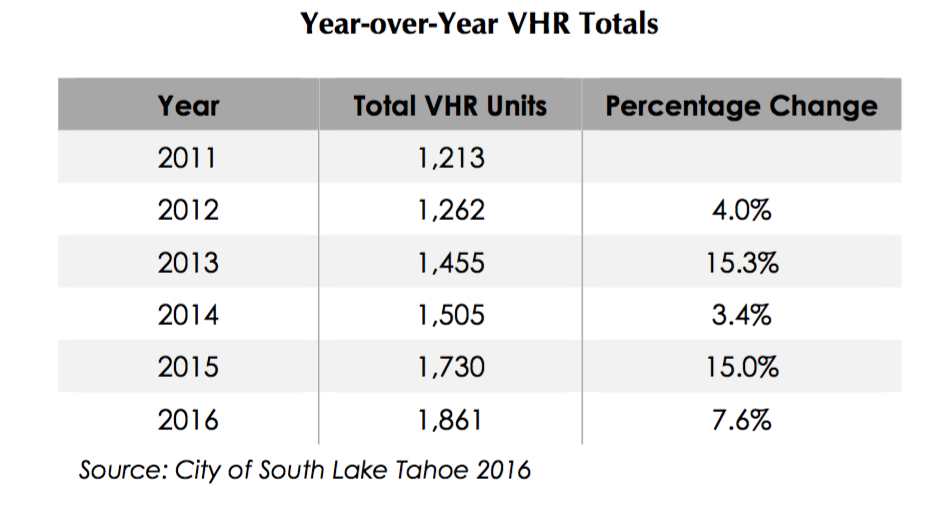
The report used data from the 2015-16 Lake Tahoe Visitor’s Authority Visitor Profile Study, that says 19 percent of tourists stay in VHRs. Of all the lodging units available throughout the South Shore, VHRs in the city limits account for 12.8 percent of the market.

The report says almost half of the housing stock in the city is owned by people who don’t live here full time. At one time that figure was more than 70 percent. The shared economy is increasing the numbers, especially as platforms like VRBO and Airbnb make it easier for the owner to rent their home without a middle manager.

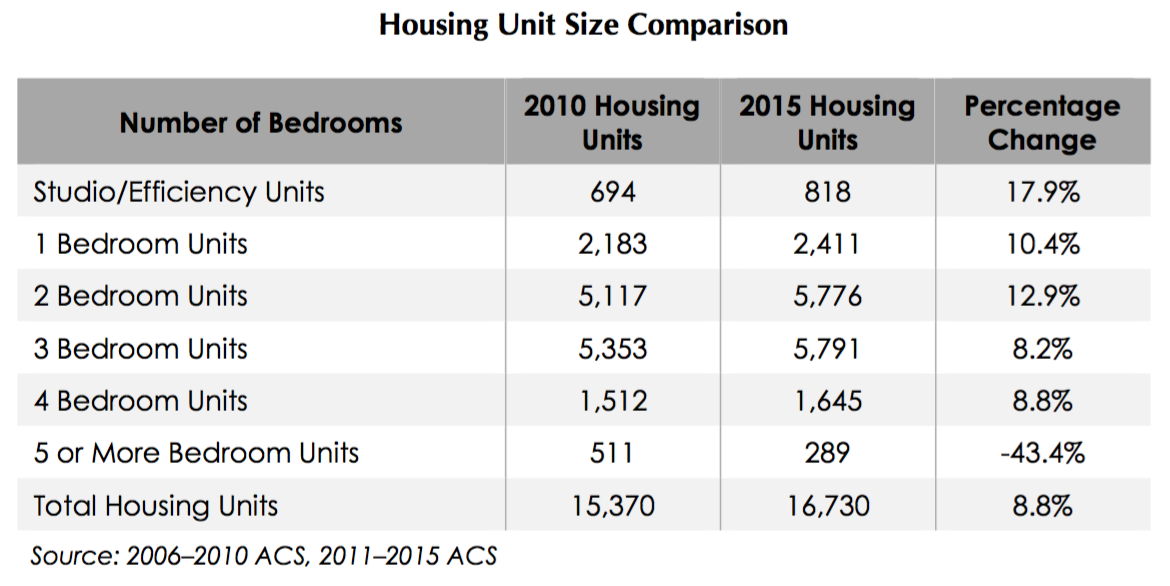
The city lost about 400 rental units for full-time residents between 2010 and 2015, the report states.

The report says, “About 44 percent of housing is owner occupied in the city, while the remaining 56 percent is renter occupied. … there has been a shift from occupied units to vacant units in the city. Between 2010 and 2015, about 6.2 percent of the city’s occupied housing was converted to vacant. Approximately 5.3 percent of these lost units were rental units and 7.3 percent were owner-occupied units. The conversion of housing units from occupied to vacant has predominantly occurred in the city’s single-family units.”

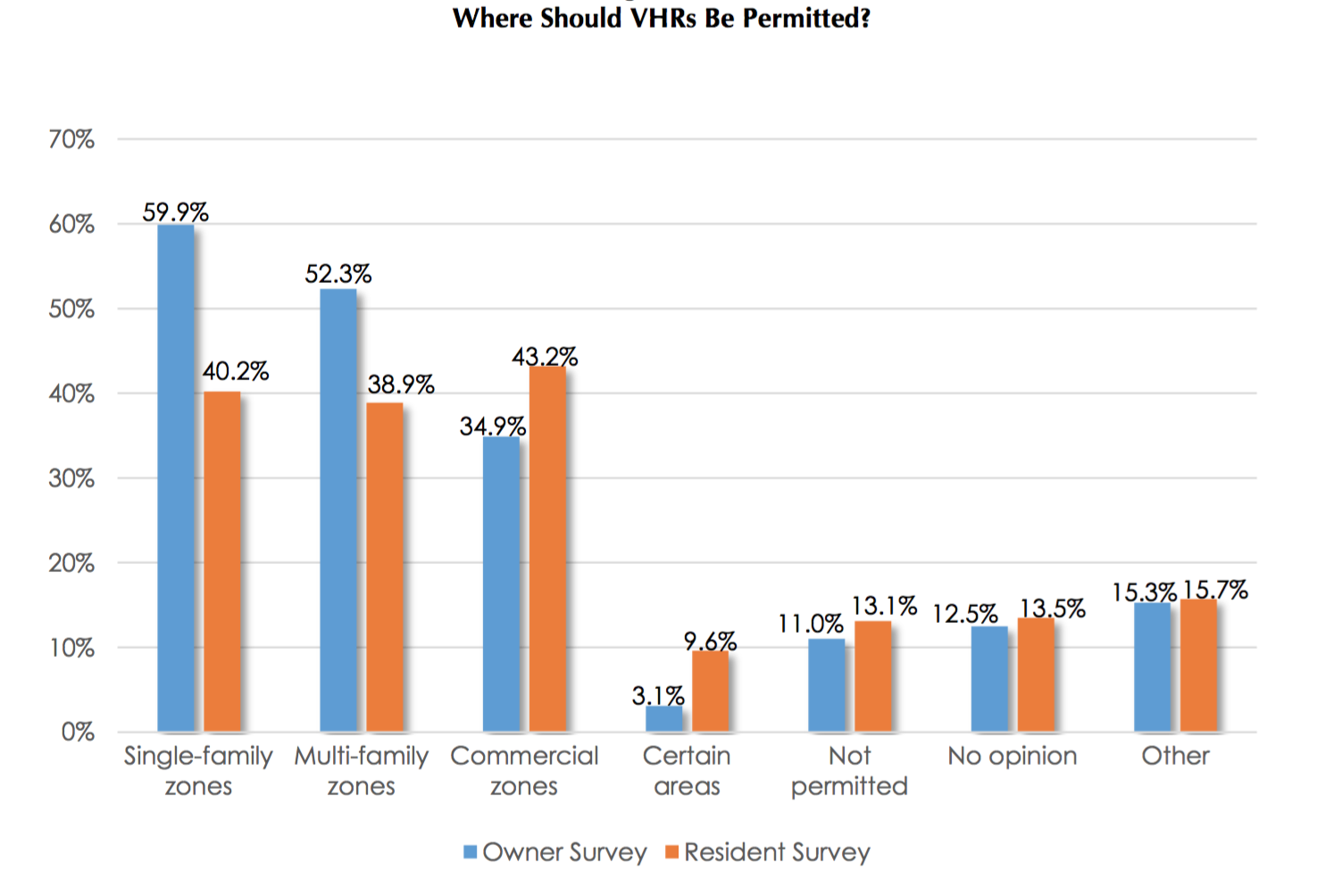
When residents were asked where VHRs should be permitted, 43 percent said commercial zones and 40 percent said single-family zones. The owners of VHRs predictably (60 percent) want them in residential areas, with 11 percent saying they should be allowed everywhere.

Here is a copy of the VHR study.



Opinion: The need to bridge the high desert

By Joe Mathews

What’s the fastest way to change California?

Unless you have the power to set off a major earthquake, your best bet would be to connect Palmdale and Victorville. 

Joe Mathews

These two working-class desert cities aren’t often associated with economic or political power. But building world-class infrastructure to bridge the 50 miles between them might be the most powerful current idea in California. Strong Palmdale-Victorville connections could transform Southern California’s traffic and economy, boost the West’s energy markets, and reconfigure the path of American trade with Asia and the rest of North America. It might even save the California high-speed rail project.

Why would such a connection be so valuable? To bridge Palmdale and Victorville is to connect the Antelope and Victor valleys, two fast-growing exurban regions that each include a piece of a major North American highway corridor. Palmdale’s home region, the Antelope Valley, in L.A. County, now has more than 500,000 people; its highways make it part of the Interstate 5 corridor, from Tijuana to British Columbia. Fifty miles east, the Victor Valley, where Victorville is the anchor town, has about 400,000 people, and sits right on Interstate 15, which moves Southern Californians to Las Vegas every weekend while transporting goods from San Diego to Alberta, Canada.

Current connections between interstates 5 and 15 are primitive. Truckers either have to navigate the awful traffic of the L.A. basin, or must find a way across the High Desert. The latter requires driving surface streets, or the traffic-clogged 138, known unofficially as Blood Alley, since it’s one of America’s most dangerous roads.

Good news: This infrastructure gap creates an enormous opportunity.

Which brings me to the High Desert Corridor, a decade-old proposal that is one of the most underrated ideas in California. Backed by a joint powers authority of Los Angeles and San Bernardino counties, the High Desert Corridor is a public-private partnership to build not one connection between Palmdale and Victorville, but four.

First would come a 56-mile freeway connecting the two cities. Second, the High Desert Corridor would establish a high-speed rail right of way, with the goal of connecting the California High-Speed Rail’s proposed station at Palmdale with the planned and private Xpress West high-speed rail project between Las Vegas and Victorville.

The third piece of the connection involves energy: Underneath the freeway and rail would run electric transmission lines, and above ground, there would be charging and alternative fuel stations for cars and trucks. Finally, the High Desert Corridor would have a 40-mile bikeway between Palmdale and U.S. 395.

If such a corridor were ever to become a reality, the impact would go beyond the convenience of connecting the 5 and the 15. The high-speed rail piece of the High Desert Corridor would connect San Francisco and Los Angeles to Las Vegas, inspiring more high-speed rail and economic integration in the West (Phoenix and Salt Lake City should be next).

Today, international trade is slowed in the L.A. basin by dense traffic in the seaports and on the streets.  Advocates of the corridor say it could become a new “inland international port,” if land for logistics is closely connected to rail and airports in the corridor, allowing cargo to be moved between transportation modes. Such a port would support

trade, spawn more businesses, and allow the logistics industry to expand beyond the basin to the Inland Empire, bringing more jobs to the desert for local residents, shortening their commutes.

At the same time, the project could take pressure off of Los Angeles’ roads, while providing infrastructure to encourage more green technology and transportation. Supporters are also betting that manufacturers will flock to the High Desert Corridor, since it is outside the basin and its strict air regulation.

Be skeptical if you wish. The history of the California desert is filled with grand plans that went nowhere. But the High Desert Corridor isn’t grand—it’s a tightly focused connection. The environmental reviews are complete; the next steps are figuring out the exact route, and the costs of acquiring the right of ways.

Current estimates of the project’s overall cost are $8 billion. That’s a lot—but high-speed rail is projected to cost at least nine times that. Supporters had hoped to fund much of the expense with federal earmarks, but Congress has eliminated them. So the project will require a mix of private and public money, and be built in phases (rail first). Los Angeles County’s transportation tax, Measure M, will provide some dough.

But the state should step up. California politics is dominated by the coasts, and especially the Bay Area, which is why big funds were lavished on the new Bay Bridge. It’s now time to look south and inland, and build the next great California bridge in the High Desert.

Joe Mathews writes the Connecting California column for Zócalo Public Square.


Swimmer rescued by paddleboarder on N. Shore

A swimmer is alive thanks to the help of a paddleboarder.

Placer County sheriff’s deputies on July 8 got a call saying a swimmer was in distress just off Dollar Point. By the time the police boat arrived the person had been pulled onto a paddleboard.

The swimmer, who was not wearing a life jacket, was taken to an area hospital.

“We can’t repeat enough the importance of wearing personal flotation devices with the very cold water in the lakes and rivers this year,” deputies said in a statement.

— Lake Tahoe News staff report


Scientists leaving labs to experiment with politics

By Melissa Healy, Los Angeles Times
 
They have built careers isolating cells, designing integrated circuits and mastering computer languages. Now they are knocking on doors, being interviewed on TV and asking perfect strangers to give them money.

Across the country, scientists — card-carrying members of an elite that prizes expertise — are exiting their ivory towers to enter the political fray. There’s the cancer researcher from Mississippi, the integrated circuit designer from New York, the physician from Utah and the stem cell biologist from Southern California, among dozens of others.

It’s a move that appears to defy the first principle of their profession: logic. Unlike a law degree, a Ph.D. does not provide a well-worn path to politics. And while 79 percent of Americans believe that science has made life easier, their esteem for the scientific enterprise has been on a steady decline, according to the Pew Research Center.

Read the whole story