Cold front could bring snow to Tahoe’s peaks

Sunday is not the day to plan to be outside, at least in Lake Tahoe, according to the National Weather Service in Reno.

That “s” word (snow) is even in the forecast at elevations above 9,500.

For the rest of the basin it could be rain and thunderstorms.

Temperatures are expected to be 10 to 15 degrees cooler than normal. The high on Sunday is expected to be 61 degrees, with it returning to 74 by Tuesday.

Strong winds are expected as the cold front moves in. This will bring 2 to 4 foot waves on the lake.

— Lake Tahoe News staff report


South Tahoe gives athletes a place of honor

Glen Plake, right, talks as fellow athletes, from left, Jamie Anderson, Hannah Teter, Maddie Bowman, Travis Cabral and Juan Torres listen. Photo/Kathryn Reed

By Kathryn Reed

In some ways the athletes inducted into South Lake Tahoe’s Champions Plaza look ordinary. But wait. Listen to their accomplishments or watch them in person or on TV or look at photographs and the truth is crystallized. These are no ordinary human beings.

These 11 athletes, five could not attend the June 15 ceremony, have redefined their respective sports. Some were pioneers – doing things no one else was at time, while others reached the pinnacle of their sport in a more traditional path.

All, though, put in countless hours of training. They gave up normal childhoods and teen years. Their families paid in many ways. They reached heights that most people don’t even fantasize about.

After the 2014 Olympics, when the area had three medalists, South Lake Tahoe officials decided it was time to honor the area athletes in a permanent, public way. This is how Champions Plaza at Lakeview Commons came into being. But it’s not just about Olympians – all athletes are eligible if they meet the rigorous criteria.

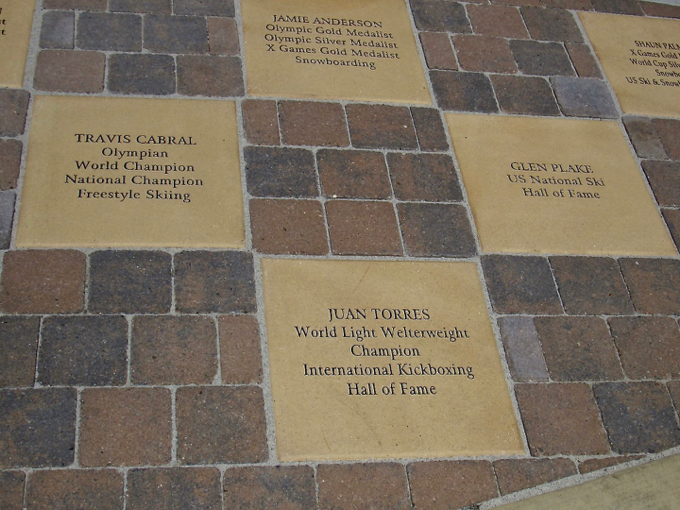
A bronze statue was commissioned two years ago. On Friday the unveiling of the names of the inaugural 11 inductees was commemorated. The name of each person and a brief list of accomplishments is etched into a square paver that is embedded into the walkway right in front of the statue.

Large squares highlight the athletes’ accomplishments. Photo/Denise Haerr

In attendance were:

·      Jamie Anderson – Olympic gold medalist, Olympic silver medalist, X Games gold medalist – snowboarding.

·      Glen Plake – Three-time World Hot Dog champion, in U.S. National Ski Hall of Fame, pioneer of extreme skiing.

·      Maddie Bowman – Olympic and X Games gold medalist – skiing.

·      Juan Torres – World light welterweight champion, International Kickboxing Hall of Fame.

·      Hannah Teter – Olympic gold and silver medalist, X Games gold medalist, World Championships bronze – snowboarding.

·      Travis Cabral – Olympian, World Cup champion, U.S. Nationals champion – skiing.

Not in attendance:

·      Jonna Mendes – Olympian in 1998 and 2002, World Championships bronze medalist – skiing.

·      Kyle Smaine – World Championships gold medalist – skiing.

·      Elena Hight – Olympian in 20016 and 2010, X Games gold medalist – snowboarding.

·      Travis Ramos – U.S. Nationals champion – skiing.

·      Shawn Palmer – X Game gold medalist.


Opinion: $120,000 for California preschool

By Joe Mathews

Since the 1990s, California’s leaders have promised to make preschool universal for every child.

Maybe they’ll do it by the time I have grandchildren.

Joe Mathews

It’s already too late for my own kids. The youngest of my three sons graduated from preschool last week. I celebrated by writing my final preschool check, for monthly tuition of $1,165. With that payment, my total spending on preschool tuition for all three boys surpassed $120,000.

All that tuition has wiped away most of my family’s savings. And yet, my kids are extremely lucky—because they got to go to preschool at all.

Today, only half of California’s 4-year-olds and 21 percent of our 3-year-olds are enrolled in either a public preschool or federally funded Head Start, according to the National Institute for Early Education Research. By comparison, 90 percent of 5-year-old Californians attend a public kindergarten.

Left on their own, California families, especially in the middle class, struggle to find anything affordable (many preschool tuitions are greater than the University of California’s) and full-day (to accommodate their working lives). Most existing pre-school programs are targeted at low-income kids, though an estimated 170,000 eligible children can’t go because there simply aren’t enough spots. Only 13 percent of low-income kids are in high-quality programs, advocates say. In a state with the high poverty and inequality, those numbers are unconscionable.

Preschool makes liars of California adults, demonstrating the canyon between progressive rhetoric (“children are the future”) and reactionary reality (“kids don’t vote so who cares?”). Investments in early childhood education are of enormous social value: Kids who get high-quality preschool are less likely to fall behind in school, be victims of crime, and drop out of high school.

But California hasn’t managed to match Oklahoma, which adopted universal preschool in 1998. California voters turned down a ballot initiative for universal preschool in 2006. Even part-way measures get blocked. In 2015, Gov. Jerry Brown vetoed a bill guaranteeing one year of part-day preschool to every low-income 4-year-old. This year, instead of making preschool universal, the new state budget throws $16 billion into rainy-day reserves.

Since experiencing big cuts in the recession, preschool programs have seen progress: an increase in the number of subsidized slots, the establishment of transitional kindergarten for 4-year-olds, some local taxes to support early childhood education. But all this falls short of a universal system in which preschool is guaranteed like another grade in school; instead, early childhood education is provided through a complicated patchwork of nine programs with different settings, standards, hours and fees. And transitional kindergarten is limited to students born between Sept. 2 and Dec. 2.

This lack of commitment to preschool undermines quality and staffing. It’s hard to get talented people to devote their careers to early childhood, and the training necessary for such careers, given the uncertainty. And California relies far more than most states on unlicensed providers.        

Despite these challenges, I do have hope. That hope is grounded in four Marin County children—the four kids, all under the age of 9, of Gavin Newsom.

Our likely next governor proposes to create a robust system of public early childhood services that starts in the womb (with greater prenatal care), emphasizes coaching for parents, and includes universal preschool that is integrated with K-12 schools and even universities.

This could be one more of a generation’s worth of unfulfilled promises, but there are reasons to take him seriously: As mayor of San Francisco, he implemented a “Preschool for All” program, funded by a voter-approved tax. And Newsom’s cannabis legalization ballot initiative directed marijuana money to early childhood.

Newsom will have to negotiate with change-wary preschool providers and education and health interests who see universal preschool as unwelcome competition for public funds. He should build a broader constituency for preschool by making sure that his expansion reaches middle-class families. Middle-class support is why Social Security and Medicare more popular than targeted programs for the poor.

And he shouldn’t wait. Those early years fly by. In the fall, my youngest will start kindergarten at our local public school. And while I no longer will be paying preschool tuition, I still will be writing checks.

California guarantees only half-day kindergarten, which means that he’ll be in the classroom for just three hours and 25 minutes a day, 8:10 to 11:35am. Since my wife and I work, we’re very relieved that we can keep him at school for the rest of the day, by enrolling him in a “kindercare” program for the 11:35am-3pm stretch, and then an after-school program to cover 3 to 6pm.

Those two extra programs will allow us to keep our jobs. They also will cost us $750 a month.

Joe Mathews writes the Connecting California column for Zócalo Public Square.


McDonald’s going to test plastic straw alternative

By Zlati Meyer, USA Today

Under pressure by environmentalists, McDonald’s said Friday that it will start testing alternatives to plastic straws at select locations in the U.S. later this year.

The burger giant also announced that it will adopt more eco-friendly paper straws across all its 1,361 restaurants in the United Kingdom and Ireland, a region where the company started testing the alternative to plastic straws earlier this year. The regional rollout begins in September.

Single-use straws are the scourge of the packaging-waste world because they don’t easily biodegrade and aren’t really necessary for most people when it comes to gulping a soft drink.

Read the whole story


Growing number of Nev. voters eschews 2-party system

By Yvonne Gonzalez, Las Vegas Sun

Tens of thousands more voters were registered as neither Democrat or Republican this midterm election compared with 2014, with most of that growth coming from Libertarians.

Voters outside the Democratic and Republican primaries had a limited ballot of nonpartisan candidates in their jurisdiction to choose from. A slew of ideological differences separate candidates and voters outside the two-party system, but in the November general election, those ballots could tip the scales for Republican or Democratic candidates.

Read the whole story


West Coast a haven for unsheltered homeless

By Margot Kushel, The Conversation

One-quarter of homeless people in the U.S. live in California, despite Californians making up only 12 percent of the population.

Not only is homelessness more common on the West Coast, but it is also more visible because a higher proportion of homeless people are unsheltered. In the U.S., 24 percent of homeless people sleep outside, in vehicles or somewhere else not meant for human habitation. But that varies greatly from place to place: In California, 68 percent of homeless people are unsheltered, compared to just 5 percent in New York.

Visitors to the West Coast may be shocked to find the tents that line cities from San Diego to Seattle. Like a modern-day “Grapes of Wrath,” the tents are a stark reminder of the suffering of the thousands living outside, homeless.

What’s to blame for such high numbers of unsheltered homeless on the West Coast? The reason isn’t drug use, mental health problems or weather. Rather, it is due to the extreme shortage of affordable housing.

Life unsheltered

As a physician and researcher who provides medical care for people experiencing homelessness, I have seen firsthand how devastating homelessness is to health.

Being unsheltered is terrifying, humiliating and isolating. People living without shelter lack access to toileting facilities, sinks and showers. They have no way to store or prepare food and no protection from the elements. Hunger is common.

Sleeping in makeshift beds or on the ground, they get little sleep. They must contend with having their possessions stolen. They face frequent forced moves, which disrupt relationships and make it difficult for family, friends or service providers to find them.

People who are unsheltered are at high risk of physical and sexual abuse. If they struggle with substance use disorders, their use of drugs and alcohol occurs in public, leaving them open to arrest. There are no places to refrigerate or store medicines, no place to receive mailed appointment reminders or a visit from a visiting nurse, no place to dress a wound or plug in medical equipment like oxygen. Without access to hygiene facilities, they are at high risk for communicable diseases like hepatitis A.

Unaffordable housing

Some assume that homelessness is so common on the West Coast because people move here when they become homeless, but data do not support this. Most people experience homelessness close to where they lost their housing. My team’s research in Oakland found that 81 percent of older adults who are homeless became homeless in the Bay Area. Only 10 percent had lost their housing outside of California.

Instead, the high rate of homelessness can be attributed to the lack of affordable housing in these regions. The West Coast suffers from rising costs of rental housing, stagnant incomes for low-wage workers and a decline in federal support for affordable housing. For example, California has gained 900,000 renter households since 2005, but lost $1.7 billion in state and federal funding for affordable housing.

Extremely low-income households – defined as those with income less than 30 percent of the area median income – are at the highest risk of homelessness. Nationally, there are only 35 units available for every 100 extremely low-income households.

In the West, these shortages are more severe: Nevada has 15 units available for every 100 extremely low-income households; California has 21.

In 2017, for the first time in 13 years, Los Angeles opened its wait list for housing choice vouchers. These vouchers allow households to pay 30 percent of their income in rent, with the rest paid by the government. There were 600,000 applicants for just 20,000 spots on the list, highlighting the enormous unmet need.

Who pays for homeless services

Why are people on the West Coast so much more likely to be unsheltered than homeless people in other parts of the country? It reflects differing government priorities .

New York City, where there is a legal right to shelter, spends approximately $17,000 per homeless person per year on homeless services. Massachusetts spends approximately $14,000 per year. Los Angeles, by contrast, spends approximately $5,000.

With enormous numbers of people living outside, West Coast cities are scrambling for solutions. Some cities, like Seattle, have created sanctioned homeless encampments, bringing hygiene facilities and other services. However, the U.S. Interagency Council on Homeless cautions that this approach is costly and doesn’t provide a solution to homelessness.

Other cities are following San Francisco’s example and creating navigation centers, homeless shelters with added services. Unlike typical shelters, these centers allow people to come in groups, bring pets and belongings and stay all day.

Many areas have passed tax increases to fund new housing and services. These efforts show modest success but continue to struggle against the unfavorable housing conditions that lead people to become homeless in the first place.

So where can we go from here? There are solutions to homelessness, but, in my view, these will not succeed without solving the affordable housing crisis that is the underlying cause of homelessness.

For people who are chronically homeless and have disabling conditions, permanent supportive housing is highly effective. This type of subsidized housing offers supportive services, without the requirement that people be sober or engaged in medical care. Studies show that expanding permanent supportive housing has reduced the number of people experiencing homelessness in many parts of the country.

The success of permanent supportive housing has been overshadowed by increases in people becoming newly homeless due to the lack of affordable housing. In my view, preventing and ending homelessness will require a commitment to creating housing that is affordable to all.

Margot Kushel is professor of medicine, UC San Francisco.


History tour of backcountry in Incline Village

Park rangers will be giving guided tours of the historic bull wheel located near Incline Village on June 30.

The bull wheel was part of the Great Incline Tramway of the Sierra, and was used for logging during the Comstock Era. The tour will begin at 9:30am and end by 3pm.

Vehicles are provided. Be prepared for a 2-mile moderate hike, and be sure to bring food and drink for the day.

Reservations are required as group size is limited to 12. Call 775.749.5980 or email spooner.ranger@gmail.com to sign up. The group will meet in Incline Village.


Snippets about Lake Tahoe

·      Music in the Castle is a fundraiser for Vikingsholm at the castle in Emerald Bay. The twilight reception in the courtyard includes wine from Fawnridge Winery and hors d’oeuvres following the concert. It will be July 14 from 5-7:30pm. Tickets are $100. For more info, email dtran@sierrastateparks.org.

·      For the fourth year, writing industry experts C.S. Lakin, Carla King, and Beth Barany will be teaching writing and self-publishing boot camps in the South Lake Tahoe area this fall. For more information, go online.

·      Tito Jackson has teamed up with the legendary BB King’s Blues Band to carry on the rich musical legacy of the Jackson 5, the Jacksons, and the late BB King. They will perform at MontBleu in Stateline on Aug. 18 at 8pm.

·      The 50th annual pancake breakfast supporting California State Parks and Meeks Bay Fire District is July 7 and July 8, 8am-noon both days. T-shirts and raffle items available too. Cost is $10 adults, $6 children, ages 5 and under and first responders eat free. It will be at the fire department on Highway 89 in Tahoma.

·      Douglas County Public Library is providing a free class on how to draw and create with 3D printing pens at the Minden Library on June 25 from 4-6pm and at the Zephyr Cove Library on June 28 from 3-4pm. Preregistration is required at the libraries or call 775.782.9841. The library will provide 3D pens, plastic filament, tutorials, and template.


Rethinking ‘leave no trace’ for outdoor social media

By Sierra Davis, Powder

The Leave No Trace Center for Outdoor Ethics, a national organization that protects the outdoors by teaching and inspiring people to enjoy it responsibly, recently released new guidelines for social media as it relates to documenting our time spent in the outdoors. We like their suggestions a lot. (We may consider revising our course syllabus for Instagram For Skiers, 101.)

The organization, which aims to offer “a framework for making good decisions about enjoying the outdoors responsibly, regardless of how one chooses to do so,” says it hopes to encourage social media posts from outdoor spaces to include a message of stewardship as part of enjoying the outdoors responsibly.

Read the whole story


Letter: Financial support helps TCH

To the community,

Tahoe Coalition for the Homeless is grateful to Mechanics Bank for a corporate donation of $2,500. Founded in 1905, Mechanics Bank provides personal banking, business banking, trust and estate services, brokerage and wealth management services throughout California. They invests in the same communities in which they live and work.

“As a community bank, Mechanics Bank is pleased to support Tahoe Coalition for the Homeless, as we feel that homelessness and access to housing is one of the most pressing issues today in our community,” states Randal W. Stoller, senior vice president and chief of residential mortgage lending.

The South Lake Tahoe Warm Room completed its third season on April 1. The warm room was open 98 nights, serving 109 individuals. Two families with children were provided temporary shelter in motels. Thirteen veterans stayed in the warm room, with two finding housing, one finding employment, and two reconnecting with out-of-state family with whom they chose to return this winter. Twenty-seven percent of guests were employed during their stay in the warm room. Nineteen guests found long-term housing with TCH’s support last winter, and only six individuals have used the warm room all three seasons. Since inception, the warm room has been open 337 nights, providing 7370 shelter bed-nights.

Tahoe Coalition for the Homeless continues to operate after the Warm Room closes. Right now, our staff continues to perform coordinated entry, street outreach and case management at community locations throughout South Lake Tahoe. Our board and volunteers are at work all year doing strategic planning, planning fundraisers, picking up litter, writing grants.

Donations can be made online or mailed to PO Box 13514, South Lake Tahoe, CA 96151. For questions about our operations, contact me at tahoewarmroom@gmail.com.

Marissa Muscat, TCH executive director