Nev. adopts emergency rules to combat weed bottleneck

By Chris Kudialis, Las Vegas Sun

Distributors previously operating in Nevada’s medical marijuana program may soon enter the recreational marijuana market after the Nevada Tax Commission on Thursday approved emergency regulations to reopen distribution licensing.

The Nevada Tax Commission voted to let the Department of Taxation again determine whether limiting licenses for those who transport weed from Nevada cultivation and production facilities to dispensaries only to licensed alcohol distributors — as called on by November’s Ballot Question 2, which legalized recreational use and possession of the plant — would result in a shortage of distributors for the new industry.

If so, it would be able to award licenses to previous medical marijuana distributors.

Read the whole story


Al Tahoe bike project to start next week

The Al Tahoe Safety and Mobility Enhancement Project, also known as the Safe Routes to School project, will begin with striping bike lanes on Al Tahoe Boulevard the week of July 17. 

The pilot project will be the first step toward the full project planned for 2019. As part of the project class 2 on street bike lanes and a class 1 off street multi-use path will be added in conjunction with vehicle lane restriping.

To test of the concept plan, the pilot project introduces the bike lanes now by reconfiguring two of the four vehicle travel lanes and keeping the two-way center turn lane. In the interim, the extra width will be striped as a “buffered bike lane” which is roughly 6 feet of bike lane and a 5-foot-wide striped buffer between the traffic. 

While the City of South Lake Tahoe is the lead on the project and is contributing roughly 13 percent in funding for the project, this project would not have come to fruition without the On Our Way grant funding from the Tahoe Regional Planning Agency. The majority of the planning, permitting, design and construction costs are covered by grant funding from the state through the Active Transportation Program.


Arrest made in death of former Truckee coach

By Jim Krajewski, Reno Gazette-Journal

David Slaughter was arrested earlier this week in the death of former Truckee football coach Bob Shaffer.

Slaughter, 54, from Sacramento, was charged with vehicular manslaughter.

Shaffer was killed April 1 when he was driving northbound on Interstate 89 just south of Cold Creek Campground in Sierra County. Slaughter was driving his 1989 Ford F250 southbound on the state route.

Read the whole story


Seat belts coming to Nevada school buses

By John Potter, KNTV

The worry many parents feel when putting their children on school buses won’t be experienced in the future. After much debate, Gov. Brian Sandoval signed legislation that requires new school buses bought after June 2019 to be equipped with seat belts.

But for school buses on the road right now, Nevada is still a “let ’em fly” state, where kids and all are loose cargo going every which way in the event of a crash, like test rollover video shows. All you have to do is see those to understand the importance of seat belts in school buses.

The Nevada Legislature did, requiring lap-shoulder belts for new school buses in two years.

That may be a long time to wait, but putting your children on a school bus is much safer than driving them to school.

Read the whole story


SNC reducing staff to manage its budget

Sierra Nevada College is cutting positions in order to be fiscally solvent.

The 2017-18 budget includes the elimination of 4.75 full time equivalent positions (this affects six people); reduction in hours equivalent to affect the equivalent of 1.5 FTE positions (six individuals) being reduced from full to three-quarter time (still benefit eligible), and 4.5 FTE positions (seven individuals) currently vacant that will remain unfilled.

According to a press release, “The goal is to build the long-term sustainability of the college by optimizing enrollment at the main campus in Incline Village and through growth strategies that include adding new partnerships, focusing on high-demand fields of study, and expanding online programs. The college’s highest priority is always to preserve the student-centered, high-value, unique educational experience for which SNC Tahoe has become well-known.”

Lake Tahoe News reported last month how full time faculty was put on notice.

The satellite campus at Lake Tahoe Community College will not be adversely impacted.

— Lake Tahoe News staff report


Be cognizant of heat-related illnesses

By Tamara Burns

It’s that time of year where heat-related illnesses are on the rise for locals and visitors alike. Heat illnesses include dehydration, heat exhaustion, and heat stroke.

Tamara Burns

It is important to understand the differences, especially when exercising in an area like Lake Tahoe with higher altitudes and higher temperatures. 

Dehydration occurs when the body does not have enough fluid to carry out normal functions. Young children, older adults, and people with chronic illnesses are most at risk. Common causes include intense diarrhea, vomiting, or excessive sweating.  Not drinking enough water during hot weather or exercise also may cause dehydration. 

Mild to moderate dehydration symptoms include:

·       Dry, sticky mouth

·       Fatigue

·       Feeling thirsty

·       Headache

·       Not urinating

·       Dry skin

·       Constipation

·       Dizzy/lightheaded.

You may reverse dehydration by drinking more fluids, but severe dehydration requires medical treatment. 

Heat exhaustion can occur after a prolonged dehydration period. Triggers that cause the body to overheat include extended time in higher temperatures, and strenuous activity. Symptoms may appear suddenly, or develop over time, particularly after extended periods of exercise. 

Possible symptoms of heat exhaustion include:

·       Confusion

·       Headache

·       Muscle cramps

·       Nausea

·       Pale skin

·       Fatigue

·       Rapid heartbeat.

Treatment for dehydration and heat exhaustion is straight forward. If you, or anyone else, has mild or moderate symptoms of a heat-related illness, I recommend:

·       Drink plenty of fluids (avoid caffeine and alcohol)

·       Take a cool shower/bath/sponge bath

·       Remove any tight or unnecessary clothing,

If this does not provide relief within an hour, contact a doctor because heat exhaustion can progress to heat stroke.

Heat stroke is the most serious heat injury. If the body’s core reaches 104 degrees, this is a medical emergency. If you suspect someone has heat stroke, also called sunstroke, call 911 immediately. Help cool the patient until paramedics arrive. The National Athletic Trainer’s Association (NATA) released new guidelines in June suggesting that heat stroke victims need immediate cooling before going to a hospital.  

Symptoms of heat stroke:

·       Fainting (may be first sign)

·       Nausea

·       Altered mental state: person agitated, aggressive, or confused

·       Dizziness/lightheadedness

·       Red, hot, and dry skin

·       Rapid heartbeat

·       Muscle weakness, cramps

·       Throbbing headache

·       Seizures.

The safest approach is prevention and education. In hot weather, drink fluids regularly to help prevent dehydration and heat-related illness. Avoid waiting until you feel thirsty, you may be dehydrated.  Monitor fluid loss during hot weather, illness, or exercise, and consume liquids to replace water loss. Sports beverages can replace salts and minerals after you sweat. Wear sun protection, including a brimmed hat, sunglasses, and sunscreen. Take breaks in the shade and wear lightweight, loose-fitting clothing.

Tamara Burns is a nurse at Barton Family Medicine.


Coast Guard Auxiliary adds layer of safety at Tahoe

By Susan Wood

When it comes to those who venture out into a vast and cold Lake Tahoe, it’s good to know the ones who provide backup for emergencies have backup of their own.

The U.S. Coast Guard Auxiliary achieved its 50th year in service to the Lake Tahoe region on April 20, serving as support for the station located in Tahoe City.

The service is much-needed, especially in years like this one in which the banner snowfall is resulting in a deluge of runoff that has raised the lake level so much the beaches have all but disappeared.

High water mixed with high temperatures in the two valleys east and west of Lake Tahoe usually equate to increased boating, swimming and even debris floating around. The latter can place even the most cautious boater in hazardous conditions.

In the last decade, the lake has averaged two to three drownings a year. But in the wake of stand up paddleboarding’s immense popularity over the last few years, that number has at least tripled.

“The problem is, when something goes wrong, it goes terribly wrong,” said Bruce Martin, who has volunteered in the Coast Guard Auxiliary in this district for five years.
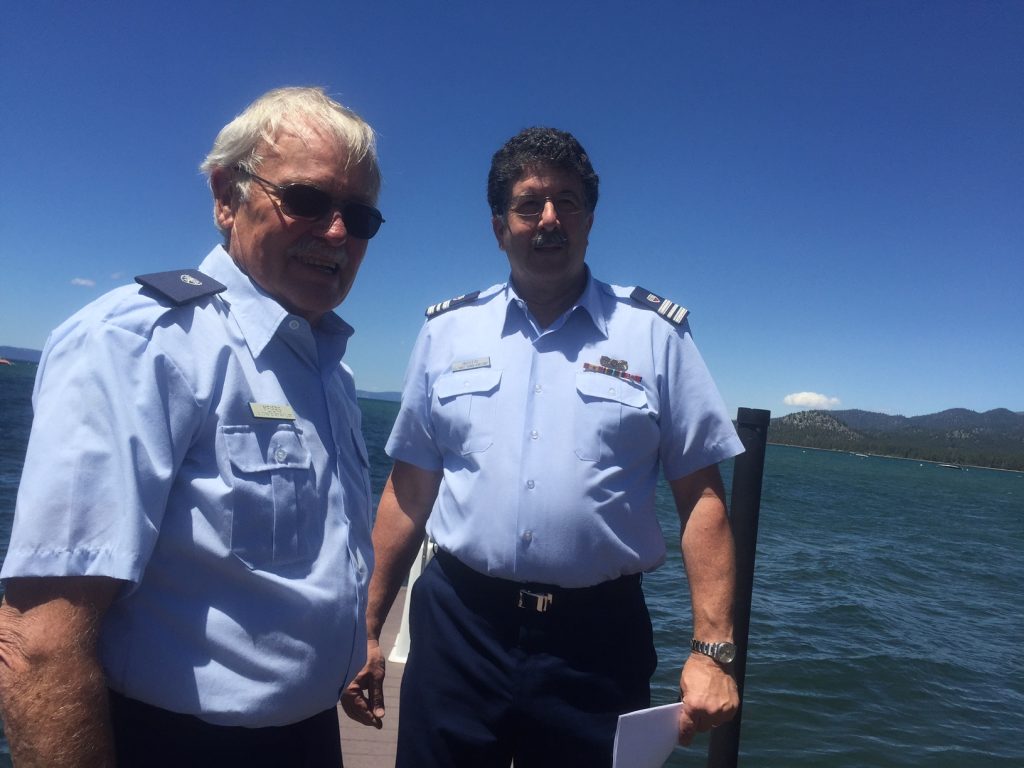
Mort Meiers and Bruce Martin stand guard at Ski Run Marina during windy conditions. Photo/Susan Wood

The district has 21 South Lake Tahoe volunteers working the sidelines. Nationally, there are more than 30,000 men and women who have volunteered over the last 75 years. The Auxiliary is under the wing of the U.S. Department of Homeland Security. The volunteer organization has played a role in every major conflict since World War II. Most notably in recent times the Auxiliary helped with Hurricane Katrina relief efforts.

The Coast Guard itself is 226 years old, under the same U.S. cabinet – but can be transferred to the U.S. Navy by the president or Congress during times of war.

“Our main focus is recreational boating safety,” Martin told Lake Tahoe News.

The retired South Shore fire chief, whose father served in the U.S. Navy, knows the hazards that can occur in an emergency.

Hypothermia can set in less than 15 minutes in the most extreme of cases as in lake temperatures at 32.5 degrees. When it rises to double that, a victim may not even survive two hours.  The cold water renders the muscles useless when hypothermia takes over, causing the swimmer to stop paddling. Some drowning cases happen when the swimmer dives in and gulps water during the shock of the temperature. Without a life jacket, the body may never surface. People have drowned close to shore.

That’s why in the Coast Guard Auxiliary’s role to be proactive in water and boating safety education it’s all about water adventure seekers wearing their life jackets.

Many paddleboarders have not been wearing them.

In its duties as the civilian volunteer arm for the Coast Guard, the Auxiliary will put on events aimed at teaching safety, as well as conduct vessel examinations, patrols, drills and even monitoring the buoys to ensure they don’t get blown off.

One drill involved the Coast Guard chief being dropped off in the middle of the lake in a dry suit, with auxiliary patrollers plotting where to find him. The chief was out there for an hour.

“I was impressed,” Martin said of the commitment.

Auxiliary volunteers must be certified, and it takes all summer to complete crew training, but the South Shore district welcomes more. One may be asked as a “first aider” to rescue dummies and navigate lake waters.

Volunteers are responsible for a number of duties – even if they just want to cook for others at events.

“We need all hands on deck,” Martin said of the demands of boating safety on Lake Tahoe.

Auxiliary members may see the gamut of disasters or near misses.

“In the times I’ve been out on patrol, I’ve seen people going too close to shore and hitting a rock. We inform Vessel Assist,” said Mort Meiers, a longtime South Shore resident, boating enthusiast and 27-year Auxiliary member.

Meiers recalled how a man operating a Jet Ski near the Tahoe Keys found it hard to reach his watercraft with no leash while it continually made circles.

As it turns out, fires on board prove to be life threatening.

Then there’s the drinking that’s often associated with boating, a misfortune Coast Guard auxiliary members can only attribute to the planet’s “pirate history.”

The hazards are such that in 2018 California law will require a boating license. The Golden State is one of the last to mandate the license. Alaska is another.

To the Coasties, the Auxiliary team is “indispensable.”

Tahoe City Executive Petty Officer Josh Fennell called the team “a force multiplier for us,” meaning an “extra set of hands and an extra set of eyes.”

“We only have two boats and can only be in so many places. It’s nice to have reinforcements in South Lake Tahoe,” Fennell told Lake Tahoe News, adding that having Auxiliary members conduct the vessel inspections helps substantially.

Other law enforcement agencies such as El Dorado County, Douglas County, South Lake Tahoe and the Tahoe Regional Planning Agency also have boats patrolling the South Shore waters alongside the Coast Guard.

“The Coast Guard Auxiliary is one of the Coast Guard’s greatest hidden gems. Without their countless volunteer efforts, Coast Guard Station Lake Tahoe wouldn’t be able to operate safely and efficiently,” said local Cmdr. Dustin Finkelson, who just reported to duty last month from the station in Galveston, Texas.

It’s a welcome sign to longtime residents who have gone boating on Lake Tahoe – especially those who are familiar with the lake’s treacherous history.

“I’ve been here almost 60 years, and I had a boat for many years. Of course, if we’re going to provide amusement for people on the lake, at least we should be responsible to advise of what’s available to help them,” said Betty Mitchell, longtime Lake Tahoe Historical Society volunteer. She and her late husband owned a sailboat together. Sailing on the lake can be tricky enough with its bowl-like geography and wind spurts.

So to Mitchell, a life jacket should just be considered an appendage to a swimmer or boating enthusiast.

“I respect the water. Anyone who doesn’t use a life jacket when the conditions call for it is a little bit crazy,” she said.



Opinion: Trust in government not a great idea

By Joel Fox, Fox & Hounds

Reassurances to taxpayers about proper management of new revenue on the state and local level is too often ignored by politicians once the money is secured. Recent examples of attempts to spend money differently than promised are common—but it’s an old story, as well.

The legislature passed the gas tax and vehicle license fee increase amid promises that the money would go to the much-needed repair of transportation infrastructure. Before the governor had a chance to sign the bill, Democratic politicians were proposing ways to spend the money that were far afield from the transportation goals such as repairing restrooms in state parks.

Part of the promises made on the use of the new gas tax money is that voters will have a chance to pass a constitutional amendment in an election next year to assure that the money will be spent for transportation purposes.

Read the whole story


Cup holder keeps sand out at the beach

By Judi Dash, Los Angeles Times
 
Would you like sand with that drink, beach boy or girl?

Probably not. You can keep the grains out of your cup with the Spiker Sand Drink Holder.

The bottom half of this 8-inch-tall by 4-inch-diameter heavy-duty plastic cup holder has four integrated slats that anchor it into the sand with a twist of your wrist, steadying and elevating the cup.

The Spiker is just the right size for a can of beer or soda, pint or quart bottle or tapered plastic cup.

Read the whole story


California water bill passes House

By Sarah D. Wire, Los Angeles Times
 
Some of California’s decisions about how to use its water would be relegated to the federal government under a bill passed by the House on Wednesday.

Republicans say the bill will bring more water to the parched Central Valley. California’s Democratic senators have promised to fight the bill in the Senate because it weakens California’s ability to manage its own resources.

The Gaining Responsibility on Water Act, sponsored by Rep. David Valadao, R-Hanford, was approved in the House by a 230-190 vote largely along party lines.

Read the whole story