Turning off the chatter for better night’s sleep

By Barbara Pidermann

Mental noise can affect the ability to concentrate and often contributes to anxiety. This continuous inner conversation in your head can be particularly bothersome at bedtime or when waking in the middle of the night.

Here are a couple tricks to calm or turn off mental noise when trying to sleep.

1. Plan ahead. Before going to bed, grab a pad of paper and write down anything that is bothering you right then or that you think may be of concern if you wake in the middle of the night. Even the smallest things seem out of proportion at 3am as you toss and turn. 

If you do wake up at 3am or have difficulty falling asleep, remind yourself that the list is there, it isn’t going anywhere, and you will tackle it in the morning. Say to yourself: “That problem is on the list and I will take care of it in the morning.”

2. Tame your monkey mind. Buddha described the human mind as being filled with off-the-wall monkeys jumping around from tree to tree and chattering endlessly. He named it the monkey mind.

To quiet mental noise, try to tame your monkey mind. Befriend your monkey and ask it to complete a task.  For example, say to your monkey mind: “Hello monkey, please watch my breathing. Breathe in, breathe out, breathe in, breathe out.” Or put your monkey in charge of progressive relaxation. If your monkey mind is busy with a job assignment, it won’t keep chattering.  

Practice both techniques. You can do them anytime you need to turn off the mental noise and focus.  Sweet dreams. 

Barbara Pidermann, DNP, FNP is a primary care provider at Barton Family Medicine in South Lake Tahoe.


Review: ‘The Life We Bury’ an attention keeper

By Kathryn Reed

Seeking justice isn’t what Joe Talbert was after. He just wanted an interesting subject for one of his college classes. He got that and then some when he chose convicted child murder Carl Iverson.

As a former defense attorney Allen Eskens has an authenticity with the criminal details that many writers struggle with.

“The Life We Bury” (Seventh Street Books, 2014) isn’t your ordinary crime novel. There is depth to it on multiple levels. The title is apropos in that most people are more than what appears on the surface; we all have a past, just some are more interesting than others.

Relationships are one of the key aspects of this book. Some are developed better than others, but all have relevance.

The book starts out full of clichés and is a bit overwritten, but then Eskens settles in to a good rhythm. The ending is a bit rushed; where it seems like the author just wants to be done.

But the meat of the book is well written and intriguing. There is enough substance to keep wanting to turn the pages.

“The Life We Bury” was July’s book club book. Unfortunately, I was not able to make it to the meeting to know what my friends thought of it.

While this genre won’t be for everyone, it is a good, fast read.


Pray Meadows dazzles with its verdant beauty

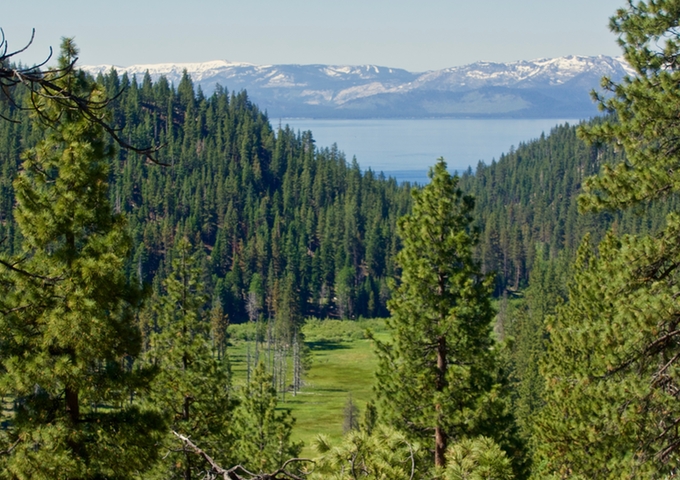
Pray Meadows can be seen looking west from Highway 28. Photo/Kathryn Reed

By Kathryn Reed

It’s always an interesting hike when you have to flag down a truck to ask where you are.

And so it was late last month with Rosemary. We knew where we wanted to go. And we got there. We just didn’t know where we were when we went a little farther.

We were in Glenbrook, on Lands End Road.

We got there by going through Pray Meadows, which was our original plan.

I just figured we could get to Lake Tahoe through the meadow. I didn’t realize there would be a subdivision in between the two – and a private one at that. We opted not to even try to deal with getting to the lake; partly because we didn’t know if we’d be breaking some law, and partly because we had gone far enough for one day.

It was about 9.4-miles round trip from the starting point at Highway 28.

Fortunately, there was a creek running through the meadow so the dogs could cool off their bodies and lap up the water. Still, it was good we brought water for them because it was a warm day and we ended up going more miles than expected.
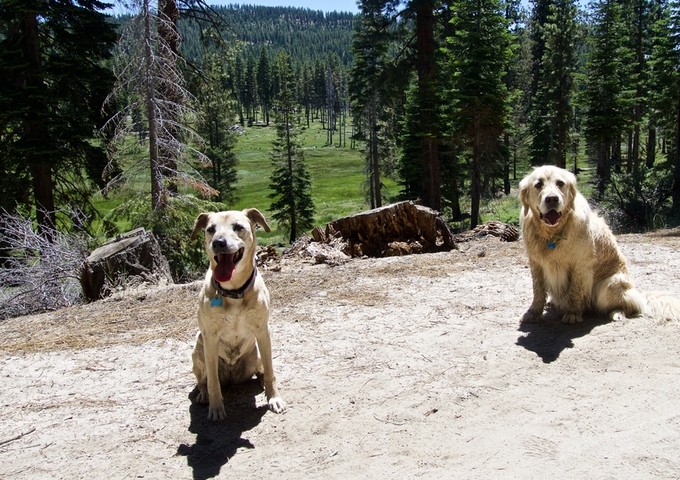
AJ and Cody are content to stick with the trail and not run in the meadow. Photo/Kathryn Reed

At least on June 29 there were no signs of wildflowers, but as the meadow dries out a bit that will change, and may already be doing so.

The lush green meadow is so incredibly vibrant. It looks like it would be wonderful to run through, maybe even bring a blanket for a picnic.

We stayed on the trail, though, which got a little buggy. I can only imagine how bad it would have been in the thick grass.

Tall conifers surround the meadow on all sides. Aspens are in abundance as well, which makes me think this would make for a beautiful fall excursion.

This area of Nevada was once a bustling timber haven that provided wood for the mines in Virginia City during the silver rush in the late 1800s. There are remnants of the old railroad grade. It was nice having it so wide so it was easy to have a conversation. The one mountain biker we saw made us think we might want to revisit the area on two wheels.

According to “The Saga of Lake Tahoe” by E.B. Scott, Capt. Augustus W. Pray was one of the first settlers in Glenbrook in 1860. The two volumes of this book reference Upper and Lower Pray Meadow.

Interestingly, most modern day references for the meadow spell Prey with and E. However, in Glenbrook there is a Pray Meadow Road.

At one time Pray owned hundreds of acres in Glenbrook and was instrumental in the lumber business.

“Pray and his associates — N. E. Murdock, G.W. Warren and Rufus Walton — felled, barked and faced sugar pine to build a crude log cabin, splitting cedar for the shake roof. They harvested the wild hay that grew abundantly on the rich bottom land of the meadow and planted grain and vegetables,” the book says. “In the rarefied mountain air a yield of 60 bushels of wheat and 4 tons of timothy hay per acre was not unusual, while oats grew 7 and 8 feet tall.”
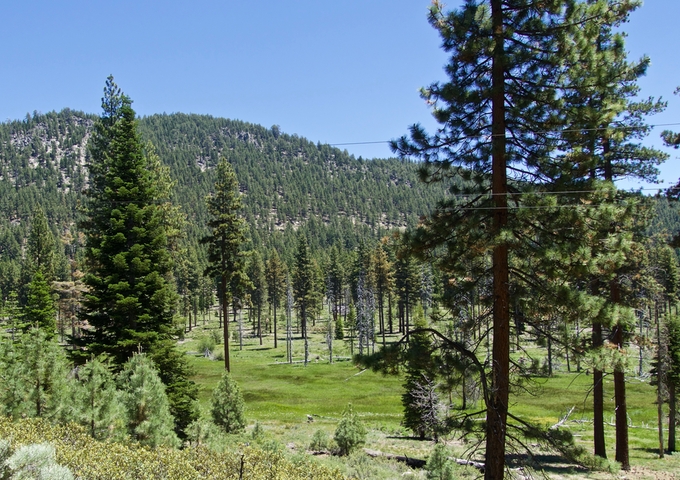
Going to Pray Meadow is the long way to get to Glenbrook. Photo/Kathryn Reed

—–

Getting there:

From South Lake Tahoe take Highway 50 east. Turn left on Highway 28 toward Incline Village. Go about 2.3 miles, park on the left. There is a gate leading down. A trail will intersect with this one, take it to the left. If you go straight, you will hit Skunk Harbor.



Opinion: Benefits of an LTCC education

By Bob Cliff

Everyone knows what Barton Memorial Hospital does. We have all used it for one reason or another. Yet many people in our community may not fully appreciate what Lake Tahoe Community College brings to our community.

On June 30, LTCC held its graduation ceremony with over 150 students getting a degree or certificate. Many will go on to a four-year university to get a bachelor’s degree.

Bob Cliff

We now know where last year’s 163 students who graduated from LTCC went. Of these, 80 went on to a university for a bachelor’s degree, and 28 went on to a two-year school (for example, a two-year nursing program). The rest (25) earned an associate’s degree or certificate and went on to get a job. Each of these students now has many new options ahead of them.

Let’s look at the impact of an LTCC education.

With a high school degree, the average income in our country is $35,300 per year. With two years of college leading to an associate’s degree from LTCC, or a certificate, the average income in the U.S. is $41,500 per year. With this degree, our students can enter a variety of fields. For example, LTCC has programs in fire science, dental assisting, phlebotomist (someone who draws blood), computer and information sciences, business, and the list goes on. The good news is that the students pick the field they want to go into. They are working in an area they love.

But there is more good news. As you can see, many students who graduate from LTCC go on to a university for a bachelor’s degree. These universities include University of California schools (like UC Davis or UC Berkeley) or one of the California State universities (Sacramento State University or Chico State University). These college students, when they graduate, will earn an average of $59,100 per year, but in California the wages will often be higher than that. A student graduating in mechanical engineering who lives in California (a higher income state), can often start at around $100,000 per year depending on the school they attend. Furthermore, workers with a bachelor’s degree will usually get retirement contributions paid by their employer along with medical insurance. Not a bad deal.

The average fees at LTCC are about $1,350 per year, but low-income students can often get this waived. At a UC the fees are about $14,000 per year, or total fees of $56,000 for four years. But with the first two years at LTCC and the last two years at a UC university, the total tuition would be $30,000. Having the first two years of college at LTCC reduces the tuition costs by almost half. In addition, the cost of living in Tahoe is much cheaper than living, for example, in Berkeley or Davis. Many of our students from LTCC will also get scholarships and grants at a UC university, which will further lower their costs. And now with LTCC’s new University Center, which was dedicated this past month, we will start to offer four-year degrees in selected fields.

LTCC offers excellent college courses taught by experts at a much lower cost. Many graduates of LTCC probably feel that LTCC has been a miracle maker for them. Our alumni have become business persons, doctors, engineers, firemen and women, nurses, and other professionals.

An LTCC degree can provide a student with an amazing start for their future career at a fraction of the cost of a four-year university. This fall, the college is hosting a community forum to introduce some of the students who are now finishing their educations at a university, as well as students with two-year degrees from LTCC who are now working in successful careers. Come hear their success stories and ask questions. Save the date of this forum: Sept. 14 at 6pm on LTCC’s campus. See the miracle LTCC helps to create.

Bob Cliff is an LTCC Foundation board member.


Not all sunscreens are created equally

By Alene Dawson, Los Angeles Times
 
The sizzling summer sun doesn’t have to keep you from enjoying California’s great outdoors, but be smart about it.

Even though there’s growing awareness about the damage sun rays can cause, the rates of melanoma have been rising for the last 30 years, said David Andrews, a senior scientist for the Environmental Working Group, a nonprofit agency that specializes in research and advocacy.

One factor is that sunscreen’s efficacy isn’t just about using it — but how you use it.

Read the whole story


California the world’s fifth largest economy?

By Dale Kasler, Sacramento Bee

Frustrated about unaffordable housing or clogged freeways? Think of it as the price you pay for living in one of the world’s largest economies.

California’s economy ranked sixth in the world in 2016, according to rankings released by Palo Alto economist Stephen Levy last week. That’s the same as the year before, when California overtook France and Brazil.

But the state’s economy isn’t stagnating; California’s economy is growing so quickly that Levy thinks the state will overtake the United Kingdom this year for No. 5.

Read the whole story


Why are coyotes so polarizing?

By Lawrence Lenhart, High Country News

First things first: Coyote. When you read the word, how many syllables do you hear? Your answer, according to Dan Flores, author of Coyote America, may be “immediately diagnostic of a whole range of belief systems and values.” The ki-YOH-tee versus ki-yote divide is one of the best indicators of a person’s coyote politics, a nearly hard-and-fast way that we subconsciously identify ourselves: as defenders of the species, in the case of the former, or as a manager, shooter and/or trapper, in the latter.

In “Coyote America,” Flores occasionally assumes the mantle of coyote’s head of public relations, demonstrating how the species, once “dead last in public appeal — behind rattlesnakes, skunks, vultures, rats, and cockroaches,” overcame its stigma as “varmint” to become a darling among the very people who most infrequently encounter it — modern-day urbanites.

More often, though, Flores is content to serve as a guide to the species, relaying the coyote’s complicated natural, cultural, political and mythological histories. It is why Flores describes his book as, “in most respects, a coyote biography.”

Read the whole story


Snippets about Lake Tahoe

·      Frontier Airlines is returning to Reno-Tahoe International Airport in November.

·      On July 25 from 6am-3:30pm the parking lot for the El Dorado Trail trailhead at Missouri Flat Road will be closed due to construction.

·       Barwick & Siegfried, an acoustic roots duo, will play at the Grand Lawn at Valhalla on July 23 from 1-3pm for free. Donations accepted.

·       For the TOCCATA Tahoe Symphony 12th Summer MusicFest BOPS August schedule, go online.

·       There will be an antique and vintage sale at Alder Creek Middle School in Truckee July 21-23. Proceeds benefit the Truckee High School Boosters Club.


Lake Valley expands wood chipping program to SLT

Lake Valley Fire Protection District is offering free chipping through October. 

Converting slash and cut limbs into wood chips reduces flammable vegetation and helps homeowners create defensible space to protect their property from the threat of wildfire.

The program includes residents of El Dorado County, South Lake Tahoe, Fallen Leaf, and Alpine County. 

Go online to get more details.


Truckee part of inaugural state cultural district

Truckee Cultural District has been selected as one of California’s premier state-designated cultural districts.

Truckee joins 13 other districts that will launch the innovative new program highlighting thriving cultural diversity and unique artistic identities within California.

A cultural district, as outlined by the program, is a well-defined geographic area with a high concentration of cultural resources and activities. The 14 districts that comprise the program’s first cohort were selected with variety in mind, intended to help tailor the program to meet the complex needs of a state kaleidoscopic in nature. 

The Truckee Cultural District is organized by a partnership between the town of Truckee, Truckee Public Arts Commission, Truckee Chamber of Commerce, with support from Truckee Arts Alliance and the Nevada County Arts Council. 

Over the years Truckee has attracted and grown a vibrant, entrepreneurial, artistic community which has birthed over a dozen art galleries and exhibit spaces, created continuous year-round artistic and cultural events, inspired numerous public art pieces across town, and most recently created the 3,000 square foot makerspace that offers the community a place to learn, build and practice a wide variety of art and creative skills. As part of the application process, the partners created an online inventory which highlights over one hundred existing cultural assets, including venues, organizations, activities, events, and historic sites. T

Truckee Cultural District will receive the designation for  five years per state legislation. Designation, under this pilot launch of the program, includes benefits such as technical assistance, peer-to-peer exchanges, and branding materials and promotional strategy. The California Arts Council has partnered with Visit California and Caltrans for strategic statewide marketing and resource support.