Conquering ‘brown pow’ in Tahoe’s backcountry

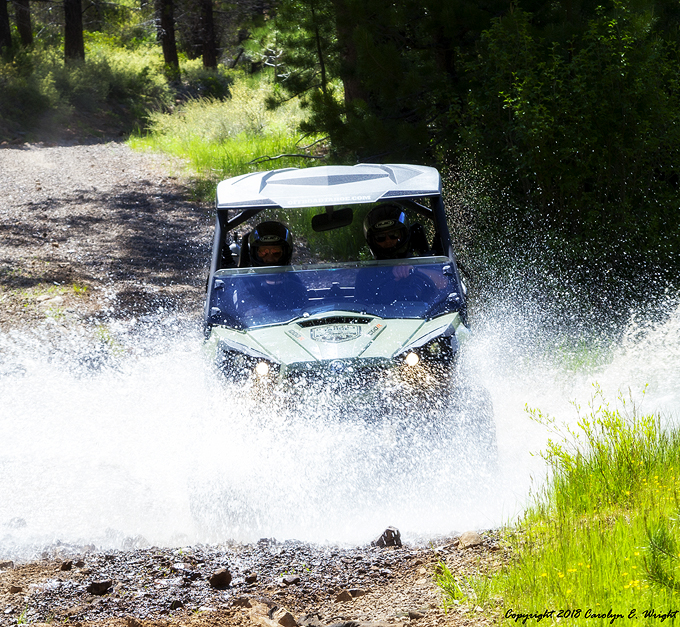
Getting wet and dirty are all part of the fun. Photo Copyright 2018 Carolyn E. Wright

By Kathryn Reed

TRUCKEE – Four-wheeling is often a mix of going faster for the adrenaline rush and slowing down to take in the scenery. This excursion was no different.

One of the best parts is that guide Sean Field knows this terrain better than most because he grew up in Tahoe City exploring the mountains in every season, in practically every possible manner. Now the three-time X Games skier is slaying “brown pow” as he shares this part of the world with anyone who wants to spend about three hours in the backcountry in a UTV – utility terrain vehicle.

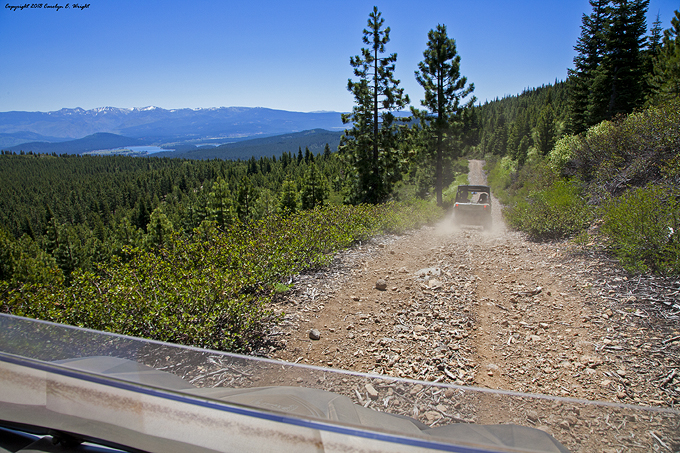
Prosser and Stampede reservoirs from the trail. Photo Copyright 2018 Carolyn E. Wright

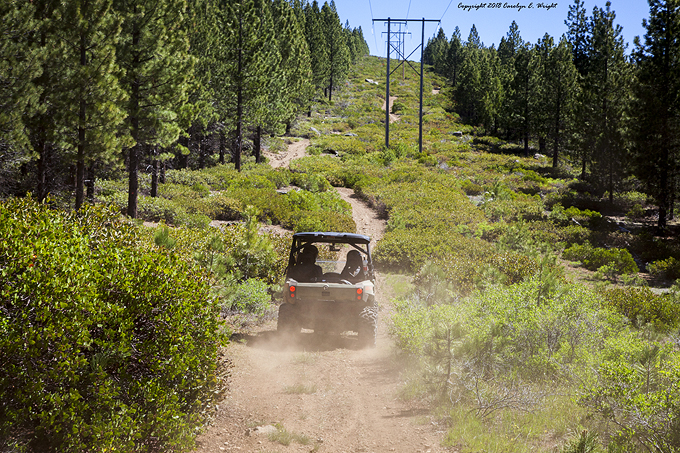
So much dust kicks up it’s necessary to lag behind a bit as his taillights disappear around a corner. For someone with off road experience (none is required to rent a UTV) I was pretty pokey until my passenger essentially said there would be no photos at the pace I was going.

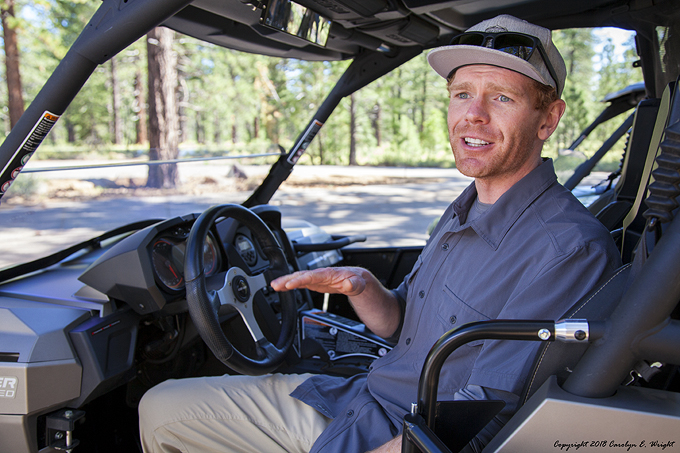
What makes these Can-Am Commander 1000cc machines different than an all-terrain vehicle (ATV) is that driver and passenger sit side-by-side and it’s a normal wheel instead of like a bike. The suspension is outstanding – better than a 2002 Wrangler on similar terrain.

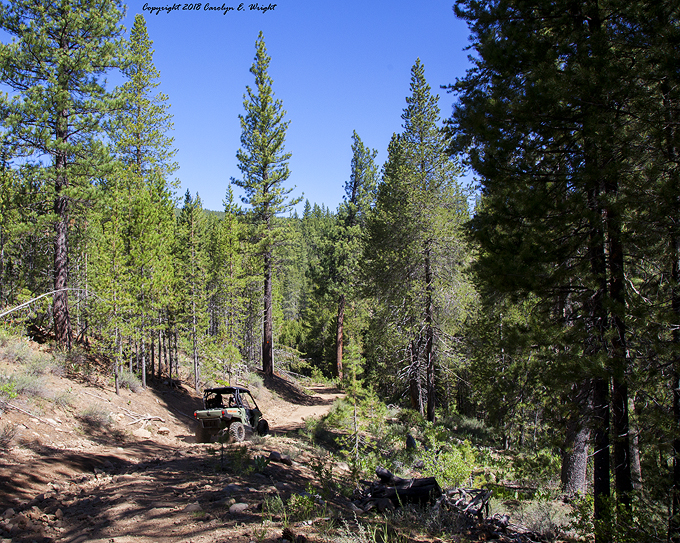
Most of the route is through the tall pines in the Tahoe National Forest. Photo Copyright 2018 Carolyn E. Wright

The company’s motto is: “We guide, you drive.” It’s perfect. It would be easy to get lost as one dirt road starts to look like the next. Using a tree as a marker isn’t likely to get you back to the trailhead when you’re in a forest.

Cass Walker is Field’s passenger; she adds to the experience by making sure guests are staying hydrated and have snacks at select stops. The wipes to clear the accumulated dust from exposed skin and sunglasses were welcome along the way and at the end of the expedition. Sunscreen, bug spray and Advil are in the glove compartment.

Sean Field is sharing his love of the outdoors with people who might not otherwise be able to see these locations. Photo Copyright 2018 Carolyn E. Wright

Field knows when to slow down, when to stop – where that Kodak moment is. And there are plenty. But that doesn’t mean there is a lot of stopping.

This adventure is about driving the bumpy U.S. Forest Service roads, going through some water, getting super dusty and grinning with glee.

At one outlook Stampede and Prosser reservoirs are visible, with Boca barely noticeable. Beyond that is the Carson Range and the backside of Mount Rose.

Wildflowers are just starting to pop in the Truckee area. Photo Copyright 2018 Carolyn E. Wright

“Skiing definitely taught me a lot about these mountains,” Field says as he imparts tidbits about the area. His exploration started in the winter and now continues with summer pursuits.

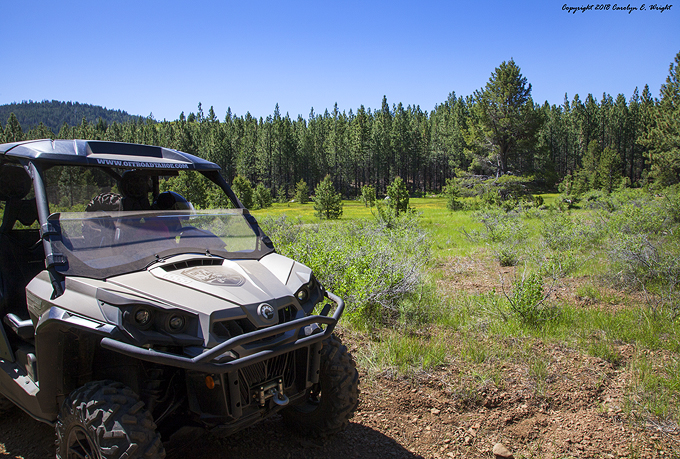
A pristine meadow which is the headwaters for Prosser Creek comes into view. This is the perfect spot to take in all the scenery, including the Pacific Crest, before turning around. Few signs of civilization are visible, making one feel so removed from everything; and feeling so small in this lush, vast terrain that almost looks like a painting.

Incredible vistas are the reward of having a guide lead the way. Photo Copyright 2018 Carolyn E. Wright

Field had done almost every sport the Sierra is known for before getting into rock crawling.

“I consider it a tool to access the backcountry,” he told Lake Tahoe News on a recent trek out of the Prosser OHV area near Truckee. “I almost got bored going by myself. It’s more fun with people.”

That is how Tahoe Off Road came into being. After securing a permit with the Tahoe National Forest he started offering tours in May.

The ride is about a 1,500 foot elevation gain. Photo Copyright 2018 Carolyn E. Wright

—–

Notes:

·      More details are on Off Road Tahoe’s website.

·      Season – May-October

·      20-mile round trip

·      Add-ons like lunch are available

·      2 2-person vehicles, 1 4-person vehicle

·      Open 7 days a week

·      2 tours a day


Editorial: Brown makes a good deal on budget

Publisher’s note: This editorial is from the June 12, 2018, Sacramento Bee.

All budget deals are compromises in which not everyone gets everything they want. The agreement last week by Gov. Jerry Brown and legislative leaders strikes a good balance, given the state’s budget surplus, its pent-up needs and the prospect of the next recession.

The rank-and-file in the Legislature should sign off this week on the $200 billion budget. In total, the deal adds about $1 billion in spending to the budget that Brown proposed in May and addresses some key priorities.

Read the whole story


Why everyone loves macaroni and cheese 

By Gordon Edgar

Being a judge at a macaroni and cheese competition in San Francisco taught me a lot about American food. The competitors were mostly chefs, and the audience—the online tickets sold out in minutes—was soaking up the chance to be at a “Top Chef” kind of event, but more urban and cool. The judges included a food writer, an award-winning grilled-cheese-maker, and me, a cheesemonger.

We awarded the win to a chef who made mac and cheese with an aged Vermont cheddar. The audience, however, chose another contestant. When he arrived at the winner’s circle, he made a stunning announcement: His main ingredient was Velveeta.

Amazement! Shock! Betrayal! The audience clutched their ironic canned beer but didn’t quite know how to react. Was it a hoax?  A working-class prank against elitism in food? Was this contest somehow rigged by Kraft? In the end it turned out to just be a financial decision by the chef: In great American tradition, he bought the cheapest protein possible.

To understand the evolution of macaroni and cheese is to realize that pursuit of the “cheapest protein possible” has been a longstanding quest of the American food system. At times, cheese itself has shared a similar trajectory. Cheesemaking, which began 10,000 years ago, was originally about survival for a farm family or community: taking a very perishable protein (milk) and transforming it into something less perishable (cheese) so that there would be something to eat at a later date. Many of us today think of cheese in the context of tradition, flavor, or saving family farms, but a basic goal—whether a producer is making farm-made cheddar or concocting the cheeseless dairy product Velveeta—has always been getting as much edible food from a gallon of milk as possible. Cheesemakers weren’t always successful at this. Cheese is vulnerable to mold, rot, and maggots, not to mention pitfalls like excess salt. Many generations of cheesemakers have tossed countless bad batches, which meant feeding a lot of precious protein to their farm animals instead of their families.

The first cheese factory in the U.S. was built in 1851, making cheddar one of the first foods affected by the Industrial Revolution. Before that, all cheese made in the United States was made on a farm, usually by the farm wife or—on prosperous farms—a cheese maid or an enslaved woman. As foods industrialize, they often go from being made by women to being made by men, and so it was with cheese: Women were mostly absent from the make rooms of these new cheese factories, and didn’t return to cheesemaking until the artisanal cheese revolution of the past few decades.

Processed cheese, which was invented 107 years ago, is basically cheese that is emulsified and cooked, rendering it much less perishable (but also no longer a “living food” because, unlike natural cheese, processed cheese’s flavor will no longer alter with age). The advent of processed cheese has led over the years to innovations like Kraft Singles, Easy Cheese, powdered “sauce” for boxed mac and cheese, and Velveeta—a type of processed cheese when it was invented in 1918, and now a dairy-based processed food, with 22 ingredients, that is no longer regulated as a cheese.

Processing cheese was a good way to make food for soldiers at war, to turn safe but not-as-good-as-standard cheese into edible food, and to save producers when there was a glut in the market and too much cheese to sell. It was also a good way to get nutrients to people who didn’t have refrigeration. Ironically, perhaps, it was the culmination of the age-old cheesemakers’ goal: producing as much edible food as possible from the original protein.

Although processed cheese was invented in Switzerland, big American cheese producers—as part of our factory-scale, get-big-or-get-out philosophy of food production—bought into processed cheese so heavily that the very definition of “American cheese” has come to be a processed product. Many Americans may never have had a macaroni and cheese made with real cheese, and many who grew up on mac and cheese may never have had a version that wasn’t made with a powdered mix. While the most popular brand of boxed mac only just recently quietly removed artificial colors and preservatives from their “cheese sauce,” it seems, from a traditional roux-making perspective, still far removed from the original recipe.

Macaroni and cheese has been served as long as there has been a United States of America, but in a 20th-century economy driven by convenience packaging and industrialization, it was elevated to an ideal American food: Pasta and processed cheese are very cheap to make and easy to ship and store, and they certainly fill up a belly. It’s no wonder a hot gooey Velveeta mac and cheese tastes like a winner to so many Americans, even those attending a fancy contest in San Francisco.

As with many foods, white culture and African-American culture diverge on the make and use of macaroni and cheese. Food historian Adrian Miller points out that while Thomas Jefferson often gets credit for popularizing macaroni and cheese in the United States, it was of course his enslaved black chef James Hemmings who learned to cook it. In the Antebellum South, mac and cheese was a weekend and celebration food. Many African Americans have continued this tradition to this day.

I have a collection of quotes I post above my computer for writing inspiration and as a reminder to examine my own historical assumptions. One is from Miller from the Charlotte Observer on Nov. 15, 2017: “They [older black people interviewed by Miller for his book] were convinced mac & cheese was something white people stole from us. I thought they were kidding, but they were like, ‘No, it’s like rock ‘n’ roll—we started that.’ They were serious.”

This is the conundrum and beauty of mac and cheese. It is one person’s survival food, another person’s staple main course, and yet another person’s food of culture and celebration. Divided, as America is, along class and race lines, when you bring up mac and cheese you have to be careful or you may be talking about a different mac and cheese altogether.

The one thing that does seem to unify people who eat macaroni and cheese is that everyone views it as “comfort food”: Whichever form of mac and cheese people grew up with, it provides them with something visceral that they want to recreate as adults. In my experience selling food, I’ve seen many folks who eschew one of the major components of the dish, due to allergies or politics, yet expend great effort trying to find or create gluten-free or vegan simulacra. It’s just that important to them.

I truly grasped how macaroni and cheese works as comfort food while visiting cheesemakers in Maine and Vermont in 2006 to meet some of the artisans whose food I sold and to learn more about the cheeses of the Northeast. That year was an amazing time for cheese. Decades of work by back-to-the-landers and multigenerational cheesemakers were finally coming to fruition and an appreciation for the beauty of inefficiency had provided an opportunity for American cheesemakers to start creating new cheeses, and to reinvigorate old-fashioned ones that had never industrialized or had gone extinct in this country altogether.

At that time, all of this cheesy activity was new, and because of that, these artisan cheesemakers often welcomed us with spare beds and home-cooked meals.

They gave us so much cheese that we had to put out the word to friends and friends of friends, who met up with us in convenient parking lots as we drove through small-town New England. We handed them cheeses out of our rental car trunk—brainy-looking goat cheeses, clothbound cheddar, oozy rice-flour-rinded Teleme, pungent blues. That many of these cheeses were just a few years away from being recognized as some of the best in America made it an especially sweet contribution to our extended community. To passersby, it must have seemed like the oddest smelling drug deal ever.

Unfortunately, one of the cheese-making couples we had been looking forward to visiting had begun breaking up by the time we arrived. As we pulled up, one half of the couple had moved out temporarily, while the other half and the kids were packing their things to move out permanently. We stayed in that house to be supportive, surrounded by all the emotions that go along with a breakup, especially a sudden one: anger, blame, despair, doubting of self-worth, fear of the unknown … all of ‘em.

I don’t remember whose idea it was to cook a big dinner, but it gave us something to do during the time we thought we’d be talking cheese and frolicking with the farm animals. What does one cook as an antidote to despair? Especially when one is staying at a farmstead dairy and loaded down with the best cheese the Northeast has to offer? Mac and cheese, of course.

Someone was dispatched to raid the farmstand shop. I brought out our collection of cheese from the farms we had visited. If we had actually paid retail, our meal might have been the most expensive per-serving mac and cheese in history. 

But that wasn’t why it was so great. 

Our mac and cheese elevated us emotionally because it brought everyone together for the common tasks. There was cheese grating, roux making, onion chopping, vegetable prepping, side dish making. Soon, while despair was not entirely gone, it wasn’t quite as thick. The rehashed jokes of shared cooking inevitably came. The anticipation of something-that-was-not-misery came. When the meal was prepared, we all sat down to eat—and drink—and create the possibility of new community in the very location where the past configuration had been destroyed. That is what comfort food does.

Gordon Edgar has been a cheesemonger since 1994 and eaten macaroni and cheese his whole life. Edgar’s latest book is “Cheddar: A Journey to the Heart of America’s Most Iconic Cheese.”
Off Road Tahoe

Guided four-wheel drive tours out of Truckee provide a unique perspective to the Sierra.


Snippets about Lake Tahoe

·       The South Lake Tahoe pool will be closed June 18 from 10:30am-1:30pm for the annual eighth-grade graduation party.

·      Parking will be free at Harrah’s and Harveys during celebrity golf in July.

·      The comment period has been extended to July 30 for the environmental documents related to Washoe Meadows State Park.

·      Douglas County Public Library will be closed July 4.

·       Live at Lakeview free concerts in South Lake Tahoe start June 21. They are every Thursday from 4:30-8:30pm.


Calif. considers sharing control of power grid

By David R. Baker, San Francisco Chronicle

A web of power lines stretching from the Rocky Mountains to the Pacific weaves all the western states and Canadian provinces into one vast electric grid.

But control of that grid is anything but unified.

Thirty-eight separate organizations, known as balancing authorities, run their own portions, some as big as states, others as small as counties. The California Independent System Operator, a nonprofit corporation, controls the grid throughout most of the Golden State, its experts monitoring the flow of electricity from a darkened room in Folsom lit by a wall of data screens.

A bill facing debate Tuesday in a California Senate committee — AB 813 — would make a revolutionary change to that decades-old system.

Read the whole story


Financial class in South Lake Tahoe

St. Joseph Community Land Trust will host a financial fitness class on June 30 from 10am-noon at the South Tahoe Association of Realtors office located at 2307 James Ave. in South Lake Tahoe.

A few of the topics to be covered are setting financial goals, tracking spending habits, managing money and more.

Executive Director Cathy Kope will be leading the class. She was the loan program specialist in the South Lake Tahoe Redevelopment and Housing Department.

The class is free to members of St. Joseph Community Land Trust. Non-members are asked to donate $5-$10 to cover the cost of printed materials.

Register in advance by calling 530.541.8930 or emailing cathy@saintjosephclt.org.


EDC committee to discuss cannabis ballot measures

The ad hoc Cannabis Advisory Committee of the El Dorado County Board of Supervisors will meet June 19 to discuss commercial cannabis proposed ballot measures that are planned to go to the full Board of Supervisors on July 17.

If the Board of Supervisors approves the ballot measures, they will be placed on the ballot in November.

The meeting will be from 3-5pm at the Planning Commission Room, Building C, 2850 Fairlane Court, Placerville.

The purpose of the committee is to study and create ballot measures for different cannabis commercial uses tied to a tax.


More wildlife now work the night shift

By Kaitlyn Gaynor, The Conversation

For their first 100 million years on planet Earth, our mammal ancestors relied on the cover of darkness to escape their dinosaur predators and competitors. Only after the meteor-induced mass extinction of dinosaurs 66 million years ago could these nocturnal mammals explore the many wondrous opportunities available in the light of day.

Fast forward to the present, and the honeymoon in the sun may be over for mammals. They’re increasingly returning to the protection of night to avoid the Earth’s current terrifying super-predator: Homo sapiens.

My colleagues and I have made the first effort to measure the global effects of human disturbance on the daily activity patterns of wildlife. In our new study in the journal Science, we documented a powerful and widespread process by which mammals alter their behavior alongside people: Human disturbance is creating a more nocturnal natural world.

Many catastrophic effects of humans on wildlife communities have been well-documented: We are responsible for habitat destruction and overexploitation that have imperiled animal populations around the world. However, just our presence alone can have important behavioral impacts on wildlife, even if these effects aren’t immediately apparent or easy to quantify. Many animals fear humans: We can be large, noisy, novel and dangerous. Animals often go out of their way to avoid encountering us. But it’s becoming more and more challenging for wildlife to seek out human-free spaces, as the human population grows and our footprint expands across the planet.

Global increase in nocturnality

My collaborators and I noticed a striking pattern in some of our own data from research in Tanzania, Nepal and Canada: animals from impala to tigers to grizzly bears seemed to be more active at night when they were around people. Once the idea was on our radar, we began to see it throughout the published scientific literature.

It appeared to be a common global phenomenon; we set out to see just how widespread this effect was. Might animals all over the world be adjusting their daily activity patterns to avoid humans in time, given that it is becoming harder to avoid us in space?

To explore this question, we conducted a meta-analysis, or a study of studies. We systematically scoured the published literature for peer-reviewed journal articles, reports and theses that documented the 24-hour activity patterns of large mammals. We focused on mammals because their need for plenty of space often brings them into contact with humans, and they possess traits that allow for some flexibility in their activity.

We needed to find examples that provided data for areas or seasons of low human disturbance – that is, more natural conditions – and high human disturbance. For example, studies compared deer activity in and out of the hunting season, grizzly bear activity in areas with and without hiking, and elephant activity inside protected areas and outside among rural settlement.

Based on reported data from remote camera traps, radio collars or observations, we determined each species’ nocturnality, which we defined as the percentage of the animal’s total activity that occurred between sunset and sunrise. We then quantified the difference in nocturnality between low and high disturbance to understand how animals changed their activity patterns in response to people. 

Overall, for the 62 species in our study, mammals were 1.36 times as nocturnal in response to human disturbance. An animal that naturally split its activity evenly between the day and night, for example, would increase its nighttime activity to 68 percent around people.

While we expected to find a trend toward increased wildlife nocturnality around people, we were surprised by the consistency of the results around the world. Eighty-three percent of the case studies we examined showed some increase in nocturnal activity in response to disturbance. Our finding was consistent across species, continents and habitat types. Antelope on the savanna of Zimbabwe, tapir in the Ecuadorian rainforests, bobcats in the American southwest deserts – all seemed to be doing what they could to shift their activity to the cover of darkness.

Perhaps most surprisingly, the pattern also held across different types of human disturbance, including activities such as hunting, hiking, mountain biking, and infrastructure such as roads, residential settlement and agriculture. Animals responded strongly to all activities, regardless of whether people actually posed a direct threat. It seems human presence alone is enough to disrupt their natural patterns of behavior. People may think our outdoor recreation leaves no trace, but our mere presence can have lasting consequences.

Future of human-wildlife coexistence

We don’t yet understand the consequences of this dramatic behavioral shift for individual animals or populations. Over millions of years, many of the animals included in our study have evolved adaptations to living in the daylight.

 Sun bears, for example, are typically diurnal and sun-loving creatures; in undisturbed areas less than 20 percent of their activity occurred at the night. But they increased their nocturnality to 90 percent in areas of the Sumatran forest where intensive forest research activity created a disturbance.

Such diurnally adapted animals may not be as successful at finding food, avoiding predators or communicating in the darkness, which could even reduce their survival or reproduction.

However, because our mammalian ancestors evolved under the cover of darkness in the time of the dinosaurs, most mammal species possess traits that allow for some flexibility in their activity patterns. As long as animals are able to meet their needs during the night, they may actually thrive in human-dominated landscapes by avoiding daytime direct encounters with people that could potentially be dangerous for both parties. In Nepal, for example, tigers and people share the exact same trails in the forest at different times of day, reducing direct conflict between humans and these large carnivores. Dividing up the day, through what researchers call temporal partitioning, may be a mechanism by which people and wildlife can coexist on an ever more crowded planet.

An increase in nocturnality among certain species may also have far-reaching consequences for ecosystems, reshaping species interactions and cascading through food webs. In California’s Santa Cruz Mountains, coyotes are becoming more nocturnal in areas with human recreation. By analyzing coyote scat, scientists have linked this behavioral change to dietary shifts from diurnal to nocturnal prey, with implications for small mammal communities and for competition with other predators.

Working on this study reminded me that people aren’t alone on the planet. Even if we don’t see large mammals while we’re out and about during the day, they may still be living alongside us, asleep while we are awake and vice versa. In areas where threatened species live, managers may consider restricting human activity to certain times of the day, leaving some daylight just for wildlife.

And it is likely that we need to preserve wilderness areas entirely free of human disturbance to conserve the most vulnerable and sensitive mammal species. Not all animals are willing or able to just switch to a nocturnal lifestyle around people. Those that try to avoid human disturbance entirely may be most vulnerable to the consequences of the expanding human footprint.

Kaitlyn Gaynor is a doctoral candidate in environmental science, policy and management, UC Berkeley.


Festival all about birds of Tahoe basin

As part of the Wild Tahoe Weekend, the Tahoe Institute for Natural Science in partnership with the U.S. Forest Service Lake Tahoe Basin Management Unit will host the 8th annual Lake Tahoe Bird Festival on June 24.

Located at Taylor Creek Visitor Center, just three miles north of South Lake Tahoe on Highway 89, residents and visitors are invited to attend this free family event from 10am until 3pm.

The event includes hourly guided bird walks along the Rainbow Trail in search of local birds. In addition, the bird festival will offer information and presentations on migratory birds, bird crafts and games, bird house building, demonstrations with live birds, a falconer, and much more.

Various local agencies will be participants of the Bird Festival including California State Parks, Nevada Department of Wildlife, Lake Tahoe Wildlife Care and much more. Food vendors will be present.