Anti-bullying program coming to S. Lake Tahoe

On July 27 at 5:30pm there will be a bullying talk at the South Lake Tahoe Recreation and Swim complex.

The free Strike Out Bullying presentation is provided by Soul Shoppe. The focus will be on teaching youth about the types of bullying, how to stop bullying and why people don’t need to bully.

Soul Shoppe’s mission is to create safe learning environments that bring forth a culture of compassion, connection and curiosity—eliminating bullying at the roots.

The recreation department was awarded this free presentation through Junior Giants and it is open to the public to attend.


Creditors don’t want Olson case extended

Entities involved with the Olson bankruptcy case want the court to deny the appeal to extend the stay and instead want a more immediate ruling.

The bankruptcy judge in May put a 60-day stay on the foreclosure process to give Patty Olson time to decide if she wanted to appeal his decision. She is appealing. But the appeal will not be resolved before the 60 days is up.

A hearing is scheduled for next week.

Those filing paperwork with the court include:

·      Cody Bass, who owns the Tahoe Wellness Cooperative in South Lake Tahoe. He is a player because he believes he has a legitimate contract to buy the building in which his business resides, yet Olson brought him into the bankruptcy case.

·      US Bank is owed money. Attorneys in court filings said, “The principal balance is $640,696.16. Interest accrues at $155.72 per day and totals $79,488.22 as of June 30, 2017. Late charges of $5,930.24 have accrued and fees for appraisals, environmental inspection, force-placed flood insurance, advances to the debtor, and attorney and foreclosure fees total $85,160.24 as of June 30, 2017.”

Olson owns the retail center where the lone medical marijuana facility in the city exists. She also has a house nearby. Only the commercial property is threatened by foreclosure.

She filed for bankruptcy, which stopped the foreclosure process. The problem is the judge said because federal law does not recognize medicinal marijuana the bankruptcy court was not the appropriate venue. That is the decision she is appealing.

— Lake Tahoe News staff report


Snippets about Lake Tahoe

·      Bring your dog to Basecamp Hotel’s beer garden on Aug. 21 from 4:30-7:30pm for Wild Blue Dogs fundraiser. Money raised will provide cancer treatment for dogs in the Lake Tahoe area. No cost to attend.

·      Placer County took Best Agriculture Presentation at the California State Fair.

·      El Dorado County is using grant money to remove unhealthy trees for low income seniors. For more info, call 530.621.5159.

·      Comedy duo Cheech and Chong will be at MontBleu in Stateline on Aug. 18 at 8pm.

·      South Shore swim coach Jerry Erickson has retired after 46 years.


Wildfires surge in Western United States

By Benjamin Spillman, Reno Gazette-Journal
 
Wildfires are surging across the Western U.S. with more than 4 million acres charred this year.

That’s almost double the rate from last season and more than 40 percent above the five-year average for mid-July. 

While fire is part of healthy forest and rangeland regeneration it can also be dangerous for communities in its path and expensive to fight. Wildfires can spew unhealthy levels of air pollution hundreds of miles and deplete the budgets of federal agencies charged with preserving the land. 

In general, about 80 percent of wildfires are human caused. 

Read the whole story


Nevada cops going after speeders

More than two dozen law enforcement agencies throughout Nevada will be joining forces to crack down on drivers exceeding speed limits or driving aggressively through July 30.

Speeding is a contributing factor in approximately one-third of fatal crashes on the nation’s roadways. Exceeding the speed limit is considered aggressive driving just as weaving in and out of traffic, passing in emergency lanes or along the shoulder and failing to yield to other motorists.

According to officials, the consequences of driving too fast include:

·       Greater potential for loss of vehicle control

·       Reduced effectiveness of occupant protection equipment

·       Increased stopping distance when the driver perceives a danger

·       Increased degree of crash severity leading to more debilitating injuries

·       Unexpected economic and psychological implications of a speed-related crash.


Breeds not being touted in Truckee dog adoptions

The Humane Society of Truckee-Tahoe’s dog descriptions read less like a list of stats, and more like a friendly dating site, thanks to a recent move to drop breed labels.

Potential adopters may find that Lily is a “fun-loving and energetic girl with a lot of love to share,” while Sherman’s favorite activity is “going on long nature hikes with you.” But what they won’t find are specific breed labels.

The goal is to make sure adopters are picking dogs that are the right fit for them and their families, regardless of breed.

The majority of dogs in shelters are of mixed breed.

For more information about adopting a dog or cat from the Humane Society of Truckee-Tahoe, go online.


Road Beat: 2017 Honda Civic Hatchback Sport, wow

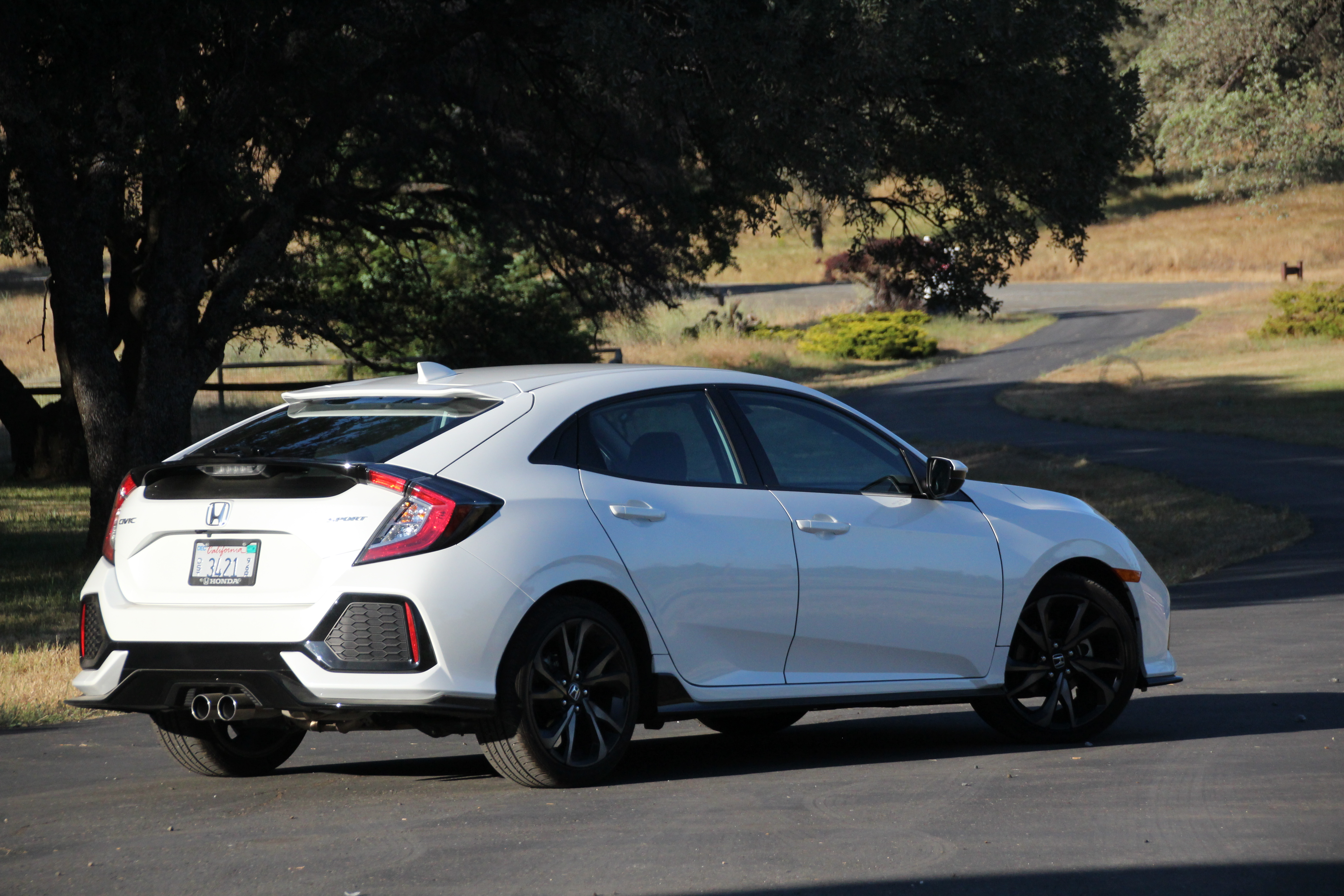
The 2017 Honda Civic Hatchback Sport is fun to drive. Photos/Larry Weitzman

By Larry Weitzman

I remarked in several recent Road Beats that Honda was on a roll. After testing this new Honda Civic Hatchback Sport, I have to report that the roll is accelerating and rather quickly.

Here is a car with loads of utility, outstanding performance, great fuel economy, superb handling and good comfort for a sticker price of $22,135 with the boat ride from Swindon, Wiltshire, England. (Don’t they have some great names in England?)

Not only was the new Civic Hatch Sport built in England, the engine comes from Thailand and the 6-speed manual cog swapper was assembled in India. It’s a world-class car right out of the box.

Civic’s new design is its best yet; sleek and stylish with a long character line emphasizing its muscle and strong flanks. The grille is a little big, but the car’s substantial width of 71 inches not only improves handling, but enhances its aggressive stance.

Powering up this Hatchback Sport is a more powerful version of its new 1.5L DOHC, 16 valve, direct injected turbo inline four. Belting out 180 hp @ 5,500 rpm and 177 pounds of twist from 1,900-5,000 rpm, it bests all Civic engines by at least 6 hp and 15 pounds of twist. It is also more powerful than the 180 hp more expensive and top of the line Sport Touring model in that the Sport gets its peak hp 500 rpm earlier and retains the 15-pound torque advantage. However, the Sport when equipped with Honda’s superb CVT (instead of the manual six-speeder in my tester) has the identical engine output numbers as the Sport Touring model.
Specifications
Engine
1.5L turbocharged, direct injected, DOHC, 16 valve inline four cylinder 180 hp @ 5,500 rpm
177 lb.-ft. of torque @ 1,900-5,000 rpm
Redline 6,500 rpm
Fuel requirement both engines regular unleaded
Transmission
Six speed manual
CVT
Configuration
Transverse mounted front engine/front wheel drive
Dimensions
Wheelbase 106.3 inches
Length 177.9 inches
Width 70.8 inches
Height 56.3 inches
Track (f/r) 60.5/61.1 inches
Weight 2,871
Weight distribution (f/r) 60/40
Fuel capacity 12.39 gallons
Trunk capacity 22.6 cubic feet
Passenger volume 97.2 cubic feet
Wheels 18X7.5 inch alloys
Tires 235/40X18W
Steering lock to lock 2.11 turns
Turning circle 37.8 feet
Performance
0-60 mph 6.99 seconds
50-70 mph 3.80 seconds
50-70 mph up a 6-7 % grade 5.07 seconds
Top speed 130 mph easy
Fuel economy EPA rated at 30/39/33 mpg city/highway/combined. Expect 36 mpg overall and 45 plus mpg on the highway at legal speeds.

Performance for the Hatch Sport was excellent for a compact with a 0-60 mph time of 6.99 seconds and 50-70 mph passing times (level and uphill) of 3.80 and 5.07 seconds. But here is where it gets interesting, the 180 hp CVT tranny model does better as it posted times of 6.48, 3.42 and 4.63 seconds, an improvement of about half a second in each category. The engine is incredible smooth and quiet, at least on the inside as it has, centered under the rear bumper, a set of menacing paired exhausts. But there is more.

Civic sips fuel and through a narrow straw at that. EPA rates the Sport manual at 30/39/33 mpg city/highway/combined. As usual, those numbers are very conservative as in 350 miles of driving, including all performance testing, it averaged 36.6 mpg. On a level highway with the cruise set at 70 mph its two-way average was 46.1 mpg. A round trip over the Sierra to Lake Tahoe averaged 41.6 mpg. But here again, the CVT outperforms the manual with an overall average of 38.5 mpg and a highway average 50.7 mpg. Fuel capacity for the new Civic is smaller at 12.4 gallons, but even with that small tank, highway range is a comfortable 400 miles, when most people need a pit stop anyway. Unless you crave right arm, left foot exercise, spend the grand or so for the CVT. My test numbers clearly demonstrate the efficiency of new Honda CVT tranny. Best CVT in the business.

Civic Hatch Sport gets the same big meats as the Sport Touring Civic, 235/40 mounted on some good looking 18 inch blacked out alloys. Suspension is small car state of the art MacPherson Struts up front and a multilink system in the rear with stab bars at both ends. Track is a wide 61 inches front and rear while the steering is a go-kart like 2.1 turns lock to lock. And, yes, it goes around corners and changes directions like water in a hose. Civic Hatch Sport tips the scales at less than 2,900 pounds and the CVT adds less than 70 pounds which also helps in all aspects of handling. Feedback and feel are near perfect with a very crisp turn-in and great off and on center feel. It definitely rivals the Mazda 3 and then some.

The ride is very smooth, quiet and supple. You could do some serious traveling in this ride. More on that later. The CVT brings another advantage, lower rpms at cruise as the manual spins 2,700 at 60 mph and the CVT spins a very low 1,900 which makes the CVT perhaps a skooch quieter and improves the highway fuel economy as reflected above.

Safety is standard on the Hatch Sport as in all Hondas with four-wheel disc brakes, ABS and all the other acronyms, plenty of airbags, backup camera, LED DRLs and more. But things like lane departure warning, blind spot monitoring, auto high beams are not available. Most of these items are optional or standard on other model Civics. This is a driver’s car.

Inside are some comfortable seats and a surprising amount of room. The trunk of the hatchback has a volume of over 22 cubic feet and with the second row folded flat that volume more than doubles. In fact, when you combine the 97.2 cubic feet of passenger volume, this Civic is less than a half a cubic foot shy of a large car volume as defined by the EPA and giving the Civic awesome utility.

Instruments are all business, big tach, with a digital speedo inset, flanking graphic ancillary gauges and a trip computer. Perfect. Materials are all first rate as you would expect from Honda and the rear seating is good with the four doors.

But the Civic Hatch Sport is more basic. It has everything you need and not much else. Power windows and mirrors are standard of course as is the AM/FM fine sounding stereo with media connections and Bluetooth with steering wheel controls. No Sirrus/xm, no Nav. This Hatch Sport is geared more to the enthusiast driver who is looking for an inexpensive, entertaining daily driver.

Civic Hatch Sport does it all while being very entertaining in the drive, offering good comfort, great performance, fabulous fuel economy and its utility and roominess.

Pricing for the Civic Hatchback Sport is one size fits all, $21,300 plus $835 for the Atlantic crossing. Floor mats and a full tank of gas are part of the deal. Don’t ask for less and you don’t need more. This Civic moves (quickly at that) to the top of the class.

Larry Weitzman has been into cars since he was 5 years old. At 8 he could recite from memory the hp of every car made in the U.S. He has put in thousands of laps on racetracks all over the Western United States.


‘Flushable’ wipes a problem for Tahoe sewers

By Kurt Althof

Although the sewer systems around Lake Tahoe are all carefully engineered and designed to export waste from the Tahoe basin, the complex process can be dramatically affected when certain materials are flushed down the toilet.

These materials include so-called “flushable wipes,” paper towels, cotton swabs, feminine hygiene products, condoms, facial tissues (Kleenex), dental floss, or anything other than toilet paper and human waste.

In fact, toilet paper is the only “product” that is designed to break down quickly and pass harmlessly through the sewer system. The sewer system is not designed to be a garbage disposal. The consequences of using it that way are sometimes harmful, particularly in such an environmentally sensitive area as Lake Tahoe.

There is nothing pleasant about a sewer backup, but a sewer backup in your home is not only stomach

churning, it can also be costly and a significant health concern. If that sewer backup makes its way into Lake Tahoe, or any part of the environment, it creates significant challenges and harm.

Most of the time a sewer “spill” is preventable and caused by the misuse of the sewer system.

Wipes clog sewer systems, even ones that say “flushable” on the container. Photo/TCPUD

The sewer system’s No. 1 enemy is the misnamed “flushable wipe.” Many wipe products are marketed as “flushable,” and although they do go down the toilet, they cause tens of thousands of dollars in damage and numerous sewer back-ups each year. To make matters worse, the concept of flushable wipes has established a perception that wipes in general are flushable and subtly encourages customers to flush any and all wipes.

Although makers of these so called “flushable wipes” contend their products break down appropriately in the sewer system, test after test proves this is not the case.

When you or your neighbors flush non-flushable items, the risk of a sewer backup increases significantly, not only in the lateral that connects your house to the main, but in the main system and in sewer pumps. Regular routine maintenance and inspections of sewer mains are performed throughout the region, but this cannot catch every problem before it causes a backup and damages homes, businesses, and the environment.

The best approach is to keep it simple: nothing but human waste and toilet paper should go down the toilet. Flushing anything else will damage your household plumbing, the environment, and the wastewater system.

Kurt Althof is the grants and community information administrator for the Tahoe City Public Utility District. This article is republished from the summer 2017 edition of Tahoe In Depth.


Opinion: North Tahoe Event Center giveaway

By Ann Nichols

For the past 14 months the North Tahoe Public Utility District executive staff and board have been negotiating with the developer Laulima on a long-term lease of the North Tahoe Event Center in Kings Beach. 

Laulima originally asked for a 99-year term; really a sale. Although the NTPUD claims it has had many public meetings on the issue, the terms of the deal have been kept secret from the public with the justification that it would impede negotiations.  The result has been behind-closed-doors meetings held in a vacuum with zero transparency and zero public input.

Area residents served by the NTPUD are the actual owners of this important free and clear lakefront venue. As a 45-year real estate broker, I estimate its value at approximately $4 million. The event center is the resident and non-resident affordable “go to” for weddings, Quinceanera celebrations, yoga, funerals, group/business meetings and public meetings to name just a few.

The NTPUD within its recreation and parks department manages the property.  The recreation and parks department includes the North Tahoe Regional Park, the Tahoe Vista Recreation Area Boat Launch and the event center. The entire NTPUD Recreation and Parks Department spends approximately $1.8 million per year with little revenue except for around $600K in tax money paid by residents.   

The event center, which in the past has generated as much as $970K, now is at approximately $400K per year.  As the only venue that generates significant money an event center, $90K yearly loss is minimal in relation to the larger Parks and Recreation budget.  The Tahoe Vista boat launch alone lost $75K last year. Community centers rarely make money. 

Unbelievably, the event center has no marquee alerting the public to events and until just now no staffing on weekends. The NTPUD is not the best event operator, but does that mean we need to give it away to a developer and lose control. Couldn’t the NTPUD allow an established local event operator such as Granlibakken to step in. Granlibakken and the Biltmore Casino made a proposal to the NTPUD, but they didn’t make the outlandish promises Laulima did.

Laulima’s PowerPoint promised a rebuild and a $7M infusion. Somehow this investment would be justified by an expensive wedding operation. Laulima did purchase the Ferrari/Crown motel property for approximately $12.5 million. They propose condos on the lake and a hotel across the street. Vetting Laulima revealed a series of evaporated projects, including an equestrian project in Cloverdale and the Monterey Downs racetrack/residential project.

In defense of the NTPUD, how could you turn down millions, especially when Laulima promised to retain the same or better public access? Well, it’s easy, actually: once you go down the road of losing control to a third party, it’s over. NTPUD must say no thanks.  The public deserves to retain the event center. The Kings Beach redevelopment mess is over and business is booming. Look at last winter’s crush of visitors and occupancy rates. NTPUD: hire a competent operator and be transparent about the real financial narrative.

Ann Nichols is with the North Tahoe Preservation Alliance.


How California’s community colleges are changing

By Emily DeRuy, Bay Area News Group

As the jobs that keep California’s economy running change at a rapid clip, the workers who fill them are expected to keep pace. That puts enormous pressure on all schools in the state, but especially on the state’s community colleges — which help prepare more than 2.1 million students across 113 campuses to enter or move up in the workforce.

In 2013, California’s community colleges began restructuring — talking to each other more, scaling up programs in high-demand fields and paring back others, working more closely with companies that want to hire new employees and creating course schedules that let students balance school and jobs. In the next five years, the system is set to spend $1 billion trying to move those changes forward. 

Now, a new report from the Institute for the Future, which the system asked to evaluate its work so far, shows the schools are making good progress. But the terrain they’re navigating is moving.

Read the whole story