Study highlights economic impacts of ‘quiet’ recreation

By Amy Joi O’Donoghue, Deserest News

SALT LAKE CITY — Some quiet time in the great outdoors in a portion of Utah delivered a sizeable chunk of change to local economies, with an estimated $17 million in impacts logged in one year alone.

A first-ever study devoted to an exclusive analysis of “quiet recreational activities,” looked at what was taking place on 2.1 million acres of Bureau of Land Management lands in Iron and Beaver counties, or those lands within the purview of the agency’s Cedar City field office.

 The report released Thursday details that out of 492,000 recreation visits logged in 2015 by the BLM, 364,000 — or 74 percent — were for quiet recreation that includes hiking, hunting, biking, fishing, camping or wildlife viewing.

Quiet recreation is generally nonmotorized activity that excludes off-highway vehicle use, power boating, snowmobiling or driving for sightseeing.

Read the whole story


Snippets about Lake Tahoe

·      Here are the El Dorado-Tahoe and Sierra roadwork schedules from Caltrans for the week.

·      Three new species of toads have been discovered living in Nevada’s Great Basin in an expansive survey of the 190,000 square mile ancient lake bottom.

·      The South Lake Tahoe Recreation JPA will meet July 28 at 9am at Lake Tahoe Airport.

·      Here is the schedule for the El Dorado County dental van coming to Lake Tahoe Unified School District for the 2017-18 school year. 

·      The Way It Was Rodeo will be Aug. 19- 20 at the Virginia City Arena and Fairgrounds. For tickets and more info, go online.


Indian tribes’ gaming win shifts landscape in Nev.

By Richard N. Velotta, Las Vegas Review-Journal
 
Record gross gaming revenue at casinos operated by the nation’s Indian tribes in 2016 has been an economic success story for tribes but has altered the landscape in Reno and Laughlin, two Nevada destinations most affected by the competition.

But an expert at UNLV’s International Gaming Institute says the success of tribal casinos in California and Arizona may actually help Las Vegas instead of hurt it.

Bo Bernhard, executive director of the institute, said tribal resorts in Northern California and suburban Phoenix have developed into entertainment centers for local residents there to enjoy a night on the town that could inspire future visits to bigger and brighter properties in Las Vegas.

Read the whole story


EDC receiving state money for Hwy. 50 work

El Dorado County roads will be benefiting from state money.

The California State Transportation Agency and Caltrans have money through the passage of the Road Repair and Accountability Act of 2017 (Senate Bill 1) that was recently passed by the Legislature and signed by the governor.

Construction will begin this summer on 13 pavement projects across the state. Additionally, Caltrans has expedited the design of an additional 50 projects, which will also begin construction this fiscal year.

Caltrans is expediting more than $285 million in road repairs across California months before the revenue from SB 1 even starts to accrue this fall. The road repair projects will include repairing and resurfacing hundreds of miles of highways to extend the service life of California roads. Caltrans will also improve lane-line visibility and motorist safety with new striping. The new striping will include highly reflective and durable beads, making it easier to see lane demarcations in all weather conditions. In some locations, roads will get completely repaved.

Projects include:

  • In El Dorado County: A $2.8 million project to resurface more than three miles of Highway 50 through Placerville. Construction is scheduled to start this year.
  • In El Dorado County: A $7.1 million project to resurface 10 miles of Highway 50 between Cedar Grove and Riverton east of Placerville. Work is scheduled to start in 2018.


Camp Rich light back in operation

The light in Camp Richardson has been reactivated. Photo/Bill Kingman

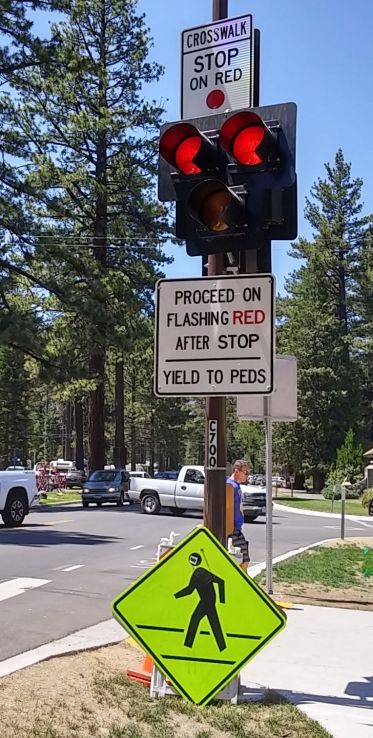
Since the July 4 weekend, the pedestrian-activated crossing lights on Highway 89 at Camp Richardson were covered and deactivated following complaints of traffic delays.

Motorists were confused as the dark signals would start with a single flashing yellow to two alternating flashing red, and then solid red, then dark. This was instead of the familiar green-yellow-red sequence signal.

The existing two-color installation was reactivated this weekend with this added sign: “Proceed on flashing red after stop — yield to peds.”

A pedestrian button activates the signals within about 20 seconds.

— Bill Kingman


Carson bypass opens to human-powered transport

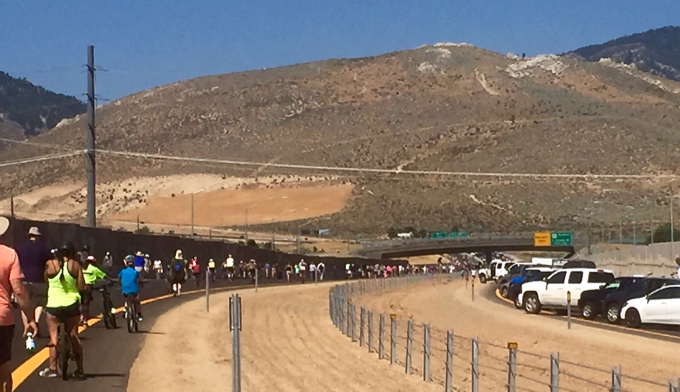
Swarms of people on July 22 break in the 1-580 connector in Carson City. Photo/Susan Wood

By Susan Wood

CARSON CITY – Americans love the open road.

That sentiment is not reserved to travel on four wheels – as evidenced July 22 in Nevada’s capital city to commemorate the completion of the last leg of the Interstate 580 Carson City Freeway.

Travelers of all sorts and all ages took the invitation from the Nevada Department of Transportation on Saturday morning to zoom up and down the 2-plus mile stretch between the Highway 50-Spooner Junction and Fairview Avenue.

With a majority from Carson City, more than 1,000 people showed up on road, mountain, cruiser, BMX and vintage bikes, accompanying walkers, runners, skateboarders, Rollerbladers, roller skaters as well as pedestrians with baby carriages and scooters. Drones and Ultralights even flew overhead.
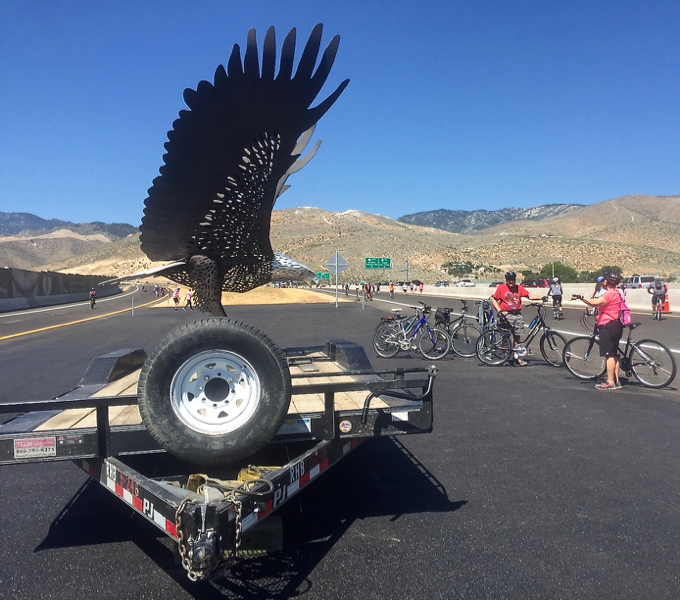
Artwork is part of the freeway, with the eagle to be near the Spooner intersection. Photo/Susan Wood

Many locals expressed relief and exhilaration that the day had come, considering the long, hard-fought process. The freeway is expected to open in early August, according NDOT — which celebrated its centennial last March.

The interstate completion allows one to drive from the south side of Carson City to the San Francisco Bay Bridge without a stoplight. This means going to Reno first.

Doing so was no easy task over the last few decades. The $42 million project – which includes an accompanying trail and décor — underwent at least seven contracts to accommodate the funding stream that included additional sales tax. The construction that started in June 2015 required 1 million cubic yards of earth excavated, 97,000 tons of asphalt paving and 950,000 pounds of reinforcing steel installed.

“We’ve waited a long time for this,” Carson City Mayor Robert Crowell said, recalling the milestones of progress amid the challenges.
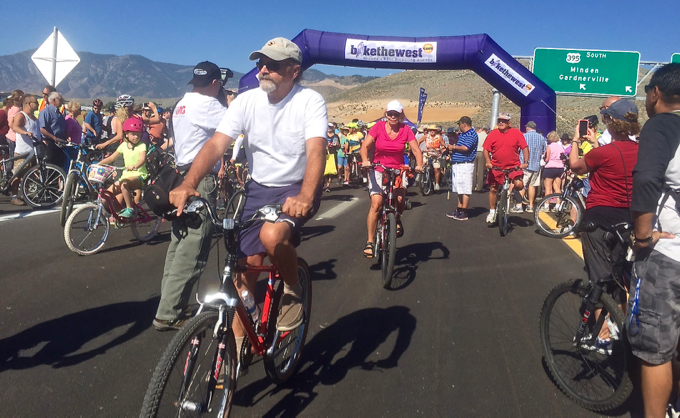
Cyclists would love for this smooth pavement to be the norm everywhere. Photo/Susan Wood

He remembered the late Nevada Gov. Kenny Guinn driving a black Cadillac over the first freeway section from the north end of town to Fairview Avenue in 2006. With overpass crossings at Koontz, Snyder and Clearview, the new leg links Fairview with the Highway 50 connection to South Lake Tahoe.

“I-580 allows us to showcase the state Capitol that will be the envy of all,” Crowell told the cheering crowd.

He acknowledged the tough road in getting to the day of opening given criticism the bypass would “kill downtown” – as declared by his own father. The mayor also tipped his hat to nearby businesses enduring dust.

“This is a turning point we must embrace with vigor,” Crowell said.

For one person in particular, the morning was an emotional one.

“My heart beats a little faster thinking about this,” the mayor said.

The freeway was dedicated to the late Carson City Sheriff’s Deputy Carl Howell, who was shot and killed in August 2015 on a domestic battery call on the east side of town.

“The family doesn’t have enough words to explain the wonderment about this. The honor and accolades are over the top,” his father Kevin Howell said, while wearing his son’s badge No. 5466. “I never stop thinking about him.”

Now he’ll be reminded of the community’s gratitude when he drives the freeway around town.
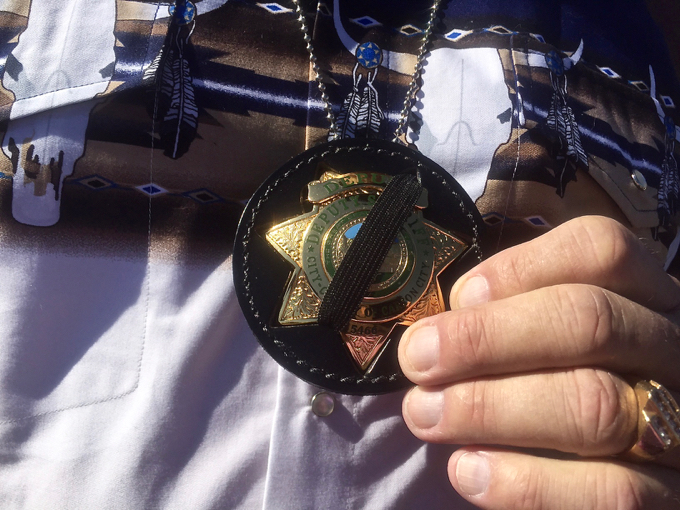
Kevin Howell with his son, Carl’s, badge. The freeway honors the fallen sheriff’s deputy. Photo/Susan Wood

Once it opens, NDOT estimates 43,000 vehicles daily will use the section of freeway by 2035.

But on Saturday it was all about human power – in its many forms.

“It’s nice to have this crowd. Look at all these cyclists,” Alta Alpina Bike Club member Michael Bayer said, while visiting with friends under the overpass. The freeway turned into a giant social hour.

Mayer guessed that over half of the bike club’s 200 members came out to support the free event.

The avid cyclist contends the public only needs a nudge such as this to get them to see the beauty and benefits of using a bicycle as a means of transit.

The removal of the “freeway ends” sign will happen in August. Photo/Susan Wood

A Carson City retail worker on roller skates had another idea.

“I’m doing shameless self-promotion,” Danielle Friend said.

She used the opportunity to hand out fliers highlighting Eyemart, a new business on the south side of town.

Like so many others who covered the short stretch, Friend was geared up for a workout that morning.

A workout is what Carl and Leanne Heard were going for too. The doctor-nurse duo, who work at Carson Tahoe Hospital, decided he would place a bungee cord between them. He was on Rollerblades and she tugged him on her mountain bike.

“I’ve said he almost brought a whip,” she said, laughing.

And with that, the couple took off.

William Frederick admitted to having his hands full trying to round up his 4-year-son, James, who ran into the mayor on his bicycle.

“This is great. I never thought it was going to be,” Frederick said, calling the event an historic milestone experience for Carson City.

Gardnerville resident Scott Doerr agreed, while taking a break on his vintage New Belgium bicycle with a basket up front. He appeared content leisurely sauntering up the road on his Fat Tire bike.
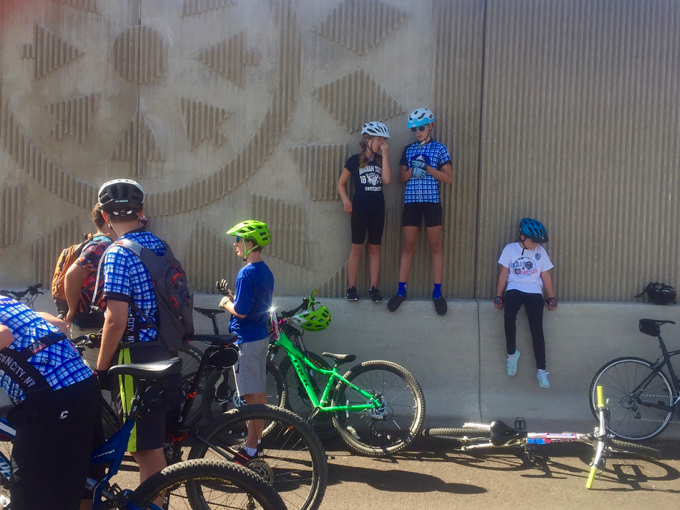
All ages enjoy the rare opportunity to be on the freeway before it opens to cars. Photo/Susan Wood

Skateboarders Robbie Rupp and Devon Fulmer were a little more serious about the endeavor, sizzling in 80-plus degree heat on the smooth asphalt at about 20 mph.

The members of the Wheelhouse Club had been looking forward to the event to ride their skateboards where no vehicle dares to go just yet. Apparently, they’re not alone. Fulmer, who works at the Wheelhouse skateboard shop, said he knew of an Arizona woman who flew into town with her bicycle to ride the new freeway section.

Nevada Highway Patrol officers Greg Moore and Erik Lee turned their Saturday duty into a community event. Some attendees saw the opportunity to look into hitching a ride with a cop.

“Everybody asks,” Lee said, while standing next to his shiny, fully-equipped motorcycle. Ironically, the officers were out there to keep an eye on the traffic with its varying speeds people were traveling. They were tasked with rounding up the public at 11:45am.

No traffic is allowed on the road until it officially opens to vehicles.


Opinion: Probation has important role to play

By Brian Richardt

By proclamation of the Board of Supervisors, El Dorado County celebrated probation services July 17-21.

As the chief probation officer in El Dorado County, I would like to take the opportunity to reflect on the critical work probation does in our criminal justice system and say thank you to all the men and women of my department who work tirelessly to protect our communities, reduce recidivism, restore victims, promote healthy families, and live the vision of our department: Safe communities through changed lives. 

Brian Richardt

Even though probation has for years been the most frequently used sanction in the criminal justice system, the reliance on probation services in California has increased significantly in the past few years. For some, probation can have a singular connotation that does not accurately represent the multifaceted mission and work of probation departments across California. The work of a probation officer is a highly technical and ever evolving profession focused on behavior change in individuals, leading to positive impacts in all the people they touch.

Probation is committed to a research-based approach to public safety that promotes positive behavior change. In other words, research has proven that communities are safer when we give offenders the tools to succeed, during and after incarceration, all the while holding them accountable for their actions. These tools can be anything from appropriate counseling, to addiction recovery or job skill training with a focus on changing “criminal thinking” patterns. This is a proven way to lower recidivism and thereby preventing the next victim.

Our multi-dimensional approach to community safety includes holding people accountable through community supervision. Investment in services and evidence based rehabilitation is critical to lowering recidivism, but equally important is ensuring those we supervise are accountable for their choices and behavior.

A critical part of rehabilitation is educating clients on how their choices impact their lives and those around them, including and especially victims. We do this by providing the tools to change criminal thinking. Thinking for a change and moral reconation therapy are two of the many evidence-based programs that are integrated, cognitive behavioral change (how thinking effects actions) programs delivered through our probation department to assist individuals in better understanding the process of their decision making and how to change decision-making norms that have led to past criminal justice involvement.

This approach and the work probation does helps restore victims and prevent future victimization. The best thing we can do as law enforcement officers is prevent a future crime from being committed and prevent future victims. Research and evidence shows us that these strategies and practices do just that.

Consistent with probation’s role as an evidence based and data driven decision maker, we also have a lesser known but critical function in providing detention services for youth. Probation is responsible for the operation of two county juvenile detention facilities as well as a long-term commitment program operated in our South Lake Tahoe facility. The staff in our facilities are intensely trained and steeped in the latest scientific research about what works to change behavior. Our staff work tirelessly to safely supervise these youth, to prevent them from hurting themselves or each other, and to provide comfort and resources for them when the youth are confronted with the realities of the trauma many have experienced. Probation prepares these youths for transition back into their communities as they either return home or are placed in foster care in the community for a limited period of time, continuing to supervise and rehabilitate the youth during their term on probation, all while holding them accountable for actions leading to their detention.

We are a law enforcement agency that touches almost all aspects of the criminal justice system and we have a unique, innovative, and multidimensional approach to community safety. When we are successful, the payoff is immeasurable. From the prevention of future victims to the value of saving a life and helping regenerate a contributing member of our community. Beyond the personal and public safety impact probation makes, there are enormous and obvious cost savings for the entire criminal justice system when we succeed in our mission. In a recent report from the Public Policy Institute of California it was shown that of the average annual cost of the four corrections options in California, probation was by far the least expensive option to taxpayers.  The annual cost of probation services statewide per offender was $4,400 as compared to parole services ($10,000), jail ($38,600), and prison ($60,000). Probation services are simply put, a bargain for taxpayers and an effective means of reducing recidivism.

This is why probation is so critical to our county and state and will continue to be the linchpin of the criminal justice system. Myself and all probation officers in El Dorado County take great pride in the work we do and appreciate the community support we receive. The continued investment in probation will be critical to the future of California and the societal approach to public safety Californians want to see.

Brian Richardt is the chief probation officer for El Dorado County.


Race to ski world’s most dangerous mountain

By Devon O’Neil, Outside

Among the countless peaks around the world that have yet to be skied, one stands alone in prestige and allure: the 28,251-foot K2. The reasons it remains unskied are many—fatal exposure on much of the route, notoriously harsh weather, an oxygen shortage—but they do not include a lack of interest.

Over the past 25 years, a handful of the most accomplished steep skiers in history have tried to notch the first descent of K2—skiing off the summit and continuing uninterrupted as far as conditions allow back to base camp. All have failed.

In recent weeks, two more aspirants began trekking into the Karakoram Range in northern Pakistan to try to notch the historic first descent, which could happen anytime from mid-July through early August. One is Davo Karnicar, a 54-year-old father of seven from Slovenia who made the only complete ski descent of Mount Everest in October 2000, five years after he completed the first full descent of Annapurna with his younger brother, Drejc. The other is 29-year-old Andrzej Bargiel of Poland, who brings an impressive résumé of his own, having skied Shishapangma in 2013, Manaslu in 2014, and Broad Peak in 2015, the first complete descent of that mountain.

Read the whole story


Roaming the Nev. desert in search of rare plants

By Patricia R. Olsen, New York Times

Janel Johnson, 39, is a botanist with the Nevada Natural Heritage Program in Carson City.

“We’re part of the Nevada Department of Conservation and Natural Resources. My group collects information about rare plants and animals in the Great Basin and Mojave deserts. I identify potential plant habitats on a map or aerial photograph, and travel to the plants. I’m also the webmaster. I’ve worked here for 13 years,” she said.

Builders use the information to know if an endangered species exists in a particular location. Findings also serve as a scientific record.

Read the whole story


Mini gold rush in N. California

By Michelle Robertson, San Francisco Chronicle
 
When asking seasoned miners about this year’s so-called gold rush in Northern California, it can be a challenge to obtain trustworthy information. 

“People who are smart don’t advertise what they’ve found,” said Bob Van Camp, better known as “Digger Bob.” “If you’re finding nuggets in an area, you don’t tell anyone about it; I’ve made that mistake before.”

Northern California was pelted with record rainfall this winter, and miners predicted that once all the water washed away, gold would be left in its wake. It appears that their predictions are panning out.

Read the whole story