Arrest made in ski resort indecent exposure cases

By Jason Green, Bay Area News Group

Wellington Potter

Detectives have arrested a 34-year-old San Jose man suspected of exposing himself to more than half a dozen children in Santa Clara and at ski resorts in the Lake Tahoe area.

Santa Clara police kicked off an investigation on July 17 after a man reportedly called a 9-year-old girl over to his window and exposed himself while masturbating.

A few days later, a detective reviewed a Placer County Sheriff’s Office flier naming Wellington Harned Potter as a suspect in seven indecent exposure incidents at Lake Tahoe area ski resorts. Most of the victims were girls, ranging in age from 7- to 15-years-old.

Read the whole story


Lake Tahoe water level starting to recede

By Amy Graff, San Francisco Chronicle

Lake Tahoe is brimming, nearly full for the first time in 11 years.

On July 9, the lake level peaked at 6,229 feet, a hair shy of 6,229.1 feet above sea level, the point when it reaches full capacity. The last time it reached near full capacity was 11 years ago.

Tahoe’s water level is slowly going down by 0.12 to 0.24 inches a day.

Read the whole story


Soccer player rescued from Tahoe back with team

Reno 1868 FC midfielder Matheus Silva on Saturday returned to Greater Nevada Field for the first time since nearly drowning at Zephyr Cove on July 4.

Silva met with the people who helped pull him from the water and received a standing ovation from the Greater Nevada Field crowd.

Matheus Silva

Head coach Ian Russell said, “I thought it was great. He’s been working out with us the past couple of days. He’s wanted to come back and play soccer ever since he was in the hospital. It was great to see him out there with the people who helped save his life.”

The 20-year-old was playing this season on loan from the San Jose Earthquakes for Reno 1868 FC, which is part of the United Soccer League.

Seth Casiple, Reno 1868 FC midfielder said, “We just want to thank the Lord for his recovery. The people at Renown (hospital in Reno) did a fantastic job and it was great to have him back.”

— Lake Tahoe News staff report


Snippets about Lake Tahoe

·      Need to know where the breweries are on the South Shore? Check out this map.

·      Campfires will be banned at the Bear River Park and Campground in Placer County from July 24-Oct. 1 to reduce the risk of wildfires.

·      Homewood Mountain Resort and its sister resort Red Lodge Mountain in Montana have partnered with Silverton Mountain in Colorado to offer reciprocal season passholder benefits for the 2017-18 season.

·      Liberty Utilities is looking for people to participate in its solar program. For more info, go online.

·      Lake Tahoe Educational Foundation’s Food Fest is Oct. 7 from 6:30-10pm at Hard Rock Lake Tahoe. Tickets will be available at all school district sites starting in September.


Progressive plan by Vail Resorts to use 100% renewable energy, create zero waste by 2030

Vail Resorts is initiating a companywide policy to thwart climate change. Photo/LTN file

By Kathryn Reed

California and Colorado-based Vail Resorts on Tuesday each took significant steps in the fight against climate change.

Gov. Jerry Brown signed legislation to extend the state’s cap-and-trade program to 2030. The legislation, which gives companies incentives to pollute less, was set to expire in 2020.

Vail Resorts is implementing a plan at all of its ski resorts – including Heavenly, Kirkwood and Northstar in the greater Lake Tahoe area – to have zero net emissions by 2030, zero waste to landfills by 2030 and zero net operating impact to forests and habitat.

“This initiative is smart for our business and good for the planet. Being energy efficient results in immediate and lasting reductions in our company’s operating costs and improves our energy resiliency,” Kevin Cooper, spokesman for Heavenly-Kirkwood, told Lake Tahoe News. “Our investments in renewable energy can lock in very competitive rates well into the future, which provides cost certainty. Our efforts to achieve zero waste result in considerable reductions in both hauling and landfill costs. And managing the health and resilience of our forests and habitat is sound, long-term planning for our critical mountain environments and for watersheds.”

The cost to implement the plan and any long-term savings are not being disclosed by the ski conglomerate.
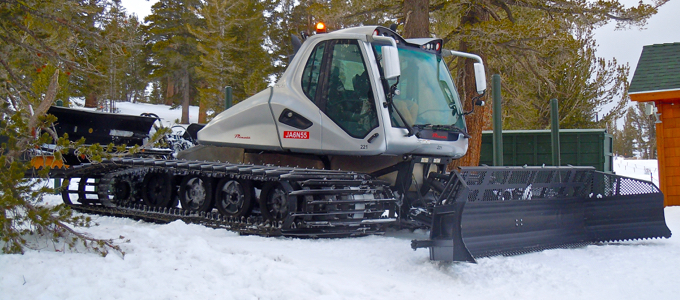
Improving the snowcat fleet will help reduce emissions. Photo/LTN file

While California and Vail Resorts tout their environmental initiatives, the United States as a whole will not attain the goals set forth in the Paris accord without other states and large companies following their lead.

At the ski resorts there will be no immediate impact to skiers or other guests. What they are likely to notice is information being provided to explain the program, and food being served in recyclable or compostable containers.

Lake Tahoe News asked: How can there be zero waste to landfills when guests bring their own food/waste? The answer: silence.

Today, about 60 percent of Vail’s waste ends up in a landfill. By 2020, the goal is to reduce that to 50 percent, with 100 percent diversion planned for 2030.

More efficient grooming practices is one way to help reach the company’s goals.

“Our commitment to energy efficiency includes reducing fuel usage in our mountain operations vehicles – from snowcats to shuttle buses to Colorado Mountain Express. As the mountain resort industry leader, we’ve had the opportunity to pilot the latest technology for grooming, hybrid-electric snowcats and are working with vendors to improve those technologies,” Cooper said. “We’ve also invested in state-of-the-art grooming efficiency software which is being piloted in Colorado in anticipation of a companywide roll out.”

Another way to be more energy efficient is with better chairlifts. This will happen at Vail, Beaver Creek, Keystone and Breckenridge in Colorado before next season. No chairlift upgrades are planned this year for any of the California Vail-owned resorts. Considering Kirkwood Mountain Resort mostly has outdated infrastructure and Heavenly still operates a two-person lift, there is plenty of room for improvement locally.
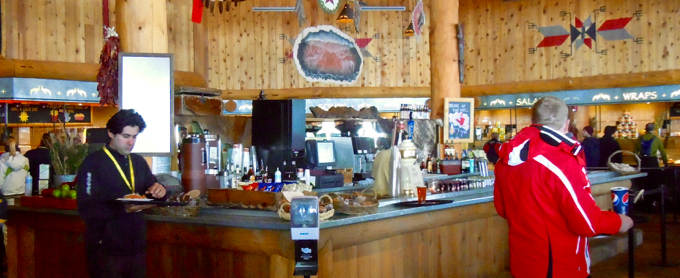
The goal is in 13 years to not have any food product go to a landfill. Photo/LTN file

New lifts often require the elimination of trees.

“Under our commitment, any tree removal would be offset by replanting or restoring forests and trees equivalent what may be removed acre for acre. We’re partnered with the National Forest Foundation, the nonprofit arm of the U.S. Forest Service, to identify and prioritize opportunities for reforestation and improving the health and residency of existing forests in or around our resorts,” Cooper said.

However, he would not say if the replanting would actually occur in the same forest where the trees were removed.

Whistler Blackcomb’s progressive environmental policies helped push its new owners to make this similar commitment companywide. It is being called the Epic Promise for a Zero Footprint. Vail bought the Canadian resort a year ago.

“For our zero net emissions goals, we are working with Ceres, Rocky Mountain Institute and RE100. To accurately track our progress toward zero waste, we are piloting a new waste tracking software solution. For our commitment to zero net operating impact to forests and habitats, we are partnered with the National Forest Foundation and the U.S. Forest Service and will continue to leverage their established methodology for identifying opportunities and managing forestry projects,” Cooper said. “We will work with these and other third-party organizations to study and report on the long-term impacts of these projects. We will plan to share the company’s progress in an annual sustainability report, following the close of the fiscal year ending July 2018, which will follow the Global Reporting Initiative’s standard.”

RE100 is a group of companies with the same goal of using 100 percent renewable energy; including Anheuser-Busch InBev, Coca Cola, Apple, Google, Facebook, Microsoft, Nestle, Nike and Starbucks.

This is how Vail plans to achieve its goals:

·      Reduce electricity and natural gas use 15 percent on top of the 19 percent already achieved since 2008 by improving operating practices and investing $25 million in innovative, energy-saving projects, such as low-energy snowmaking equipment, green building design and construction, and more efficient grooming practices and equipment.

·      Purchase 100 percent renewable energy equivalent to Vail Resorts’ total electrical energy use and working with utilities and local, regional and national governments to bring more renewable energy to the grids where the company operates its resorts.

·      Investing in programs such as tree planting to offset the use of other types of energy like gasoline and diesel.

·       Engaging with vendors and suppliers to reduce their emissions and environmental impact.


Opinion: The overlooked weather trackers

By Roger Turner

You’ve probably never heard of the Air Resources Laboratory. I hadn’t until two years ago, when I was hired to preserve a trove of oral histories recorded in the early 1990s. Those audio cassettes held a history of hidden science, full of amazing stories about nuclear explosions, air pollution, and volcanoes. I encountered scientists whose research had strengthened national security, improved emergency response, and protected human health for almost 70 years—with barely any credit or acclaim.

And with the lab now under threat of budget cuts, it’s all the more important to understand its little-known history.

The Air Resources Laboratory (ARL) researches atmospheric transport, dispersion, and diffusion—how dangerous things move around in the air. It is part of NOAA (National Oceanic and Atmospheric Administration), the government agency that monitors the oceans and atmosphere to help individuals, businesses, and the government make informed decisions.

The ARL began in 1948, as a handful of security-cleared Weather Bureau meteorologists whom other government agencies could rent to answer questions about nuclear fallout. The lab met its first challenge a year later, when an Air Force “bugcatcher” trapped radioactive dust during a flight between Alaska and Japan in 1949. ARL scientists tracked the air mass backward to deduce potential sites of the first Soviet atomic bomb test.

The Atomic Energy Commission became the ARL’s primary client as open-air nuclear testing intensified through the 1950s. ARL scientists worked in Nevada to delay blasts when nuclear debris was likely to blow over urban areas. The Atomic Energy Commission originally assured citizens that radioactive debris would remain safely suspended high in the stratosphere. But ARL research challenged that claim. The ARL showed that debris would fall out of the atmosphere before most of the radioactivity decayed, and that dangerous fallout would concentrate in the middle latitudes of the Northern hemisphere. This discovery set the stage for the Limited Test Ban Treaty negotiations in 1962; ARL expertise informed sections on monitoring compliance.

During the Cuban Missile Crisis, ARL meteorologists prepared daily forecasts for dozens of cities, predicting how fallout would travel in case of an atomic attack. Throughout the Cold War, ARL staff practiced deploying to the doomsday bunker buried beneath Mount Weather in Maryland, where they would track fallout and advise the surviving leaders of the U.S. government during a nuclear war.

Nuclear bombs aren’t the only things that shoot dangerous dust into the stratosphere. In December 1989, a 747 flying above Alaska lost all four engines when it flew through a cloud of invisible volcanic ash. The Federal Aviation Administration sponsored ARL scientists to develop a computer simulation that allows airlines to find the most efficient ways to safely avoid ash plumes. Similar models continue to direct global air travel, including during the 2010 eruption of the Eyjafjallajökull volcano in Iceland.

As nuclear testing declined and the environmental movement grew, new agencies began to request the ARL’s expertise. The Public Health Service and later the Environmental Protection Agency sought to understand the movement of air pollutants. The lab conducted field experiments to verify its computational models. One smog experiment tracked radar-reflective pyramid-shaped balloons, called tetroons, across the Los Angeles basin. An experiment related to acid rain measured the dispersion of distinctive chemical “tracers” over continental distances. Today, one of the lab’s jobs is to study mercury deposition, a potentially serious pollution problem caused largely by burning coal.

Understanding atmospheric transport is essential to many kinds of emergency response. The lab’s research guided government responses to the nuclear accidents at Three Mile Island, Chernobyl, and Fukushima. The lab’s HYSPLIT computer model helps the National Weather Service protect first responders during chemical spills. First deployed in the 1980s and iteratively improved since, the model integrates current weather observations with information about a chemical release to predict where toxic substances will go and in what concentrations. In the wake of the Sept. 11, 2001 attacks, the ARL’s Field Research Division conducted tracer experiments in Manhattan and other urban areas to explore how chemical or biological weapons might disperse at ground level. This work can aid emergency personnel in case of a dirty bomb or bioweapon attack.

Listening to the scientists tell these stories, I was struck by the absence of self-promotion common in oral histories of Nobel Prize winners or scientist-entrepreneurs. The ARL staff were modest people content to have made a modest contribution to the problems of their time.

But this modesty is dangerous in an era when government and science are often denigrated. The government rarely gets credit because the benefits of its scientific services are designed to be invisible, like plane crashes that don’t happen, chemical burns that don’t kill and maim, and people who aren’t poisoned. And the ARL costs less than 2 cents per American per year—NOAA has been famously frugal since the 1930s, when its predecessor, the Weather Bureau, instructed weathermen to write on both sides of every sheet of paper.

While the work of the ARL is worth knowing on its own terms, it can also stand in for a swath of hidden science. We think a lot about the kinds of science that are culturally influential, but much less about the science that is practically important. There are many organizations across the federal government like the Air Resources Lab, modest groups of researchers whose quiet expertise makes us safer. We forget about their service at our peril.

Roger Turner is a historian of science and Research Fellow at the Chemical Heritage Foundation in Philadelphia. He writes about surprising images and atmospheric science at PicturingMeteorology.com. He wrote this for Zócalo Public Square.


An athlete’s ode to the potato

By Michael Easter, Outside

 I spent the first few years of my life in Idaho and have always eaten potatoes—white, usually baked, sometimes mashed or sautéed with eggs. This alone doesn’t make me unique—potatoes are the largest vegetable crop in the United States—but the rate at which I eat the root vegetable might make me a standout.

I consume them four nights a week and will proudly tell you that a baked russet potato with sour cream is my favorite food. Especially the oversized variety you find accompanied by fatty slabs of prime rib served in Western saloons or smoky casino diners in small gambling towns. (The two best baked potatoes in the country, for what it’s worth, are found at the Pioneer Saloon in Ketchum, Idaho, and the Virgin River Hotel and Casino River Café in Mesquite, Nevada.)

I believe you can largely forget about exotic, exorbitant eats like goji berries, chia seeds, and coconut oil. The humble spud is the real superfood.

Read the whole story


Youth tennis lessons available in Douglas County

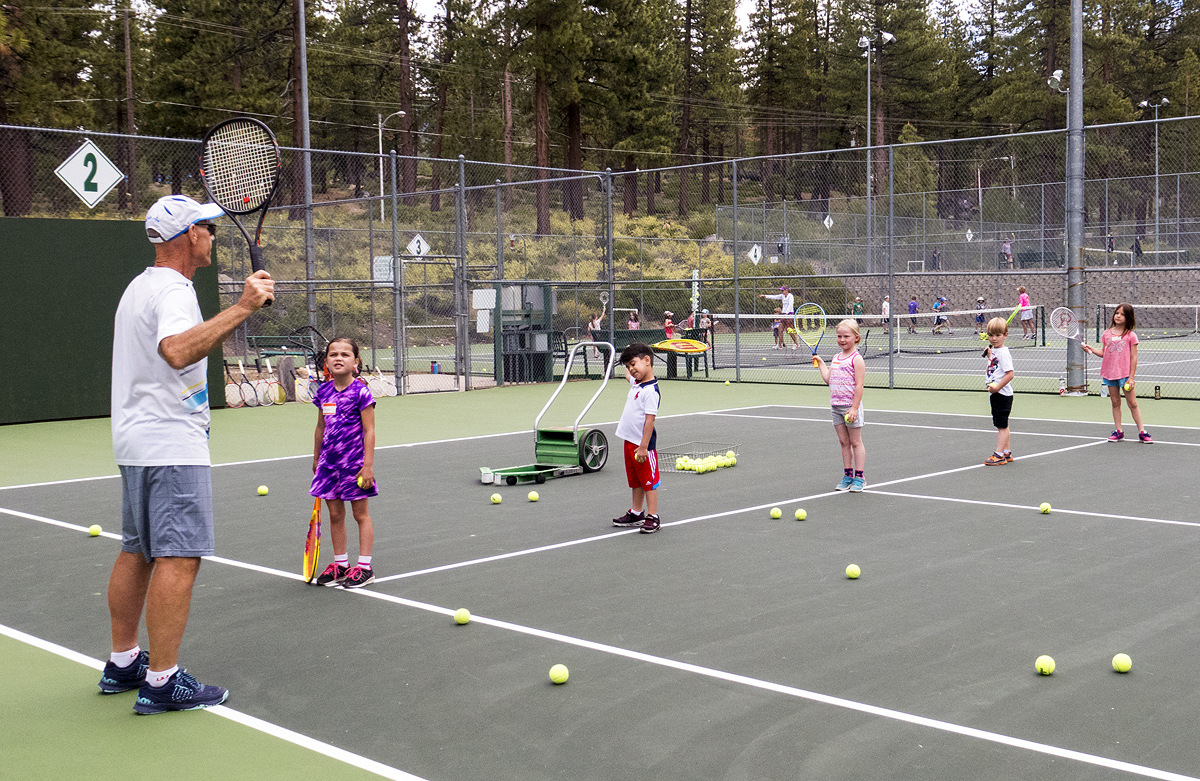
Dave Nostrant in August will be teaching another group of kids how to serve. Photo/ZCTC

A six-day tennis class is being offered for youth ages 4-12 at Zephyr Cove Tennis Club.

Instruction is provided by Dave Nostrant, who has been teaching for more than 30 years. Nostrant is a highly sought after pro who is in his first year at Zephyr Cove.

He is popular with youngsters because he is able to effectively blend fun and seriousness on the court. Nostrant also can juggle various ability levels so every child gets the appropriate instruction and individualized attention even in a group setting.

Classes are Aug 1-3 and Aug. 8-10. For ages 4-7 they will play from 1-1:30pm, with those 8-12 on the courts from 2-3pm. Cost of the younger kids is $35 and $75 for the older kids.

Bring a racket, water and sunscreen, and wear non-marking shoes.

Space is limited. Sign up online.


Dems going after Calif. GOP congressional seats

By Angela Hart, Sacramento Bee
 
Regina Bateson was one of 750 people who at an April town hall listened to Republican Congressman Tom McClintock voice support for efforts by leaders of his party to scrap Obamacare, question the science behind climate change and dismiss the need for an investigation into Russian meddling in the 2016 presidential election.

It was a pivotal moment for her. Soon after, she launched her campaign for California’s 4th Congressional District, a deep-red Republican stronghold encompassing the heart of the Sierra — including Lake Tahoe — that McClintock has represented since 2009.

Bateson, a Democrat and political newcomer, is one of more than 40 Democrats challenging Republican incumbents next year in 11 of the 14 House seats California Republicans hold in Congress. Between April and the end of June, the first quarter she filed, Bateson raised almost $100,000 – more than any Democrat running in the district has raised in a first quarter.

Read the whole story


Electrical issue forces evacuation of SLT hotel

Guests at Lake Tahoe Vacation Resort mill about outside July 25 after being evacuated. Photo/SLTFD

Guests at Lake Tahoe Vacation Resort in South Lake Tahoe were evacuated briefly Tuesday night when a fire alarm went off.

Firefighters said soldering in the wall on the fifth floor activated the alarm on July 25. Soldering is used to connected electronic components.

As of 6:30pm all the guests were allowed to return to their time shares on Ski Run Boulevard. They were out of the complex for about 30 minutes.

A call to the hotel was not returned.

— Lake Tahoe News staff report