Book delves into Nevada politics

By Sean Whaley, Las Vegas Review-Journal
 
CARSON CITY — Those interested in Nevada history can check out a significant new addition on the subject with the publication of “Mister Speaker to Madam Speaker,” a labor of love for Carson City resident Cindy Southerland.

The hardbound volume is a compendium of biographies of the speakers who oversaw the Assembly in the Nevada Legislature, starting with three territorial officials who served in what was then called the House of Representatives.

It takes the reader up to the 2013 session of the Assembly, recounting all 65 speakers along the way, including two women: Barbara Buckley and Marilyn Kirkpatrick. The 1995 Assembly also had the distinction of having two speakers who shared duties — Joe Dini, a Democrat, and Lynn Hettrick, a Republican — because there was a 21-21 tie.

Read the whole story


Tips to prevent bike from being stolen

Truckee police are warning cyclists to lock their bikes to help prevent it from being stolen.

High-end downhill mountain bikes are what thieves like. Most thefts involve expensive bikes being stolen out of vehicles that were unattended. The thieves have cut cables on bikes locked to vehicle racks and other simple locking mechanisms.

The Truckee Police Department recommends using a high quality bike lock, and recording the serial numbers on the bike upon purchase. Not doing so can make it difficult for the rightful owner to get her bike back.

Proper locking is the first defense against bike theft. Officers say to use a hardened-steel U-lock as a primary lock. Cable locks and cheap U-locks can easily be cut. Secure your wheels with locking skewers (best) or cable around both wheels. Lock the U-lock to the bike frame (never just the wheels) and to a secure rack or pole.


Snippets about Lake Tahoe

·      Lake Tahoe Community College’s Intensive Spanish Summer Institute kicks off July 31 with a special appearance from Selene Barceló, consul for community affairs at the Consulate General of Mexico in Sacramento. She will take part in the opening session at 7:45am in the plaza located in front of the library. She will then make a presentation in Spanish at 9am in Duke Theatre. At 10am, she’ll make the same presentation in English.

·      A partnership between Sierra Nevada College and Truckee Meadows Community College is bringing a four-year degree completion program to the TMCC campus starting this fall. Programs being offered include global business management, entrepreneurship and psychology.

·      The Loft in South Lake Tahoe is having winemaker dinner with Michael David Winery on Aug. 16. For more info, go online.

·      The next cannabis dialogue meeting will be Aug. 22, 6pm at the Truckee Town Council meeting at the airport.

·      The zero tolerance trash program starts Aug. 1 in Incline Village. This means no gaps in trash lids and no bags next to a trash can.


Breezy Jack Johnson makes Tahoe connection

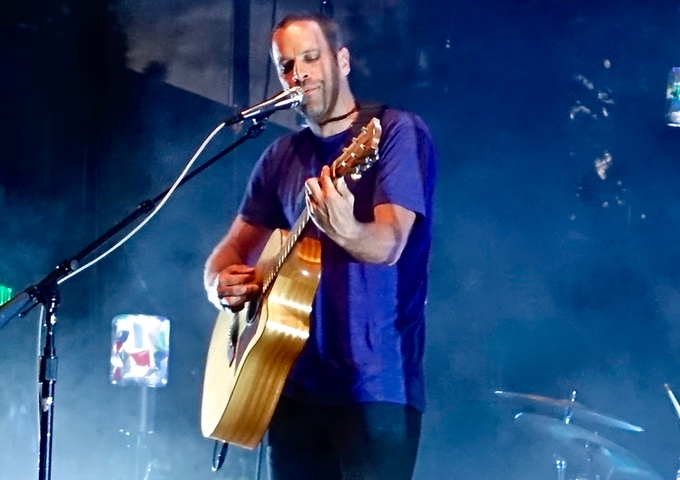
Jack Johnson will return July 29 to the stage at Harveys for his second consecutive sold-out show. Photo/Kathryn Reed

By Susan Wood

STATELINE – Donning a Keep Tahoe Blue T-shirt, singer-guitarist Jack Johnson made his priorities clear early on to the environmentalists and fans on hand for the Harveys Summer Outdoor Concert Series Friday night.

Booths to support his philanthropic, eco-friendly messages, soft rock smooth enough to provide the urge to swing in a hammock to gentle breezes, and a painter’s palette sky marked the evening.

“They told me you’d be kind, and a beautiful sunset was happening,” Johnson told the crowd after the opening number from his four-member band. He was referring to ALO — Animal Liberation Orchestra – that first took to stage July 28.

Johnson isn’t your average rock singer-songwriter. For starters, even before he started playing, the Johnson Ohana Foundation he created with wife Kim donated $4 million to 400 nonprofit agencies around the planet. Among them are the League to Save Lake Tahoe, Sugar Pine Foundation, Sierra Watershed Education Partnerships, Clean Tahoe and Tahoe Rim Trail Association.

Johnson puts his money behind his claims of caring about the environment. In 2008, he adopted the concept of “greening” meaning reduce and reuse – applying the concept to the 2010 tour.

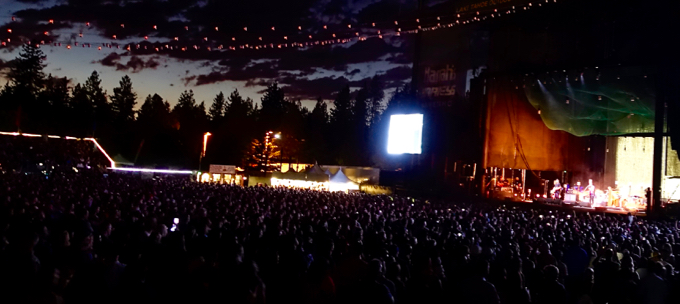
The musician, who was also a professional surfer in Hawaii, has developed quite a following. A mass of people showed up Friday night — general admission style – standing and dancing most of the time in the Harveys back parking lot.

The cool vibe was accentuated by the show the night sky was giving, as well as the melodies and effects on stage.

During his landmark love-lorn tune “Sitting, Waiting, Wishing” off the “In Between Dreams” album of 2005, smoke billowed from the machine on stage. It was as if Johnson sent his audience to the Na Pali Coast of Kauai, where the fog rolls into the valleys in a dream state.

Thousands of fans sway to the music of Jack Johnson on July 28 at Harveys. Photo/Kathryn Reed

“This is the kind of music that transports you,” South Lake Tahoe City Councilwoman Wendy David summed up, while embracing the free-flowing style of the artist with her husband, Kerry, from the bleachers.

When he broke into his hit single “Upside Down,” the crowd roared as he sang “I don’t want this feeling to go away.”

He urged the concert-goers to raise their kids in the air to get the full effect of the vibe, which was essentially created for them since the song comes off the album “Sing-A-Longs and Lullabies for the Film Curious George.” The kid-friendly band at one point even brought a stunned boy in the front on stage to use his light sabers to spur audience participation.

Coco McCue of Gardnerville thought of her grandson, who couldn’t make it that night.

“He loves Jack Johnson,” she said, citing the youngster’s love of Curious George. McCue, who owns a few of Johnson’s albums, sat in the bleachers enjoying the high view over the sea of people crushed in to make their connection with Johnson. 

Johnson also helped with that connection by enlisting a drummer straight out of Tahoe, introducing Adam Topol. Topol called out to North Tahoe High School graduates and asked who’s been to Tahoe City hangouts like Rosie’s. The audience responded with vigor.

Johnson and Topol apparently joked with each other about Tahoe’s high elevation.

“Man, do you feel this altitude?” Johnson recounted asking Topol.

In turn, Topol supposedly told Johnson it was “nothing” and that’s because he “grew up here.”

The drummer consequently showed off his specific jazzy, Afro-Cuban percussion fundamentals throughout the night. His journey demonstrated it was a far cry from when he started out touring school talent shows, while later discovering at USC that people actually pay to hear bands. He recalled playing cover songs at a party with a homegrown band, in which “someone gave me $50, and I got this girl’s phone number,” the band’s website read.

The perform-for pleasure, laid-back-surfer lifestyle and mentality of Hawaii and Santa Barbara permeated the whole evening with Johnson’s band as well as California-based ALO. The ensemble joined Johnson on stage for a set, highlighted by the sensuous “Girl I Wanna Lay You Down” and “Big Sur” that the front man said “because this song is about that.” He described the beach scene around a campfire where a pick-up band would improvise music.

Johnson’s small band had highlights of its own – in particular his keyboardist Zach Gill, who occasionally brought out his buka for accompaniment. The Japanese wind instrument provided a bellowing style to tunes.

And in pure Hawaiian style, Johnson added to the latest craze among wannabe musicians by pulling out his ukulele for the sweet, sentimental “Breakdown.”

Within a long encore, Johnson even launched into a special song about gambling with Willie Nelson, declaring the legendary country singer “got stoned and took my cash.”

Diverse and eclectic, Johnson and his band not only delighted the concert-goers with other fan favorites like the cute “Banana Pancakes,” in addition to “Better Together” and “Good People.” The latter two have a social conscience message about the quest for a tender goodwill and respectable humanity.

He received a rousing applause near the end of the night with “Home,” citing it’s “wherever we are,” a song he wrote for his three children on the North Shore of Oahu.

“You guys made us feel at home,” he told the crowd.

Harveys shares the love a little longer this summer with more shows to come, including: the second Johnson show tonight; Slightly Stoopid on Aug. 4; The Who on Aug. 16; and performances by Eric Church on Sept. 2-3. 


Interior secretary to be in Nevada next week

By Henry Brean, Las Vegas Review-Journal

Ryan Zinke

Interior Secretary Ryan Zinke will be in Nevada on Monday as part of his review of national monuments in the Silver State, according to a rural county commissioner who said he has been invited to meet with the Trump Cabinet member.

The Interior Department has not yet announced the visit, but Nye County Commission Chairman Dan Schinhofen said he and other local officials are scheduled to meet with Zinke at 11 a.m. Monday at the community center in Overton, 65 miles northeast of Las Vegas.

Zinke is in the midst of reviewing 22 national monuments and five marine national monuments created by presidential decree since Jan. 1, 1996, to determine if the designations should be scaled back or eliminated. The Interior Department announced Wednesday that Zinke will be in New Mexico for three days starting Thursday to tour the Organ Mountains-Desert Peaks National Monument near Las Cruces.

Read the whole story


Burke Creek project to be completed in mid-August

The Lake Tahoe Basin Management Unit will begin the final phase of the Burke Creek project begins Monday.

Restoring the Burke Creek channel and adjacent marsh aims to decrease the amount of sediment that flows into Lake Tahoe and reduce the potential for flooding on Highway 50. 

During this final phase, the LTBMU will use heavy equipment and ground crews to decommission approximately 500 feet of the old channel and connect the new channel to the culvert, which conveys Burke Creek under the highway and was installed in 2016. 

Work is expected to be complete by mid-August.


Ex-LTBMU, TRPA leader to give talk

In Bill Morgan’s book, “Morgan’s Tahoe,” he tells more than 30 stories of happenings at Tahoe in which he was involved from 1965 to 1989. That period was one of the most turbulent times in Tahoe’s history.

As forest supervisor of the Lake Tahoe Basin Management Unit, followed by several years as executive director of the Tahoe Regional Planning Agency, he was caught up in the turbulence. His firsthand knowledge of those happenings has given him a unique perspective of Tahoe in those days. 

He will share a few of the more fascinating episodes, in particular ones that led to the spirit of cooperation on environmental matters that Tahoe is known for today, on Aug. 24 at 6pm at the Tahoe Environmental Research Center on the campus of Sierra Nevada College.

Registration for this event is required. Seating is open at 5:30pm to guests who have preregistered, open seating starts at 5:5opm.

A $5 suggested donation will be collected at the door.


Recently discovered toad species in Nev. face threats

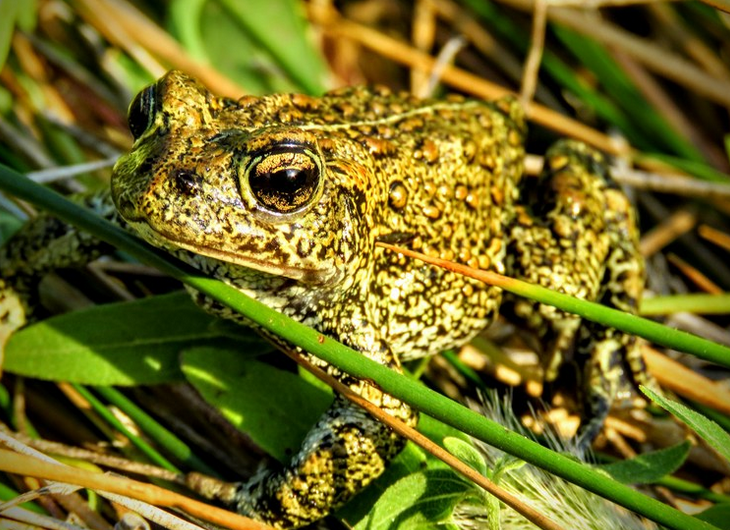
Dixie Valley toads inhabit Nevada’s Great Basin. Photo/Patrick Donnelly/Center for Biological Diversity

By Maya L. Kapoor, High Country News

Researchers at UNR have named three new toad species: the Dixie Valley toad, the Railroad Valley toad and the Hot Creek toad. This is an especially exciting feat because it’s rare to find new species of any amphibians, the class of animals that includes toads, frogs, newts, salamanders and caecilians.

The most recent toad discovery north of Mexico, the Wyoming toad, was found almost half a century ago in 1968, and it has since gone extinct in the wild.

And while it’s rare to find new amphibians anywhere, these toads are particularly intriguing because they live in the Great Basin region of Northern Nevada, which is one of the driest parts of the country, averaging slightly more than 13 inches of rain per year. The toads thrive in tiny, naturally occurring oases such as small springs, wetlands or seeps, where thick vegetation makes them hard to spot during the day, according to a statement by researchers.

Read the whole story


Opinion: Granddaddy’s version of racism in America

By Myah Genung

I lived most of my childhood convinced that my grandfather, Calvin Muldrow, was Superman. On summer evenings, I’d perch atop his knee as we sat on the creaky back porch of his red brick house in North Little Rock. He’d weave elaborate tall tales about his magical excursions gliding over the jungle canopies of Sierra Leone, or wrestling boa constrictors, or floating aloft past my bedroom window at night to check up on me.

Granddaddy had a way of blending the fact and fiction of his past into a magic realism that left me curious and amazed. Among many things, he taught me that Superman’s powers could open stubborn pickle jars, that you could pick a decent watermelon by thumping it, that golf was a dumb but fascinating sport, how to solve crossword puzzles, how to drive a car, and that it would suffice in life to have all of what you need and most of what you want.

On one topic, however, he could frustrate me to no end. As a child, I had a defiant desire to live my life optimistically colorblind. Granddaddy, however, seemed determined to judge the world based on black and white. I didn’t see it then, but I’ve begun to think that maybe we both were right.

When you’re a black person born and raised in the American South, navigating whiteness is an acquired life skill. In school you might watch movies about the assassination of Medgar Evers at the hands of a white supremacist, read chapters in your books about white mobs throwing Molotov cocktails into buses filled with Freedom Riders, or hear about the carnage on the Edmund Pettus Bridge. But even before this formal education begins, you can feel the weight of the South’s Jim Crow past. It envelops you like a hot wet blanket on a humid Arkansas summer night.

I was 4 years old when I first felt the urge to gasp for air under that heavy load. The initial burn came from a preschool classmate, a little white boy who called me a “nigger” for taking too long to go down the slide at recess. The second came from three little white girls in the same class who wouldn’t let me join their pretend game of “Let’s Be Kittens” because they didn’t want “any black cats in the sandbox.”

I felt ashamed, those nights, when my mother asked if I made any friends at school. I only reluctantly recounted my experiences. She would tell me that the girls and boys treated me this way because their parents taught them to. White hostility toward blackness was a symptom of a hereditary disease, passed down through generations. My mother wasn’t angry with the world, but rather sorry to see her daughter experience the only slightly faded shadows of the same darkness she grew up with.

In the ’60s my mother had been one of a few black students to integrate an all-white middle school in Arkansas. She was 12 years old and determined to make a good impression. She would defy the preconceived notions harbored by racist whites that black kids from the “other side of the tracks” were unlearned, uncouth, and unworthy of friendship. Still, her lunches were spent at a table alone. When she wasn’t entirely ignored, she was met with cruel pranks and sneering looks.

I can only imagine that watching his daughter endure this treatment colored my grandfather’s approach to raising me. Granddaddy was born in North Little Rock, Ark., in 1924 in a house near the train tracks. His skin was the color of coffee with no cream, and he had three sisters of the same hue. In his old age my sister Faith and I were the apple of his eye—and over the course of 88 years his eyes saw a lot.

At 19, granddaddy was drafted into the segregated U.S. Army and shipped overseas to serve in Wales, France, and Germany. His all-black regiment’s shoes and socks were secondhand. When their train passed through town, French locals jeered at the soldiers and called them “monkeys.” Eventually, granddaddy said, he and his friends would just lower the train-car window curtains. Out of sight, out of mind. After three years abroad in service he returned home to more of the same. He had to pick up prescriptions at the local pharmacy’s back door. He had to sit at the rear of the bus.

Thanks to the GI Bill, granddaddy enrolled at Philander Smith College, a historically black school in the area, where he met my grandmother. They married in 1949 and moved to Glenview, one of the few subdivisions of North Little Rock where blacks could purchase property. My grandfather taught English and became the principal of the elementary school I later attended. He and grammy never left their little red brick house on Glenview Boulevard.

My family and I followed a different path. When I was 8 years old we moved to Los Angeles, and I saw colors beyond black and white for the first time. There I met kids with last names like Mohamed and Cheng, who worshipped on prayer mats or not at all. My fourth-grade classroom resembled an ad for United Colors of Benetton. I felt at home in a Technicolor world where my skin didn’t determine who could be my friend.

So when we moved back to Arkansas two years later, I had a renewed sense of the world that didn’t quite jibe with my grandfather’s views. Arkansas boosters used to call their state the Land of Opportunity.

“The opportunity to get your hat and run,” granddaddy liked to add, with a chuckle.

I scoffed at his sense of resignation to the way things had always been. One night during the first week of sixth grade I came home from school excited to tell him about my new friends. “Are they black or white?” he asked. My heart sank. I was angry, and told him that he was stuck in the past. My white friends didn’t see color, and neither did I. “You’ll learn,” he’d say. “Most white people in life think you’re beneath them because it’s all they’ve known. There are only a few good exceptions.”

It didn’t occur to me, back then, that this was a coping mechanism he’d crystallized over time: Assume you will be greeted with prejudice and the inevitable outcome will sting less. It also didn’t occur to me that he was not entirely wrong. Decades of legal discrimination and indoctrinated prejudice manifest in myriad forms and to varying degrees, and they don’t disappear overnight.

When I was 6 years old, I represented my class during a live press conference with President Bill Clinton, the Arkansas native after whom my school, William Jefferson Clinton Elementary, had been named. I wasn’t called on during the press conference but had prepared a question just in case. I’d taken to painting and wanted to ask him if he knew the primary colors—red, blue, and yellow.

I have a vivid memory of walking alone through the double doors of my elementary school that day, hoisting my backpack onto a conveyor belt and watching it glide through the silver screening machine. The Secret Service waved the scanning wand across my red pleated dress and down to my brand-new black-patent Mary Janes. Meeting the president is a daunting occasion for any American, let alone a kindergartner. But in our family little girls who meet the president had to look the part—and my mother made sure I did.

Today I see this as an extension of the lessons that my grandparents taught my mother when she was set to integrate that hostile all-white school. Speak well. Dress well. Ask intelligent questions. Prove them wrong. It didn’t matter so much that it was 1994 and segregation was a thing of the past. The tension lingered on.

It’s kind of funny that President Clinton, who’s clearly white, was honored as the “first black president” at a dinner for the Congressional Black Caucus in 2008. Clinton took kindly to it. It was a recognition of a mutual affinity he seemed to develop with the black community. He, too, had grown up in the South and had struggled to make ends meet. He had befriended Vernon Jordan, played the saxophone, and loved Southern barbecue. He enlisted Maya Angelou to recite her poem, “On the Pulse of Morning,” before he was sworn in on the National Mall. He was a powerful white man who seemed at ease with black America.

History has rightfully trained a more critical eye on Bill Clinton’s policies and their effects on black society. But back then older Southern blacks, like my grandfather, accepted him as openly as he embraced them. He was “The Man from Hope,” one of the “few exceptions” granddaddy had told me about. Bill Clinton wasn’t a black President, but in my grandfather’s eyes, he was likely the closest we’d get.

At age 18 I left Arkansas still defiantly optimistic that more was possible. This was around the time a young senator from Illinois named Barack Obama was challenging Hillary Clinton for the Democratic nomination to be president. Granddaddy didn’t expect Obama to win even the nomination, much less the presidency.

On Election Night 2008 I called granddaddy from a jubilant and chaotic Times Square in New York City. By this time, I was a sophomore at New York University. Barack Obama had just been elected. With tears in my eyes and tightness in my throat, I shouted into my flip phone, “Granddaddy, can you believe he won?” I couldn’t make out all of his words but from the sound of his voice I knew he was smiling and that his deep set eyes, made blue with age, were beaming. America had elected its first actual black president, against all the perceived odds.

Granddaddy died in 2012. I’ll never forget something my great-aunt Rio told me after his funeral: “You know he loved you, fiercely and with all of his heart.” I did know this—and it explains the lengths he went to prepare me for the world’s bitter surprises, even when it meant we butted heads on politics and race. I also have the comforting memory that, for one fleeting moment, I felt my grandfather see the world through my defiantly optimistic eyes.

Myah Genung worked several years in the film industry before joining a nonprofit organization based in Los Angeles. She has a master’s degree in specialized journalism for the arts and studied film as an undergraduate in New York. She wrote this for Zócalo Public Square.
Amodei: Trump can’t pardon himself

By Ray Hagar, Nevada Newsmakers

The congressman who served as head of Nevada’s Trump-for-president campaign said Wednesday on Nevada Newsmakers that Trump should not have the power to pardon himself. 

Nevada’s 1st U.S. House District Rep. Mark Amodei, R-Carson City, gave his opinion in response to President Trump’s recent statement on Twitter that the U.S. president has the “complete power to pardon.”

“Would a governor commute his own sentence?” Amodei said. “I mean, the self dealing. I mean we’ve got rules about nepotism, I mean, this is nepotism on steroids. It is total self interest.”

Read the whole story