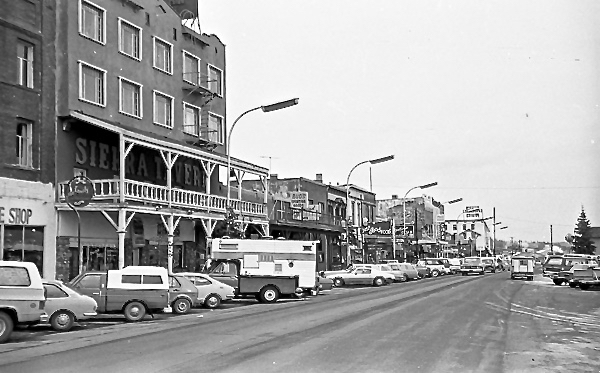
Downtown Truckee has the feel that it did decades ago. Photo/John Corbett (year unknown)
By Susan Wood
TRUCKEE – The Sierra Nevada town known for its deep snow, cold temps, growth potential, pedestrian-friendly downtown and outdoor lifestyle celebrates a milestone this September of its most significant achievement – its history.
The town marks a quarter century of incorporation on Sept. 8, with a grand picnic and new town photo. The first one featured about 6,000 people (more than half the population in 1994) and was taken from a fire engine ladder.
But to get a true sense of Truckee’s history in terms of its people and progress, one needs to perhaps date it in dog years. The establishment of the haven along the Interstate 80 corridor just north of Lake Tahoe covering a 34 square-mile swath of mountain and valley terrain dates back to 1863.
Through the years, the town flourished with lumber mills, a working railyard, a meandering river and later tourism – the latter responsible for the surge in interest of snow sports and on-foot travel. (One could argue there’s a reason the Donner Party braved treacherous conditions to get to a better life.)
Many others have followed. For the most part, Truckee has made all the right moves. This is according to historians, business owners, resort workers, city leaders and other stakeholders.
The number of permanent residents has grown to more than 16,000 living in 13,000 housing units. And with a population that can suddenly boom on a winter or summer holiday weekend to 30,000 people counting tourists who may dream about staying forever. Those 13,000 units can quickly fill to the point in which nearby Northstar ski resort has a housing specialist on staff. Some workers commute from Reno.
This may be what happens when one has too much of a good thing.

The Truckee Hotel is barely visible in winter 1890. Photo/H.K. Gage
Seizing on and maintaining a good thing
Stefanie Olivieri knows the town’s peaks and valleys first hand.
The lifelong Truckee resident will commemorate a milestone of her own this 4th of July upon her clothing store started by her parents reaching the centenarian mark.
Cabonas, in the center of the historic district, opened as a general store selling worms, tackle, guns, work clothes, appliances and diapers – all the necessities 100 years ago. A gas pump sat outside, fishing flies were made inside.
She worked with her two siblings in the 2,500-square-foot store at 9 years old. So, when her parents retired in 1967, a light bulb came on.
“I was the one who loved it most,” she said.
The 75-year-old pioneer expanded the clothing lines to include more sportswear.
“The town sort of grew up around us,” Olivieri told Lake Tahoe News.
Olivieri vividly remembers when Nevada County approved a Kmart to be built before Truckee’s incorporation. It was a watershed moment in which the town’s fathers, pioneering families and visionaries decided to be the “determiner of our own destiny.”
Big box stores were viewed as almost sacrilege to those trying to hold on to the charm and quaintness of their village.
“We nipped that in the bud,” she said.
And so it goes with Truckee’s grand achievements intertwined with its one perplexing issue plaguing a lot of resort communities people love to death.
The lack of housing led Olivieri to last year log seven months manning the store without a day off because she couldn’t find workers who could afford to live there.
It’s an issue Truckee’s second town manager and first mayor are quite familiar with.
Who would have thought that the wise decision to incorporate and let smaller government pave the way for its own future would have led to such a wagon-train style insurgence from the Bay Area?
“A big change occurred in this community in the 1970s,” said Tony Lashbrook, who recently retired as the town’s manager. He recalled the town’s history over breakfast at the Squeeze Inn with Lake Tahoe News, along with 1994’s mayor, Kathleen Eagan. The two hugged and spoke in unison as if they’ve known each other a lifetime.
Lashbrook listed the building of the Tahoe Donner community, one of the largest in the United States with 6,000 lots, as one example of Truckee’s growth potential seen decades ago. Plus, the addition of Northstar ski resort in less than a five-year period essentially placed Truckee on the map, following nearby Squaw Valley’s hosting of the 1960 Winter Olympics.
“Alex (Cushing) was a visionary – eclectic. He may not have had a regional vision, but he had a Squaw vision,” Lashbrook said of Squaw’s founder.

Truckee has had three town managers in 25 years, with Tony Lashbrook No. 2 and recently retired. Photo/Susan Wood
Taking names and taking charge
To Lashbrook, it was up to government with him working in community development at the time to rein in expenses and allocations. All the while, the first priority was taking the resources away from a county that appeared removed at times at understanding the town’s character.
“We thought we could do a better job with the same amount of resources,” Lashbrook said.
If anything, the idea of a big box store as development represented the catalyst for forming its own town government to service the half permanent population, half transient that still exists today.
In the 1990s, the community saw the writing on the wall as the Tahoe Regional Planning Agency placed its grip on development along the lake.
Truckee stakeholders decided to be proactive and deflect the building interest while abiding by its longtime citizens’ wishes.
“I think we’re darn community oriented,” Lashbrook said.
To prove that point, the question on the ballot asking to incorporate was followed by a crucial second: “We asked whether to be a town or a city,” Lashbrook said. With 72 percent voting in favor of forming its own government, an even larger percentage declared it wanted to be called “a town” – a psychological precursor to how the community folk saw themselves.
Beyond land-use, snow removal and street maintenance were main considerations, along with public safety. Lashbrook chuckled with Eagan as they recalled more police showing up on the roads.
“All of a sudden there were cops everywhere because now they live here,” Lashbrook said.
Certainly, pulling away from the county and taking charge of such a large area posed a risk.
“We had a doomsday scenario, but we knew we were all in this together,” Eagan said. “We knew we bit off a big part of the hamburger.”
When objections and concerns arose, “they were not dismissed,” Eagan insisted. “There was minimal backlash that ended in remarkable joy.”
The forming town had a financial plan to address costs. And Eagan, being a retired San Francisco banker, worked on the economic study.
Even now, the town conducted much discerning discussion over whether the community of residents and tourists would support five proposed grocery stores within city limits.

Public Works Director Dan Wilkins is proud the town put money into infrastructure at the get-go. Photo/Susan Wood
Progress has a price
As a new town, Truckee hit the ground running in terms of making the infrastructure up to par.
Dan Wilkins, the director of Public Works and town engineer, came on board at just the right time to make a difference 20 years ago. The roads were considered “a disaster,” Wilkins noted.
Under his direction, the town government spent the first nine years resurfacing its 160 miles of roadway with $23 million. Forty-four of these miles got Class 2 bike lanes alongside the streets. Roundabouts (wider than most to accommodate snow removal) were installed. Eight were built in 1998 alone. This was a huge feat considering Wilkins figured Public Works moved 10 billion pounds of snow in the phenomenal 2016-17 winter season. The town’s original maintenance yard was purchased under a five-year lease option from the Truckee Sanitation District. Stemming from safety concerns, the local government teamed up with Caltrans to install a pedestrian tunnel leading into town on Highway 89.
“That was an example of where the town saw a problem and addressed it,” Wilkins said, while walking the bike lane. “It was an accident waiting to happen.”
Paid parking meters were put in at the town’s core as a source of revenue, while beautification projects popped up everywhere. They still do, as the town is taking bids on burying utility lines underground and extending the sidewalk along Donner Pass Road. Public art and monument displays celebrating the town’s whimsical nature and undaunted history were set in roundabouts and on the main historic thoroughfare. Sidewalks replaced the dirt downtown where businesses like Bar of America, Truckee Hotel and Wagon Train Cafe which have served the community for decades remain.
It was a town proud of its own achievement, and the local government rewarded it.

Northstar ski resort has grown since this map in 1972 was made.
A pet project
The mantra was: Our people first. Dan Olsen, who works in Truckee Police Department administration, found it was animals as a close second for him.
Olsen was with the town on Day 1 as an animal control officer, moving over to the new town from Nevada County Animal Control. Now as Truckee’s support services manager, he took on the often-difficult task of turning Animal Services into Truckee’s “crown jewel.”
With good management, the unit moved out of an old, rundown building measuring 1,200 square feet to a new 10,000-square-foot facility on Stevens Lane.
“The cool thing when the town incorporated was that we were able to do as a town what we wanted to do,” Olsen said, commending Lashbrook and the first town manager, Steve Wright, for their undying support for his efforts.
Animal Services has been able to take in stray runaways through the Humane Society of Truckee Tahoe and care for the animals in a humane way. When Olsen started, they had 600 stray. Today, the figure has more than doubled.
The department tracks and manages more effectively with a computer system that makes the job more flexible. Olsen admitted the biggest change he’s seen in 25 years is the use of technology.
“When I first worked here, it was pen and paper. We didn’t even have a phone connection between departments. Now we’re much more connected,” he said, bringing up his program.
A picture of his late, beloved dog Otis popped up on the screen. The 13-year-old yellow Labrador came to work with him every day. Otis had a job in animal control too.
“He helped me catch animals because they’d come running up (to Otis),” Olsen said.
The police staffer shook his head in disbelief that he’s been with the local government for 26 years.
“I’m happy here. This place has brought me nothing but joy. I like the culture. It’s strange to be the last of the original (employees),” he said.

Truckee blends artwork with the practical revenue stream of paid parking. Photo/Susan Wood
It’s all about the history
Imagine if you’re Chaun Mortier.
A former police dispatcher, the Truckee historian celebrates the town milestone with zeal, but deep down, the 25 years represents but a sliver of the past behind her beloved community.
“In the last 25 years, the biggest things to change have been the people and the infrastructure. All that happened is a government agency came into effect,” Mortier said. “There was a concern through this that the town would lose its character.”
She said the pioneering spirit that built the community 155 years ago exemplifies “the heart of Truckee.”
Growth makes that prospect still questionable. Still, Mortier and her fellow history buffs – who took the time for a fireside-type chat with LTN during the Truckee-Donner Historical Society open house recently, commended how the town’s leaders have managed to ward off damaging forces.
Mortier reflects fondly on the old days.
She remembers when Truckee residents could ride horses through town. When vehicles replaced horses, people would often drive with their windows down to wave at everybody going by.
“Now I don’t know anybody,” she said.
Despite the new look spotting the landscape, Truckee residents – permanent and part time – opt for the town to be “a historical destination.” Mortier holds onto that declaration.
She cautions the town needs “to be careful” in proceeding with growth. Since incorporating, the physical infrastructure is “a good improvement.” But some things she believes are “totally ridiculous” like the many roundabouts installed.
Mortier cites the fine line between progress and preservation as reasons for concerns.
“I understand where it’s coming from because people want to be a part of it,” she said, agreeing that “people can infiltrate” an area.
The town fathers grappled with the issue when lumber milling declined, and they had to keep the economy buzzing.
Even as far back as the 1890s, these visionary pioneers thought about tourism. The notion held on through the last century.
“People liked coming up for the snow. Alex (Cushing) saw it standing on top of the mountain, and he knew what his dream was,” Mortier said.
But unlike other development forces, “he lived here,” Mortier added of the Squaw chief.

One of Truckee’s attributes is that it is walkable. Photo/Susan Wood
Follow the stars
The stars of the Winter Olympic Games may have come out of Squaw slopes, but the workers of Northstar have ties to the community of Truckee that run deep, despite being part of a Vail, Colo.-based conglomerate.
Maybe Truckee’s pioneering family reputation has crossed over into Northstar’s family-friendly image.
For Kipp Cooley in lift operations, his family roots come from a name. He was named after the Tahoe Truckee Lumber Company owner’s dog, while dad worked there years ago.
“My father loved that dog (Kipp),” he said, while reminiscing in the Northstar Village.
The 39-year-old ski area worker remembered as a teenager how the town reacted when major department stores were knocking on the door of his quaint community.
With the Downtown Merchants Association the driving force of opposition, the town’s residents “feared then the rest would come.”
While some may argue a ski resort is part of big business, it also brings much-needed dollars into the region. Moreover, those tourists are more inclined to visit a ski town that’s charming, Cooley said.
He’s an advocate for Truckee to “gently expand.”
Tourist families aren’t the only ones who feel the richness of the culture. Cooley said the employees at Northstar – which can soar to 1,000 in winter – have become “a very large family.” This family of workers frequents the town and loves the outdoors.
“People come here for a reason. They want mountain adventure,” he said. Northstar is situated just outside the town boundaries along Highway 267.
Operating under the adage “winter brings them, summer keeps them,” Truckee area employees don’t necessarily move on beyond Northstar. At least 13 staffers were around during the town’s incorporation.
Even when Cooley said his wife longed to return to Los Angeles for a short reprieve, and they did so, the mountain town called them back. Cooley’s not budging again.
Amy Kylberg understands this level of commitment.
The 45-year-old commercial leasing agent is responsible for acquisitions in the base area and can’t imagine a different life.
This is despite her friends’ questioning her judgment moving from Tiburon to Truckee about the time it incorporated. She’s worked at Northstar for four years.
“When I moved up here, my friends thought I was insane,” she told Lake Tahoe News. “There hasn’t been one moment I thought the grass is greener.”
Now those same friends enjoy visiting.
“I love sharing this place with people,” she said.
Kylberg’s ties embody more than her own. She has spent many hours in Moody’s in downtown Truckee. Her 17-year-old daughter Abigail just “retired” from the hot spot after three years. She started out as a utensil polisher.
“I’m so glad when our kids can appreciate what we have,” Kylberg said, while a softness came over her eyes.
And what happens when you stay in a place long enough to develop roots, and your business is about relationships?
“I’m the king of ‘I know a guy’,” she said of getting resources on cue.
After all, there’s no rest for the weary when you manage five homeowner associations and learn early on your destiny rests with your own efforts.
It helps when the people before you have faith. For Kylberg, it’s her father. When she told him she’s not going to college and wanted to do something outside, he asked: “What are you waiting for?”
This finding a path to one’s own destiny may explain how people like Cooley and Kylberg find that Northstar points to a community like Truckee that discovers its own.
Today, Truckee is embarking on a process to update its General Plan, the blueprint to the town’s vision for future growth.
For more information on the 25th anniversary festivities, go online.