Sage grouse conservation changes praised, provoke alarm

By Mead Gruver and Matthew Brown, AP

The Trump administration has opened the door to industry-friendly changes to a sweeping plan imposed by his predecessor to protect a ground-dwelling bird across vast areas of the West.

Wildlife advocates warn that the proposed changes would undercut a hard-won struggle to protect the greater sage grouse.

Representatives of the ranching and energy industries cheered the policy shift as needed to give states flexibility.

States affected by the conservation plan are California, Colorado, Idaho, Montana, Nevada, North Dakota, Oregon, South Dakota, Utah, Washington and Wyoming.

Read the whole story


Family hopes son’s drowning prevents more deaths

Marc Ma

By Vicki Gonzalez, KCRA-TV

The father of a UNR football player who drowned in Lake Tahoe wants his son’s death to send a powerful message of safety on the water.

Marc Ma, 20, was recovered in the water off the Homewood shore last week, after going missing in June 2016 during a paddleboarding trip with friends.

The Nevada Wolf Pack defensive lineman was not wearing a life jacket.

Read the whole story


Snippets about Lake Tahoe

·      Rotary Club of South Lake Tahoe’s second annual Rotary Hootenanny is Aug. 19, 3-7pm at Lake Tahoe Golf Course in Meyers. Tickets are $50 for unlimited beer and food tasting.  

·      Starting Oct. 1 it will cost more money to record documents in Douglas County.

·      On Aug. 7, Douglas High grad Zack Hickman was sworn in as a deputy for Douglas County Sheriff’s Office.       

·      Truckee’s Glenshire Devonshire Residents Association is considering adopting regulations that would limit short-term rentals.

·      On Aug. 23, Six Peaks Grille at the Resort at Squaw Creek will host a wine dinner featuring Schramsberg Vineyard. For more info or to make a reservation, call 530.581.6610.


Keeping it fresh from the garden to the table

By Melinda Myers

You spent the summer weeding, watering and tending to your vegetable garden. Now all your effort has paid off with a bountiful harvest.  Maximize the flavor and nutritional value of your homegrown vegetables with proper harvesting and storage.

For the freshest flavor, always prepare and serve vegetables immediately after harvest. But let’s face it, most of us are living busy lives and lucky to get the vegetables picked and eventually cooked. Plus, all the extras will need to be shared, preserved or stored for future enjoyment. Here are a few things you can do to keep the flavor fresh.

Handle produce with care. Nicking, breaking and bruising the vegetables during harvest decreases storage life and quality. Harvest leafy crops such as lettuce, kale, and collards last as they quickly wilt after harvest. And with the wilting goes the ascorbic acid (vitamin C).

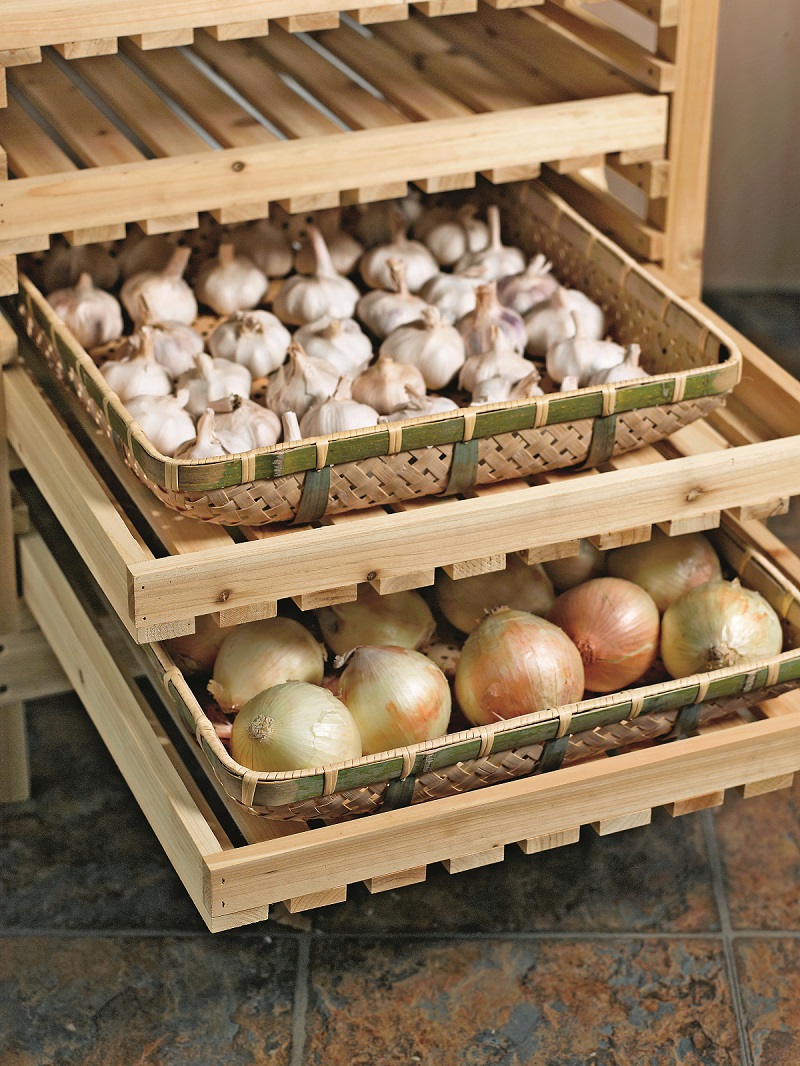
Orchard racks and other storage solutions for fresh produce increase storage longevity while maximizing space. Photo/Gardener’s Supply Company

Ideally, vegetables you plan to prepare immediately should be cleaned outdoors. You’ll keep garden soil out of the kitchen sink and in the garden where it belongs. Collect your veggies in an open weave wire or plastic harvest basket like the Mod Hod. Its fold out legs allow the produce to dry before bringing it indoors. Rinse off the soil with the hose, drain excess water and carry your veggies into the kitchen to prepare.

Clean your counters and cutting boards before you start slicing, cutting and dicing your vegetables. Trim stems, remove damaged leaves and compost these in the garden or worm bin. They will have a second life as compost in next year’s garden.

Wait to wash, trim, and clean the vegetables you plan to store or prepare later. The scraping, cutting and slicing process increases the loss of vitamins and flavor and reduces storage quality.

Increase storage longevity by matching vegetables with their preferred storage conditions. The closer you come to this, the longer your produce will last.

Store roots crops like beets, turnips and radishes as well as cabbage and Brussels sprouts in a cold, moist condition. A spare refrigerator works great for these. Those in colder climates can store their carrots and parsnips right in the garden. Once the soil gets a bit crunchy, cover them with straw or evergreen boughs for easier digging in winter. Then dig as needed or harvest during the first winter thaw.

Keep potatoes in a cool, humid and dark location like a cool corner in the basement. Sunlight causes the exposed portions to produce green chlorophyll and solanine, a glycoalkaloid toxin. The solanine gives the potatoes a bitter flavor and can cause vomiting and diarrhea if enough green potatoes are eaten. Just cut away any green portions before using.

Store winter squash in a cool location as well. They can tolerate a bit lower humidity and last for four months or more when properly harvested and stored.

Use slatted crates or other vegetable storage solutions to maximize storage space and increase storage longevity. These systems provide ample storage space, so fruits and vegetables do not touch. Keeping stored fruit separated prevents rot from spreading from one fruit to the next. Plus, the slatted sides allow airflow to extend storage longevity.

A few simple changes in handling your harvest will improve its storage life, flavor, and nutritional quality. Better quality means less waste and more abundance for cooking and sharing.

Follow these harvesting tips to enjoy garden-fresh meals throughout the remainder of the growing season. Then continue creating tasty meals reminiscent of the garden season with properly stored produce long after your harvest is past.

Melinda Myers has written more than 20 gardening books, including “Small Space Gardening.” She hosts The Great Courses “How to Grow Anything: Food Gardening For Everyone” DVD set and the nationally syndicated “Melinda’s Garden Moment” TV and radio segments.


Anthem pulling out of Nevada health exchange

By Reuters

U.S. health insurer Anthem Inc. said on Monday it will no longer offer Obamacare plans in Nevada’s state exchange and will stop offering the plans in nearly half of Georgia’s counties next year.

The moves come after Republican senators last month failed to repeal and replace Obamacare, former President Barack Obama’s signature healthcare reform law, creating uncertainty over how the program providing health benefits to 20 million Americans will be funded and managed in 2018.

Hundreds of U.S. counties are at risk of losing access to private health coverage in 2018 as insurers consider pulling out of those markets in the coming months.

Read the whole story


Opinion: California’s non-citizens should vote

By Joe Mathews

President Trump claims that California allowed millions of non-citizens to vote in the 2016 elections. This allegation, while totally bogus, has put California on the defensive as Trump and his allies use the lie to justify a new federal commission devoted to making it harder for all Americans to vote.

Californians should go on offense – by embracing Trump’s ugly lie and transforming it into a beautiful civic truth. Let’s make our state more democratic—by guaranteeing California’s non-citizens the right to vote in local and state elections.

Joe Mathews

Sounds radical, right? It’s not. In this country, there is no constitutional prohibition against non-citizens voting; states decide who gets to vote. For most of American history, voting by non-citizens was commonplace. Given Trump’s threats both to immigrants and democracy, Californians should seize this moment to give the franchise back to non-citizens.

California is home to about 5 million adults (or one in six California adults) who can’t vote because they’re not citizens. This huge disenfranchised cohort is an affront to American principles. Taxation without representation? These non-citizens pay taxes, but they are not represented. Consent of the governed? Noncitizens must follow our laws—but they can’t vote to consent. Home of the brave? Noncitizens serve in the military but can’t vote for the government that sends them to war.

We Californians tolerate this form of apartheid, even though the lesser status of non-citizens—especially the 2 million-plus undocumented Californians—makes them more vulnerable to abuse and removal from the country they’ve helped build. To its credit, California has taken steps on behalf of non-citizens, who now enjoy in-state university tuition, driver’s licenses, the ability to practice the law, and—if they are children—state-funded health care.

But none of this is enough. All Californians won’t be equal until all have that great democratic weapon: the vote. As Martin Luther King Jr. said, “Give us the ballot and we will no longer have to worry the federal government about our basic rights.”

Americans tell themselves that our country has extended the franchise over time—to African Americans, women, 18-year-olds. But non-citizens had the vote, and lost it.

From the founding through the 20th century, non-citizens voted in dozens of states. The vote was a lure for settlers and part of assimilation process. What better way to educate yourself in civic traditions than by voting? But the coming of the First World War produced an anti-immigrant backlash. By 1926, every state had banned non-citizen voting.

Such voting continues only in limited local form. Some Maryland cities, New York, Chicago, and (as of 2016) San Francisco, allow non-citizens to vote in certain local elections. And internationally, as global migration grows, two dozen countries have established voting rights for non-citizens in recent decades.

And U.S. Supreme Court precedent remains clear; states can let non-citizens vote if they choose. While Congress explicitly outlawed non-citizen voting in federal elections, the door remains open for local and state elections.

California should walk through that door.

Non-citizen voting not only would express our commitment to universal suffrage and protecting vulnerable people. It also would make the voting population, now older and whiter than the state, more representative. 

By the same token, the arguments against enfranchising non-citizens make little sense. Non-citizens don’t constitute some distinct or isolated group that doesn’t understand the rest of us; California’s non-citizens are a diverse array of people by origin, class and education, many of whom have been in California longer than our citizens.

And the go-to argument of the anti-immigrant crowd—that excluding non-citizens from voting makes our society cohesive—is a tautology, as the legal scholar turned Congressman Jamie Raskin has written: “When opponents of inclusion make an argument about insufficient commonality, they are only reinforcing and deepening what they claim to bemoan.”

Practically, establishing non-citizen voting would be hard. It might require a new governor; Jerry Brown, who has said voting should be reserved for U.S. citizens. And in an era of mass deportation, few undocumented Californians would register to vote, since it means putting your name and address on a public list.

But that shouldn’t stop us from enfranchising the millions of non-citizen Californians who have spent at least five years here. The easiest way to do that is to permit voting only in local elections. Allowing non-citizens to vote in state elections would escalate our war with the federal government, since voting for federal representatives is conducted at the state level, and non-citizen voting for federal offices is illegal.

But escalation is inevitable. Trump will dishonestly attack California and its voting practices, whether we let non-citizens vote or not.

California should take the clear and just position: universal suffrage means universal suffrage. If America is going to call itself a democracy, there ought to be at least one state in this country that is an actual democracy.

Joe Mathews writes the Connecting California column for Zócalo Public Square.


Federal cuts will end some PBS stations, CEO says

By Lynn Elber, Associated Press

The chief executive for PBS is sounding the alarm about public broadcasting’s future if federal funding is axed as called for by President Donald Trump.

“PBS will not go away, but a number of our stations will,” CEO Paula Kerger said Sunday. “There is no Plan B for that.”

PBS’ share of the roughly $450 million in federal funds allocated for public TV and radio goes largely to support public TV stations nationwide, a number of which rely on it for up to 50 percent of their budgets and can’t survive without it, Kerger told a TV critics’ meeting.

Read the whole story


Foreclosure on Olson property on hold

A judge has given Patty Olson her request of time.

Olson, whose commercial property in the Bijou area of South Lake Tahoe is tied up in court, was granted an extension to the stay. This means while her appeal to the bankruptcy court’s decision is ongoing the foreclosure process on the real estate is on hold.

The stay has been extended to Oct. 30 or until the appeal is decided, whichever comes first. There will be a status conference in October to assess where the case is.

The court, though, mandated Olson start paying US Bank $1,500 a month. Olson owes $640,696.16, plus interest. Interest accrues at $155.72 per day and totaled $79,488.22 as of June 30.

This strip mall is where Tahoe Wellness Cooperative operates. The medicinal pot shop is tied up in the bankruptcy case, but has a separate but related dispute going on with the city of South Lake Tahoe. A hearing on that case is set for later this month.

— Lake Tahoe News staff report


Dutch oven cooking demo in Genoa

Rangers at Mormon Station State Park in Genoa will be putting on a breakfast Dutch oven cooking demonstration on Aug. 13.

Rangers will be cooking up a breakfast casserole and a bacon bomb, all while explaining the basics of Dutch oven cooking. Guests will learn today’s cast iron techniques, as well as those used by pioneers in the 1850s as they came through the Carson Valley on their way to California.

Samples will be served as long as the food lasts.

The free event is from 11am-12:30pm.

For more info, call Daniel Wassmund at 775.782.2590.


KMS deal collapses; property going back on market

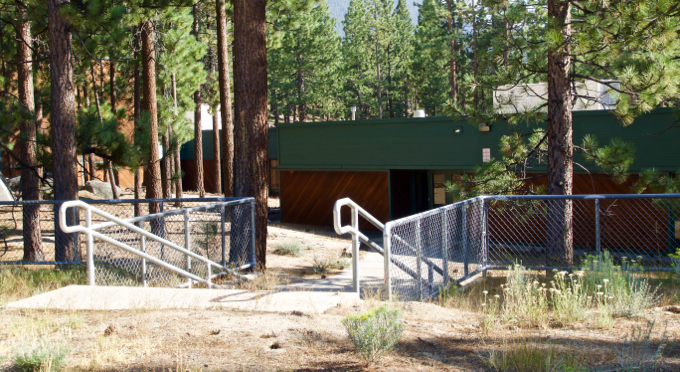
The future of the former Kingsbury Middle School is still a mystery. Photo/LTN

By Kathryn Reed

STATELINE – The vote and tone of Tuesday’s Douglas County School District board meeting proved the electeds are tired of dealing with Patrick Taylor.

Taylor is the Cave Rock resident who a year ago entered into an agreement to buy the shuttered Kingsbury Middle School property. He has been given multiple extensions throughout the process.

On Aug. 8 the board unanimously said no more extensions would be granted. The board will seek a new appraisal on the 22-plus acre site that has 36,000-square-feet of space. It will then be put back on the market.

The original asking price was $4 million when the board in January 2012 put it on the market. In September 2015 the price was lowered to $3.125 million by averaging the two appraisals.

It’s anyone’s guess what the new appraisal will come in at.

Whoever buys it will have to contend with zoning issues and potentially irate neighbors. The public has been slow to show up at meetings to voice their concerns. While the room was packed Tuesday afternoon, only three people spoke.

Despite the decision, Taylor could submit another offer.

The board’s issue with him was the delays. They didn’t see what good it would do to keep extending an offer without getting anything in return. Taylor was adamant in telling the board, “There is no way in the world I would extend it to just Sept. 17 and I won’t put up more money.”

His $55,000 deposit is now the district’s to do with what it wants. (The district is paying about $5,000 a month for the upkeep of the site, which includes utilities.)

Asked after the meeting if he had a Plan B, Taylor told Lake Tahoe News, “Nah, I’m done with them.”

Whether that was said in anger or if he’ll change his mind remains to be seen.

The school was closed in 2008 because of declining enrollment.

It was pointed out by a member of the public that Taylor’s plan to build affordable housing could have created a scenario where the remaining two DCSD schools at the lake would be overcrowded if his plans came to fruition and families filled those residences.