Man critically injured in stabbing at Harrah’s

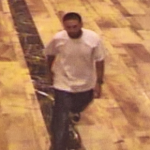
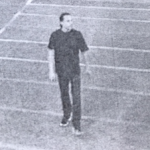
Investigators would like to question these two men. Photos/Provided

A man was stabbed early Sunday morning near the valet at Harrah’s Lake Tahoe.

Douglas County sheriff’s investigators are looking for the person or people who committed the crime.

The suspect is wanted on robbery, battery with a deadly weapon, and assault with a deadly weapon charges. He fled the scene.

The victim was taken to Renown Medical Center in Reno with a serious stab wound. He required surgery, but officials did not know his current condition.

The altercation took place about 3:10am Aug. 13 on the sidewalk of valet. It is not known how the people involved know each other or what led to the confrontation.

Anyone with information is asked to call Douglas County Secret Witness at 775.782.7463.

— Lake Tahoe News staff report


UNR working to stop mosquitoes’ spread of disease

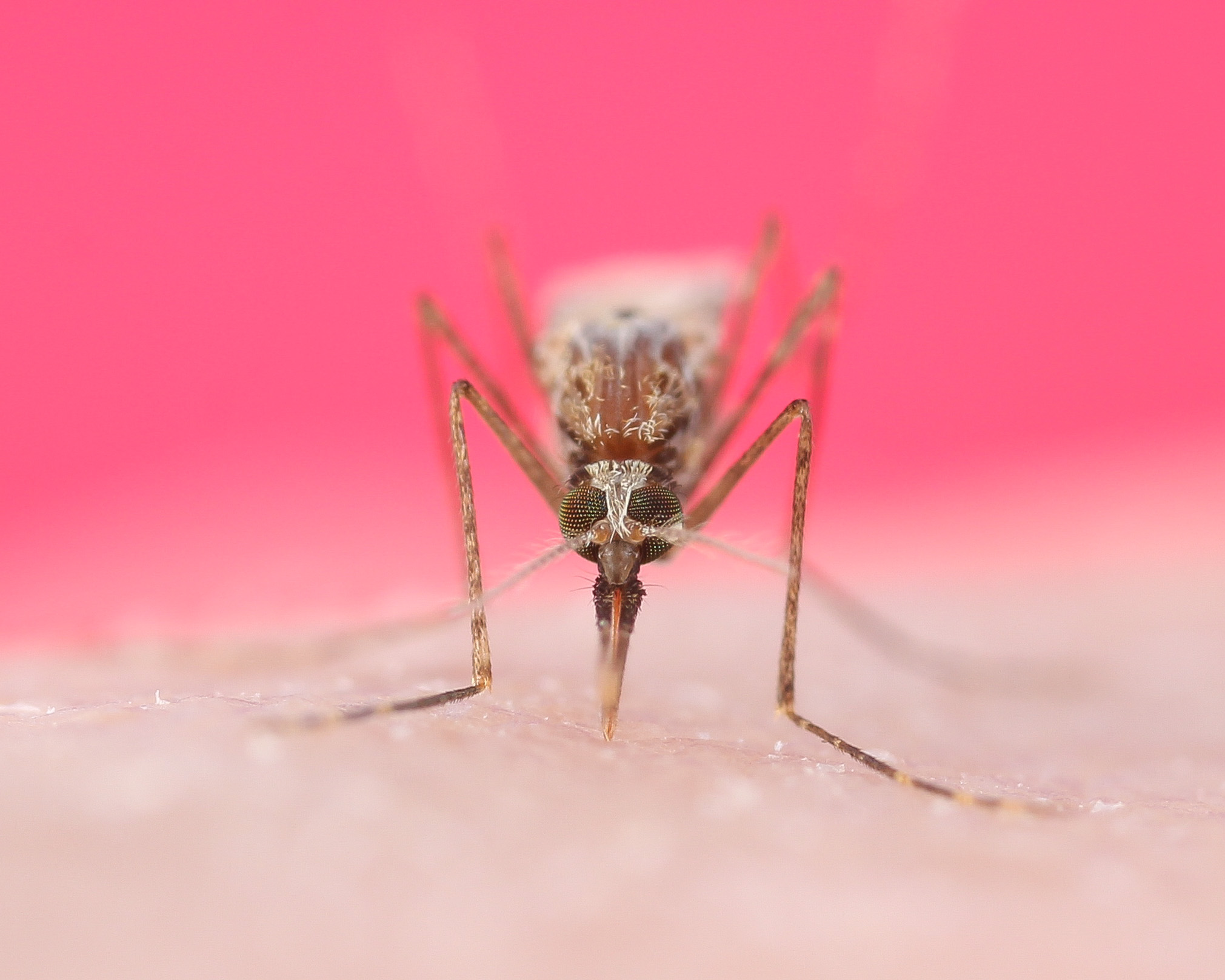
A gambiae, also known as a mosquito, feeds on a human. Photo/Andrew Nuss

By Mike Wolterbeek

UNR entomologist Andrew Nuss and biologist Dennis Mathew are looking for a way to stop the spread of mosquito-borne disease. The goal of their research is to identify key mosquito odorant receptors that govern mosquito host-preference for humans and to genetically modify those genes in order to create mosquito strains that avoid biting humans.

“Mosquitoes are a big problem in transmitting disease,” Nuss said. “Malaria is foremost among these, resulting in more than 400,000 deaths worldwide every year and millions infected. Not all of these infections are fatal, but this illness contributes to other diseases, the ability to work and quality of life.”

Nuss is an assistant professor in the university’s Department of Agriculture, Nutrition and Veterinary Science, whose research proposal was recently awarded a $500,000 grant by the Defense Advanced Research Projects Agency, an agency within the U.S. Department of Defense.

By taking a closer look at the issue, Nuss noted key problems in the way mosquitoes are controlled now, and he came up with his new approach.

“Killing mosquitoes is one way of preventing the spread of disease, and others are trying to develop malaria vaccines, which has been difficult,” Nuss said. “By and large, we have been using vector control as a way to prevent the spread of disease, and primarily that has been through the use of insecticides. While that works pretty well for a while, eventually the mosquitoes can become resistant, then you’re left with a chemical you can’t use, and sometimes they become resistant to entire chemical classes.”

Nuss decided to approach the mosquito problem by studying their sense of smell. The mosquitoes that are most important when it comes to transmitting diseases are the ones that have become highly attuned to feeding on humans, facilitating rapid human-mosquito-human disease transfer.

“They have become co-adapted to us because we live in these nice, concentrated cities where they can find lots of people to feed on,” Nuss said. “They preferentially feed on humans, and their odorant receptors may be attuned to human odors, specifically. So, we want to tweak that system by either knocking out the receptors that are responsible for human feeding, or replacing them with receptors from other mosquito species that feed on other animals in the environment.”

If these human-seeking mosquito species can be modified to avoid feeding on humans and instead on other animals, this could break the human-mosquito-human transmission cycle. Unlike insecticide-based vector control strategies, this would also ensure that mosquitoes could still feed on other animals in the environment to complete their life cycle without pressure to develop resistance.

Nuss continues his research with the help of collaborator Dennis Mathew, an assistant professor with the Department of Biology whose lab focuses on the neuroscience of smell, specifically in fruit flies. Together, Nuss and Mathew have combined their labs to work on understanding the olfactory makeup of mosquitoes.

“In my lab, we have a system where we can measure what the smell receptors of fruit flies – or other insects – can sense,” Mathew said. “So, Andrew and I talked about taking advantage of this system and in this project we are going to identify those mosquito smell receptors that we suspect smell human odors and put them in the fruit flies. We will then use the fruit fly system in my lab to figure out which receptors are most sensitive to human smells.”

Mathew’s research looks at understanding how fruit fly neurons that express smell receptors sense environmental odorants and translate these olfactory inputs into the insect’s behavioral output.

The fruit fly larva, which is the Mathew lab’s favorite model system, has a very simple smell system compared to mammals or even other insects. It has only 21 smell receptors and 21 pairs of neurons expressing them. In contrast, a human nose has approximately 400 smell receptors and approximately 10 million neurons. The numerical simplicity of the fruit fly system enables elegance and simplicity in the scientific approach.

While most scientists who work in this field are developing repellents, Nuss and Mathew are taking a bioinformatics approach to truly understand and change the common receptors found in mosquitoes.

Nuss and Mathew are working on the project together, along with Nuss’s Research Associate Rana Pooraiiouby. With the recent grant from the Department of Defense, they are able to continue their research in what is considered a relatively new field. The $500,000 grant covers the first two years of their research, with a possible extension period of one year for an additional $470,000.

“Insect mitigated disease is a tremendous problem and we have been hammering away at it with a number of different approaches, with most of them involving chemical insecticides for years and years, but the problem remains,” Nuss said. “So, we need new strategies, and our research is an approach where the mosquitoes still get to survive in an environment just as long as they are not biting humans. Preventing the spread of disease is the ultimate goal.”

Mike Wolterbeek works for UNR.


Citizens for Fair Representation’s case moves forward

On Aug. 25 U.S. District Judge Kimberly Mueller is expected to reconsider her own request for the chief magistrate to appoint a three-judge panel to hear Citizens for Fair Representation v. Secretary of State Alex Padilla.

Mueller had made this request earlier this month. Hours later the state’s attorney filed a motion to reconsider that order.

Citizens for Fair Representation, which is made up of people behind the State of Jefferson movement that supports succession, filed the lawsuit against the state for lack of representation.

Mark Baird, one of the CFR spokespeople, said, “The case will ask important questions: Can one state senator properly represent 1 million people? Can one state assemblyman properly represent one-half million people?”

— Lake Tahoe News staff report


Snippets about Lake Tahoe

·      Brian Krolicki, former lieutenant governor and current Stateline resident, has been appointed to the Nevada Commission on Tourism. He was on that board when he was an elected official.

·      Lake Tahoe South Shore Chamber of Commerce is offering a travel opportunity to Spain and Costa del Sol. The chamber is hosting a travel planning event facilitated by CI Destinations travel agent Oliver Bergeron on Aug. 31 from 5-7pm at the chamber office in Stateline.

·      Caltrans QuickMap has added more information to assist drivers with avoiding slow traffic, road closures, highway incidents, and other travel issues. Waze app data layers can now be launched from within QuickMap.

·      Cheech & Chong will be at MontBleu on Aug. 18 at 8pm.

·      South Lake Tahoe Library is putting on 3D Thursdays now through October. Do you know what a 3D printer looks like? Have you printed a 3D object? Come by the library on Rufus Allen Boulevard on Thursdays between 2-3pm to learn more about the innovative ways people use 3D printing.


Tahoe scientists studying secret travels of thrush

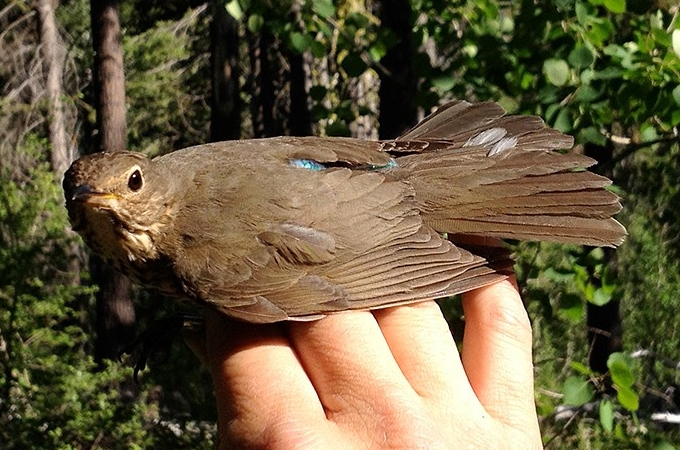
A rare Swainson’s thrush before being outfitted with a tracking device. Photo/TINS

By Jim Sloan

In 2009, Will Richardson was doing some summertime bird-monitoring research in aspen stands in Ward Canyon near Lake Tahoe when he heard an unexpected birdsong.

It was a high, pleasing, spiraling song, like a flute, and he recognized it right away as the song of a Swainson’s thrush, a bird that had all but disappeared from Tahoe and the Sierra south of Yuba Pass.

He heard one bird singing and then he heard others responding. To his astonishment, he realized that there was a small colony of the elusive bird.

“It floored me,” said Richardson, executive director of Tahoe Institute for Natural Science. “I always expected to see them and always wondered why they were never there. So, it was pretty thrilling to find a pocket of survivors.”

Richardson had studied thrushes in Vermont and Canada years before and had earned his doctorate in ecology, evolution and conservation biology from the UNR by studying bird communities in Sierra aspen habitats. He knew that Swainson’s thrushes had been common at Tahoe years ago and that their disappearance from Tahoe and other areas of the Sierra was considered “one of the unresolved mysteries of Sierra Nevada ornithology.”

He decided to investigate. He wanted to find out if the birds were declining, stabilizing, or rebounding in the Tahoe region.

He knew that Tahoe had plenty of habitat to attract the bird, which favors aspen forests and dense, riparian thickets. So, to explain its small numbers, he reasoned that he would need to learn if the bird’s wintertime habitat had changed in a way that affected its resiliency. That meant capturing birds twice.

First he had to catch some and attach a tiny tracking device. Then, the next year, he had to catch the banded birds a second time to retrieve the data. Not a simple proposition.
Secret to scientific success: Know how to pick a fight
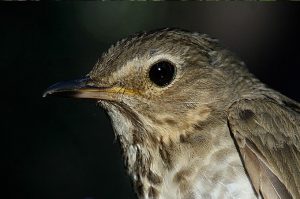
To capture Swainson’s thrushes for his study, Will Richardson of the Tahoe Institute of Natural Science said he “basically picks a fight with the bird.”
He sets up nets in a bird’s known territory and plants decoy thrush in a tree. Then he sneaks off a short distance and plays a sound of the Swainson’s thrush’s spiraling woodwind song. Other thrushes, intent on protecting their territory, swoop in to drive off the invaders. Some get caught in the net.
Richardson removes them, takes measurements, attaches leg bands and the tracking device, and
releases them. The next summer he plays the same trick and tries to recapture the same birds.
“You basically need to catch the same bird twice, and that’s not easy when you consider how few birds there are to begin with,” Richardson said.
While he’s not sharing the location of his Ward Canyon site, Richardson said birdwatchers can find Swainson’s thrushes along Strawberry Creek just below the Lover’s Leap trailhead (off Highway 50 west of Strawberry Lodge), along General Creek at Sugar Pine Point State Park, and along the Upper Truckee River near Hawley Grade south of Christmas Valley.
Swainson’s thrushes are more likely to be heard than seen. Their song has a “ventriloquial quality” that makes them difficult to track. They also fly around quickly, and sometimes they use a quiet song that sounds like it’s farther away than it actually is. — Jim Sloan

Although Swainson’s thrush has an estimated global breeding population of 100 million birds, the species has lost 38 percent of its numbers since 1966, according to the Cornell Lab of Ornithology.

The bird breeds in the north and migrates in fall to Mexico, Central America, and northern South

America. Birds from the majority of the United States and Canada winter in South America while the

Pacific Coast population migrates to Mexico and Central America.

According to researchers at Cornell, Swainson’s thrush is particularly sensitive to such breeding habitat problems as grazing, development, human activity, and nonnative invasive plants.

Migrating Swainson’s thrushes are killed — in greater numbers than any other bird species — by collisions with windows, radio and cellphone towers, and tall buildings.

In 2014 and 2015, with financial support from the Sierra Foothill and Sacramento Audubon Society chapters, TINS and colleagues at the Point Reyes Bird Observatory captured more than three dozen thrushes from Ward Canyon, Strawberry Creek, and Plumas County locations and equipped them with one of two tracking devices.

In subsequent summers, the team recaptured 15 of the 46 originally tagged birds. What they have learned has surprised them.

The Tahoe birds from Ward Canyon and Strawberry Creek were not migrating to Mexico, as Richardson

had theorized, but were joining eastern birds for a trip to northern South America. The Plumas County birds, meanwhile, were “bopping all over the place,” with some making their way to Central America.

One Swainson’s thrush from the Quincy area spent the winter in balmy Panama.

The conclusion? It’s too early for solid theories yet, Richardson said. His colleagues are still breaking down the data collected from the tracking devices, and another colleague from UC Santa Cruz is doing genetic tests on feathers from the captured birds.

Richardson hopes that additional data will shed some light on the habits of the Swainson’s thrushes spending their summers at Tahoe. He also plans to monitor the thrushes’ nests to determine how many young they produce at places like Ward Canyon. It will be a few more years before any solid theories emerge.

In the meantime, he’s encouraged. “It’s great to know these birds are coming back to the same location each year,” he said. “They are producing young here, and that’s also encouraging. We know babies are produced, but whether there are enough young to sustain the population still isn’t clear.”

This article is republished from the summer 2017 edition of Tahoe In Depth.


Opinion: Time to pull the plug

By Larry Weitzman

In the Wall Street Journal on Aug. 7, there was a column by Christopher Mims entitled “Electric Car Hurdle: Not Enough Chargers.” It described the coming dilemma that there will not be enough public electric charging stations for all the coming millions of electric cars, courtesy of Tesla which says it will sell 500,000 EVs next year.

That will be a good trick, considering Tesla is current losing $13,000 per car according to the latest financial report, the second quarter of 2017. If you consider the loss per car for the first half of 2017, the loss per car goes up to about $14,500 per car produced.

Larry Weitzman

For the column, the author left out the two most important words regarding EVs and everything about them, “incentives and mandates,” for without those keywords there would be no EVs and their ghastly expensive attendant charging stations. The article even discussed making lampposts into charging stations. First it would be 110v and plugging in for even as much as an hour it would only add three to four miles of range. Think of the inconvenience, repairs and perhaps a public cost in people being electrocuted, like plugging in during rainy weather. This idea is absolutely brilliant, like an inefficient incandescent lightbulb.

As to those incentives and mandates here is a partial list 1. federal tax credits; 2. state tax credits; 3. zero emitting vehicle credit; 4. federal and state requirements for the production and sale of EVs; 5. federal CAFÉ standards; 6. conventional car mandates, regulations, and requirements which raise the price of conventional cars; 7. gas guzzler taxes; 8. state EV car pool lanes; 9. potential new massive incentives from California Assembly Bill 1184 which is already halfway through the Legislature and there are many more, too numerous to list.

And then there are all the giveaways to Tesla. It has been estimated by many noted economists that Tesla has received in excess of $5 billion in total incentives. And for what, so Musk can continue to build his house of cards?

About a week ago Tesla released its latest earnings performance to roars of approval because it lost less money than expected, this time only $336 million. But there is an analysis done by Insideevs.com that says that the loss should have been over $400 million. So, what did the stock do? It went up. Insideevs.com also wrote that Tesla sold $100 million in ZEV credits (created by government mandate and incentives) which without would have extended their loss over $500 million for the quarter.

In the first quarter of this year losses were $330 million with no ZEV credit sales. In the second quarter losses were up to $400 million, including ZEV credit sales of $100 million, meaning that to compare the quarters, the actual losses from their business for the second quarter rose by 50 percent over the first quarter, $330 mil compared to $500. The loss per car actually rose from about $16,000 per vehicle to about $17,000 per unit (ZEV credit sales were $4,000 per vehicle) and overall income from the sale of cars actually dropped by about one percent. Total losses for Tesla have now grown to over $2.4 billion.

Tesla is literally burning through cash like, not a drunken’ sailor, but the entire crew of the aircraft carriers Harry S Truman, Carl Vinson, Teddy Roosevelt, Eisenhower, and the Nimitz combined. Last quarter’s cash burn was over $1 billion ($1.16B) and it’s expected to continue. Tesla’s cash position of about $3 billion will be exhausted in less than three quarters especially with the ramp up of the Model 3, another losing proposition.

As a result of this dwindling cash position, Tesla is going to sell up to $1.5 billion in bonds to raise cash with about a 5.25 percent coupon. Yesterday, $600 million sold. Total debt for Tesla will reach close to $10 billion. At 5 percent, their debt service will be $500 million a year or $5,000 per car at the current rate of approximately 100,000 units. Even if they sell 500,000 cars, it will add $1,000 of cost to every vehicle. Ford and GM make from sales of 7-8 million vehicles a year a net profit of about $1,400 a vehicle. You can do the math.

But what about the Model 3, the new inexpensive EV Tesla has started producing and selling. They claim a base price of $35,000, but most will leave the factory at over $50,000. But why is the base Model 3 about half the price of the base Model S? And therein lies an interesting story.

If you stop and think about it, it should cost almost as much. In the long-range Model 3 the battery pack is about the same size and almost every other internal component of the Model S is used in the Model 3 or vice versa. Back in the late 1950s, it was said that it only cost $300 more to build a Cadillac than a Chevy, but the Cadillac sold for double the price. When you think about it, the parts and labor for each car cost the same, putting a door on is putting a door on, an a/c compressor is an a/c compressor as is an electric power steering rack, the only different is the amount of steel and leather over cloth (base Model S does not have leather, anyway). A V-8 engine is a V-8 engine, no matter what the size, they essentially cost the same as the components are the same. Ditto for an electric motor. The amount of steel or aluminum in the cost of producing a car is insignificant. It’s the cost of the components and the assembly labor and those are required for any car in similar amounts. Just because it is smaller, doesn’t mean it costs that much less to build. It doesn’t. In fact, most manufacturer’s give away their compact cars so they can sell pickups, crossovers and SUVs for large profits because of, that’s right, government regulations (CAFÉ) and intervention in the market place.

Tesla cannot survive because of the Model 3, you can’t lose money on every sale and make it up in volume.

The sooner the government pulls the plug on Tesla incentives and mandates and leave the free market unto itself, the sooner this house of cards can come tumbling down. EVs are a pipedream until “unobtainium” is discovered. They only way EVs are even remotely succeeding is because of government’s attempt at behavior modification. Fiddle with human nature at your peril.

Larry Weitzman has been into cars since he was 5 years old. At 8 he could recite from memory the hp of every car made in the U.S. He has put in thousands of laps on racetracks all over the Western United States.


More mice may mean more Lyme disease

By Amy Harmon, New York Times

It is August, the month when a new generation of black-legged ticks that transmit Lyme and other diseases are hatching. On forest floors, suburban estates and urban parks, they are looking for their first blood meal. And very often, in the large swaths of North America and Europe where tick-borne disease is on the rise, they are feeding on the ubiquitous white-footed mice and other small mammals notorious for harboring pathogens that sicken humans.

But it doesn’t have to be that way. A new study suggests that the rise in tick-borne disease may be tied to a dearth of traditional mouse predators, whose presence might otherwise send mice scurrying into their burrows.

If mice were scarcer, larval ticks, which are always born uninfected, might feed on other mammals and bird species that do not carry germs harmful to humans. Or they could simply fail to find that first meal. Ticks need three meals to reproduce; humans are at risk of contracting diseases only from ticks that have previously fed on infected hosts.

Read the whole story


Tesla wants to test self-driving semi-truck in Nev.

By Marc Vartabedian, Reuters

Tesla Inc. is developing a long-haul, electric semi-truck that can drive itself and move in “platoons” that automatically follow a lead vehicle, and is getting closer to testing a prototype, according to an email discussion of potential road tests between the car company and the Nevada Department of Motor Vehicles, seen by Reuters.

Meanwhile, California officials are meeting with Tesla “to talk about Tesla’s efforts with autonomous trucks,” state DMV spokeswoman Jessica Gonzalez told Reuters.

The correspondence and meeting show that Tesla is putting self-driving technology into the electric truck it has said it plans to unveil in September, and is advancing toward real-life tests, potentially moving it forward in a highly competitive area of commercial transport also being pursued by Uber Technologies Inc.  and Alphabet Inc’s Waymo.

Read the whole story


With bankruptcy nearly over, Caesars exec talks up growth

By Richard N. Velotta, Las Vegas Review-Journal
 
Now that Caesars Entertainment Corp. is well on its way toward emerging from bankruptcy, company officials have affirmed significant growth plans are in the works.

Speaking Wednesday to members of the state Gaming Control Board in Carson City, President and CEO Mark Frissora said the new Caesars not only would be growing in Las Vegas, but at Lake Tahoe and Laughlin as well.

Caesars is the parent company of Harrah’s Lake Tahoe and Harveys at Stateline.

The board voted unanimously to recommend approval of the registration of subsidiary companies and LLCs and the licensing and suitability of several corporate officers, executives and key employees.

Read the whole story


Graffiti a growing problem at Donner Summit

The natural granite beauty at Donner Summit is being marred by graffiti.

It used to be that vandals limited their damage to inside the train tunnels. Not so many more.

Local residents are working with the U.S. Forest Service to clean up the mess.

Preventing the problem from reoccurring will be the harder endeavor.

— Lake Tahoe News staff report