
Obamacare available throughout Nev. for 2018

By Sean Whaley and Ben Botkin, Las Vegas Review-Journal

Every Nevada county will have an insurance carrier through the state exchange in 2018, ending two months of uncertainty about coverage.

Gov. Brian Sandoval, speaking outside Renown Health Urgent Care Clinic in Silver Springs in Lyon County, announced in a press conference Tuesday that SilverSummit will offer 2018 coverage in 14 rural Nevada counties.

The subsidiary of Missouri-based Centene has never offered insurance through the Silver State Health Insurance Exchange, which provides coverage through the Affordable Care Act, also called Obamacare.

Read the whole story


Star Guide: Cosmic scavenger hunt

By Tony Berendsen

The Milky Way in August as seen from the North Shore of Lake Tahoe is spectacular to behold on a moonless evening. Breaching as a gigantic silvery whale our galaxy’s shape towers across the sky through the constellation of Cassiopeia and at the South Shore it’s heart is exposed near the constellation of Sagittarius, the galactic center.

To gaze upon our galaxy with the naked eye conjures thoughts of the immensity of the cosmos. To explore its star fields and dust lanes with binoculars is a visual adventure where discovery meets imagination and beckons the realization of our smallness.

A fun way to explore our galaxy’s neighborhood is with a cosmic scavenger hunt. Here is list of items: Swan, Harp, Dolphin, Arrow, Eagle, and Coat Hanger. The best way to find all of these is to head out under the starry sky about 9pm and find the summer triangle stars, Vega, Deneb, and Altair.

You will find the Swan near Deneb, the Eagle near Altair, and the Harp by Vega.

The dolphin (Delphinus) is a little more difficult to find since its stars aren’t as bright as the summer triangle, so grab a star gazing app like SkyPortal and ask it to point the way.

Next try for the Arrow (Sagitta), which is closer to the center of the Milky Way band within the Summer Triangle; an app can help with this too.

Within the summer Milky Way the bright star Vega in the upper left and Altair the lower right. Photo/Ryan Berendsen

Last, the most difficult item: The Coat Hanger (Brocchi’s Cluster). It’s a little asterism shaped like an upside-down coat hanger that is just off the side of Sagitta and below the star Albireo in the Swan. Binoculars will help you find the six stars that form the bar of the hanger, and the another four forming the hook. It’s upside down position in our northern latitude prompts some people to call it the Ski Lift.

Interestingly, the Coat Hanger has been known for more than 1,000 years for its distinctive shape and grouping of relatively bright stars within the Milky Way. It was once thought to have been a galactic cluster (stars bound in gravitational association), but recent measurements by astronomers have determined the stars are just a chance alignment making them look like they are close to one another from our viewpoint.

The reclassification of the Coat Hanger from a cluster to an asterism is just one example of our evolving understanding of our view in to space.

A cosmic scavenger hunt is not your usual hunt because once you have found all these items you don’t really have them in possession as proof you have found them. But you now know where they are and can return to them on any dark cloudless night of the summer. It may be there will be other hunts in your future? There are plenty of items like the Coat Hanger, not easy to find, but rewarding just the same, helping you find your way around the galaxy.

Tony Berendsen runs Tahoe Star Tours. He may be reached at 775.232.0844 or tony@tahoestartours.com.


Treatment options for low back pain

By Zachary Child

Back problems can be severe. A natural alarm in the body signals a sudden, debilitating onset of gripping back pain. It not only hurts, but interferes with your ability to work, play, and participate in your daily activities.

Most adult Americans, between 80 and 100 percent, will experience severe lower back pain at least once in their adult lives. Fortunately, only a small percentage will need attention from a spine surgeon. Below are options to address lower back prior to considering surgery.

Zachary Child

Heat or ice can be very effective at relieving some acute pains and spasms. Depending on your preference and area of pain, try an ice pack, a hot shower, or a heating pad.

Nonsteroidal anti-inflammatories, NSAIDs, are another core treatment. They act in two ways. One, they are a pain reliever usually bringing relief within 30 minutes to an hour. Two, NSAIDs break the biochemical chain of inflammation, or cyclooxygenase (COX) pathway. This requires a sustained treatment from several days to two or three weeks. Ulcers can be common if NSAIDs are not taken with an antacid or food. Specific dosage amount and schedule should be obtained from your primary care provider.

Renewed attention has been placed on the non-pharmacologic therapies for lower back pain. Several recent meta-analysis studies show yoga and mindfulness-based stress reduction have the best outcomes reported by patients. These approaches were compared to exercise, psychological therapies, multidisciplinary rehabilitation, massage, chiropractic care, and acupuncture. However, some scientific data shows positive results for patients who tried the other options described above.

My advice is try different options and focus on treatments that work well for you.

Finally, a physician or rehabilitation specialist may recommend steroid anti-inflammatories. These can be taken orally or through injections, but require a prescription or referral. Steroid anti-inflammatories work best for sciatica, a radiating arm or leg pain. This treatment takes about six weeks to see results.

Addressing lower back pain will take a “tincture of time.” Watchful waiting and pain monitoring should be implemented throughout the treatment process. An MRI and other screenings may also be necessary during this period. If symptoms remain unresolved after other treatment options are taken, a referral to the spine surgeon is the last step.

Zachary Child is a board certified orthopedic spine surgeon who specializes in spine surgery and orthopedic oncology. He recently joined Barton Health’s Tahoe Center for Orthopedics to expand care for spine health throughout the Lake Tahoe and Carson Valley regions. 


Calif. bill would speed up affordable housing projects

By Jim Miller, Sacramento Bee

A California lawmaker has made a key change to expand the reach of a plan designed to speed up construction of affordable housing projects.

The move suggests the Legislature, due to return from summer recess Monday for a final four-week crush of business in the 2017 session, is moving toward agreement on a package of bills aimed at easing the Golden State’s housing crisis.

The measure by state Sen. Scott Wiener, D-San Francisco, would require cities and counties to offer expedited review for affordable housing developers.

Read the whole story


Placer County Sheriff’s Office faces lawsuits

By Sam Stanton, Sacramento Bee

Ten weeks after Placer County Sheriff Devon Bell announced that three of his officials had been arrested on allegations of excessive force against inmates at the Auburn Main Jail, his department is facing a series of lawsuits claiming that abuse at the jail has routinely gone unchecked and that video and audio recordings have been altered to cover up the wrongdoing.

At least three cases have been filed so far, and attorneys say several more are expected. The most recent case was filed Friday in federal court in Sacramento by civil rights attorney Mark Merin, who is seeking class-action status to represent hundreds of former and current inmates who may have been victimized.

The lawsuit, filed on behalf of former inmate Beau Bangert, claims that there “has been a group of sheriff’s deputies … working at the Auburn Main Jail that frequently utilized unreasonable force against inmates, sometimes individually and sometimes collectively.”

Read the whole story


Haase talks about what’s ahead for Stanford basketball

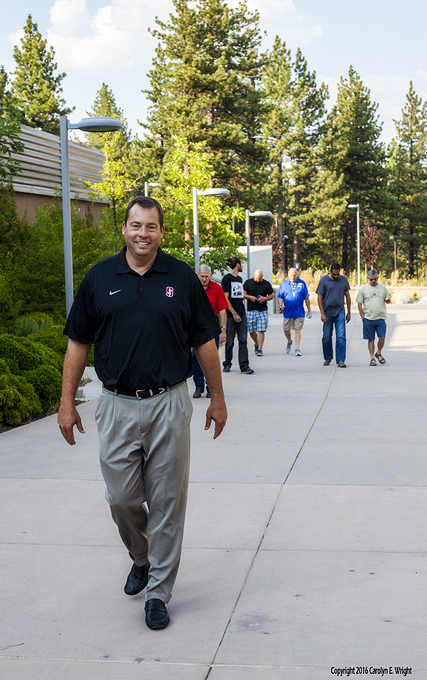
Jerrod Hasse, a South Tahoe High alum, is eager for the 2017 Stanford basketball season. Photo Copyright 2016 Carolyn E. Wright

By Judy Horst, InMenlo

Stanford men’s basketball coach Jerod Haase wanted to play for Stanford while growing up in South Lake Tahoe, but attended Cal before transferring to the University of Kansas, playing for coach Roy Williams.

Haase highlighted Stanford’s upcoming men’s basketball season for the audience at the Menlo Park Kiwanis Club’s luncheon earlier this month, eventually yielding to questions from the audience.

“Since I wanted to play ball at Stanford many years ago, I’m very happy to be here and to start another era of Stanford basketball,” Haase said. “Stanford University is a world-class institution which represents excellence across the board. My goal is to continue this tradition. We will compete for championships by doing it the right way and graduating young men who will go on to accomplish great things in the world.”

Read the whole story


Snippets about Lake Tahoe

·      The Aug. 29 South Lake Tahoe City Council workshop on marijuana will be at 5pm at the airport.

·      The American Century Championship golf tournament’s record attendance of 55,801 was a 16 percent increase from 2016.

·      South Tahoe High grad Leon Abravanel is now head coach of his alma mater’s boys’ soccer team.

·      The second annual Virginia City Rodeo, The Way It Was, will be Aug. 19-20.

·      There will be a vigil for peace and love in Truckee on Aug. 18 at 7:30pm in the wake of the unrest in Charlottesville, Va. Meet at the corner of Spring Street and Donner Pass Road.


SLT council wants 10-year contract for SnowGlobe

SnowGlobe will be under contract through 2028 when the deal is finalized. Photo/Lesia Witkowsky

By Kathryn Reed

SnowGlobe, the three-day controversial music festival, is going to be part of the South Shore lexicon for another decade.

The South Lake Tahoe City Council on Tuesday agreed to several details in what will be a long-term contract with Chad Donnelly, who first brought the electronic, mostly disc jockey produced bass-centric music event to the area in 2011.

Donnelly had a cadre of people at the Aug. 15 meeting to talk economics, sound and trash.

The current contract with the city and SnowGlobe goes through 2018. This new one would start in 2019. It will be for five years, with the potential for another five years. Donnelly wanted 10 years with two five-year extensions.

“We will never give up the annual reviews. There is always an out clause if the measures are not met,” City Manager Nancy Kerry told the council.

Exact performance measures will be brought to the council at a later date for approval.

Lake Tahoe Community College is an integral player, and without that board’s approval the city’s desires would be quashed. The college board is expected to take up the issue on Aug. 29. It has always had a year-to-year contract. Until last year the field where the soccer teams play was the venue, with the gym as the “green room.” (In 2016, the new community field which was just dirt was the venue site.)
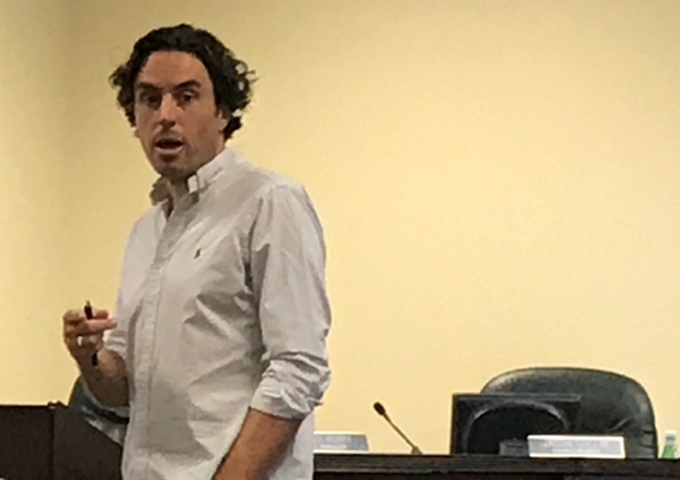
Chad Donnelly, SnowGlobe promoter from Colorado, has made millions off the South Lake Tahoe festival. Photo/LTN

“I did meet with Chad and city staff (Monday) and the proposal addresses many of the concerns raised by LTCC, but I think it is still imperfect as it is currently presented,” LTCC President Jeff DeFranco told Lake Tahoe News.

The college was less than thrilled with how long it took to remove all of the infrastructure from campus this year, with it looking trashy as the snow started to melt.

At the council meeting Donnelly blamed one vendor, said it wouldn’t happen again, but didn’t give specifics how that would be prevented.

It’s likely Bijou Park will become a part of the event for parking or bus drop offs.

The promoter said with a long-term contract he will be able to invest in infrastructure that will help protect the field and reduce sound issues. A commitment was also made to do a better job of cleaning up trash that attendees leave in neighborhoods.

Multiple times Donnelly equated his event to Coachella in Southern California. That three-day spring music festival went from 99,000 people to 125,000 this year with the addition of 46 acres.

Councilwoman Wendy David reminded him that Coachella is in the middle of a field, whereas SnowGlobe is in the middle of a residential area.

SnowGlobe attracts almost 20,000 each of the three nights. At the meeting Tuesday Donnelly said he had no interest in attracting more people, just making it better. However, in his written material that was part of the agenda packet it calls for 27,000 people in 2024, which is what revenues are based on. (That’s a 35 percent increase in the number of attendees.)
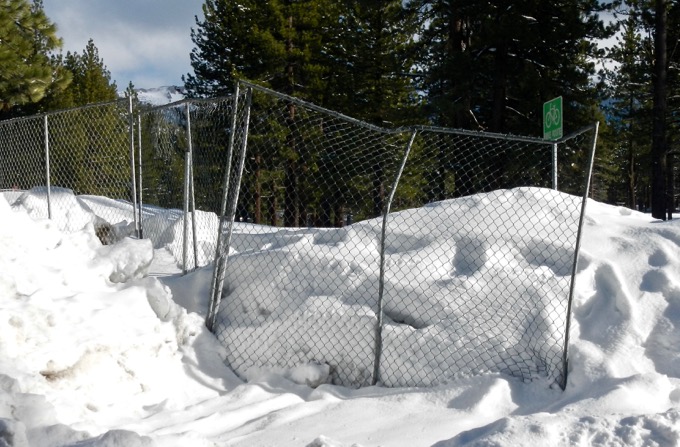
Damaged chain link fences remained for months after SnowGlobe 2016. Photo/LTN

Other aspects of the deal include the city’s agreeing to not allow another electronic music promoter to have an event at the new ball field either 60 days before or after SnowGlobe. (SnowGlobe is always Dec 29-31.) Donnelly doesn’t want a competitor eroding his profits.

Jesse Walker with New Economics Advisory went over an economic report he did from SnowGlobe 2016 that Donnelly paid for. The data he dissected was based on surveys that SnowGlobe employees conducted.

Walker concluded the financial impact was $11.4 million to South Lake Tahoe, with direct spending by concert-goers $6.1 million. They account for 50,785 room nights. (People tend to stay four nights.) On average each attendee spends $123/day, which does not include the price of the ticket. Sales tax revenue was $52,152 and transient occupancy tax $403,465.

(Stateline recorded 9,248 visitor nights, $10,646 in sales tax, $95,515 in TOT, $1.9 million in direct spending, with an overall economic output of $2.8 million.)

A big change with the long-term contract is the distribution of money. The city currently pays Donnelly $50,000. The new contract won’t have that deal. In fact, Donnelly’s proposal calls for the city’s contribution to go away starting this December and paying South Lake Tahoe a one-time $25,000 signing agreement.

Still to be worked out is if the city will be receiving a percentage of ticket sales or a set fee per ticket.

Taylor Storms, who is a co-founder and principal of Orkila Capital, was at the meeting as part of Donnelly’s financial team. His proposal is a graduated fee of 50 cents to $1.25 to be added to tickets that would be a pass-through to the city that has an estimated value of $11,000 to $33,750.

“This is separate from fixing the field or mitigating sound,” Storms said. “Our intent is if the field is damaged, we would fix it.”

The sod isn’t even in the ground, which is a concern of the entire council. That won’t happen for another month.

“We will be 100 percent responsible for the damage that occurs,” Donnelly said.

Besides the money, the council likes that this event is in essence an insurance policy against the weather. It means people are coming to town no matter if there is no snow. Plus, it brings a different demographic to the region. The festival also has made the hoopla at Stateline almost non-existent, which means less of an ordeal for law enforcement.



Opinion: Rafters, not taxpayers need to foot the bill

By Larry Weitzman

El Dorado County has a competent deputy chief administrative officer and former chief budget officer working in our administration, Laura Schwartz. She understands cash flow, spending and overall, she is pretty smart.

I understand she has a master’s degree in accounting. Darn good credentials. In fact, about the only thing I remember from my psychology 1A class was a chart listing the highest IQ of all professions and accountants were ranked No. 1. Of course, you can probably now guess my major in undergraduate school.

Larry Weitzman

But–and don’t you love “buts” because here it comes–at the Aug. 10 Planning Commission meeting when discussing item No. 5 regarding the new updated River Management Plan (RMP), I thought Schwartz had morphed into Nancy Pelosi, when she said, “We need to pass the RMP before we do a financial analysis of its impact.” Pelosi said an almost identical statement when she said, “We need to pass Obamacare to see what’s in it.”

Are you kidding me? What was the name of that turnip truck I just fell off? Of course, in spite of the objections of certain members of the public who even presented information as to the preliminary sheriff’s costs relative to the river totaling about $1 million, there was no analysis or method within the plan of how to recover these taxpayers’ costs. Yet, the entire Planning Commission approved the RMP recommending that the Board of Supervisors approve the RMP “as is.”

I don’t want to waste “the ink” telling you who the commissioners are who serve at the pleasure of the board. Understand that RMP appears to have been crafted by mostly the commercial rafting industry here in EDC as there are no provisions for cost recovery to the county for costs their industry creates. Sounds like the tail may be wagging the dog.

In fact, one of the ringleaders, Nate Rangel, in his column and in his appeal to the Planning Commission at the hearing to pass this updated RMP, attempted to counter facts that with respect to their approximately $30,000 grant for shuttle buses, the money doesn’t come from EDC, but comes from some state or local government environmental grant. Hello! Can anybody tell me where any government money comes from? How about grants, paychecks, pensions, police cars, road repairs, Delta tunnels, and high-speed rail? It comes from one place and one place only–the taxpayers. All Rangel is saying in his obfuscation of the facts is that the shuttle buses are essentially being paid for by different taxpayers, but paying just the same.

What the Planning Commission has done is similar to going to the board of directors at a bank with a business model but with no financial data. Here is our new plan to build a widget factory. It will be the best widget factory ever. Trust us. Just look at the drawings, equipment and factory buildings. But the board will ask the big question before showing them the door. You want our money to finance this monstrosity, right? Well how much is it going to cost? How are you going to pay for it? And how will you pay us back for the money you want?

That’s exactly what’s going on here. If the Planning Commission were a bank, the depositors would lose everything as it would go broke in a nanosecond. But we are dealing with government here, they don’t care about money because it is always “other people’s money” — your money and my money — never their own money. But the Planning Commission can’t think that deep.

The first things anyone with any brains asks of a new proposition is how much is it going to cost, and how are we going to pay for it? What happens to people when they get into government? Do they all lose their common “cents?” That’s just not in EDC, it’s problematic in all governments.

Not only did the Planning Commission fail to ask these most important questions, they failed to even ascertain one iota of information relative to costs. I did ask some questions and received incredibly quick answers from someone in the know. While they admittedly were good guesstimates, some of the numbers was quite accurate; however, further studies need to be done from the law enforcement, emergency response and public safety perspective. I was advised that information will be forthcoming as soon as EDC’s new computer system gets up and running. We also have no idea about code enforcement, another huge (cost) issue along the river, and that includes continuing violations of many concessionaire’s special use permits. Inquiring minds want to know, but unfortunately none of these minds reside in the EDC administration and/or the Planning Commission members.

You may hear things like “We have a river trust fund.” Well give the taxpayers and other concerned individuals an accounting. It isn’t called a trust fund for nothing. And they may claim they already pay fees for this and that. Well tell us how much the total is? And they claim they bring ancillary business to the county. Well let’s cut through the chase on that one. All businesses do that especially hotels and motels who already pay a 10 percent transit occupancy tax. The argument of the rafters that they make money for the county just doesn’t hold water.

When is this incompetence going to end? Or the free ride of the commercial rafters and the businesses who operate on special use permits going to end? They need to be paying for the costs of their river use, not the taxpayers.

Larry Weitzman is a resident of Rescue.              


Later start times in Calif. schools could save sleep, complicate life

By Hawken Miller, Sacramento Bee

Knikki Royster starts her workday as a juvenile court teacher in San Diego at 7:30 a.m., and she’s not sure what to do if her two kids can’t start high school until an hour later.

“I don’t like the idea of my kids having to walk to school. I prefer to drop them off,” Royster said. They would have to walk a mile to school. “I want that supervision in the morning. … When you don’t allow parents to do their job, we start making systems that don’t work for parents and hurt the family.”

Working parents like Royster are wondering about new routines as the idea of later school starting times gains traction in California. Sen. Anthony Portantino’s Senate Bill 328, which would prohibit middle schools and high schools from starting earlier than 8:30am, is cruising through the Legislature and faces final votes when lawmakers return next month. The debate also is playing out in school board meeting rooms around the state. In the area, some schools in Davis and Sacramento have already moved to the later start time.

Read the whole story