Eldorado Forest implementing fire restrictions

Fire restrictions go into effect in the Eldorado National Forest on Aug. 18.

Wood and charcoal fires will be restricted to designated recreation sites and other fire related activities will be prohibited until the end of fire season. Gas or propane fires are allowed with a free 2017 California campfire permit.

On USFS lands, fire restrictions mean:

  • No wood or charcoal fires are allowed outside of exempted recreation sites even with a valid campfire permit.
  • No smoking, except within an enclosed vehicle, building or exempted recreation site.
  • Operating a welding or other torch with an open flame is prohibited.
  • Operating an internal combustion engine without a properly operating spark arrestor is prohibited.
  • Lanterns and portable stoves using gas, kerosene, jellied petroleum or pressurized liquid fuel are allowed with a valid 2017 California campfire permit.
  • Those with a valid 2017 wood cutting permit may cut firewood in compliance with the terms of their permit.

Complete details regarding the 2017 fire restrictions, including the list of designated recreation sites, is available online.


Squaw appealing state fine from patroller’s death

Squaw Valley Ski Holdings is appealing the decision by CalOSHA that found infractions at the ski resort after the death of ski patroller Joseph Zuiches.

The state Occupational Safety and Health Administration this month said it was fining Squaw $11,250 for “failing to correct an identified unsafe working condition by implementing a procedure for protection against the workplace hazards associated with hang cord entanglement during hang cord blasting operations.” The second fine of $9,000 was for “failing to ensure that all crew members maintained visual contact or awareness of physical location of crew members at all times during avalanche control activities.”

Zuiches died Jan. 24 at the resort working in avalanche control.

Squaw believes the state’s findings are not accurate and the fines not justified. The resort wants to keep investigating the death.

— Lake Tahoe News staff report


Efforts to keep sediment from Tahoe paying off

By Kathryn Reed

“It’s about finding opportunities and doing the work we know needs to be done.”

This is how Bob Larsen with the Lahontan Regional Water Quality Control Board summarized the ongoing efforts to reduce the pollutants reaching Lake Tahoe. Much of that is fine sediment that is washed into the lake, which then degrades the clarity of the water.

His agency along with the Nevada Division of Environmental Protection are the overseers of the total maximum daily load program in the basin. Goals are set for each government jurisdiction in Tahoe – from the city to the counties, state departments of transportation, U.S. Forest Service and state land owners.

The 2017 performance report was released Aug. 17.

“Exceeding the target was expected based on the work done,” Larsen told Lake Tahoe News.

The five-year goal was to reduce sediment reaching the lake by 10 percent. Collectively, there was a 12 percent reduction from the 2004 base year. (The TMDL program started in 2011.) In the process, the amount of phosphorus reaching the lake decreased by 8.5 percent and nitrogen by 6 percent.

The sediment reduction equates to 268,500 pounds or 70 dump trucks worth of fine dirt that have been keep from the water.

In the spring, South Lake Tahoe, El Dorado County and Placer County were notified they met their goals. The next five-year goal for each is reducing pollutant loads by another 15 percent.

Throughout the basin the next five-year goal is another 11 percent reduction on top of the last 10 percent goal.

“It will be a challenge, but I feel it’s a challenge we can overcome,” Larsen said.

Runoff from roads is a primary source of sediment reaching the lake. The worst roads, according to officials, mean more gunk going into the water.

“There is some new information we have showing roads contribute upward of 30 percent of the sediment into the lake,” Russ Wigart with El Dorado County said last spring.

Different surface materials are being studied and various catch basins installed.

The long-term goal of the TMDL is to restore the lake’s clarity to 97.4 feet by 2076. This means when scientists put what looks like a white dinner plate into the water it will be able to be seen by the naked eye to that depth.

In 2016 the average depth of clarity was 69.2 feet. Sixty-four feet is the worst it’s been. That was recorded in 1997; the same year as the first environmental summit at Lake Tahoe. Since that time about $2 billion worth of environmental improvement projects have been implemented in the basin, all with the ultimate goal of protecting Lake Tahoe.

Other factors besides sediment are contributing to the clarity loss-gain. Climate change is a biggie, according to scientists. Time will tell if the millions of dollars spent each year on these TMDL projects will be enough to keep Tahoe blue and not have it look brown like so many lakes in the world.


El Dorado Savings’ quarterly profits increase

El Dorado Savings Bank’s second quarter profits were $723,944 above the same period a year ago, at $3,607,198.

Earnings for the first half of 2017 totaled $6,581,965, compared to $6,465,488 in 2016.

“The continued strong profits reflect the stable performance of the loan and investment portfolios,” CEO George L. Cook Jr. said in a statement. ““The bank remains in excellent financial condition with strong capital, high liquidity and excellent asset quality. We ended the first half of 2017 with no foreclosed property on the books.”

El Dorado ended the quarter with $2.165 billion in total assets and savings deposits of $1.92 billion.

As of June, El Dorado Savings Bank maintained its top five star rating with Bauer Financial Reports, a recognition El Dorado has had since December 1993.

The bank operates 35 branches, 31 in California and four in Northern Nevada.

— Lake Tahoe News staff report


Road Beat: Kia jolting the EV market

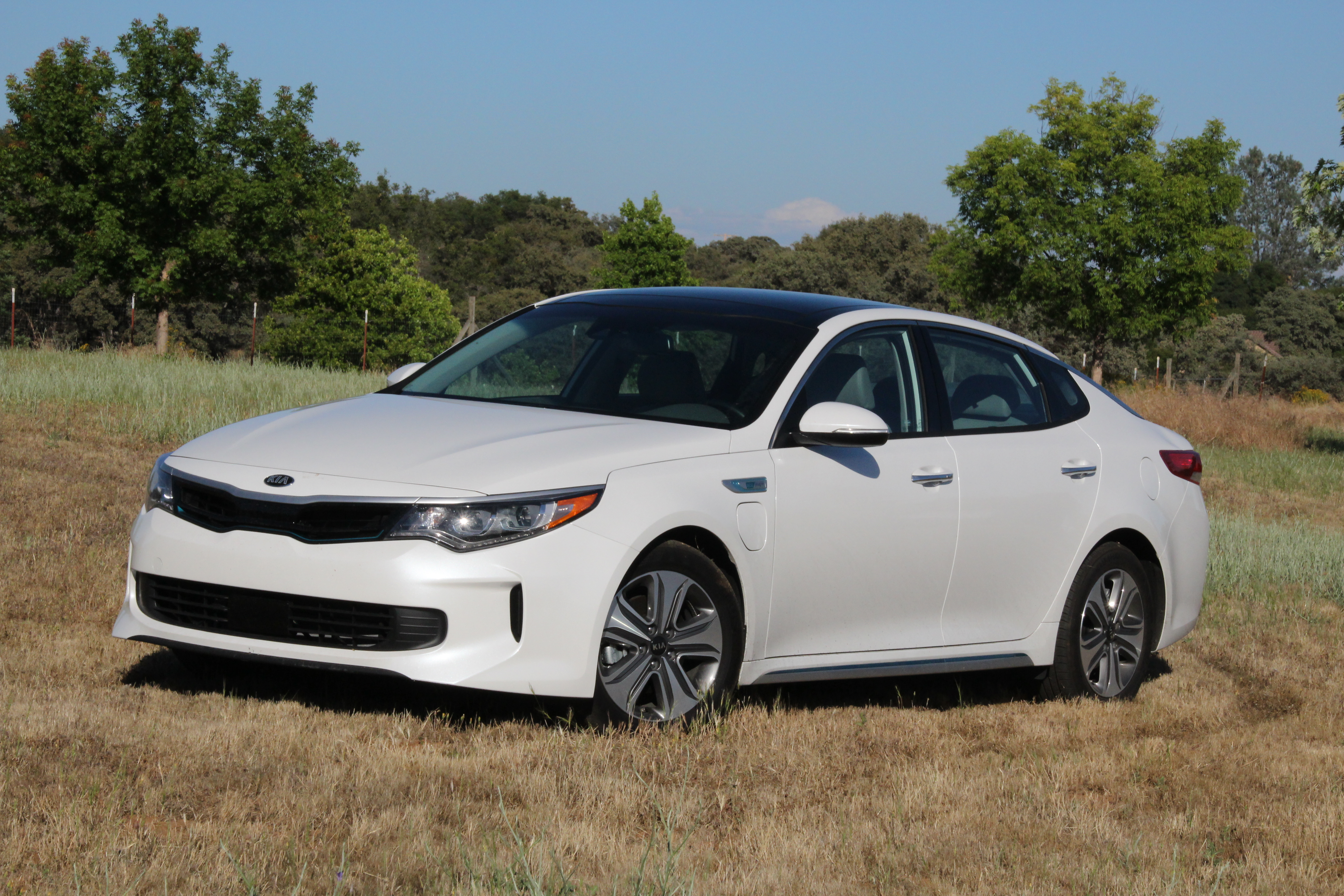
The 2017 Kia Optima PHEV is impressive to drive. Photos/Larry Weitzman

By Larry Weitzman

While electric vehicles seem to be all the rage, sales are still dismal with sales being about one-half of 1 percent of the entire automobile market. Pure electric cars are expensive and suffer from limited range and range anxiety. Cars aren’t for pushing, they are for driving.

Kia has taken the beautiful and stylish Optima body, stuck another small spring-loaded door on the left front fender to access a port for the plug-in receptacle, added a 9.8 kWh L-I battery behind the rear seat and tire well (to increase trunk space) and 67 hp electric motor mounted to the six-speed automatic cog-swapper. Modifications to the body, such as active grille doors to smooth airflow in front and a diffuser in the rear, reduce wind resistance to a co-efficient of drag of 0.24 equaling a Tesla S.

Optima is a true midsize riding on a 110-inch wheelbase supporting a 191-inch body that stands 58 inches tall with an aggressive 73-inch width.

Power comes obviously from two sources, a 2.0L Atkinson Cycle, DOHC, 16 valve direct injected inline four that cranks out 154 hp at 6,000 rpm and 140 pounds of twist at 5,000 rpm. If the numbers seem slightly depressed from other 2.0L high performance four bangers, it’s because this is a higher efficiency Atkinson cycle engine. The electric motor with the L-I battery at full charge is the main motive source for this PHEV. Combined they push out 202 hp and 276 pounds of twist. And it certainly feels like it.
Specifications
Price $36,105 to $41,750
Engine
2.0L DOHC, 16 valve, direct injected inline four cylinder 154 hp @ 6,000 rpm; 140 lb.-ft. of torque @ 5,000 rpm
67 hp electric motor
9.8 kWh L-I battery, max output 91 hp
Combined Max hp 202 hp @ 6,000 rpm
276 lb. ft. of torque @ 2,330 rpm
Transmission
Six speed torque converter automatic
Configuration
Transverse mounted front engine/front wheel drive
Dimensions
Wheelbase 110.4 inches
Length 191.1 inches
Width 73.2 inches
Height 57.5 inches
Ground clearance 5.1 inches
Track (f/r) 63.1/63.4 inches
Weight 3,788 pounds
Fuel capacity 13.4 gallons
Trunk capacity 9.9 cubic feet
Passenger capacity 104.8 feet
Steering lock to lock 2.78
Turning circle 35.8 feet
Wheels 7.0X17 inch alloys
Tires 215/55X17
Co-efficient of drag 0.24
Performance
0-60 mph 7.52 seconds
50-70 mph 4.01 seconds
50-70 mph uphill 5.65 seconds
Top speed plenty fast
Fuel economy EPA rated 103 MPGe/40 mpg gasoline only. Overall in rural country driving expect 60 mpg. On the highway at legal speeds should net 46 mpg.

You cannot run the battery down to zero. It always holds some charge so it can operate as a regular hybrid. When I plugged in after 40 miles the battery showed a 19 percent charge or about double the energy in a fully charged regular hybrid battery.

Performance is above average for this class of cars with 0-60 mph arriving in 7.52 seconds, certainly equal or better than the Chevy Volt. Passing times are also good with a level 50-70 mph pass of 4.01 seconds and the same exercise uphill slows that time by a second and a half to 5.65 seconds.

What makes the Optima EV outstanding is the pure electric performance. Even with what would seem a modest power output of just 67 hp from the electric motor alone, it is very responsive and acceleration is strong, so strong I kept looking for the engine to be running but it never lights off, even with half throttle which will push you back in the seats with authority. Transitions between the EV and the integration of the gas engine is absolutely seamless. This Optima is fun to drive.

I just finished a 40-mile trip with many stops and the Optima was able to remain in full electric up to the last mile, 39 miles, basically the EV driving range. Optima says the system should yield about 29 miles. Pure electric speeds exceeded 70 mph even up a slight grade.

I plug it in nightly and even during the day if my trips are spaced out and for the last 300 miles, which includes a one-day round trip to Carson City of 198 miles where it averaged 52.4 mpg. Optima average is 62 mpg for that 300 miles. At 70 mph on the highway in HEV mode, Optima PHEV will return 46 mpg. EPA numbers which are a bit confusing rated the Optima at 103 MPGe and 40 mpg only on gasoline. In overall driving the average will easily exceed 50 mpg. Amazing, especially with the kind of performance this Optima can produce. Fuel tank is 5 gallons less at 13.4 gallons, so highway range will be less than a conventional Optima.

But there is a rub, especially here in California, electricity is very expensive. I am paying 30 cents a kWh meaning even at four miles a kWh it costs me 7.5 cents a mile for energy. Gasoline only costs about 6 cents a mile. I understand there are some incentives offered by utilities to subsidize that cost, but it doesn’t really lower the overall cost, it just shifts the cost burden to someone else.              

 But California is the anomaly, as the average cost of electricity across the U.S. is about 12 cents a kWh meaning the cost per mile is about 3 cents a mile or about one half of gasoline. The average in California is about 16 cents a kWh, but as with El Dorado County rates increase as you use more. If the U.S. were more nuclear, the cleanest and cheapest form of power, costs would drop even further.

The other negative with a PHEV is the additional weight, although Kia has done a great job of adding a second power system (battery, electric motor and system components) with just a 300-pound weight penalty. Not bad, Kia.

In comparison to the Volt, which is supposed to run almost 50 miles as an EV before the engine lights off, the Optima PHEV has more performance and a much larger cabin as the Volt is a compact car with a much smaller cabin. While I haven’t tested the Volt, overall mileage might be just a bit better as it has twice the battery capacity.

Other than carrying an extra 300 pounds, suspension is similar to other Optimas, with all four corners sprung independently, roll bars at both ends and coil springs in all the corners. Steering is a quick electric rack at 2.8 turns lock to lock. It rides on 17 x 7 inch alloys which must have been designed for aerodynamics and not looks, shod with 215/55 tires. Nothing special here. While a Miata would smoke the Optima PHEV in the twisties and it might not set any Nürburgring records it handles predictably with descent cornering power, certainly more cornering power than any of its drivers will ever demand. I pushed it pretty hard and it complied, changing directions without complaint. Turning circle is reasonably tight at 36 feet.            

If you expect a soft floaty ride, look elsewhere. In fact, while the ride is well controlled and incredibly quiet, especially when operating as an EV, over bumps it is firm, not harsh or jolting, just firmer than anticipated. There is no tach, so no 70-mph rpm. There is also no wind noise and little tire noise.

Safety begins with the driver, but to help you along, Optima PHEV has all the acronyms, rear camera and air bags plus with the EX Tech ($5,250) package comes blind spot detection, lane departure warning, auto high beams, forward collision warning, emergency braking and more.

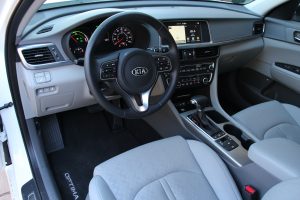
Leather is the material of choice in the high-quality interior. There is no tach but the rest of the instruments are front and center including a couple of trip meters and a battery level meter to tell you how much you have left. Seating is comfortable, if not on the firm side and the rear seating is good for three adults with plenty of shoulder and leg room. The supposedly large trunk is still small by mid-size car standards at a well-shaped 10 cubic feet also down by about 5 cubes over the conventional Optima.

Pricing starts at $35,210 plus $895 for the boat ride from South Korea. My tester has the tech package plus a special snow-white pearl paint ($395). This is a remarkable ride demonstrating just how good the technology is. Imagine 60 mpg and 0-60 mph is 7.5 seconds. How do they do that?

Larry Weitzman has been into cars since he was 5 years old. At 8 he could recite from memory the hp of every car made in the U.S. He has put in thousands of laps on racetracks all over the Western United States.



South Lake Tahoe city attorney calling it quits

By Kathryn Reed

South Lake Tahoe City Attorney Tom Watson tendered his resignation Aug. 16, with his last day being at the end of September.

Tom Watson

Watson told council members he is leaving to become city attorney for Tracy.

When he was hired in May 2013 he told Lake Tahoe News the Tahoe position was a “dream job.” Clearly, things changed. He did not return calls Wednesday.

Mayor Austin Sass said he was not surprised Watson is leaving based on his wife living in Fresno, which is where he lived before taking the Tahoe job. She was not able to get a job in this area; she is the coordinator for the Department of Educational Leadership at California State University, Fresno.

The new job will put him much closer to his wife. There was a time she lived here, along with their daughter. She is now in college.

Watson has been a victim of the housing shortage in the basin. He never owned here, and has had to move when his long-term rental became a vacation home. Being gone so much for personal reasons he never made Tahoe his home and was not immersed in the community.

“I enjoyed working with Tom. I enjoyed the fact that he had a background in private industry and a public service background. I thought his perspective on things was good,” Sass told Lake Tahoe News. “He could look at things from both sides of the aisle, so to speak.”

Sass and Councilwoman Wendy David plan to meet with City Manager Nancy Kerry this afternoon to discuss how to proceed. The entire council at the Sept. 5 meeting will likely make a decision about the next steps.

The two city employees who report directly to the council are the city manager and city attorney; therefore, they are the ones who hire, fire and review those individuals. This will be the first time Sass, David and Councilmember Jason Collin have gone through this process for either of those jobs. David, though, was part of Lake Tahoe Unified School District’s board when Diane Scheerhorn and Jim Tarwater were hired as superintendent.

Most likely the city will hire a consulting firm to aid in the search. Inevitably it will take several months to fill the position. And depending on how much time that person would need to give notice it could be after the winter holidays before someone is on board.

Watson is leaving at a time when two key issues are before the City Council. It’s likely the revise of the vacation home rental ordinance will essentially be written next month before he leaves, but the marijuana issue could be unresolved.

In the interim, the city has a deputy city attorney and a legal secretary. The city also contracts with Burke, Williams & Sorensen LLP out of Oakland for Nira Doherty to come up once a month for one week. Doherty was the assistant city attorney for South Lake Tahoe before leaving to be a partner in the private law firm. On that firm’s website she is listed as the assistant city attorney for South Lake Tahoe, though on the city’s website there is no mention of her.

Nonetheless, Doherty is well versed in many city legal issues. She gave the last presentation about marijuana and will likely be at the workshop later this month.


Opinion: Federal lands need to be in public domain

By Nicholas Kristof, New York Times

This will make me sound grouchy and misanthropic, but I sometimes wonder if what makes America great isn’t so much its people as its trees and mountains.

In contrast to many advanced countries, we have a vast and spectacular publicly owned wilderness, mostly free and available to all. In an age of inequality, the affluent have gated neighborhoods, private schools, backup generators and greater influence on elected officials. But our most awe-inspiring wild places have remained largely a public good to be shared by all, a bastion of equality.

My family and I have been backpacking on the Pacific Crest Trail through the Sierra north of Donner Pass, enjoying magnificent splendor that no billionaire is allowed to fence off. We all have equal access, at no charge: If you can hold your own against mosquitoes and bears, the spot is yours for the night.

Read the whole story


California confronts its Confederate past

By Esmeralda Bermudez, Corina Knoll and Anh Do, Los Angeles Times

The backhoe crept into the graveyard as the city lay still.

It had come for the 6-foot granite monument with the bronze plaque, a salute to the Confederate Army veterans interred below.

Hollywood Forever Cemetery had housed the marker since 1925, but the recent events in Charlottesville, Va., had sparked phone calls, emails and social media rants calling for its removal. An online petition circulated. Vandalism threats were made. By Tuesday, the word “No” had been written across the monument in black. The staff of a generally beloved institution was overwhelmed; the monument owners uneasy.

And so at 3am Wednesday, the monument aged with a green patina was excavated, covered with a blue tarp and carted away in a pickup, a patch of fresh sod patted into its place.

California has been grappling with uncomfortable symbols of past racism and cruelty for years.

Read the whole story


Calif.’s investment in needy students not paying off

By Jessica Calefati, CalMatters

California’s new system for funding public education has pumped tens of billions of extra dollars into struggling schools, but there’s little evidence yet that the investment is helping the most disadvantaged students. 

A CalMatters analysis of the biggest districts with the greatest clusters of needy children found limited success with the policy’s goal: to close the achievement gap between these students and their more privileged peers. Instead, test scores in most of those districts show the gap is growing.

The test scores echo a broader and growing concern about the Local Control Funding Formula from civil rights groups, researchers and legislators.

That formula sends more money to schools with higher concentrations of foster youth, kids learning English and students from low-income families. But four years after it was adopted, there are few signs the program is working, and questions have arisen about whether the $31 billion invested so far is being spent effectively.

Read the whole story


Camp Rich bike trail to be off-limits at times

Beginning next week, the Pope Baldwin Bike Path near South Lake Tahoe will be subject to traffic control while crews thin trees around the bike path. Flaggers will intermittently close the bike path for up to 30 minutes at a time for public safety during the tree felling operations. 

This phase of the project will take place Monday through Friday from 6am-3pm and is expected to last several weeks. 

Bicyclists may use the bike lane on Highway 89 to detour around the traffic control areas.

This project involving mechanical cut-to-length thinning near Pope Beach is under way. This involves using a harvester to cut the tree down, remove the limbs and cut the tree into sections in the cutting area. For public safety, the Forest Service advises people to avoid these areas due to the hazards posed by heavy equipment and falling trees.  Hazards may be present even when operations have ceased for the day. Work is expected to continue through mid-October.    

The forest thinning is part of the South Shore Hazardous Fuels Reduction and Healthy Forest Restoration Project, which aims to treat approximately 10,000 acres on the South Shore of Lake Tahoe over the next few years.