Trail will retrace Donner Party path

Placer County this week took action that will help the Memorial Overland Emigrant Trail through Donner Memorial State Park become a reality.

Placer County will be the lead when it comes to planning and designing the trail. Money will in part come from hotel taxes.

California Department of Parks and Recreation will oversee permitting and construction of the trail, and will be responsible for maintenance within its boundaries.

The 16-mile trail will re-create the original wagon route west over Donner Summit. It will go from Kingvale through Donner State Memorial Park in Truckee, following the original Overland Emigrant Trail but away from its remnants to protect its historical artifacts.

Environmental studies should be done a year from now, with public workshops planned in the months to come.

— Lake Tahoe News staff report


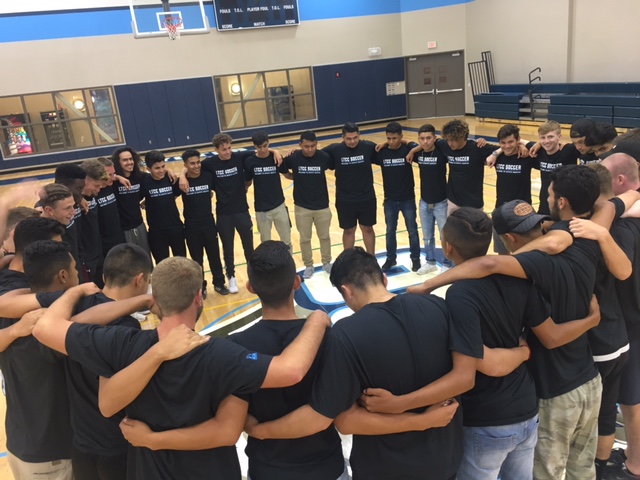
LTCC soccer teams eager to launch ’17 season

Camaraderie is key to success on the soccer field. Photo/Terra Breeden

By Terra Breeden

The only thing artificial about soccer at Lake Tahoe Community College is the field on which the players smack that white and black ball.

The men and women’s teams have been practicing for weeks in anticipation of the season opener Aug. 22, with both squads hoping to improve upon last year’s results. In 2016 the men went 12-5-6, after winning the Golden Valley Conference championship the year before for the second time. Two years ago the team earned its first state final four appearance. The women went 11-5-4 in 2016.

Men’s head coach Nick Arbelaez and women’s head coach Jeremy Evans have built what they hope are all-star teams, having recruited players from all over the country to play at LTCC. Both soccer teams are expected to do well this year.

LTCC coach Jeremy Evans, center, works with the women in preparation for the 2017 season. Photo/Diane Lewis

The Coyotes are in their fourth season, with head coaches who are in their second (Arbelaez) and third (Evans) years.

“In soccer, we are one of the top 10 junior colleges in the country,” Arbelaez told Lake Tahoe News. “The focus is there and we’re hoping to come away with a championship this year.”

Sixty percent of sophomore soccer players at LTCC receive an athletic scholarship to attend four-year schools and because of LTCC’s standing as a top junior college, many gifted players come to the school for soccer.

“I’m looking forward to a fun year and the expectations are high because for these players. Soccer is a privilege, not a right,” Arbelaez said.

Both teams are practicing nonstop to get ready for their first game on Tuesday. The women take on West Valley College at 5pm and the men will be playing the 1868 Reno professional soccer team at 7pm. Both games will be at the LTCC soccer field.

Once the season starts, the LTCC teams will be competing every week. Each plays 22 games in 90 days.

“It can be a grueling schedule, but we’re excited for the season,” Evans said.

Although the teams are composed of a lot of talented locals, both have players from all corners of the globe. On the men’s team, three players come from England, one from Spain and another from Jamaica. The women’s soccer team has many local players, as well as members from the Bay Area and England.

“This is about providing a college experience and having players from different cultural backgrounds provides that,” Evans said.

There are several players to keep an eye on this season.

“We have 18 solid players,” Evans said. “It’s the best collection of talent that has ever come through this program.”

Veterans like Caitlyn Bidart, who plays defender center-back, and forward Kenya Maltese should be forces to be reckoned with.

“Caitlyn Bidart had a phenomenal freshman year and having that kind of leadership on the team is critical because I have 16 newcomers who are looking for guidance,” Evans said.

Last year, Maltese was voted to be an all-league player in the Golden Valley Conference as a freshman. This year, she is revving up for another big season as she returns to the field at LTCC.

“I’m looking for her to be leading goal scorer and build on her impressive first year,” Evans told Lake Tahoe News.

On the men’s team, sophomore forward Sean Keith is captain of the team. Keith will be graduating from LTCC in June. He already has an opportunity to play at Creighton College, which is a Division 1 school in Nebraska.

LTCC men’s soccer team is aiming for a division title. Photo/Diane Lewis

“He’s quick and an overall leader,” Arbelaez said. “He’s the first one at practice and the last one to leave, just a really special athlete.”

Co-captain of the men’s team Dalton Rice plays center-mid position and brings high energy to the game.

“He’s a dynamic player and a team leader who’s also great in the classroom,” Arbelaez said.

Sophomore Omar Trujillo came to LTCC from the Reno area and is the goalkeeper. Although Trujillo will be graduating from LTCC soon, his soccer skills define him as one of LTCC’s star players.

“He has quite a few schools gauging his interest — he is that good,” Arbelaez told Lake Tahoe News. “He had the starter position as a freshman.”

Although both LTCC soccer teams are looking forward to a stellar season, there is more to the players than school and sports. Players are involved in the South Lake Tahoe community throughout the year. They tutor and read books with local children at South Lake Tahoe elementary and middle schools. Several team members also volunteer at Tahoe Youth & Family Services and provide mentoring to youth. Both LTCC soccer teams are involved in the South Lake Tahoe American Youth Soccer Organization (AYSO) and have “soccer days” at the schools.

“Soccer is a big part of their lives, but we encourage community outreach. When the players get out in the community, the community gets to know them on a different level, as human beings and not just talented athletes,” Arbelaez said.


Opinion: The Apocalypse in San Juan Bautista

By Joe Mathews

If the apocalypse comes to California, I’ll be ready. After all, I’ve been to San Juan Bautista.

This summer I visited the San Benito County town, which has centuries of experience with the ending of worlds, as Armageddon drew closer than ever. North Korean missiles can reach California. The American president has the nuclear codes and no impulse control. State-sized icebergs break off Antarctica.

Joe Mathews

In California, this moment seems especially apocalyptic. Our governor routinely thunders that unmitigated climate change will make the planet uninhabitable soon. Huge fires rage from Yosemite to Modoc. Even if we somehow survive natural and man-made apocalypse, Elon Musk says robots will just inherit the world anyway.

In these scary times, a small, out-of-the-way place like San Juan Bautista—with fewer than 2,000 people, just off the 101 between Gilroy and Salinas—might seem like an escape. But no California place is more haunted by visions of apocalypse—historically, seismically, cinematically.

Armageddon and the town come together in the most famous local structure, the Mission San Juan Bautista, the 15th of the 21 California missions. It is distinguished by its size—it was the largest mission—and its movie fame, as the setting of the most terrifying scenes of Alfred Hitchcock’s “Vertigo.”

At the mission, I walked into the Guadalupe Chapel, where the Rev. Alberto Cabrera was saying Mass and singing all the verses of “Amazing Grace,” including “The earth shall soon dissolve like snow, / The sun forbear to shine; / But God, who called me here below, / Will be forever mine.”

The hymn put me in mind of the apocalyptic story of California’s Indians, and their deaths by the thousands, mostly from disease. The mission period saw a decline in the state’s native population from 300,000 to 250,000; it collapsed even further after the U.S. conquest, from 150,000 in 1850 to 30,000 a quarter-century later.

This history feels alive in San Juan Bautista. Descendants of decimated local tribes have raised the topic so consistently that Bishop Richard Garcia of Monterey gave a Mass at the mission in 2012, asking for forgiveness for the sins committed against Native Americans in California. Less than a half-mile from the mission, El Teatro Campesino has built a national reputation with diverse works, some of which look back at Mission Indians as well as the Aztec and Mayan civilizations, which suffered their own catastrophes.  

For all the weight of past apocalypses, looming destructions are plainly visible at San Juan Bautista. After walking through the mission cemetery, I encountered a U.S. Geological Survey marker noting what lies beneath the mission: the San Andreas Fault. For more than 200 years, the fault has damaged parts of the mission. A major retrofit is being planned for next year, but can the mission stand at this dangerous spot for another 200 years?

From the fault, I walked across the grassy plaza, bordered by preserved buildings in a state historical park. Among the structures is the Castro-Breen Adobe, named half in honor of Patrick Breen, the Irish immigrant who, with his wife and seven children, joined the Donner Party, and lived to tell the tale.

The square is instantly recognizable to movie buffs. Jimmy Stewart and Kim Novak run across it twice in “Vertigo.” Each of those scenes ends with a different blonde woman seemingly falling to her death from the mission tower. The church had no tower when Hitchcock filmed in San Juan Bautista 50 years ago—the one you see in the movie is a Hollywood special effect.

But those cinematic falls in San Juan Bautista, have made “Vertigo” a document for contemplating the fall of humanity. One great philosopher of our age, Jean-Pierre Dupuy, a Frenchman who teaches at Stanford and is close to Gov. Jerry Brown, has written that the movie inspired his own career as “an enlightened doomsayer” who developed “a metaphysics of the age of catastrophe that awaits us.”

Dupuy devotes the epilogue of his masterful book, “The Mark of The Sacred,” to “Vertigo’s” complicated plot, and especially to how Stewart’s character allows himself to be twice deceived by Novak’s character, only realizing the peril after it’s too late.

In this, Dupuy sees humanity’s failure to recognize how close we are to the apocalypse. The apocalypse, Dupuy writes, is nothing like death, which is part of life. The apocalypse presents us with the greater horror of nothingness. If humanity ends, it will be as if all the people who came before—Alfred Hitchcock, the Donner Party, or California Indians—had never existed.

To save ourselves, Dupuy argues, we must treat the apocalypse as inevitable, stare as deeply as possible into the abyss, so that we inspire ourselves to avoid falling in.

So, please, visit the apocalypse as soon as possible. San Juan Bautista is nigh.

Joe Mathews writes the Connecting California column for Zócalo Public Square.


Saga of a poacher: crime and punishment

By Tom Stienstra, San Francisco Chronicle

A wildlife detective saga in Northern California ended with the conviction last month of an out-of-state deer poacher — with a twist from a law that just took effect: The same poacher, caught now, would have faced fines of $80,000 instead of the $1,500 he was assessed in Superior Court.

The new law, five years in the making, says that poachers who take trophy deer, with antlers 3×3 or better, and other trophy wildlife, can face fines of $40,000 per animal, and those who illegally shoot wild turkeys up to $5,000 per bird, plus jail time.

The trail of evidence led game wardens to Nevada, on to Truckee and then ultimately to remote Mendocino County.

Read the whole story


Review: ‘Belgravia’ a bit disappointing

By Kathryn Reed

The predictability of “Belgravia” had my book club giving it mediocre scores when it came to whether we liked it and would we recommend it. My ratings were lower than the group average.

The Julian Fellowes (Grand Central Publishing, 2016) novel is mostly set in London in the mid-1800s. While it is considered an historical novel, it’s more like a period piece. Only the first chapter has a real sense of anything historical.

Those who watched “Downton Abbey” had better things to say about the book than the rest of us. Fellowes was the creator-writer of that television series. He has also won an Academy award in 2002 for best screenplay for “Gosford Park.”

Clearly, Fellowes has writing credentials. But from his efforts with “Belgravia” this would have seemed more like an early attempt at writing. 

Secrets and lies that link two disparate families are woven throughout the book. While at times it seems like the lies will unravel everything, ultimately it is a lie that binds them together.

Nobility, money, social climbing, adultery and love are part of the book.

Society’s various classes are a central theme – from those born with titles and money, to the working person striving to rise to the next level, to the ranks among the servants. Each seems to have a jealousy of the other, a certain disdain and somewhat of a desire to be something they aren’t.

“Belgravia” is a fairly quick read, and good for a bit of escapism, but it is also a bit repetitive.


Replica of Vietnam memorial coming to Douglas County

The Moving Wall, a half-size replica of the Vietnam Veterans Memorial Wall in Washington, D.C., is coming to the Carson Valley in 2018.

It will be at Eastside Memorial Park in Minden from May 31 to June 6. It will be erected on the back lawn. 

People will be able to view the wall 24 hours a day.

Details about the opening ceremony will be forthcoming.


Violent crime in El Dorado County up 15%

By Jim Miller, Sacramento Bee

For the second year in a row, California saw an increase in violent crimes, according to new state figures, which also include the first detailed look at peace officers’ use of force.

The Department of Justice’s inaugural use of force report, required by recent state legislation, covers incidents that caused serious bodily injury or death. There were 782 such incidents in 2016, including 328 that involved the discharge of a firearm, according to the agency.

Most Sacramento-area counties had overall decreases in violent crime in 2016. Violent crime reported by 17 agencies in Sacramento County declined by 6.4 percent. Placer County had a 7.9 percent drop and Yolo County violent crime declined by 20.5 percent. El Dorado County had a 15.1 percent increase.

Read the whole story


Snippets about Lake Tahoe

·      South Lake Tahoe wants people to take this one-question survey about dogs in the city’s parks.

·      Lake Tahoe South Shore Chamber of Commerce is hosting a workshop Sept. 20 from noon-1pm about marijuana in the workplace. It will be at the Stateline office. Go online to register.

·      Tahoe Douglas Fire Protection District is collecting hazardous waste for free on Sept. 16 from 10am-3pm at the station on Elks Point Road.

·      Tahoe Show – NPC Bodybuilding, Figure, Fitness & Bikini is Aug. 26 at MontBleu. For details, go online.

·      Jackson Michelson is putting on a free show Sept. 8 at Blu Nightclub inside MontBleu at Stateline. Doors open at 8pm, show is at 9pm. Must be 21.


Energy conservation urged during eclipse

Liberty Utilities is encouraging customers to conserve energy during the solar eclipse on Aug. 21.

While the eclipse will last for less than three minutes on Monday morning, California is asking residents to conserve from 9am-10:30am. The state’s “Do Your Thing for the Sun” campaign is designed to reduce energy demand on the electrical grid when solar energy sources will be affected during the eclipse.

Liberty is not anticipating any lapse in power during the eclipse.

Liberty Utilities offers these year-round no-cost energy conservation tips:

  • Turn off lights and appliances when not in use, including computers.
  • Charge your electric vehicle and other electronic devices in the late evening, preferably after 10pm.
  • In warm months, set the thermostat to 78-80 degrees when home, and 5-10 degrees warmer at night or when you’re not home.
  • In the cooling season, close blinds and drapes during the day to keep heat out.
  • Use your electric dishwasher, clothes washer and dryer after 10pm when demand is lowest. Cook as late in the evening as possible.
  • Barbecue outdoors when practical.
  • Set your water heater to 120 degrees.
  • Vacuum refrigerator coils, underneath and in the back. They need air space to work.


West Nile virus found in Nevada horses

Three horses in Northern Nevada have tested positive for West Nile virus in the last two weeks. Not one was vaccinated.

Two horses were in Lyon County — one in Yerington and one in Dayton — and one horse was in Washoe County.

Nevada Department of Agriculture veterinarians say the best protection horse owners have is to vaccinate animals.

West Nile virus has been prevalent in Nevada since 2004. Residents can take precautions by eliminating mosquito-breeding sites around houses and barns, using insect repellents to fight the bite and keeping horses vaccinated.

— Lake Tahoe News staff report