2 young girls deliberately start fire in South Lake

South Tahoe firefighters quickly extinguish the Aug. 22 blaze. Photo/SLTFD

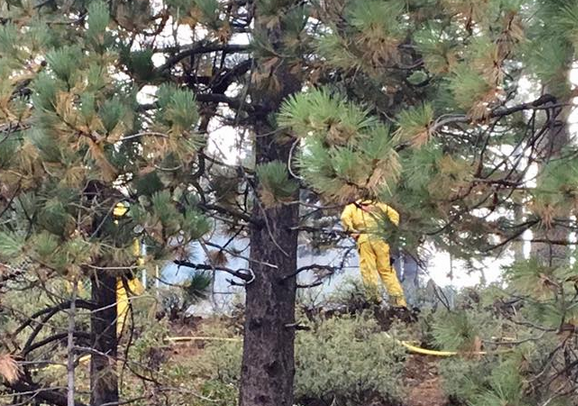
Life imitated art in a dangerous way on Tuesday when two youngsters started a fire by the apartments on Lake Tahoe Boulevard just below South Tahoe High School.

“The 8- and 10-year-old girls are fans of ‘Naked and Afraid’ and wanted to start a survival fire,” Police Chief Brian Uhler told Lake Tahoe News. (This is a television show about surviving in the elements.)

They were successful in starting the fire the afternoon of Aug. 22, but not so good with putting it out. It grew to about 20 feet by 30 feet by the time firefighters extinguished it.

When they saw the response by fire and police they came forward and admitted what they had done.

Police officers and firefighters talked with the two youngsters as well as their parents.

While this situation could have turned out a lot worse, Uhler said he is confident the message hit home, and hopes the incident is a teaching moment for other parents and a lesson for other kids who might think about starting an illegal fire.

— Lake Tahoe News staff report


Genetic screening to speed up search for resilient pines in Tahoe

By Carolyn Wilke, Sacramento Bee

A recent report by UC Davis gave a grim assessment on the health of forests around Lake Tahoe.

The threats facing them include white pine blister rust, an invasive fungus, and bark beetles, an insect that attacks trees. And both of these were exacerbated by the recent drought. From 2015 to 2016, tree mortality more than doubled, from 35,000 to 72,000.

Blister rust has hit sugar pine trees hard. They’re the largest species of pine, with enormous pine cones, and they grow at low elevations.

Read the whole story


Snippets about Lake Tahoe

·      Live Violence Free’s annual gala is Sept. 15, 5-8:30-pm at the Landing Resort in South Lake Tahoe. The $85 tickets are available online.

·      The 43rd annual Truckee Pro Rodeo is Aug. 26-27. For details, go online.

·      The Village at Squaw Valley continues its longstanding tradition of raising a glass to Labor Day weekend with the 29th annual Alpen Wine Fest. In years past, this festival has raised more than $40,000 for Can Do Multiple Sclerosis, a nonprofit providing supportive and empowering programs for people and families living with Multiple Sclerosis. The event is Sept. 3 from 2-5pm. Tickets are less expensive if purchased in advance online.

·      Christina Schwartz has been named director of marketing and member relations at Tahoe Donner Association.

·      The South Shore joins the cities of Reno, Carson City and Virginia City in participating at the annual Street Vibrations rally on Sept. 27-Oct. MontBleu will be part of the poker run activities on Sept. 28-29, and will host the grand finale on Oct. 1.


Millions flowing to help with Nevada flood recovery

By Sean Whaley, Las Vegas Review-Journal

Federal financial assistance is starting to flow into Nevada to help defray an estimated $30 million in damage from two flooding events in much of the state in January and February.

The state Division of Emergency Management already has $4 million in authority from the federal government for the January flooding. On Thursday, the Legislature’s Interim Finance Committee will be asked to accept another $5.9 million from the Federal Emergency Management Agency for damage from the February flood.

Read the whole story


How California’s housing crisis happened

By Angela Hart, Sacramento Bee

California’s high housing costs are driving poor and middle income people out of their housing like never before. While some are fleeing coastal areas for cheaper living inland, others are leaving the state altogether.

Homelessness is on the rise. California is home to 12 percent of the U.S. population, but 22 percent of its homeless people. Cities that have seen dramatic rent increases, such as San Francisco and Los Angeles, attribute their spikes in homelessness directly to a state housing shortage that has led to an unprecedented affordability crisis.

Housing experts trace the problem back to the 1970s. Backlash began to arise – in coastal communities, in particular – from neighbors who opposed new housing in their neighborhoods.

Read the whole story


Genoa Peak Fire at 5% containment

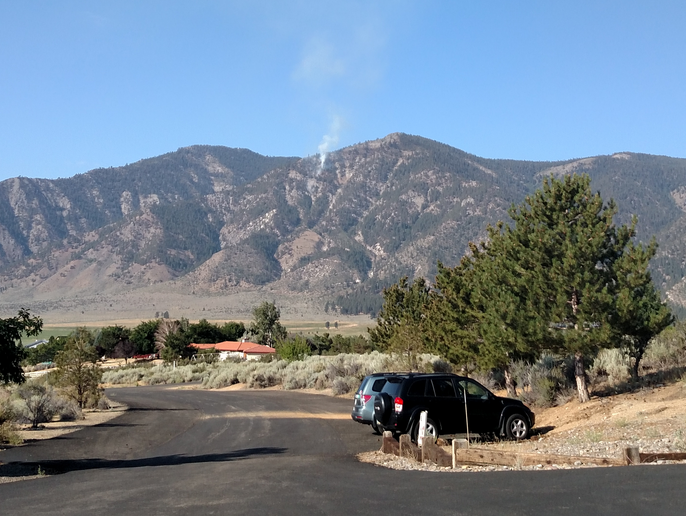
Smoke from the Genoa Peak Fire is seen from Carson Valley on Aug. 23. Photo/USFS

A nearly 15 acre fire burning two miles south of Spooner Summit is 5 percent contained.

It started about 2pm Aug. 22 from lightning.

The Genoa Peak Fire is creeping and smoldering in timber and brush, according to the U.S. Forest Service. No structures are threatened at this time.

Two helicopters are working the fire along with crews on the ground. The Boise Hotshots and a third helicopter are expected to arrive later Wednesday. The hope is to have the fire 40 percent contained later today.

The fire is visible from locations in the Carson Valley.

— Lake Tahoe News staff report


Caltrans removing unsafe trees from highways

Caltrans is identifying and marking dead and dying trees that could impact the safety of the traveling public along state highways. The effort is part of an on-going need to address over 102 million dead trees that have died due to drought and bark beetle infestation since 2010.

Caltrans is marking potentially hazardous trees along the roadway with orange paint and is seeking permission from private property owners to remove marked trees from their property. Tree removal is provided at no cost because dead and dying trees near highways are potentially hazardous to the public.

In October 2015, Gov. Jerry Brown recognized the magnitude of tree mortality and declared a state of emergency.

Caltrans has been working with partners like PG&E, county public works, CalFire and the U.S. Forest Service to coordinate tree removal. Task force members have removed or felled more than 640,000 dead trees in high hazard areas. Caltrans has removed 107,000 hazardous trees near California highways and is expecting to remove 54,000 more by summer 2018.

Counties most-affected are: Amador, Calaveras, El Dorado, Fresno, Kern, Madera, Mariposa, Placer, Tulare, and Tuolumne.

Trees in the Lake Tahoe Basin have already been marked at locations along highways 28, 50, 89 and 267. Removal work will begin after Labor Day.


One-day event all about women

Women As Change Makers, a one-day summit featuring the region’s best and brightest women, will delve into what it really take to grow a business, nurture a career, find balance, and forge lasting relationships.

The female speakers have taken the road less traveled, learned valuable lessons along the way, and cultivated success on their own terms. They’re ready to share their insights in interactive, energizing sessions, designed to get creative juices flowing and impart tangible tools that anyone can apply to their business or career.

The event is Sept. 15 from 8am-6pm at the Atlantis in Reno.

Tickets range from $65-$350. For more info, to learn about the speakers or to buy tickets, go online.


Who are these people moving to N. Nevada?

By Kim Burrows, KRNV-TV

Shane Roskie just moved to Reno from Parker, Colo., to be closer to his girlfriend. The two quickly realized that the housing market was tight.

He purchased a new home in Double Diamond with his girlfriend because he couldn’t find one in an already established neighborhood.

“There’s not much available so we decided to go with a new house,” Roskie said.

He’s one of many people who are quickly realizing that there’s a shortage of homes in the Reno/Sparks area. And the ones on the market are expensive, and the prices keep going up. So who’s buying these homes and where are they from?

Read the whole story


Climate change, forest fires focus of Tahoe summit

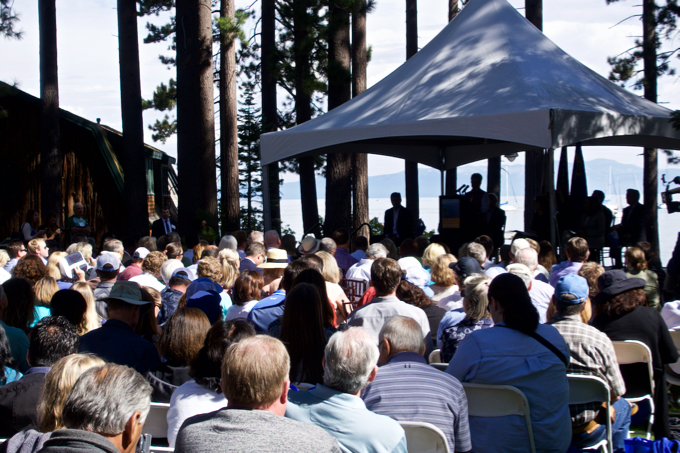
TRPA chief Joanne Marchetta talks to about 300 people about the challenges and successes of protecting Lake Tahoe’s environment on Aug. 22 at the annual summit. Photo/Kathryn Reed

By Kathryn Reed

CAMP RICHARDSON – On the same day when climate change and what that means for potential wildland fires dominated the conversation, the reality of the threat came to fruition hours later as firefighters fought multiple blazes from lightning strikes.

Speaker after speaker on Tuesday dwelled on the health of local forests and that more needs to be done to quash the threat of fire. Then that afternoon between 1:51pm and 6:41pm the Sierra Front Interagency Dispatch Center recorded 12 wildland fires caused by lightning.

Yes, lightning happens in this region in the summer. But there is no arguing the climate is changing. Scientists have the data to back it up.

Joanne Marchetta, executive director of the Tahoe Regional Planning Agency, pointed out how the warming air and water temperatures are impacting the ecosystem in the basin, that drought takes a toll. Climate change is not unique to Tahoe, it’s a global crisis, she said.

Aug. 22 marked the annual Lake Tahoe Environmental Summit. With Lake Tahoe’s pristine waters as the backdrop at Valhalla, it was hard not to want to buy into what the lawmakers had to sell. The message – the fight to protect the basin on land and water is a struggle, but one that is worth the effort.

California Sens. Dianne Feinstein and Kamala Harris are committed to protecting Lake Tahoe. Photo/Kathryn Reed

Partially it was a new slate of characters on the podium with the retirements of Sens. Harry Reid and Barbara Boxer. Taking their place were Sens. Catherine Cortez Maesto, D-Nev., and Kamala Harris, D-Calif. Sen. Dianne Feinstein, D-Calif., hosted the event which is now in its 21st year. Joining them were Nevada Republican Gov. Brian Sandoval, Rep. Tom McClintock, R-Calif., Sen. Dean Heller, R-Nev., and Rep. John Garamendi, D-Calif. Bruce Babbitt, secretary of the Interior under President Bill Clinton and the former governor of Arizona, gave the keynote address.

Heller pointed out that at the start of the day more than 1 million acres had already burned in Nevada this year. That number increased in the 24 hours since he spoke because most of those lightning strikes were in his state.

He is an advocate for more funding for Alert Tahoe, which puts cameras in locations to detect wildfires.

“I won’t be satisfied until there is a camera covering every inch of this (basin),” Heller said.

Cortez Maesto said, “We need to appreciate climate change and why fires are happening. The threat is only increasing, especially under this administration.”

Harris said it’s important to realize that it’s not a choice to help the environment or help the economy; that decisions can be made to enhance both. She also promised to be at all future summits, something her predecessor did not believe was important.
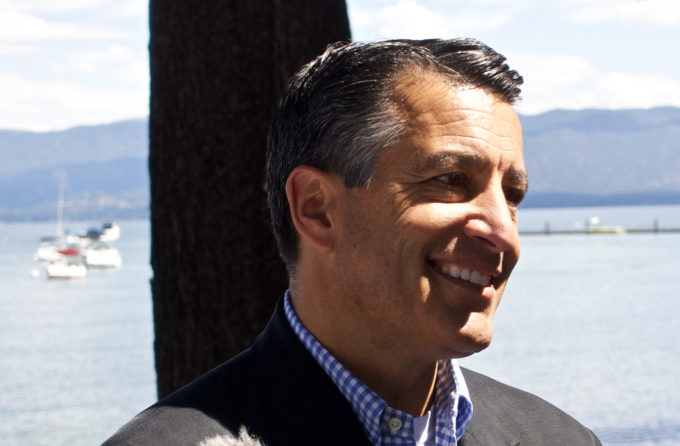
Gov. Brian Sandoval said Lake Tahoe is his favorite place. Photo/Kathryn Reed

Lake Tahoe has long had bipartisan congressional support from both states. They all have stories about what the area means to them on a personal level. This makes the basin special, showing that cooperation can work.

Another component of Tahoe being able to infuse $2 billion into environmental projects since the first Lake Tahoe Restoration Act was approved in 2000 is that local government and private individuals/companies have also stepped up to do their part. (The act was reauthorized last year, but the $415 million over seven years has not been appropriated.)

Babbitt said this is what makes Tahoe unique, that much of what has taken place to improve lake clarity and forest health has been at the ground level and not dictated from those in Washington, Sacramento or Carson City.

While McClintock is not a believer is human-caused climate change, citing how the climate has been changing since the last ice age, he is a huge proponent for being able to make the forest healthier faster.

“The management tools are now in place and we need to use them with the urgency that our forest systems demand and hope that it is not too late,” McClintock said.

On summit day it was announced the Tahoe-Central Sierra Initiative was created as yet another layer to protect Lake Tahoe and the central Sierra from impacts from large, damaging wildfires and unprecedented tree die-off.

Members are Sierra Nevada Conservancy, California Tahoe Conservancy, U.S. Forest Service, Nature Conservancy, National Forest Foundation, University of California, Natural Reserve System-Sagehen Creek Field Station, and California Forestry Association.

The number of dead trees in the Lake Tahoe Basin has more than doubled from 35,000 to 72,000 in the last year.

CalFire has pledged $5 million to the Sierra Nevada Conservancy to implement high-priority forest health projects within the TCSI area.

The other financial commitment at the event was the Environmental Protection Agency disclosing it was giving $197,250 to the Tahoe Regional Planning Agency to assess and restore wetlands in the Lake Tahoe Basin.