Basque Fry speeches delight conservatives in Nevada

By Ben Botkin, Las Vegas Review-Journal

GARDNERVILLE — Speakers at the third annual Basque Fry gave red meat speeches to an appreciative crowd of 3,000 who flocked to the conservative Republican gathering in Northern Nevada.

The event at the Corley Ranch in rural Gardnerville, organized by the Morning in Nevada PAC, comes as Republican Attorney General Adam Laxalt eyes a run for governor in 2018. Laxalt told the Las Vegas Review-Journal he’ll announce his plans soon. Although his run is not official, speakers at the event showed support for Laxalt.

House Majority Leader Kevin McCarthy of California came to speak at the Aug. 26 event after Vice President Mike Pence and U.S. Sen. Ted Cruz of Texas canceled because of Hurricane Harvey.

Read the whole story


RV crash, fire injures 2 on Kingsbury Grade

Two people were hurt Aug. 27 when their RV caught fire on Kingsbury Grade. Photo/NHP

Kingsbury Grade is closed because of a single-vehicle accident that occurred Sunday afternoon.

Nevada Highway Patrol officers are still trying to determine exactly what happened.

The crash occurred just past Tramway Drive on the Tahoe side of the summit a little past 3pm Aug. 27.

The RV was a total loss because of a fire. The fire spread into the wildland, but was quickly contained.

The driver and passenger were transported to Renown Medical Center in Reno with unknown injuries.

NHP did not know when the road would be reopened. It was still closed as of 5:20pm.

— Lake Tahoe News staff report


Tahoe Yoga hosting sound immersion event

Nationally known sound healer, educator and author Diáne Mandle will be performing at Tahoe Yoga Shala on Sept. 27 at 7:30pm.

The event will be a sound immersion with ancient Tibetan bowls, gongs and percussion to soothe, inspire and awaken the body, mind and spirit.

The concert is designed to relieve stress, enlighten the mind and bring people into a transcendent state of being.

Mandle is a frequent presenter at the Deepak Chopra Center, the Golden Door and Rancho la Puerta. She has presented workshops for cancer patients and oncologists and has developed a sound meditation program for incarcerated veterans with PTSD.

Tahoe Yoga Shala is located at 585 Tahoe Keys Blvd., Suite F1A, South Lake Tahoe.

Sound immersion is $25 in advance, $30 week of event. Bring a mat to lie on. For more info, call 530.543.1400.


Slew of authors to be at Douglas County library

The Douglas County Public Library is hosting a local author gathering at the Minden branch on Sept. 19 from 4:30 to 6:30pm. 

Meet and chat with local authors as they sell and sign books. 

Todd Borg and Mike White will be featured alongside authors Jay Crowley, Karen Dustman, Sally Mooney, Bonnie Nishikawa, Jerry Pattison, Kat Simmons, Elaine Snyder, and Anne Thomas. 

The Minden Library is located at 1625 Library Lane. 


Expert: Looming water crisis for thirsty world

By Megan Rowling, Reuters

The world needs to use water more efficiently rather than exhausting invisible underground supplies and blindly exporting “virtual water” to avert a global crisis that would undermine food and energy systems, a leading expert warned.

More than one-third of humanity is water-stressed every year or season, while drought crises are on the rise from California to Ethiopia as the planet warms, said Fred Boltz, who leads The Rockefeller Foundation’s work on science and environment.

“We are really facing a global crisis,” he said, noting that demand is predicted to outstrip supply by 40 percent by 2030.

Read the whole story


At McClintock’s remote town hall, Trump is never far

By Phil Willon, Los Angeles Times
 
Rep. Tom McClintock, R-Elk Grove, who has faced rowdy protesters and sharp barbs at town halls this year, received a kinder if not exactly warm response in a remote town in the Sierra foothills Thursday evening.

Most of the hostility from the crowd inside the Foresthill High School gym focused on McClintock’s support for President Trump.

The congressman faced multiple questions on Trump’s controversial comments about the deadly white supremacist rally in Charlottesville, Va., on Aug. 12, prompting McClintock to disavow the hate groups and defend the president.

“There’s no such thing as a fine person who marches with the Ku Klux Klan or the Nazis,” McClintock said, a clear repudiation of Trump’s assertion that there were “very fine people on both sides.”

Read the whole story


Snippets about Lake Tahoe

·      South Lake Brewing Company’s gives TAMBA 10 percent of every TrailBuilder beer people purchase.

·      Incline Village bike park is going to become a reality. Construction bids are being sought.

·      The Sept. 16-18 motorcycle training course is aimed at beginning riders. Students must be at least 16 with a class C or A license. On Sept. 16 it is from 6-10pm, then 7am-5pm on the weekend. It is at Western Nevada College in Carson City. Cost is $160. For more info, email ericka.munoz@wnc.edu.

·       Kiwanis Club of Tahoe Sierra’s 15th annual  SeptOberfest is Sept. 21 at MontBleu at 6pm. There will be a full German buffet, music, auctions, envelope  prizes, beer garden,
wine tasting, and stein holding contest. Tickets are $45 per person until Sept. 17, then $50.

·       Here are the El Dorado-Tahoe and Sierra roadwork schedules for the week from Caltrans.


Caesars clears Nev. hurdle in bankruptcy emergence

By Richard N. Velotta, Las Vegas Review-Journal

For Caesars Entertainment Corp.’s lengthy and, so far, triumphant climb out of Chapter 11 bankruptcy protection, it was “Veni, vidi, vici” — “I came, I saw, I conquered.”

Nevada Gaming Commission Chairman Tony Alamo, like his state Gaming Control Board counterpart, A.G. Burnett, two weeks earlier, quoted the Latin phrase attributed to Julius Caesar on the Battle of Zela after commissioners unanimously approved a series of registrations and licensing that will enable the Las Vegas-based gaming giant to clear Nevada’s final regulatory hurdle while in bankruptcy.

Caesars has 47 properties worldwide, including two in Stateline.

Read the whole story


Water recovery experts find missing kayaker’s body near Emerald Bay, boy in Stampede Reservoir

Bruce’s Legacy is helping families locate their loved ones who have drowned. Photo/Bruce’s Legacy

By Kathryn Reed

Being in the business of recovering dead bodies is stressful and rewarding.

The past few days have been extremely satisfying for Keith Cormican and his girlfriend Beth Darst.

On Saturday they recovered the body of Pham Dan Vu Thanh just north of Emerald Bay. He had gone kayaking by himself on June 8 from D.L. Bliss State Park and was never heard from again. Two days earlier they found the body of a Carson City boy who had drowned near Truckee.

Cormican, through his nonprofit Bruce’s Legacy, travels the United States with his 22-foot Hewescraft boat in search of people who are presumed to have drowned. His equipment is top of the line, but could be bought by any agency. And some have. But not all know how to use the sonar or have the manpower to scour a waterbody for the missing individual.

Cormican takes the time. He knows what it’s like to have a loved one who never surfaced.

“Bruce’s Legacy is in memory of my brother. He was a firefighter in our hometown in Wisconsin. He passed away in a recovery operation in a drowning back in 1995,” Cormican told Lake Tahoe News. “I’ve been involved with public safety diving for 25 years. I’ve seen the need for specialized equipment.”

Cormican started the nonprofit about four years ago. Mostly it is he and his girlfriend who are doing the work, sometimes with volunteers at the location.

“The El Dorado County sheriff’s detectives have just been fabulous to work with. You don’t always get that,” Cormican said. “They are a big reason we were so successful. Their cadaver dogs need to be credited as well.”

The dogs had pinged on a location near where Thanh’s body was found. That was critical because there had been no witnesses to whatever went wrong that day.

Thanh’s body was in 245 feet of water, more than 100 yards from shore, just north of Emerald Bay.

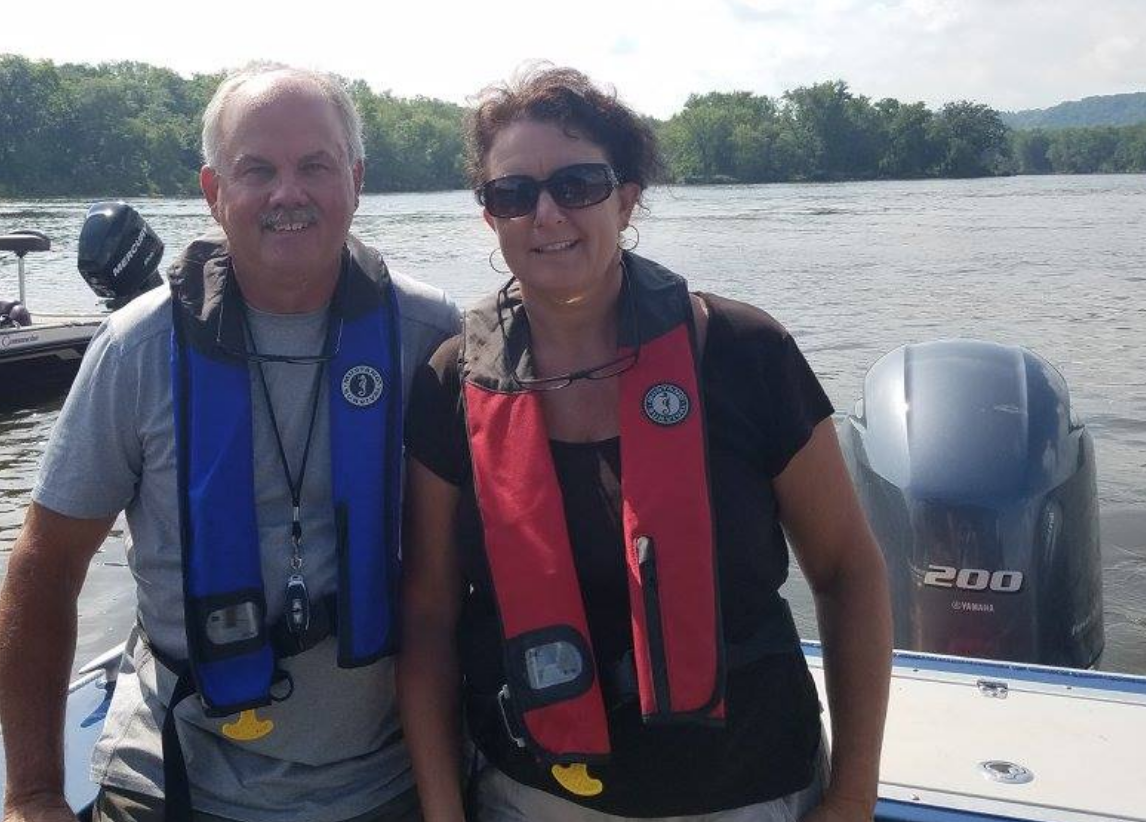
Keith Cormican and Beth Darst

Cormican and Darst are also the duo who found the body of UNR football player Marc Ma in July, about one year after he went missing on the West Shore.

On Aug. 23-24 the rescue team was at Stampede Reservoir near Truckee looking for 11-year-old Markos Vasquez of Carson City. He had been with a friend when their canoe capsized July 10. Neither was wearing a life jacket. The 14-year-old was pulled to safety, but his younger friend was not so lucky.

Not every mission is successful. The Aug. 26 recovery of Thanh’s body was the 19th for the Wisconsin duo.

It’s a labor of love, not something the couple make money from. They ask for their travel expenses to be paid for, like gas and lodging. The rest of their expenses are covered by donations.

After the Ma recovery their phone has been ringing more frequently. They can’t go everywhere. The next operation will be somewhere in California. They have multiple options.

But today, well, it’s a day off. They will be back out on their boat, only this time to enjoy Lake Tahoe.

Tools of the trade aboard the recovery boat. Photo/Bruce’s Legacy

They have come to appreciate Lake Tahoe.

Working on it, though, is a challenge.

“This area is so brutal. It drops off so horribly fast. There are boulders as big as a house down there,” Cormican said. “There are so many places they can fall and you cannot see them.”

They used a grid search based on the cadaver dog ping. They started at 7am Aug. 26. At 5pm Thanh’s body was located.

The one good thing about Lake Tahoe is the clarity. They were able to use an underwater camera to find the body.

Long days are the norm. Rivers are hardest. There is no exact time that they work a body of water. It’s a matter of going back and forth, and then having to call it quits.

“It’s horribly tough to tell someone’s family you can’t find them. That is the hardest thing we do,” Cormican said.

But this past week it was elation, of sorts. Recovery is a bittersweet ending. It means a proper burial, no wondering what really happened and the proverbial closure.

“It’s extremely rewarding to bring these family member home when they’ve been told there is nothing else they can do,” Cormican said.


Opinion: Learning about the U.S. via trains

By James McCommons

Amos, a one-legged Amish man, was having trouble with his new prosthesis. He left the leg in his sleeping compartment and came to the diner on crutches—a hazardous ambulation on a moving train.

Because Amish do not buy health insurance nor take Medicare or Social Security, he rode the Southwest Chief from Chicago to California and went to Mexico to see a doctor. He paid cash for the leg in Tijuana.

“A van picked us up at the border and took us to a clinic,” he told me. “They have everything down there.”

Now he was eastbound, crossing the treeless high plains of eastern Colorado. Amos stared out at the sagebrush and sighed, “I just want to be back on the farm. I don’t suppose you know anything about feeder calves, do you?”

I knew enough to make conversation, and by the time dessert arrived, I had learned how to finish, or fatten, a calf with corn.

I’ve ridden Amtrak since college, and, in recent years, logged nearly 100,000 miles researching and promoting a book on rail policy. Dinner with Amos was one of my more remarkable encounters. But it wasn’t entirely unusual. During meals in the diner, where Amtrak practices community seating, Americans who might never otherwise encounter one another sit face to face at tables and break bread.

All mass transit brings Americans together, of course. When we travel, the self-segregation we otherwise practice—by race, income, education, politics, culture, religion, class, or political tribe—evaporates. But a train is special. Unlike a 20-minute commute on a city bus or subway, or an airline flight in the cramped seat of a fuselage, a train requires the commitment of time and space. Passengers ride together for hours, even days, and during the journey have the liberty to move about, eat and drink, and socialize.

Trains also have an intimacy with landscape. Incapable of negotiating steep topography, they follow valleys, hug rivers and ocean fronts, and strike out across plains and desert basins. Train travel induces a sort of reverie—a hypnotic feeling of being adrift on the geography of America. Passengers, many of whom are seeing the country for the first time, marvel at its beauty, diversity, and exoticness. And those feelings carry over to an inclination to engage one another and embrace the same diversity within the rolling coaches.

So while I still fly on airplanes, if I can work a long-distance train into my travels, I get aboard. When I want to feel and hear the zeitgeist of America, I get on a train.

Early in the Great Recession, on the Empire Builder—running from Chicago to the Pacific Northwest—I encountered jobless men converging on North Dakota with just a few dollars in their pockets and the hope of work. In Williston, men who had arrived months earlier in the oil patch boarded the train to go home for a few days and see family before heading back to sprawling “man camps” erected by Halliburton.

A roughneck having a beer in the observation car told me a woman was arrested for prostitution the day before at his man camp.

“The cops called it a crime. It was a public service. Those man camps are tense.”

The train rolled past campers with no running water parked out on the frozen prairie and rigs flaring off natural gas like colossal candles. The snow and sky shone red and apocalyptic.

He had not been home for weeks.

“There’s no place out here for a family. And my wife, she’s sick. She got the cancer.”

On the Sunset Limited in New Mexico, I chatted with a Texan returning home from Los Angeles after being checked over at Kaiser Permanente. He tapped his chest.

“A weird virus took out my heart muscle. Two years ago, I had a heart-lung transplant.”

We watched pronghorn antelope sprint away from the train and mule deer standing in dry washes.

When he got up, he clapped me on the shoulder, “Every day is a good one … remember that.”

Over the years, I’ve dined with school teachers, a deputy sheriff, a distraught widower, an apprentice mortician, a veterinarian recruiting for slaughterhouses, a priest who discovered the call in Vietnam, an aging movie star, and a wheezy 98-year-old who was a door gunner on a Flying Fortress. A woman at our table whose own father had been a POW in Germany said, “Thank you for your service.”

He seemed bemused: “It wasn’t my idea. I got drafted.”

In Everett, Wash., my train picked up a cocky young man who told us he had piloted gunships in Iraq and was taking the train to Wenatchee for the funeral of a comrade who had committed suicide. Someone bought him a beer. Years later in Kansas, I ate a steak with a huge man in his late 30s, straw-colored hair flaring out beneath an oily baseball cap. He was like a sheep dog gone feral. He’d been in the “special forces.”

Inwardly, I groaned. Is anyone just a grunt, a cook, or a clerk anymore?

“I got fragged over in the sandbox and had to get out. I’m 6-foot-5 and used to be 215. I could run forever,” he said. “After my wife left me, I let myself go.”

He laid natural-gas pipeline in Oklahoma, lived in motels, ate Chinese and take-out pizza each night, and guzzled gallons of beer. Flush with money, he apparently lived a lonely, haunted life.

Always, I take late meal reservations so if my companion(s) are compelling, we can linger over coffee or a glass of wine. The dining car stewards are in no hurry to bus the tables and throw us out.

Not all meals are a pleasure. Teenagers remove their retainers at the table, young lovers speak only to one another, people text on their smart phones, passengers come to the diner still wiping sleep from their eyes, and others have no filter for what passes as dinner conversation.

Leaving St. Louis, I met two sisters heading west to visit a son. The mom said, “He’s such a good boy, called me every day when my husband passed.” The boy had testicular cancer when he was 16 but had still impregnated his wife on two occasions. Unfortunately, the poor dear miscarried both times.

She prattled on and on. As my father used to quip, some people never come up for air. I gobbled my food and fled the car.

On the Coast Starlight outside Salinas, the owner of a restaurant in the Wilshire district of Los Angeles told me she was worried. There were Muslims on the train. “Are they in Michigan, too?”

Yes, I say. Muslims are urban homesteading blighted neighborhoods in Detroit. “They’re making a go of it there.”

“Michigan wants Muslims?”

I listen, nod, and try not to be judgmental or revealing. If the conversation grows intense or tedious, there is always the window and a “Hey look at that” as a way to change the subject.

We could be looking at a hillside of wind turbines in Iowa, iceboats racing on the Hudson River, dapper worshipers exiting a corrugated tin church in Mississippi, delinquent kids in New Jersey heaving rocks at the train, kudzu vines strangling telephone poles in Georgia, or homeless men huddled in cardboard shacks beneath I-5 in Seattle.

A train trip unspools in an endless stream of images and words. And if you listen well, you hear America.

James McCommons teaches journalism and nature writing at Northern Michigan University. He is the author of the 2009 book “Waiting on a Train: The Embattled Future of Passenger Rail Service.”