Calif. lawmakers agree on affordable housing bond

By Guy Marzorati, KQED-TV

Gov. Jerry Brown and Democratic leaders in the Senate and Assembly have reached a deal on a $4 billion bond measure to fund affordable housing in the state.

The measure addresses one cause of California’s affordable housing crisis: a lack of state funding to construct homes for low-income residents.

Senate Bill 3, authored by state Sen. Jim Beall of San Jose, originally proposed $3 billion to fund the construction of new housing. The deal announced late Monday adds $1 billion to that total for the Cal-Vet Loan Program,  an initiative to provide home loans to California veterans that expires next year.

Read the whole story


Boulder hits vehicle on Hwy. 28, 1 injury

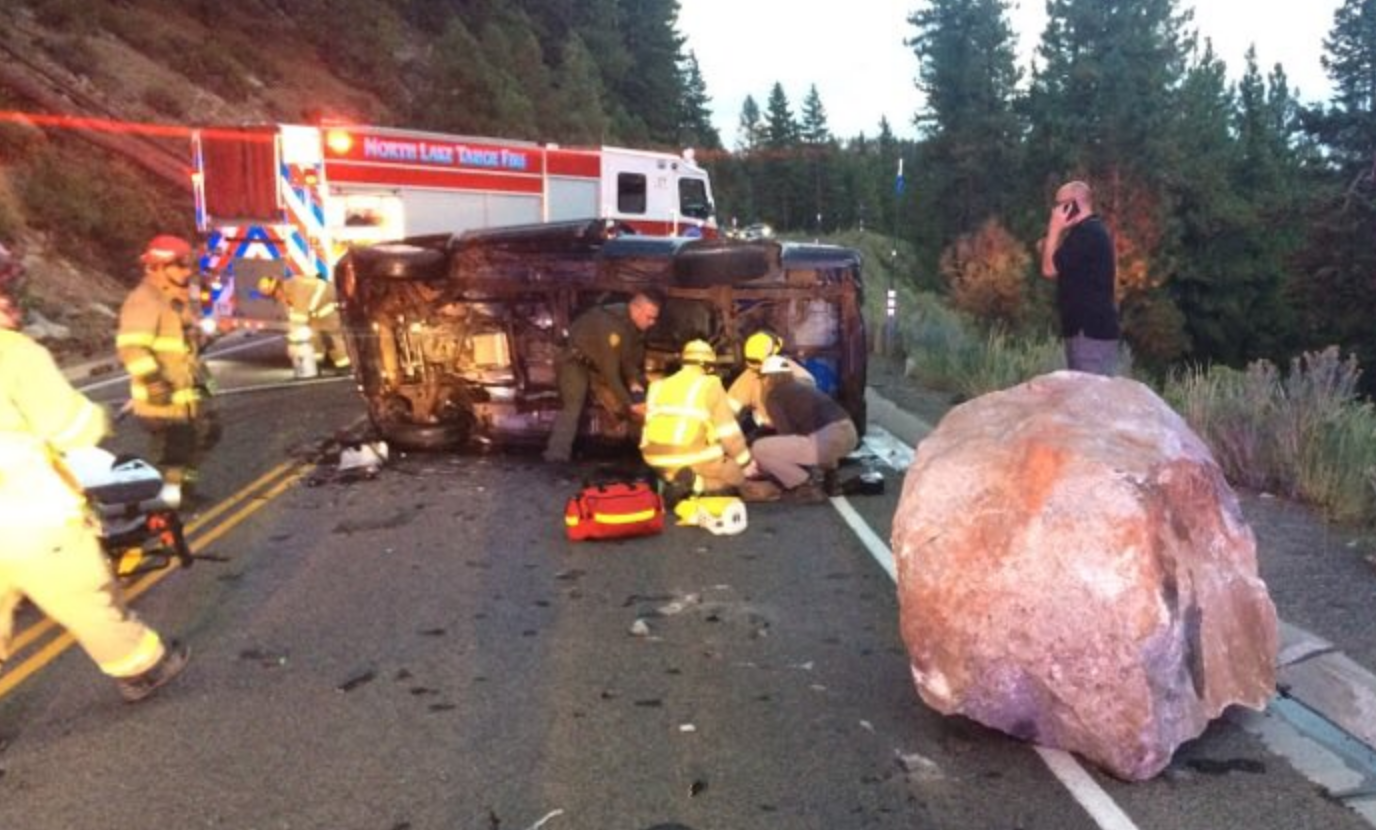
The boulder that struck the vehicle is in the foreground. Photo/NHP

A boulder came tumbling down on Highway 28 this morning, striking a vehicle in its path.

The driver was taken to Renown Medical Center in Reno with non-life threatening injuries.

The accident occurred about 6:30am on Aug. 29. It was about two miles north of the intersection with Highway 50.

Highway 28 was closed while crews removed the boulder and cleared the accident. It reopened about 8am.

— Lake Tahoe News staff report


Bay Area man dies in ATV accident on West Shore

A Bay Area man died Saturday in an ATV accident in Homewood.

The 30-year-old man, whose name has not been released, was riding the all-terrain vehicle on Forest Road 24 north of Sugar Pine Road when he failed to negotiate a curve, according to the California Highway Patrol. The ATV left the road and hit a tree.

The CHP said the San Pablo man was wearing a helmet.

The accident happened Aug. 26 at 11:35am.

— Lake Tahoe News staff report


Near shore clarity issues difficult to solve

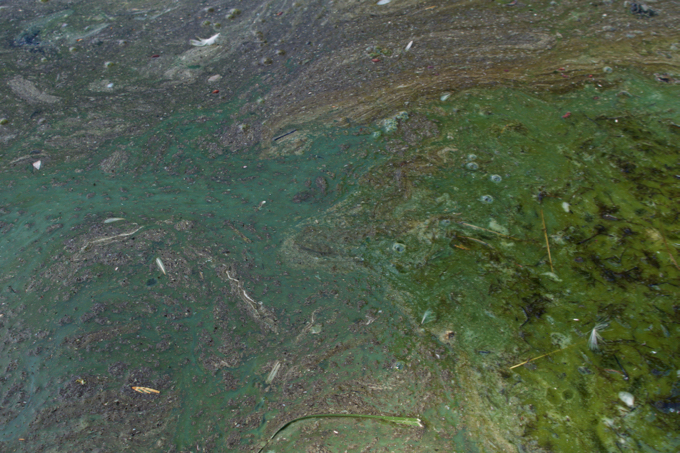
Blue-green algae in the Tahoe Keys showed up this month. Photo/LTN

By Kathryn Reed

Figuring out how to make the water near the shore as consistency clear as it is in the middle of Lake Tahoe is confounding scientists.

Part of the problem is the limited historical data there is to work with. While scientists for decades have been studying the overall lake clarity issue, the near shore has been an afterthought. Some data goes back 15 years, but even it is spotty.

It has been in the last few years that agencies have started to take an interest in the water that most people interact with. It got on people’s radars because of the deterioration of water clarity. In some places it is brown, not “blue.”

The Tahoe Regional Planning Agency was given an update last week on what is going with the near shore. Dan Segan with TRPA and Bob Larsen with Lahontan Regional Quality Control Board delivered the message.

For TRPA, there are 19 standards related to the near shore. With all the other agencies studying this subject, there are 62 standards. The bi-state regulatory agency divides them into four main groups: clarity; trophic status (primarily periphyton); fish, invertebrates, plants; community structure (human health).

“Our standard in the basin should be less than 1 NTU (nephelometric turbidity unit) at the near shore. At outflow less than 3 NTU. One NTU is near drinking quality,” Segan said.

Scientists from the Desert Research Institute in Reno did not find any measurements of more than 1 NTU from November 2014 to November 2015.

UC Davis installed 11 monitoring instruments two years ago and two more will be online this year on the South Shore. These are designed to determine if lake clarity is changing based on natural factors or if they are human caused. Wind and wave action play a role in those findings.

Periphyton, or the algae that sticks to rocks, has been studied for the last 28 years by UCD. The nine sites are visited five times a year.

“The findings are interesting. There is no lakewide trend. There is no clear signal what is happening,” Segan said.

Metaphyton is the algae that floats in the water. It has never been studied, but will be going forward.

A request for proposal is being developed for a comprehensive aquatic plant survey. The hope is it will incorporate near shore management and aquatic invasive species. The study will include marinas.

The plan is to also establish intervals for fish and invertebrate surveys.

One of the human health issues is the blue-green algae that was found in the Tahoe Keys earlier this month. And while people at the board meeting knew about the outbreak in the Keys, nothing was said to the Governing Board – at least in public – during the meeting.

For 2018, the plant survey will be done, micro-organism and toxic survey (human health) will be conducted, and algae research.


Opinion: Proving the future is bright

By Ted Gaines

To watch the news is to imagine a politically-obsessed America pulling apart at the seams, with opponents mobbing up and attacking each other at every turn and the two parties and their talking head proxies endlessly screaming at each other about the real meaning of President Trump’s tweets. It’s a phony picture. The essence of this country isn’t government at all and you might never see it on the news. It’s everyday people – hardworking people of every creed and age, living their lives the best they can regardless of what the government is doing – who make this state and nation what they are. It’s those people who make me believe that California’s future is bright.
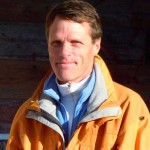
Ted Gaines

Recently that belief was driven home to me when I met three very different groups of people in the North State. I came away inspired by their stories.

North State ranchers have lived off this land for more than a century and have experienced every up and down imaginable, but they’ve persevered. Now, as the dry creek beds and barren mountains of years past have disappeared, they look forward to getting more water and getting their businesses back on their feet.

Illegal marijuana cultivation is stealing rancher water and polluting land with indiscriminate pesticide abuse, making it harder for legitimate ranchers to thrive and breaking their hearts at the same time. These men and women are the original conservationists. It’s not just words with them; they depend on clean water and healthy soils for their livelihoods. It’s why they have such a deep connection to the land and are such careful stewards of their property. I know that a solid ranching economy in the North State will secure these lands for generations.

Despite these new challenges, the ranchers were ready to fight for their futures in California, and just asked me to try to get government out of their way. They were eager to roll their sleeves up and get to work. They weren’t looking for government handouts or help, just freedom, so they could continue the agricultural legacy their ancestors built.

In Placerville, I visited with the executive director of the privately-supported and volunteer-driven Court Appointed Special Advocates (CASA). CASA recruits and trains people from the community to serve as advocates for abused or severely neglected children as they seek justice in our court system.

The CASA advocates usually take one case at a time and build a relationship with the child they are representing. They bond with the child, learn about the child’s special, individual circumstances, and they use that knowledge to report to the judges overseeing these cases, so they can make informed, compassionate decisions about the most helpful services and support for each of these children.

The CASA volunteers, donors, and other supporters together serve as a solid foundation for these kids’ futures, helping during their crises and together forging a more successful life path. One child at a time, CASA is creating healthier, more loving communities for us all.

But my favorite visit, one that brings a smile to my face even now as I think of it, was with 11-year old Preston Sharp, the flag planter. Starting in 2015, this young man started placing small flags on the graves of local veterans in Redding to honor their service. Since then, Preston has planted an amazing 28,000 flags on gravesites from Redding to Sacramento, and he’s branching out to Reno and wherever else his commitment takes him. I’m proud to know such a young patriot who shows such great empathy for veterans and their families.

I wanted to recognize Preston, and gave him an award from my office to honor his efforts. He appreciated it.  But in the end, he said he was not acting to get an award from the government, but because he wanted to give veterans the respect they had earned. He is a fine young man with the right priorities.

These three stories seem unrelated but they aren’t. They are all, in their way, stitching together a unified state – one child, one ranch, one flag at a time. Like a million little streams feeding into one mighty river, these Californians and others around the state are achieving on their own, with their individual accomplishments all pouring into a single California, robust and full of hope. Sacramento can’t mandate these acts, only get in the way.

Politicians come and go, and parties come into and fade out of power all the time. But the California spirit and the talents and desires of the builders, the achievers, the doers, is forever.

Our future is bright.

Ted Gaines represents the 1st Senate District, which includes all or parts of Alpine, El Dorado, Lassen, Modoc, Nevada, Placer, Plumas, Sacramento, Shasta, Sierra and Siskiyou counties.


Feds end ban on plastic water bottles at national parks

By Clarice Silber, AP

PHOENIX — The federal government announced this month it will eliminate a policy that allowed national parks like Yosemite to ban the sale of bottled water in an effort to curb litter.

The National Park Service said in a statement it made the decision to “expand hydration options for recreationalists, hikers, and other visitors to national parks.”

The rules were first put in place in 2011 after it became clear discarded water bottles were becoming a big litter problem in national parks. The policy did not stop the sale of bottled sweetened drinks.

Read the whole story


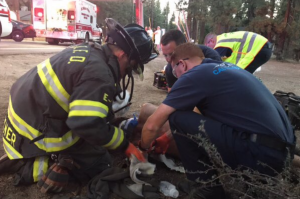
SLT cyclist airlifted to Reno after being hit by car

A cyclist in South Lake Tahoe is tended to Aug. 28 by paramedics after being hit by a car. Photo/SLTFD

An 18-year-old cyclist was severely injured Monday night when he was hit by a vehicle on Pioneer Trail in South Lake Tahoe.

The man was airlifted to Renown Medical Center in Reno with severe traumatic injuries, according to the South Tahoe firefighters.

The Aug. 28 accident occurred at dusk near the intersection of Shepherds Drive.

The driver was going about 35mph. He hit the cyclist and then ran over him, according to authorities.

Names of the victim and driver have not been released. The driver was taken into custody.

— Lake Tahoe News staff report


Nevadans must prove water ownership rights

By Sean Whaley, Las Vegas Review-Journal

With the passage of Senate Bill 270 in the 2017 legislative session, the state Division of Water Resources must get proof of ownership from Nevadans with water rights that predate state statutes.

Failure to submit the required proof will result in the vested water rights being deemed abandoned. But there is plenty of time. A decade, to be exact.

Proof must be submitted to the state engineer by Dec. 31, 2027.

Read the whole story


Lake Tahoe’s fast-pitch history revisited

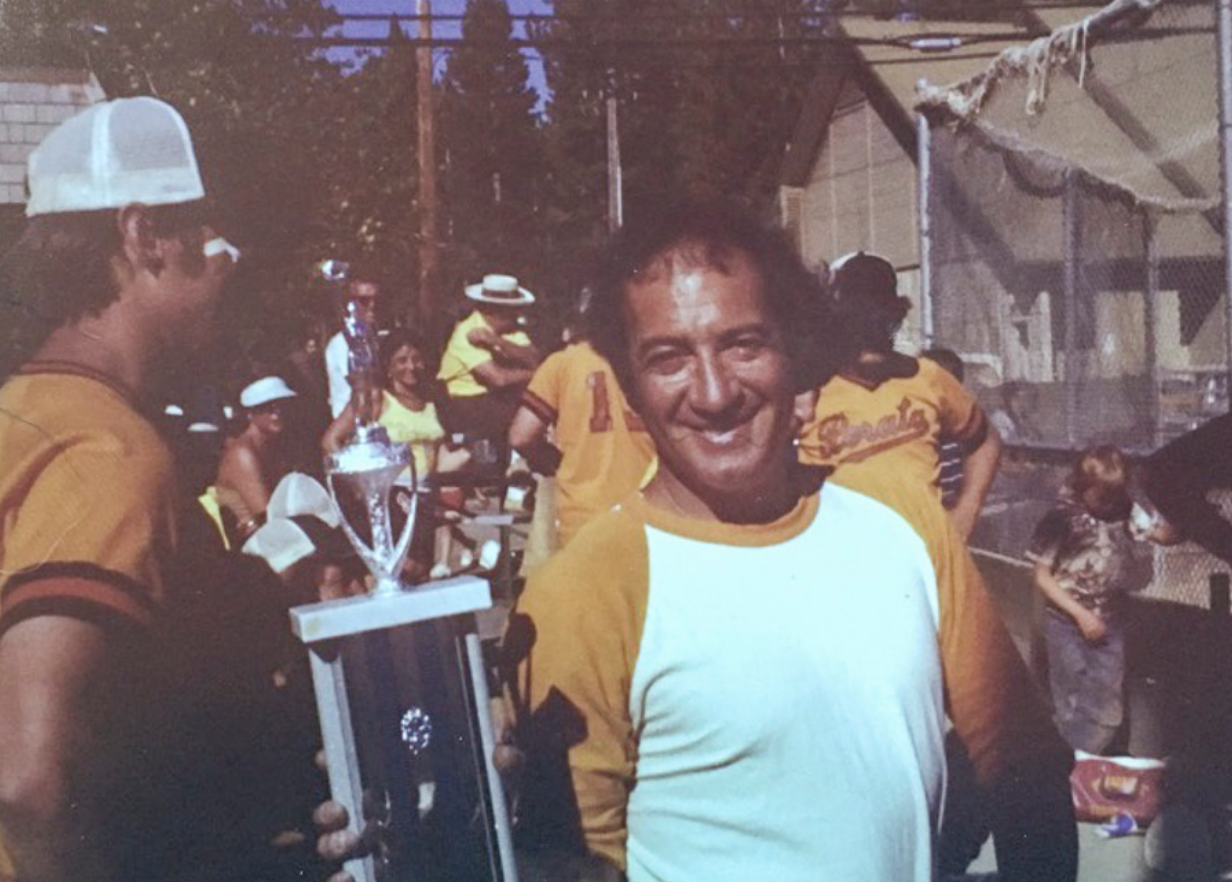
Perata Excavation team sponsor Pete Perata stands with a first-place trophy. Photo/Provided

By Moonshine Ink

They came from the San Fernando Valley, the Bay Area, the beaches of Santa Barbara and the Sacramento Valley.

Many were ex-collegiate level athletes that mostly came to Lake Tahoe to swing hammers in the summer months to help with the area’s building boom of the 1970s. Some came to work and play in the snow.

But most of all, they were Tahoe’s “Boys of Summer,” a once-in-a-lifetime grouping of fastpitch softball champions, who kicked off a community sports renaissance in the basin.

“A lot of us came up here to work, but for me, I just enjoyed the laid-back lifestyle,” said Chendo Hernandez, who owns Mountain Lake Painting in Truckee. “We got up here, loved it, and never left.”

Read the whole story


How Medicaid, and its costs, grew in Nevada

By Paul Harasim, Las Vegas Review-Journal

Nevada’s Medicaid program, caught in the political crossfire over rising health-care costs, is far different than the limited federal-state health insurance partnership for the “deserving poor” that President Lyndon Johnson unveiled in 1965.

As documented in the first installment of the Review-Journal’s Hard Medicine series, Nevada has a lot riding on the debate over Medicaid. The Silver State is one of 31 states and the District of Columbia that used a provision of the Affordable Care Act to expand their Medicaid programs. As a result, 637,795 Nevada residents — about 20 percent of the total state population — now get some or all of their health-care costs paid through the program.

Republicans have vowed for years to “repeal and replace” the ACA, better known as Obamacare, which they consider fiscally and socially irresponsible. They have not yet been able to do so, but if they eventually succeed, Nevada will have to replace $300 million in annual federal Medicaid funding, dump 224,381 people as of March from the program’s rolls or find some middle ground that would increase costs and eliminate coverage for fewer recipients.

Read the whole story