Opinion: SMART Bay Area train, dumb Bay Area transit

By Joe Mathews

The northern terminus of SMART, the new passenger-rail system in the North Bay, is the Sonoma County Airport Station in Santa Rosa. But after my 8-year-old son and I landed there, we learned the growing airport is more than a mile from the train.

There is as yet no dedicated shuttle from plane to train. My son wasn’t up for a long walk. A public bus that would get us to the train wouldn’t show up for hours. Uber wasn’t picking up at the airport. My Lyft app kept crashing. And the four cabbies outside the airport refused to take us, saying they didn’t want to give up their place in line for such a short, cheap trip.

Joe Mathews

The Bay Area is our richest large metropolitan region because its people and technologies skillfully connect the world. But if you need to make transit connections in the Bay Area, good luck.

Inspired by the soft launch of SMART—the Sonoma and Marin County light rail has offered preview rides for months—I recently spent three days navigating the Bay Area sans car. I enjoyed rides on trains, ferries, and buses. But I was bewildered by the failure of a place famous for integrating culture and technology to integrate its own infrastructure across its nine counties.

After 40 minutes at the airport, we called our own cab, which took us to the train station. The first 43-mile segment of what promises to be a 70-mile train runs from Santa Rosa to San Rafael, and has bathrooms and a café that sells wine. The ride took 90 minutes and offered a grittier view of Sonoma and Marin Counties—mobile home parks, old industrial properties—and glimpses of Mt. Tamalpais and Mt. Diablo.

The SMART train is eventually supposed to reach the Larkspur Ferry Terminal; a 35-minute boat ride from San Francisco. But the first segment ends two miles short of the ferry. There’s a bike path to the terminal, and a bus station in San Rafael that can get you to the ferry, but that bus ride would take 26 minutes. We opted for an Uber and got there in eight minutes.

We shouldn’t have hurried: The ferry left 10 minutes late. But on a clear day, we enjoyed views of the Golden Gate Bridge. At the Ferry Building, I bought my son ice cream at Gott’s.

After meetings in San Francisco, we went to BART’s Embarcadero Station, heading for Oakland Airport and a flight home. But the first six trains were too full to board. BART is a system built for 60,000 riders that moves more than 400,000 daily. The system badly needs more cars, better maintenance, governance that isn’t dominated by unions, and a second tunnel under the bay.

When the seventh train arrived, we pushed our way in. “That’s rude,” said one rider.

“We’re from L.A.,” I replied.

We made the flight, but the day produced sticker shock. The four-station ride from San Francisco to Oakland’s Coliseum Station, from which a tram takes you into the airport, cost $10.20 each. Add that to my $11.50 ferry ticket (my son’s was $5.75), the $9 Uber ride to the ferry, the $11.50 one-way fare on SMART, and $10 for the airport cab ride, our journey was pushing $70. In L.A., a Metro ride is just $1.75, with free transfers.

A few days later, I was back in San Francisco, contending with delays on Muni, when I needed to get to San Jose, a city BART doesn’t quite reach yet. So I needed to use Caltrain; BART and Caltrain share a station in Millbrae, but the schedules aren’t synchronized, meaning I could wait for 45 minutes. So I walked 25 minutes from BART’s Powell station to the Caltrain at 4th and King.

In San Jose, I disembarked at Diridon Station, which may have a bright future as the northern terminus of high-speed rail. But for now, it is just another setting for connection frustration, as I waited a half-hour for a light rail train on Santa Clara County’s VTA system.

The next day, I needed to get to San Jose Airport, and took Caltrain to the Santa Clara Station, which offers a VTA bus shuttle. But the bus driver refused to open the bus door for 15 minutes, even during a brief rain. And the shuttle took a meandering route with a stop at a soccer stadium.

No wonder less than one-third of Bay Area residents commute by transit. If the region is ever going to be the design-savvy ecotopia of its dreams, it must combine these systems and put the rider’s needs first.

Right now, using Bay Area transit makes you feel powerless. And that should be unacceptable in California’s most powerful region.

Joe Mathews writes the Connecting California column for Zócalo Public Square.


The case for community college

By Josh Sanburn, Time
 
Riley Anderson was a C student in high school, bored by the work and driven partly by a desire to stay on the football team. In 2015, he graduated 25th in his class–of 31 students.

Without a particular career in mind, Anderson enrolled at Lake Area Technical Institute (LATI) in Watertown, S.D., a relatively inexpensive two-year college 30 minutes from his home. There, his classrooms were hangar-size spaces filled with wind turbines, solar panels, ethanol distillers and miniature hydroelectric dams. It seemed more like his dad’s garage, where Anderson would spend hours tinkering with his 1971 Chevrolet pickup, than a place to learn math. But trigonometry began making sense when you used it to fit together piping systems. Basic computer code seemed worth learning when you could program an assembly-line robot.

 The former C student soon started making straight A’s. He graduated in May with a 4.0 gpa and, most important, a job lined up. Two years after squeaking by in high school, Anderson is set to become a maintenance technician at 3M. His annual starting salary is $60,000. The South Dakota median is a little over $53,000.

LATI is a model for the growing number of politicians, CEOs and academics who believe that community colleges have the potential to become much needed engines of economic and social mobility.

The value of an associate’s degree has never been clearer. Currently, the median salary for someone with only a high school diploma is $36,000. For those with a community-college degree, it’s $42,600.

Read the whole story


2 pedestrians hurt, cyclist in custody

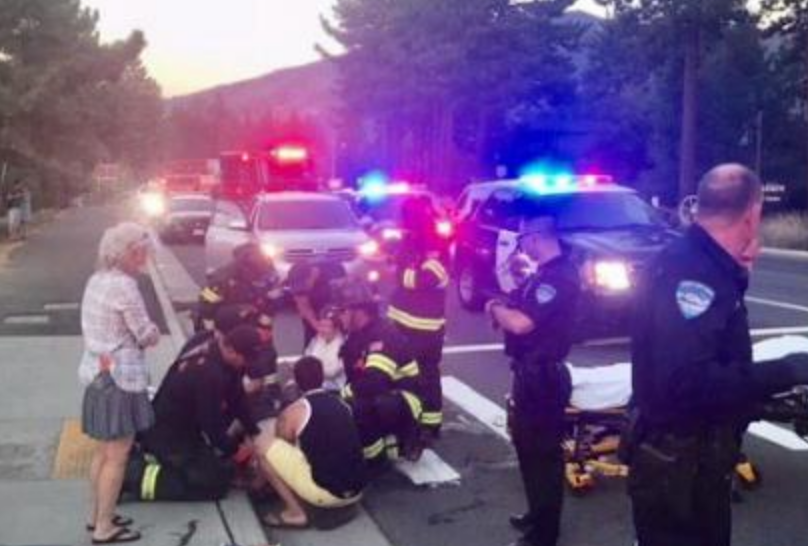
Paramedics tend to a man and woman who were injured Aug. 27 in South Lake Tahoe. Photo/SLTFD

A South Lake Tahoe man was arrested Sunday after he allegedly ran into two pedestrians with his motorized bicycle.

The collision occurred about 7:25pm Aug. 27 at Highway 50 and Rufus Allen Boulevard.

Patrick Bryan Baker, 41, was arrested on felony charges of driving under the influence, hit and run causing injuries, and a misdemeanor obstruction charge.

The pedestrians, who were in a crosswalk, were taken to Barton Memorial Hospital.

— Lake Tahoe News staff report


Heller talks tourism at aviation forecast summit

By Richard N. Velotta, Las Vegas Review-Journal

Nevada Sen. Dean Heller told the story Monday morning of how Sen. Charles Schumer, D-N.Y., invited some airline executives to his office, seated them on a couch, then jammed a coffee table up against their knees.

It is an example of how lawmakers are lobbied to legislate consumer protection because airlines won’t address it voluntarily.

This was one of a score of travel and tourism issues that Heller and Las Vegas Convention and Visitors Authority President and CEO Rossi Ralenkotter addressed at the opening session of Boyd Group International’s 22nd annual Aviation Forecast Summit at Wynn Las Vegas.

Read the whole story


Smoke filling basin from fire outside the area

Smoke is clouding the skies of Lake Tahoe, and there is a distinct wildland fire smell as well.

There is no fire in the basin.

The smoke is from fires south of Tahoe

For people with low tolerance for smoke, authorities suggest taking the following precautions:

• Stay indoors as much as possible, especially seniors and children. Avoid physical exertion.
• Close windows, doors, and outside vents. Use a fan or air conditioner to re-circulate the air. Ventilate your home and work place during periods when it is least smoky.
• Drink lots of water, eat a balanced diet, and get adequate rest. Good health strengthens your immune system.
• Wearing paper masks will generally not protect your lungs from wildland fire smoke.
• Be diligent about taking medicines prescribed by your doctor if you have pre-existing respiratory problems.


Server issues impact viewing of EDC, SLT meetings

El Dorado County and South Lake Tahoe online video services are being affected by a faulty fiber optic line in the Midwest.

The Board of Supervisors’ meeting could not be accessed online Tuesday because of the issue. The City Council meeting tonight will also not be available.

Online meeting agendas, minutes, archived audio and video content are likely to be inaccessible.

The service provider has not given an estimated time of repair as the issue is beyond their control. They are in the process of rerouting traffic to other circuits, however access may be limited and slower than expected.

The special City Council meeting on Aug. 29 will be available for viewing after the “live” event. This means that if the meeting concludes at 7pm, then the video will not be available for viewing until after 7pm.


Almost anything goes at Burning Man, except weed

By Associated Press

RENO — Nevada has legalized recreational marijuana, but it’s still not OK for tens of thousands of Burning Man fans to light up this year.

Voters in the state passed a marijuana legalization measure in 2016, and sales began at retail stores on July 1.

But consumption is allowed only in private and even possession remains illegal on federal lands, including the stretch of Black Rock Desert managed by the U.S. Bureau of Land Management where the counter-culture festival began Sunday and continues through the weekend about 100 miles north of Reno.

Read the whole story


Snippets about Lake Tahoe

·      A party to celebrate the life of Rick Angelocci will be on Sept. 10 at 2pm at Valhalla.

·       Chipotle restaurants in Reno and the greater Sacramento area will be donating 50 percent of proceeds to the League to Save Lake Tahoe on Sept. 4. Tell the cashier you want to support Keep Tahoe Blue.

·      The 25th annual Bear Valley Triathlon is Sept. 3. It features a 600-yard swim (warm water, close to 70 degrees, wet suits are allowed, but not necessary); 10.5-mile bike (rolling, climbing loop course); and 3.4-mile run (rolling road). For more info, go online.

·      Liberty Utilities customers in Kings Beach won’t have power Aug. 29-30 from 8am to 4pm as crews replace poles and wires in area of Brook Avenue, Salmon Avenue and Chipmunk Street. 

·      “Nightfall with Edgar Allan Poe” is coming to the Brewery Arts Center in Carson City. Shows are: 7pm on Sept. 22, 23, 29, 30 and 1pm on Sept. 23, 24, 30 and Oct. 1.


Nev. group files complaint over Incline public records

By Sean Whaley, Las Vegas Review-Journal

A Nevada think tank has filed a complaint with the state Attorney General’s Office over a Lake Tahoe-area government’s failure to follow the state public records law.

The Nevada Policy Research Institute filed the complaint against the Incline Village General Improvement District after discovering last week that an official with the agency allegedly acknowledged destroying or concealing public records as a matter of policy, a violation of state law.

Read the whole story


Hit-and-run driver leaves cyclist in road

By Nicole Jackson, KTVN-TV
 
According to CHP Truckee, a bicyclist is in the hospital with major injuries after being hit by a car on the West Shore of Lake Tahoe Monday afternoon. 

At approximately 12:40pm the victim, idenitified as Larry Ferguson, was riding his bike east on McKinney Rubicon Springs Road at an unknown speed. Officers say a woman driving a gray mid-size SUV was traveling west at approximately 25 mph in Ferguson’s direction.

Read the whole story