Editorial: Labor bill bad for counties, taxpayers and residents

Publisher’s note: This editorial is from the Aug. 24, 2017, Santa Rosa Press Democrat.

Even after eight years of economic expansion, California counties continue to struggle to keep budgets in check under the growing strain of retirement and medical costs for public employees. But that problem would grow substantially worse under a contemptuous bill now working its way through the halls of the state Legislature.

Assembly Bill 1250 by Reginald Byron Jones-Sawyer, D-Los Angeles, would severely limit the ability of counties to contract with community-based organizations, nonprofits and other groups to provide homeless shelters, mental health care and other services that local governments are not set up to provide on their own.

Why? The intent is clear. This bill, supported by public employee unions, would essentially force counties to use only public employees to deliver services. It would raise costs or, worse, force governments to give up on providing some needed services.

Read the whole story


‘Netflix tax’ already a thing in some states

By Mike Snider, USA Today

Netflix — and tax?

Your monthly bill for Netflix, Amazon, Hulu and other streaming entertainment services could go up soon as states such as Illinois try to find ways to offset declining sales taxes and other revenue shortfalls. Chicago, Pennsylvania and Florida have already passed a so-called Netflix tax, and cities such as Pasadena have broached the issue.

These taxes can translate to additional fees of less than $1 each month to consumers. But over the months — and tacked onto multiple streaming subscriptions — they might add up to $50 or more each year.

Netflix, consumer tax groups and tech trade organizations have voiced their opposition to such taxes, warning they can be unfair and deter innovation. Some opponents have initiated legal challenges, and at least one state has shelved plans after a court decision. But state and local governments aren’t likely to halt fresh efforts as falling pay-TV subscriptions and video rentals mean there’s less opportunity to tax cable bills or charge sales tax at the cash register. 

Read the whole story


Inoculations give endangered Calif. frog shot at life

By Scott Smith, AP

Endangered California frogs are getting an immunity boost from scientists who are scooping them up from remote Sierra Nevada ponds and sending them to big city zoos for inoculation, giving them a fighting chance to beat extinction, officials said.

The experiment aims to rescue the 3-inch mountain yellow-legged frog — named for distinctive coloring under its hind legs. Scientists use nets to capture diseased tadpoles and then fly them by helicopter from their natural range deep within the Sequoia and Kings Canyon National Parks.

They are next driven over 200 miles across the state to the San Francisco and Oakland zoos, where they are inoculated against a ravaging disease partly blamed for wiping them out from much of their historical range in the Sierra, scientists said.

Read the whole story


Comstock water history tours at Lake Tahoe

Nevada park rangers will be providing free, guided tours to learn about Tahoe’s Comstock history, when the land that now makes up the park was used to harvest wood and water to feed the mines and population of Virginia City.

The tour will follow the remnants of the Virginia Gold Hill Water Company flumes and inverted siphon. This system was built in 1873 and there are many historic sites that remain to this day. 

Bring lunch, water, sturdy boots, sunscreen and a hat. Dress for the weather.

The tours will depart at 9:30am on Sept. 9 and Sept. 10, and will return no later than 4pm.

Sign-ups are required and participation is limited to the first 12 people. Reserve a spot by calling 775.831.0494 or emailing TahoeSP@gmail.com. Parking is on the street in Lakeview Estates, 4400 Hobart Road, Carson City.


Snippets about Lake Tahoe

·       The annual Genoa Candy Dance is Sept. 23-24. For more info, go online.

·       North Tahoe Arts presents the 2017 North Lake Tahoe Plein Air Open. Artists of all levels from all over the country will gather in North Lake Tahoe from Sept. 5-10.

·      Tahoe City’s Oktoberfest is Sept. 30, noon-6pm at the Gatekeeper’s Museum/Layton Park. It’s a family event. For more info, go online.

·       Here are the El Dorado-Tahoe and Sierra roadwork schedules from Caltrans for the coming week.

·       The Douglas County Public Library in Minden is hosting a STEAM Club every month starting Sept. 6 at 3:30pm. Ages 4-11 will participate in hands-on science, technology, engineering, art, and mathematics activities and experiments. For more information, call 775.782.9841.


Slinkard Fire 20% contained, Hwy. 395 open

By KOLO-TV

Sierra Front says the Slinkard Fire is now estimated to be 7,881 acres, or 12.3 square miles, with 20 percent containment as of Saturday morning. The fire has burned into Nevada, to Highway 395, and crossed Highway 89 to the north.

Sierra Front Interagency Dispatch Center reports that Highway 395 is open, but warns it could close again.

Read the whole story


Tahoe’s summer heat ties at fourth hottest

By Susan Wood

It’s been hot this summer at Lake Tahoe – to the tune of fourth in ranking since records were taken 123 years ago at an average of 62.1 degrees. It ties with 1981’s figure. Keep in mind, this is the average from day to night.

The record was set in 1988 at 62.4 degrees – the same year in which Tahoe experienced its hottest day on record at 99 degrees on July 22, the National Weather Service reported this week.  The “summer” officially ends its quarter on Aug. 31 for the federal agency.

As a comparison, this summer’s hottest day occurred on June 19 at 90 degrees – at a time when some people were still skiing.

And so it goes with our topsy-turvy climate.

Even though this year missed the record by 0.3 degrees, the significant aspect of the data shows that four of the five record years have fallen in the last five years. Case in point, 2014 was second in line for the record at 62.3 degrees; with 2015 close behind at 62.2 and 2013 at 61.8 degrees.

This year goes down as having continuously hot days. And if you remember especially in July, the variance wasn’t as great from day to night as it traditionally is in Lake Tahoe’s surrounding air. Hence, we were near a record average for the 24-hour days.

Reno hit a record of 108 degrees this July – a month that will go down as the 10th hottest in the United States. The contiguous U.S. averaged 75.7 degrees in July. That’s 2.1 degrees above average. Even the northernmost state, Alaska, experienced a hot July with 56.2 degrees. That’s 3.5 degrees above the long-term average.
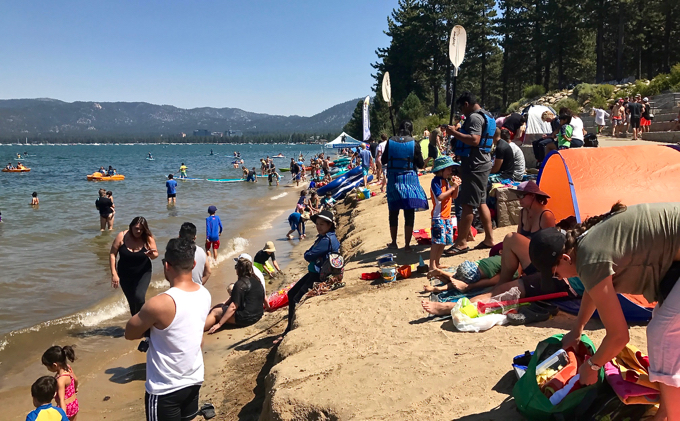
Lakeview Commons in South Lake Tahoe is a popular spot to beat the heat. Photo/Kathryn Reed

Is this the new normal?

“What contributed to our hot summer is the month of July. And (in Lake Tahoe), there were more days in which we were warm,” Evan LaGuardia, meteorologist with the National Weather Service meteorologist in Reno, told Lake Tahoe News.

Even the water temperature in the lake shows an abnormal result. The lake temperature within 2 meters down is fluctuating between 69 and 70 degrees. Albeit the water temp being normal for the summer, it shouldn’t necessarily be true this summer given the aftermath from our uncharacteristically dramatic snowfall from last winter.

“With a 69- to 70-degree average, it’s significant this summer because of the water that’s been added from the snowmelt, (which should be taken into account,)” LaGuardia said. In other words, the water temperature should be colder with the high lake level.

Another factor in warm surface water temperature: “There hasn’t been the storms to churn up the water making it cold,” the meteorologist added. Storms mix up the surface with the deep water of Tahoe through upwelling.

“It has been warm. Who knows what the future holds,” LaGuardia said.

To that, Western Regional Climate Center climatologist Dan McEvoy provided a glimpse.

“There’s definitely a climate change signal pretty much all around the region with our warm days,” McEvoy told Lake Tahoe News.

We’ve been seeing this every year. We can’t put our finger on any one thing, but we should see warmer temperatures, in general, as we’ve seen in the last few decades,” he said.

What does this mean?

“What we’re going to see doesn’t contribute to drought, but it intensifies the impact of those droughts,” he said, listing the wildfire danger and bark beetle infestation.

McEvoy pointed out that most of the 10 coolest summers of the last 100 years have occurred in the first half of the 1900s. Records show the last cool summer occurred in 2011 at an average of 58.3 degrees – the coolest in the last decade. The coolest average summer in the years of record keeping was in 1980 at 54.5 degrees.

So the decade of big hair showed big temp swings in summer as having the coolest and hottest for our region.

“The last summer when the temperature in Reno was below the 20th century average was in 1999,” said Jake Crouch of the National Oceanic and Atmospheric Administration. “While the upward trend is likely to continue, indicating that warm summers will occur more often than not, we can still experience cool summers in an overall warming world.”

Still, it’s hard to ignore that warm is the new normal, all data and climate stakeholders say.

For example, the 20th century’s average summer temperature for Reno was 71.2 degrees, while this one has already dwarfed it at 74.2 degrees. And, there are 83 years left to sizzle.

With that, utility companies are keeping an eye out and doing their record keeping.

Energy use represents a mixed bag for South Lake Tahoe. Liberty Utilities shows no spike in California electricity this summer compared to previous ones, with kilowatt hours holding steady this last July at 47.66 million. The highest in the last five years came in at 49.05 million in 2013, company spokeswoman Kathy Carter dictated.

And water use is usually higher in the summer, according to the South Tahoe Public Utility District, for obvious reasons.

And these numbers could fall for not-so-obvious reasons, with STPUD in the process of installing more than 1,000 meters this summer. The effort encourages water conservation.

“July is always the month of peak production, followed closely by August,” STPUD spokeswoman Shelly Thomsen said for now. “The district’s water production doubles to triples in summer months, mainly due to landscape irrigation.”

However, many homeowners have elected to forego grass in their Tahoe yards – with hundreds waiting to be called up for the turf buy-back program. So conservation efforts should continue to keep in line with increasingly hot summers.

This trend may represent good news for businesses such as Nixon’s. The local HVAC company has experienced a doubling of calls this summer inquiring about air conditioning during our heat waves in contrast to previous years.

“Before, people here would pass on AC. Now it seems we’re putting in AC units in every Tom, Dick and Harry unit. Lots of Bay Area people who are buying and have the means to put them in are opting to have them,” said Wendy Pierson, who works for Nixon’s.


Kingsbury Grade repairs to cause delays

The Nevada Department of Transportation will begin a project Sept. 11 to enhance roadway drainage pipes on Kingsbury Grade.

Between Sept. 11 and late summer 2018, single lane closures with a traffic flagger will periodically be in place on the Carson Valley side of Kingsbury Grade between mileposts 3 and 11. The single lane closures will primarily take place Mondays through Fridays between 7am and 5pm, with periodic Saturday lane closures. Motorists should anticipate travel delays of up to 30 minutes.

Construction will not take place during major special events or the December, January and February winter construction shutdown.

Approximately 15,000 feet of eroding roadway drainage pipe will be reinforced with a cured-in-place pipe liner. A flexible pipe liner is inserted into existing drainage pipes. Resins in the liners are then hardened, creating a durable pipe able to last decades.

Last winter, NDOT repaired a sinkhole which formed where a drainage pipe crosses underneath Kingsbury Grade, less than 10 miles up the road on the Carson Valley side. NDOT took underground video to review other roadway drainage pipes, finding moderate erosion of some pipes. 

The project will cost $4.4 million.


Pine nut harvest beginning on Nev. public lands

The 2017 pine nut harvest season is about to kick off on lands managed by the Nevada Bureau of Land Management and Humboldt-Toiyabe National Forest.

Both agencies are working together to ensure the public is safely harvesting pine nuts and aware of the regulations. The length of the pine nut harvest season varies depending on crop quality and weather conditions. It is generally September to late October.

The BLM and U.S. Forest Service have two types of pine nut harvesting: personal use and commercial use. Personal use is the harvesting of relatively small amounts of pine nuts not intended for sale. Commercial use is when harvesters intend to sell their nuts or if they are harvesting large quantities for personal use.

Individuals and families may gather up to 25 pounds of nuts per season/per household without a personal use permit and at no charge. Anyone who would like to gather more than 25 pounds must contact the local BLM or Forest Service office.

Personal use harvesting is allowed anywhere that pinyon pine trees may be found on BLM managed lands. The Battle Mountain and Ely Districts have issued a total of 11 commercial permits for the collection of just more than 205,750 pounds of pine nuts.

On the Humboldt-Toiyabe National Forest, personal use harvesting is also allowed anywhere that pinyon pine trees may be found on the Austin-Tonopah, Bridgeport, Carson, Ely, and Mountain City-Ruby Mountains-Jarbidge Ranger Districts, as well as the Spring Mountains National Recreation Area. Only one commercial contract has been awarded by the Ely Ranger District.


Proper tree planting, care critical to survival

By Melinda Myers

Whether planting a tree to add seasonal beauty, grow backyard fruit, provide a bit of shade, or reduce energy costs, it’s a big upfront investment. Make the most of your money spent by giving your tree its best chance at survival with proper planting and care.

Now is a great time to plant trees. Cooler air temperatures make it less stressful on newly planted trees and the gardeners planting them.

Select a tree suited to the growing conditions. Make sure it tolerates the sunlight, soil and temperature extremes. Check the tag for the mature height and spread. You’ll have a better-looking plant that always fits the space with minimal pruning.

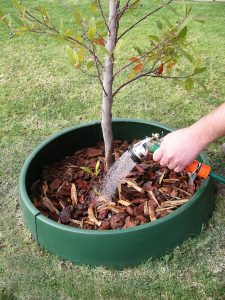
The GreenWell water saver contains and concentrates the water where it is needed during a tree’s critical root establishment phase. Photo/Provided

Plant it correctly to ensure your tree thrives for many years to come. Dig a saucer shaped hole three to five times wider than the root ball. It should only be as deep as the distance from the root flare to the bottom of the root ball.  The root flare, where the roots bend away from the trunk, should always be at or slightly above the soil surface.

Set the tree in the hole, then peel back and cut away any burlap and wire cages. These can eventually constrict root growth. Roughen the sides of the hole and backfill with the existing soil. Water thoroughly to moisten the roots and surrounding soil.

Continue to water thoroughly whenever the top few inches of soil are crumbly and moist. Proper watering, especially during the first two years, is critical for establishing trees.  Watering thoroughly as needed encourages deep roots and a more drought tolerant and pest resistant tree.

Make the job easier with a watering aid like GreenWell water saver. This contains and concentrates the water where it is needed, acting as an insurance policy for your tree during the critical root establishment phase. It also holds the mulch in place and prevents weed whips and mowers from damaging your tree. 

Be sure to mulch the soil surface with a two- to three-inch layer of woodchips or shredded bark to conserve water, suppress weeds and improve the soil as it decomposes. Pull the mulch back from the trunk of the tree to avoid disease problems.

Remove any tags that can eventually girdle the tree and prune out any broken or rubbing branches. Wait a year to fertilize and two years, once the tree is established, for additional pruning.

Continue providing tender loving care for at least the first two years. Make regular checkups, prune to create a strong structure, and keep grass, weeds and lawn care equipment away from the trunk throughout the lifetime of your tree. Your efforts will be rewarded with years of beauty, shade, and for some bushels of fresh fruit.

Gardening expert Melinda Myers has more than 30 years of horticulture experience and has written more than 20 gardening books, including “Small Space Gardening.” Myers is the host of the Great Courses “How to Grow Anything” DVD series and the nationally syndicated “Melinda’s Garden Moment” TV and radio segments.