Truckee commercial burglary suspect sought

Richard Lenning

Truckee police officers are looking for a man they believe stole more than $100,000 worth of property from local business owners. 

Richard Anthony Lenning, 37, is suspected of stealing numerous vehicles and then using them to ram the front door for the purpose of committing commercial burglary.

A felony no-bail warrant has been issued.

Lenning  is 6-feet-tall, about 150 pounds, blond hair, and blue eyes.

He has ties to the Placerville and Pollock Pines areas, as well as Sparks and Silver Springs in Nevada.

Call 530.550.2320 or the local law enforcement agency if he is seen. Any information should be given to Detective Lisa Madden at 530.550.2330 or Sgt. Danny Renfrow at 530.550.2339.

— Lake Tahoe News staff report


Snippets about Lake Tahoe

·       The Truckee Marathon (and half marathon) are Sept. 24. For more info, go online.

·      More than a dozen pets found homes last month when designer Scott Corridan stepped up to sponsor the adoption fees at the Humane Society of Truckee-Tahoe.

·       There will be a workshop in Truckee about transit on Sept. 11 from 1-3pm at the Truckee Donner Senior Apartments on Estates Drive.

·      Douglas County received the certificate of achievement for excellence in financial reporting by Government Finance Officers Association of the United States and Canada for its annual financial report for the 2016 fiscal year. 

·      Sept. 17 is the Emerald Bay Trail Run. It starts at Eagle Point, goes around Emerald Bay and up the Rubicon Trail to D.L. Bliss State Park to finish at Lester Beach. The course is a 7 miles. For more info, go online.


747 SuperTanker fights fire in U.S. for first time

By CBS/AP

Global SuperTanker Service’s Boeing 747-400 marked its first use in the United States after it was activated to fight a California wildfire.

The company says CalFire exercised a call-when-needed contract Wednesday to fight a fire in Butte County about 10 miles east of Lake Oroville.

At the time, the SuperTanker was at McClellan Air Force Base near Sacramento. The aircraft is based in Colorado Springs, Colo..

The company says it made two individual drops of 8,500 gallons of fire retardant that evening.

Read the whole story


Scientists: ‘Fingerprints of climate change’

By Dale Kasler and Ryan Sabalow

Wildfires from the Oregon border to Los Angeles. Temperatures hitting 100 degrees in San Francisco, and higher in Sacramento, capping off the hottest summer in California history.

Not to mention two of the most ferocious hurricanes ever recorded.

It has to be climate change, right?

The answer is a little more complicated than you might think.

Read the whole story


Opinion: Tell NTPUD board to say no to Laulima

By Ann Nichols

Come to the events center Sept. 7 at 5:30pm to express your concern to the NTPUD board.

The 70-year proposed lease (30 years plus two 20-year options) of the North Tahoe Event Center in Kings Beach to Laulima LLC or any of their many affiliates creates huge district liabilities for North Tahoe Public Utility District (NTPUD) ratepayers in the following ways:

  1. $43,600 NTPUD attorney’s fees already spent as of Aug. 31. 
  2. Long-term lease, really a disguised sale will require a legal validation action with the state of California which is estimated at $40K-60K additional and there may be appeals that the ratepayers will be on the hook for.
  3. It may be over two years before rent commences (in two years it begins at 22 cents per square foot; what a deal) and a further unknown amount of legal fees during that period.
  4. What about the years of losses due to poor existing NTPUD management and two more years of the same during Laulima’s attempt to develop the center?
  5. Laulima LLC  is also associated with Laulima Northstar LLC”which begs the unanswered question of who will ultimately benefit from the lease, Northstar or some other unknown principal or subdivision?  The loss of our lakefront venue is priceless.
  6. Once the lease is signed before vetting financial capability or experience, ratepayers are already on the hook for future litigation when the agreement fails to go as promised.
  7. Ratepayers may have to finish an unfinished project or pay off mechanic’s liens. A 110 percent performance bond won’t cover the penalties and interest from a bankrupt LLC and an unfinished closed structure.
  8. Laulima or whoever they designate claim they will spend $5.6M on the events center.  Don’t ask me or the board how as Laulima has not provided a design to review.
  9. The NTPUD is not considering the financial responsibility of a California Environmental Quality Analysis which could be required for the traffic impacts alone.  How much will that cost the ratepayers?

The $90K/year loss from a poorly run events center will pale against the huge liabilities the NTPUD board is proposing with this misguided association.

Ann Nichols is with the North Tahoe Preservation Alliance.


Road Beat: Mazda 6 has looks, performance

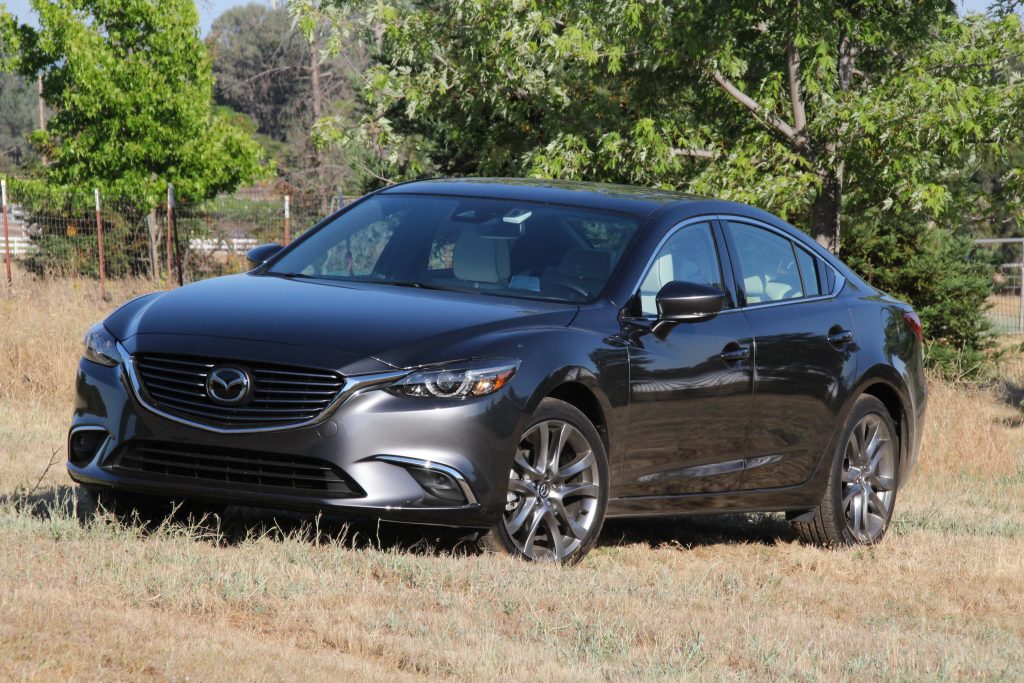
Mazda 6 is more than a great looking car. Photos/Larry Weitzman

By Larry Weitzman

Mazda has almost always designed brilliant cars. Perhaps the new Mazda 6 is their best yet and one of the best-looking cars ever put in mass production. Stand back and look at the lines. An aggressive front end, sharp character lines shape the vehicle which terminates in a softer, smooth rounded rear. The window line lowers the vehicle by stretching the cabin size and making the dog house look sleeker (Toyota Avalon has almost the identical window line, and while still an attractive car, probably Toyota’s best, the front end fails it).

If you go back to another great design, the sixth generation 929 or HD edition, you can see similarities in the smooth rear end and strong hips. It is disguised somewhat on the new 6 by a small trunk lip. You can even see some of the rear of the third generation RX-7 (FD) in the new Mazda 6 and the third gen RX-7, which was built from 1992 to 2002, is a modern-day classic.

But does it deliver? In spades, and hearts, clubs and diamonds, too. It remains the best mid-size ride in the class and that includes some serious and heady competition, especially from the Kia Optima. But be advised, there are almost no bad choices in this category of vehicles which is the bread and butter of all car sales. Mazda’s size is pure midsize at a length of 192 inches, a width of 72 inches while standing 57 inches tall.

Introduced as a 2014 model, not much has changed in the mechanicals as well. The wonderful 2.5L DOHC 15 valve with Skyactiv technology (Mazda’s name for what is basically direct injection) still pumps out 184 hp at 5,700 rpm and 185 pounds of twist at a low 3,250 rpm meaning it makes flexible power, up high and down low. It drives the front wheels via a six-speed torque converter auto cog swapper. If Mazda were to improve this power train it would be a world beater vehicle with their 2.5L blown 250 hp low pressure turbo motor found in the CX-9 with an all-wheel drive system. It would make the Mazda 6 a virtual supercar. Hint, hint.
Specifications
Price $22,780 to about $34,530
Engine
DOHC, 16 valve inline 2.5L four 184 hp @ 5,700 rpm
185 ft-lb of torque at 3,250 rpm
Transmission
Six speed torque converter automatic, with paddle shifters
Configuration
Transverse mounted front engine/front wheel drive
Dimensions
Wheelbase 111.4 inches
Length 191.5 inches
Width 72.4 inches
Height 57.1 inches
Track (f/r) 62.8/62.4 inches
Ground clearance 6.7 inches
Weight 3,305 pounds
Weight distribution (f/r) 58/42%
Fuel capacity 16.4 gallons
Cargo capacity 14.8 cubic feet
Passenger volume 99.7 cubic feet
Steering lock to lock 2.81 turns
Turning circle (curb to curb) 36.7 feet
Wheels 19X7.5 inch alloys
Tires 225/45X19 all season radials
Co-efficient of drag 0.26
Performance
0-60 mph 7.36 seconds
50-70 mph 4.15 seconds
50-70 mph uphill 6.09 seconds
Top speed 140 mph electronically limited
Fuel economy 27/35/30 mpg city/highway/combined. Expect 32-33 mpg in rural country driving and over 40 mpg on a level highway at legal speeds.

Performance remains identical to the prior 6 test two years ago with 0-60 mph coming up in 7.36 seconds and passing from 50-70 mph on the level and up a six percent grade taking 4.15 seconds and 6.09 seconds respectively. That is top of the class performance for a 4-cylinder non-blown mid-size sedan.

My tester also came with the GT premium package ($2,500) which includes nine special features including i-ELOOP which is “hybrid” system that stores electric power in a capacitor for later use in place of the alternator which takes a load off the engine. It also provides a lower final drive ratio with an overall improvement in economy of a claimed five percent. It works.

EPA rates the i-ELOOP 6 at 27/35/30 mpg and as you might expect, it does better, much better. At 70 mph on a level highway it returned an average of 42.3 mpg and overall about 32-33 mpg during my 400 miles of testing. On my round trip to Carson City in very aggressive driving the 6 averaged 32.1 mpg. Fuel economy as you can see is excellent, especially for such a high-performance car.

But that performance doesn’t end in a straight line, it continues when the road bends, no matter how sharply or whether left or right or in quick transitions. Mazda 6 flat out gets it done in style. Suspension is state of the art four-wheel independent, the electric power rack is a quick 2.81 turns lock to lock, 19 x 7.5 inch wheels are shod with serious 225/45 rubber and the track is a wide 63 inches up front and 62 inches in the rear. This all adds up to handling like water in a hose with a flat attitude. And it does it effortlessly and tirelessly in the tradition of a Miata. Perfectly weighted, quick steering and a crisp turn-in makes the 6 one of the most communicative, confident sedans on the market.

Ride quality is equally good, soft enough not to break any teeth with a supple compliance that creates what is an almost perfect ride quality, at least for guys like me who love to drive. It is also a quiet ride with no wind, road or engine noise, unless you’re at full tilt boogie trying to imitate the Space Shuttle at liftoff and then some engine noise enters the otherwise serene cabin. Engine speed at 70 mph is a low 2,000 rpm.

New for 2017 with the Grand Touring is Lane Keep Assist, besides the other acronyms which are standard like blind spot, rear camera and smart braking. LED headlights turn night into day with adaptive front lighting which turn with the steering wheel.

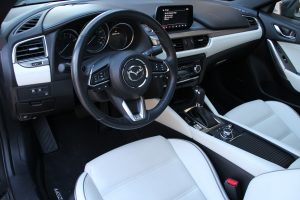
Inside is another improvement in this generation Mazda 6, with better looking, more comfortable seats. The contrasting piping with the soft Nappa leather gives the Mazda 6 an upscale luxury look and feel. Instrumentation is complete with a big tach left flanking a centered speedo and a right flanking trip computer and other ancillary gauges. With its big wheelbase, rear seating is copious and comfortable as well. The trunk is huge at nearly 15 cubic feet.

While the large info screen sits planted on top of the dash, its operation is controlled by a mouse like knob on the console. After several Mazda’s with this control system, I am finally up to speed. While it still is more difficult than some other systems especially with buttons and knobs, it has become tolerable and reasonable usable. 

Pricing for the 6 Sport starts at $21,945 with a 6-speed manual, adding $1,050 for the auto cog swapper. The upscale Touring can also be had with a manual while my Grand Touring is auto only. Mazda is one of the few midsize sedans to offer a manual tranny. My tester was a Grand Touring automatic only issue that stickered for $30,695 plus the obligatory $835 for the boat ride from Hofu, Japan. Add the GT Premium pack which has the i-LOOP for another $2,500 plus $75 for the cargo mat, $125 for the door sill trim plates and $300 for the Machine Gray Metallic paint and the Monroney totals $34,530 for a max loaded top of the line Mazda 6. Still the best of the best.

Larry Weitzman has been into cars since he was 5 years old. At 8 he could recite from memory the hp of every car made in the U.S. He has put in thousands of laps on racetracks all over the Western United States.


Emerald Bay work to cause traffic delays

Construction has started on repair work for a section of Highway 89 in the Emerald Bay area.

The work involves replacing a retaining wall and the extension of an existing barrier slab and rail.

The staging area will be at the Eagle Falls parking area alongside southbound Highway 89. Most, if not all, of the parking spots will be blocked by equipment

Work will take place from 6am-6pm Monday through Friday under reversing one-way traffic control. Motorists should expect delays of up to 20 minutes.

The project should be completed by mid-November.


Cocktail event to benefit Barton Foundation

Barton Foundation’s 8th annual Cocktails for a Cause will feature South Lake Tahoe’s best bartenders in a friendly competition to create Tahoe’s best mixed drink.

Guests will be able to sample the cocktails throughout the competition, listen to live music and munch on heavy appetizers.

The event is Oct. 4 from 5:30-8pm at the Riva Grill in South Lake Tahoe.

Tickets are available for $40 in advance or $45 at the door. All proceeds will benefit Barton’s mental health programs.


Transit agency working on short-term upgrades

By Kathryn Reed

Those who run the South Shore bus system and those who use it know it’s a bumpy ride, at least figuratively.

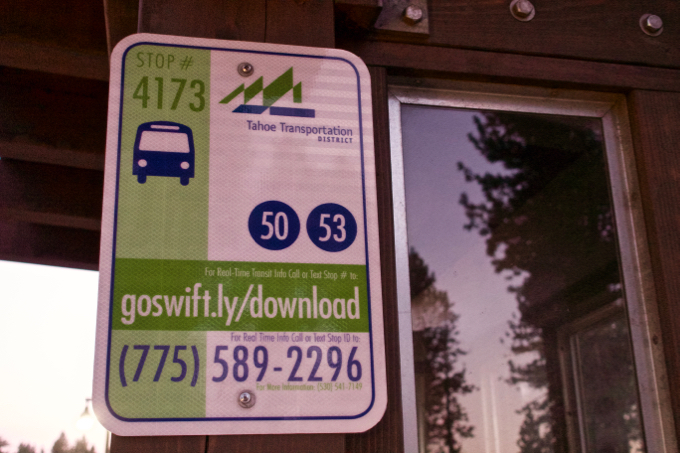
No longer using the never understood BlueGo name, the Tahoe Transportation District is just calling the system by the government body’s name. New buses have the TTD logo and color scheme. (Money isn’t being spent to repaint the old buses.) Signs at the stops have a bus symbol for the first time. No longer do people have to guess what a BlueGo is.

Three additional hybrid buses will be operational later this month; two electric buses are coming in 2018.

Even though the system appears to be managed more professionally, operationally it is still far from ideal. Frequency – or lack of – is a constant complaint. Routes are another contentious topic.

TTD is addressing some of those concerns in the short range transit plan, the first such document it has created for the South Shore bus line. This bus service also stretches into Carson City because of funding from Nevada; it’s a way to help commuters.

The document will be the subject of a discussion at the Sept. 8 TTD board of directors meeting. The five main objectives in it are: safety, workforce development, fleet expansion and replacement, facility capacity and modernization, and future service expansion. Many of these are interrelated, though not necessarily in an obvious way.

Tahoe Transportation District is working on little things — like logical signage. Photo/LTN

The district hosted a public meeting last week, which was not well attended, that was intended to provide information about the plan. The document outlines goals for the next five years.

Funding is the main constraint when it comes to expanding routes and service. Expanding to Meyers and creating a hub at Lake Tahoe Community College are the first likely expansions. Seasonal routes are being worked on to get riders from the casino area to Emerald Bay.

“Without funding to support it, it does the community no good,” Tara Frank with TTD told Lake Tahoe News of why changes will not be immediate. The same goes for increasing frequency to every 15 or 30 minutes. Those ideas are not currently sustainable.

The district has a number of funding sources, from the federal and two state governments, to grants and private contributions. Vail Resorts is a significant contributor, but no longer do the casinos contribute a dime.

Safety will always be at the top of the list as a priority – for workers and riders. Complaints were received last winter that buses weren’t rolling on time. Nothing was. They don’t have magic powers to get through unplowed streets and can only move with the flow of traffic.

Workforce development really means the district is having staffing issues. It’s not alone. TART, the North Shore bus line, had to eliminate some of its winter routes because of a driver shortage.

“We have overtime because we can’t find drivers,” Frank said. “It’s compounded because they can’t find housing. It’s hard to provide service with a thin crew.”

This, then, becomes a safety issue as well.

As the fleet expands – a necessity if routes are added and times shortened – a larger yard will be needed to accommodate the buses. The property leased in South Lake Tahoe is at capacity. The goal would be to build headquarters someplace else, then potentially have workforce housing at the garage.

No land has been identified to service the district’s needs. Officials had looked at the old Kingsbury Middle School site, but safety at the intersection at Highway 50 was a main reason that idea got nixed.

Money for such an endeavor is also elusive.

—–

Notes:

·      The TTD board meeting is Sept. 8, 9:30am at the North Tahoe Event Center in Kings Beach.

·      The draft plan is available online.

·      The last day to comment is Sept. 9.


Column: California’s football losers

By Joe Mathews

No one can know for sure whether any of California’s four National Football League teams—the 49ers, Raiders, Rams, and Chargers—will emerge as big winners in the new season.

But we already know who the losers will be: California cities foolish enough to host NFL teams.

Joe Mathews

In the rest of America, major cities try to attract the NFL because they see football franchises as providing a publicity and economic boost. But in California, where the economy is nation-sized and our big cities already are globally famous, the dynamic is the opposite. Our big cities have been shedding their pro football teams, and avoiding the headaches of devoting valuable California real estate to stadiums within their jurisdictions.

In this contest, the biggest winner is San Francisco, which got free of its NFL headache by “losing” the 49ers to Santa Clara. Across the Bay, Oakland, which resisted building a new stadium for the Raiders, will get its reward in three years, with the team’s departure for Las Vegas.

San Diego registered its civic triumph when—after its voters defeated the last of 15 years’ worth of proposals for lavish new Chargers stadiums—the team left town this summer for a temporary home in the city of Carson. In 2020, the Chargers, along with the Rams—who relocated to Southern California in 2016, after two decades in St. Louis—will move into a new, shared stadium in the small city of Inglewood.

The destinations of these teams are telling. The only places in California willing to risk permanently hosting an NFL team are smaller, poorer, obscure cities that sit in the shadow of global municipalities. Desperate for high-profile development, they are willing to devote land and resources to teams that won’t even use their new cities in their names. The teams are called the San Francisco 49ers, and Los Angeles Rams, not the Santa Clara 49ers or Inglewood Rams.

And that represents the least of the indignities of being an NFL city. Economic studies show that sports teams deliver few economic benefits—they merely siphon dollars from other entertainment-oriented businesses. And then there’s the costs of civic conflict that greedy NFL teams can engender.

Three years after the 49ers relocated to Santa Clara, city and team are engaged in a bitter fight. The Santa Clara-49ers conflict has involved the team’s use of kids’ soccer fields for parking, the amount the 49ers pay in rent, massive traffic jams on games days, and a city audit of stadium spending.

“We learned we cannot trust the 49ers,” Santa Clara’s mayor, Lisa Gillmor, told the San Francisco Chronicle this spring.

Things aren’t that bad in Inglewood yet. The opening of that stadium—part of a larger entertainment development—is still three years away. Construction is already a year behind schedule, and community opposition is growing. There’s also the whiff of bait-and-switch.

The stadium was sold as a private project that would cost the city next to nothing. But it turns out that the city could end up giving the project an estimated $100 million in tax breaks.

None of this should surprise. Most NFL teams are wildly profitable, so those teams that must relocate all carry the stink of failure. It’s no coincidence that their owners show up on media lists of the worst owners in all sports. 

These include the Rams’ owner, Stan Kroenke, who got super-rich by marrying a Walmart heiress, and who has produced teams with miserable attendance and losing records for more than a decade. The Spanos family, which owns the Chargers, alienated most of San Diego with poor management, and farcical plans for new stadiums. Raiders owner Mark Davis, perhaps the NFL’s poorest owner, inherited the team from his late father, Al Davis, a litigious scoundrel who moved the team from Oakland to L.A. and back.

And the 49ers? USA Today this year said owner Jed York had turned the team into “the NFL’s biggest joke.”

No wonder cities have let these owners leave. And life after NFL football looks pretty good.

San Francisco, sans the 49ers, is more prosperous than ever, and is using the land at Candlestick Park, its former home, for developments more valuable than the stadium was. San Diego is still wrestling with the costs of the Chargers’ old stadium. But it is also starting to imagine the happier possibilities of what could replace it.

And Oakland should find that the departure of the Raiders from O.co Coliseum, as well as the exit of basketball’s Golden State Warriors from the arena next door to the Coliseum, opens up transformational opportunities for land that sits next to a transit center.

But enough about the winners. NFL football in California is for losers. Pity the home teams.

Joe Mathews writes the Connecting California column for Zócalo Public Square.