Ski industry lobbying for more immigration

By Megan Michelson, Powder
 
Urh Vodopivec is a 24-year-old ski instructor and student from Slovenia. He’s been traveling to Tahoe the last two summers to work seasonal jobs at restaurants. He’s one of about 300,000 people, many of whom are college students, visiting the U.S. each year on J-1 visas, which are designed as cultural exchange work permits for short-term foreign visitors.

“I would love to come back in the winter to teach skiing,” says Vodopivec. “But right now, it’s too hard to get a visa.”

Ski towns rely heavily on these visas to fill seasonal jobs—an estimated 7,000 to 8,000 J-1 workers are employed at ski resorts nationwide each winter, according to the National Ski Areas Associations. Yet tightening governmental restrictions on foreign visas may make it harder for ski resorts and other ski town employers to continue hiring these short-term international employees.

Read the whole story


Rethinking how to approach prostate health

By Bradley Anderson

Should men have their PSA checked?

Not too many years ago, the answer to that question would have been a simple one: “of course!” After all, the PSA (prostate specific antigen) test was an amazing breakthrough that for the first time allowed prostate cancer to be detected before it was too late. 

Bradley Anderson

In the days before the PSA test, by the time prostate cancer was diagnosed, it had almost always spread through the body – it was already metastatic.

The excitement over PSA testing to screen for prostate cancer was later found to have a cloud hanging over it: urologists were finding far more cases of prostate cancer than had been found in earlier times. While patients were unquestionably being cured of prostate cancer who before would have died from it, there were other patients being diagnosed and treated who in the days before PSA would simply have lived out their lives without even knowing that they had a mild form of prostate cancer. Prostate cancer, which before was underdiagnosed, was now being overtreated.

This was well-known to urologists, but the problem was this: who needed to be treated, and who was safe to watch? Fortunately, large studies were already under way at institutions like the Mayo Clinic and Johns Hopkins University. These research studies proved conclusively that a large percentage of men with low grade and low volume cancer could be watched closely, without needing to go through the risk and expense of major surgery or full courses of radiation therapy. 

In the early 2000s, urologists began to transition rapidly into doing surveillance on a sizeable number of patients who were diagnosed with prostate cancer. This has proven to be completely safe as long as patients are carefully selected by strict criteria. I estimate that at least 40 percent of the patients I have diagnosed in the last 15 years have been best served by observation – not active treatment – and this has been great for patients.

Many people have heard of PSA testing as being controversial. I’ve had patients say to me: “I’ve heard PSA is a bad test.” This is too simplistic. The official recommendation of most official medical organizations is that providers should discuss the pros and cons of PSA testing with their patients before ordering the test. Men between the ages of 55 and 69 should be having this conversation. In practice, however, a lot of men simply aren’t being tested at all until it is too late, and as a result, I have seen more men with metastatic prostate cancer in the last five years than I had seen in the previous 15.

My recommendation? Ask your provider to do the PSA test every year starting at age 55 (at age 40 if African-American or if you have a family history) – and if it is high, then see a urologist who takes a cautious approach. Treatment is still the safest thing for many patients, but in 2017, you want to think surveillance first – not treatment first.

Bradley Anderson is a board certified urologist at Barton Urology.


4 distances in Kokanee running events

The annual Kokanee Trail Runs put on by the Tahoe Mountain Milers are Oct. 8.

There will be a  5K, 10K, half marathon and tadpole trot at Camp Richardson.

Race day registration begins at 6am, or register in advance online.

Races have staggered starts beginning at 7am.

No headphones, dogs, strollers or baby joggers are allowed.


Non-alcoholic drinks part of cocktail fundraiser

Twice as many drinks will be available at the eighth annual Cocktails for a Cause fundraiser on Oct. 4 compared to previous years. This is because each mixologist will be crafting a mocktail and a cocktail.  

Non-alcoholic options are being created to encourage attendance by people who choose not to drink alcohol, but want to be part of the fun and support the cause.

Cocktails for a Cause is a kick-off to the Festival of Trees & Lights, a multi-day event in November and December. Both fundraisers are put on by the Barton Foundation and will support helping fund mental and behavioral health services at Barton Health.

The mixologists, who include bartenders from local establishments, come up with their own unique concoctions. Any flavor, ingredient, or garnish is permitted and all cocktails feature Tahoe Blue Vodka.

The winning signature mocktail and cocktail will be served at the Barton Foundation’s Gala in December. Two panels of local celebrity judges determine the overall winners and attendees vote for most congenial bartender.

Cocktails for a Cause takes place at Riva Grill in South Lake Tahoe.  Purchase tickets online. Tickets are $40 in advance and $45 on the day of the event. All attendees must be 21 or older.


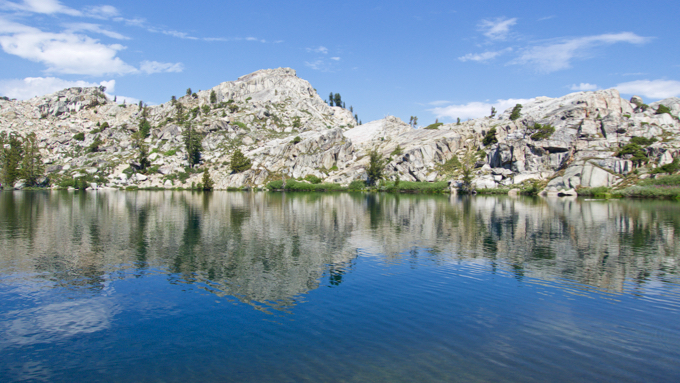
Granite Lake trail worth the initial drive

Granite Lake lives up to its name. Photo/Kathryn Reed

By Kathryn Reed

HOPE VALLEY – Hiking is supposed to be about getting away from the masses and being immersed in nature. That’s why the chaos of Blue Lakes Campground was a bit of a turnoff and caused us to wonder why we were there on Labor Day weekend.

Fortunately, the campers seemed to think the campground and immediate lakes provided enough entertainment.

Upper Blue Lake is being drawn down and Middle Creek Campground is closed to reduce the risk of flooding if an earthquake were to occur. Seismic analysis of Upper Blue Lake Dam has necessitated these actions by PG&E, which has the rights to this body of water.

As soon as we got onto the trail near upper Blue Lake it was like we were in a different world. Civilization, so to speak, was completely behind us.
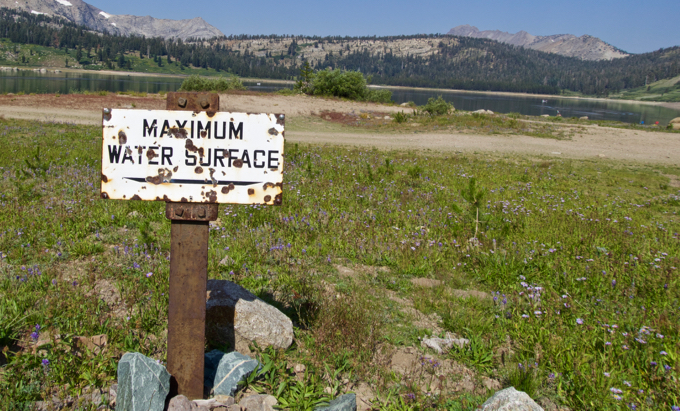
Upper Blue Lake is not full because of seismic concerns regarding the dam. Photo/Kathryn Reed

We took the advice of backpackers to walk across the earthen dam, then go down a little hill to hook up with the trail. This meant not having to cross the creek.

The superlatives ran off our tongues. None of us had been there before. There being the trail to Granite Lake. This is the Granite Lake in the Mokelumne Wilderness, not the one in Desolation Wilderness.

A pleasant surprise was the dazzling display of wildflowers not far from Granite Lake. I can only imagine what they might have looked like a couple weeks earlier.

From the trail we could see the backside of Round Top. It’s the highest peak in this wilderness area at 10,382 feet.

The trail is a gradual climb – about 700 feet total elevation gain. It meanders by a lake without a name, before taking a short, steeper climb toward our final destination. A couple splotches of snow remain to the side.
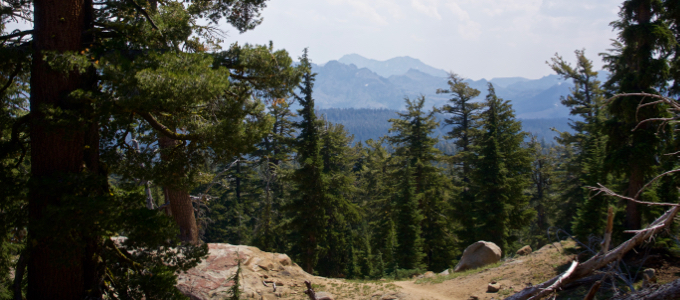
Looking toward the mountains near Ebbetts Pass. Photo/Kathryn Reed

In some places the trees are dense, other locations the foliage is lush from the ample flow of water, while other areas have rock outcroppings.

The lake is aptly named because it is essentially in a bowl surrounded by granite, though it’s not as rugged as some areas in the Sierra.

Several people were there, many with fishing poles. They were hoping to catch golden or Lahontan cutthroat trout.

While Granite Lake is hardly a secret, it was a special little gem that until then the three of us knew nothing about.

Rosemary and I have a history of extending hikes or experiencing weird mishaps. This particular Sunday was no different. A vehicle appeared to block the road just past Lower Blue Lake so we parked there. Plus, the road appeared to get a little sketchy. (Walking on it proved it was fine, and passenger vehicles had made it to the upper campground.) So, this mileage added to what we were planning on.

In total, we walked eight miles. The actual trail, according to my mileage tracker was 5 miles round trip. The sign says it’s 2 miles to Granite Lake.
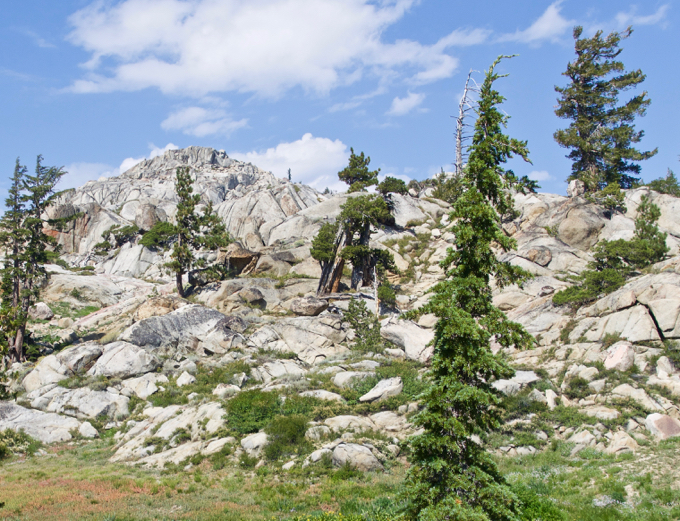
Granite is one of the dominate features in this area of the Mokelumne Wilderness. Photo/Kathryn Reed

—–

Getting there:

From South Lake Tahoe, take Highway 50 west. In Meyers, go left onto Highway 89. At Picketts Junction, go right onto Highway 88. Blue Lakes Road will be on the left; and not too far. Follow the road – it’s long – and park near the Grouse Lake trailhead. There is a trailhead sign.



Opinion: EPA cuts would put Nev. water quality at risk

By Chris Giunchigliani, Las Vegas Sun

We turn our lawns into xeriscapes, and our famed fountains on the Strip spout reclaimed and recycled water. We worry about the level of Lake Tahoe, and we build bigger water supply pipelines deep below the shrinking surface of Lake Mead.

In a state where less than 1 percent of the surface area is covered by water, water is precious — like silver and gold.

Yet even as Nevadans focus on the quantity of water in our state, the quality of our water is threatened. We need all the clean water we can get for drinking, fishing, farming and ranching, even swimming and diving.

Read the whole story


2017’s extreme weather will affect wine globally

By Elin McCoy, Bloomberg

Earlier in the summer, the Napa Valley was on track to be one of the world’s luckiest wine regions this year, having escaped everything from hail to fires to grape-gobbling wild boar.

 Then a scorching, record-breaking heat wave with temperatures up to 117 degrees swept in and stuck around over Labor Day weekend, upending vintners’ expectations. In its wake, winemakers were left with plenty of shriveled grapes and worries about both quality and quantity, despite a cool spell this week that’s now slowing the harvest.

 Welcome to wine’s new normal: extreme weather events. They influenced this year’s harvest everywhere from Germany and France to Italy and Chile last spring and, at the last minute, Napa and Sonoma. “I’ve never seen a vintage like this,” admitted Cathy Corison of Corison Winery in Napa, who is now on her 43rd season. 

Read the whole story


Nevada museum sets to launch sculpture into orbit

By Jenny Kane, Reno Gazette-Journal

While the sky will appear to have a new star next summer, it will actually be something far more rare. 

With the naked eye, onlookers will actually be squinting at the world’s first-ever piece of “space art.”

The Nevada Museum of Art is working on a $1.3 million project called the “Orbital Reflector,” a sleek slice of futuristic art dreamed up by Trevor Paglen, an internationally known contemporary artist currently based in Berlin. 

Read the whole story


Tahoe’s level could change quickly this fall

By Paul Nelson, KTVN-TV

Last winter brought a record amount of precipitation to the Sierra, filling Lake Tahoe almost to the brim. Several feet of water were also released from the Tahoe City Dam to make room for the snow melt. 

The lake is still in good shape. Tahoe’s level is still more than 5 feet above its natural rim and less than a foot from its legal limit.

The lake’s level has only been this high 12 other times. If the Sierra has a repeat of last winter, Chad Blanchard, federal water master, said it would be a welcome sight as long as it comes in the form of snow.

Read the whole story


Sandoval seeks review of gaming, marijuana relationship

By Cy Ryan, Las Vegas Sun

CARSON CITY — Gov. Brian Sandoval wants the state to take another look at the relationship between the gaming and legal marijuana industries in Nevada.

He has issued an order for the Nevada Gaming Policy Committee to meet by Dec. 15 to review the issue.

Read the whole story