
EDC working on cannabis ordinance

El Dorado County’s Medical Marijuana Advisory Committee will meet Oct. 12 to discuss proposed ordinance changes to the cannabis cultivation ordinance and code compliance ordinance to create a civil enforcement process for marijuana cultivation.

The proposed ordinance changes were initiated through a process of six meetings of the committee. The group agreed that the first step in providing a safe environment for medical users of marijuana and their neighbors was to create an effective enforcement process.

The meeting will be from 3-5pm at the Board of Supervisors meeting room in Placerville.


Poet to give free talk at LTCC

Poet and literary translator Sholeh Wolpé will be at Lake Tahoe Community College on Oct. 12 at 8pm in the Roberta Mason Library for a free reading.

Wolpé will sign copies of her books, which will be for sale at the event, and answer audience questions..
 
Wolpé is an Iranian-born poet, writer, and translator whose works include four collections of poetry, two plays, four books of translations, and three anthologies.

Wolpé’s modern translation of “The Conference of the Birds” by the 12th century Iranian mystic poet Attar (W.W. Norton) has been hailed by Reza Aslan as a translation that “is sure to be as timeless as the masterpiece itself.” Wolpé ’s writings have been translated into 11 languages and are included in numerous American and international anthologies and journals of poetry and fiction.


Disappearing Sierra meadows bad news for water

By Matt Weiser, Water Deeply
 
Mountain meadows are starting to get some respect. For over a century, meadows were the first alpine environments targeted for development, grazing and farming, because they tend to be flat and packed with rich soil and nutritious plants. But we’re starting to understand that meadows have a much more important role to play for society at large.

Meadows, it turns out, are water banks. As winter snows melt, the runoff flows into meadows, where deep organic soil holds the moisture like a sponge and then releases it slowly. This helps minimize downstream flooding during spring. Meadows release that runoff over a longer period, helping stretch valuable water supplies through the long, dry summer months.

Efforts are underway to restore meadows, which have lost some of their water-holding ability as they’ve been compacted and eroded by grazing, logging and other activity. Unfortunately, a new threat has emerged: climate change.

Read the whole story


Pre-winter cleaning event at Sierra-at-Tahoe

Keep Sierra Clean Day is Oct. 22 from 10am-3pm.

Everyone is invited to grab a group of friends, ride the chairlift, clean the mountain and collect prizes.

Participants should come prepared to navigate steep and sometimes rocky terrain with sturdy footwear. Bring work gloves, a hat, sunscreen, sunglasses, a water bottle and a bucket. Trash bags will be provided in addition to gloves and buckets if needed.

Lunch will be provided.

Registration at the Solstice Plaza begins at 10am.


Food drive for South Tahoe kids in need

St. Theresa’s Bread & Broth 4 Kids’ Cram-A-Cruiser event is Sept. 30 at Grocery Outlet in South Lake Tahoe from 10am-3pm.

Help cram a police cruiser full of food of food to aid South Lake Tahoe children in need.

Bread & Broth 4 Kids packs bags of food each week for local school kids to take home over the weekend. Students at Sierra House Elementary, Bijou Community School, Tahoe Valley Elementary and South Tahoe Middle School who qualify for the free lunch and breakfast program are also eligible to receive weekend food through Bread & Broth 4 Kids.

Each weekend the children receive three dinners, two breakfasts, two lunches and snacks to take home when food provided at school is not available.

Funded completely on donations, Bread & Broth 4 Kids appreciates food and cash in order to bag the weekend food. During the 2016-17 school year, 140 students received the weekly bags, and this year’s goal is 150 each week.

Needed donations:

Canned soup and meals such as Ravioli, Spaghetti and Meatballs, Chili
Instant cups of macaroni and cheese
Cup Of Noodles and Top Ramen
Canned Tuna and Chicken
Packets of instant oatmeal
Granola bars
Individual serving boxes of cereal
Beef jerky
Raisins and fruit snacks
Peanut butter and jelly
Crackers with cheese or peanut butter.

Individual serving sizes are needed so the children can carry them home. Many families do not have means to cook so items requiring no preparation, water or easy heating are necessary. Bread & Broth purchases fresh fruit each week to be placed in the food bags.


Athleticism not only component to being Olympian

Randy Wilber with Team USA explains how to get Olympians to sleep as they travel around the world. Photo/Kathryn Reed

By Kathryn Reed

PARK CITY, Utah – Sleep and nutrition – they can’t be overlooked when it comes to athletics. And when the competitor is on the U.S. Olympic team, the importance is ratcheted to a level a weekend warrior might not be able to fully comprehend.

These elite athletes have access to sports psychologists, the latest technology, in addition to strength and conditioning experts. Some have their own entourage, some rely on the national experts, others use a combo.

Olympic officials have taken sports and made it a science.

The U.S. team mines data, analyzing an athlete’s performance against others. When a tenth of a second can make the difference between being on a podium or going home without hardware, every second on the snow or ice can make a difference.

Information is also used in hopes of preventing injury.

Travis Ganong, who lives in Tahoe City and calls Squaw Valley his home resort, is quick to admit that the mental aspect of the sport is what separates this level of athlete from others. While the downhiller doesn’t tap into the team’s psychologist, he knows to work on the mind game himself.

He takes a step back when needed, and says he internally processes what is going on without an external facilitator.

Still, his handlers also know when to manage him, so to speak. In January, at a men’s downhill race in Germany, Ganong was to race right after fellow American Steve Nyman. Nyman crashed, had to be airlifted out and sustained a season-ending injury. Ganong’s people told him Nyman was fine and was able to ski down after the fall.

Ganong admitted on Sept. 27 at the Team USA media summit in Park City that the false information helped him to focus. He went on to win that event.

For Randy Wilber, his expertise is in sports physiology.

“The No. 1 thing we’ve learned in the last five years is a lot about the biology and physiology of sleep – about the quality of sleep,” Wilber said.

U.S. Olympic athletes have a variety of resources at their disposal. From left, Randy Wilber, sports physiology; Susie Parker-Simmons, nutrition; Brandon Sjakel, strength and conditioning; Alex Cohen, psychology; and Scott Riewald, sports technology. Photo/Kathryn Reed

Experts are using it to monitor training and recovery. Coaches-trainers can access the devices to know if the athlete had a good night’s sleep. Based on the data, the workout might be changed.

When traveling, athletes are given detailed info about when to sleep, when to get exposure to light, when to eat, when to exercise – all with the intent to get onto the new time zone as fast as possible. As little jetlag as possible is the goal.

These are disciplined individuals so being put on a regimen works – even for sleep.

“A couple challenges this year is that athletes will be competing late at night for TV. They aren’t used to that,” Wilber said of events scheduled at the 2018 Games in South Korea.

For Susie Parker-Simmons, she is tasked with making sure the athletes have enough nutrients to perform at their peak. The dietician took 10 years to develop a hot recovery drink. It’s not something that is available to the masses.

“Recovery foods have a specialized composition,” Parker-Simmons said. “Part of my job is to design foods that are not on the market.”

In PyeongChang, South Korea, she will have two venues set up just for the U.S. team competitors. She wants them in a food bubble, eating things they are used to.

She tries to get the athletes into the kitchen at the U.S. training center so they will develop healthy lifelong habits and be able to feed themselves, and make healthy decisions when she isn’t around.

An Olympian needs on average 30 percent more nutrients than the everyday athlete. Being in a cold venue requires an intake of 18 percent more calories than warm weather sports.

Cross country skiers are the hardest for Parker-Simmons to keep fueled because they need an extra 1,000 calories beyond the normal 3,000. This is because they are working their arms and legs for a sustained period of time. She said it’s that last 1,000 calories that can be difficult because people feel full. That’s why new foods need to be developed.

Parker-Simmons also has to battle the athletes being inundated by social media about the latest diet craze. Two years ago it was gluten free, today it is vegan or plant based diets.

Getting the correct allocation of nutrients is her concern and responsibility. This doesn’t usually jive with what the masses are doing.

Then there are the athletes like snowboarder Jamie Anderson of Meyers who do what they want, which isn’t always conventional at least by Western standards. She is more into holistic remedies and natural foods. She has what she calls a “green drink” with lots of nutrients.


Editorial: Focus on saving Sierra forests

Publisher’s note: This editorial is from the Sept. 21, 2017, Sacramento Bee.

We Californians take for granted the great forests of the Sierra Nevada. It is where we ski and hike, and breathe fresh air, and it’s the primary source of our water.

It’s all at risk. Drought and bark beetle infestation are the proximate cause of death of more than 100 million trees in California since 2010. But the forests were weakened by climate change, combined with mismanagement that includes well-intentioned wildfire prevention efforts and logging in past decades of old-growth trees, which are most resistant to fire and disease.

At last, an infusion of state money for the Sierra forests, not to be taken for granted, and none too soon.
“There is an urgent need to reform policy and management to ensure that Californians continue to benefit from these forests for generations to come,” a new Public Policy Institute of California report says.

Read the whole story


Calif. moves presidential primary to March

By John Myers, Los Angeles Times

Backing an effort for California to claim a bigger share of the attention from presidential candidates, Gov. Jerry Brown has signed a bill moving the state’s primary elections to early March.

Brown’s decision, announced without fanfare on Wednesday, means the state will hold its presidential primary on March 3, 2020. It’s a reversal from a decision he made in 2011 to push the state’s primary elections back until June, after years of trying — and failing — to entice major candidates to bring their campaigns to California instead of smaller, more rural states.

Read the whole story


Fire destroys Echo Lake cabin

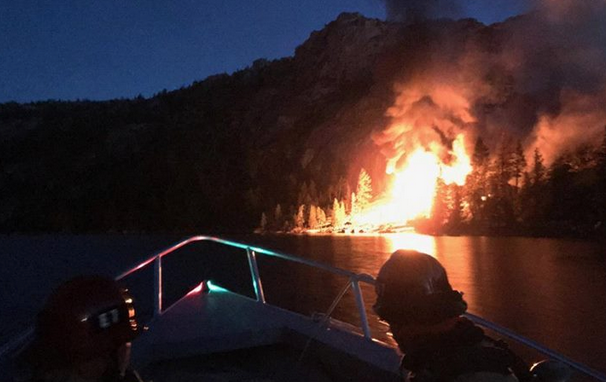
Lake Valley firefighters respond to a blaze Sept. 27 at Echo Lake. Photo/LVFPD

A resident at an Echo Lake cabin is lucky to be alive after escaping the burning building early Wednesday.

The occupant woke up about 5:50am Sept. 27 to find smoke filling the two-story cabin.

The structure was fully engulfed with flames when Lake Valley firefighters arrived. They had to use a boat from the marina to reach the cabin on the North Shore. CalFire assisted them.

The resident was able to escape without injury.

The cause of the fire is under investigation.

— Lake Tahoe News staff report


Nevada OKs ban on reptile collection

By Ben Botkin, Las Vegas Review-Journal
 
CARSON CITY — The Nevada Board of Wildlife Commissioners has permanently banned the commercial collection of reptiles in the Silver State.

The state commission’s 6-1 decision, made during its Saturday meeting, effectively ends Nevada’s policy of allowing unlimited commercial reptile collecting. The decadeslong policy set the state apart from its neighbors in the West, alarming conservationists and state wildlife officials who are concerned about the effect on reptile populations.

The Center for Biological Diversity pushed for a complete ban, sending state wildlife officials a letter signed by four dozen scientists.

Read the whole story