Cutthroat saloon returns in Markleeville

Markleeville’s legendary Cutthroat saloon is getting a new lease on life.

It has changed hands, and the new owner is restoring the name. Fawna Demond, who has periodically worked at the bar, is the new owner.

When Tom Abdoo bought the bar and restaurant in 2002 he renamed it the Wolf Creek Bar & Restaurant. He gutted the place, which included getting rid of all the bras that hung from the rafters.

Besides the name, Demond also plans to bring back some of menu items that were popular pre-Abdoo. The Cutthroat will be serving breakfast, lunch and dinner.

— Lake Tahoe News staff report


Squaw-Alpine owner adds Solitude to portfolio

By Jillian Queri, Powder
 
Alterra Mountain Company announced its plans last week to acquire Solitude Mountain Resort in Utah.

Denver-based Alterra, which is behind the Ikon Pass, now claims 27 properties (including Solitude) located in the U.S. and Canada. Once the Solitude transaction is complete, 13 of the Ikon mountains will be Alterra properties, with the remaining 14 being partner destinations. The Ikon Pass, which will debut this year, rivals Vail Resorts’ Epic Pass, which boasts 65 resorts located worldwide.

Alterra owns Squaw Valley, Alpine Meadows and Mammoth.

Read the whole story


Road Beat: Mazda 6 — the best of the best

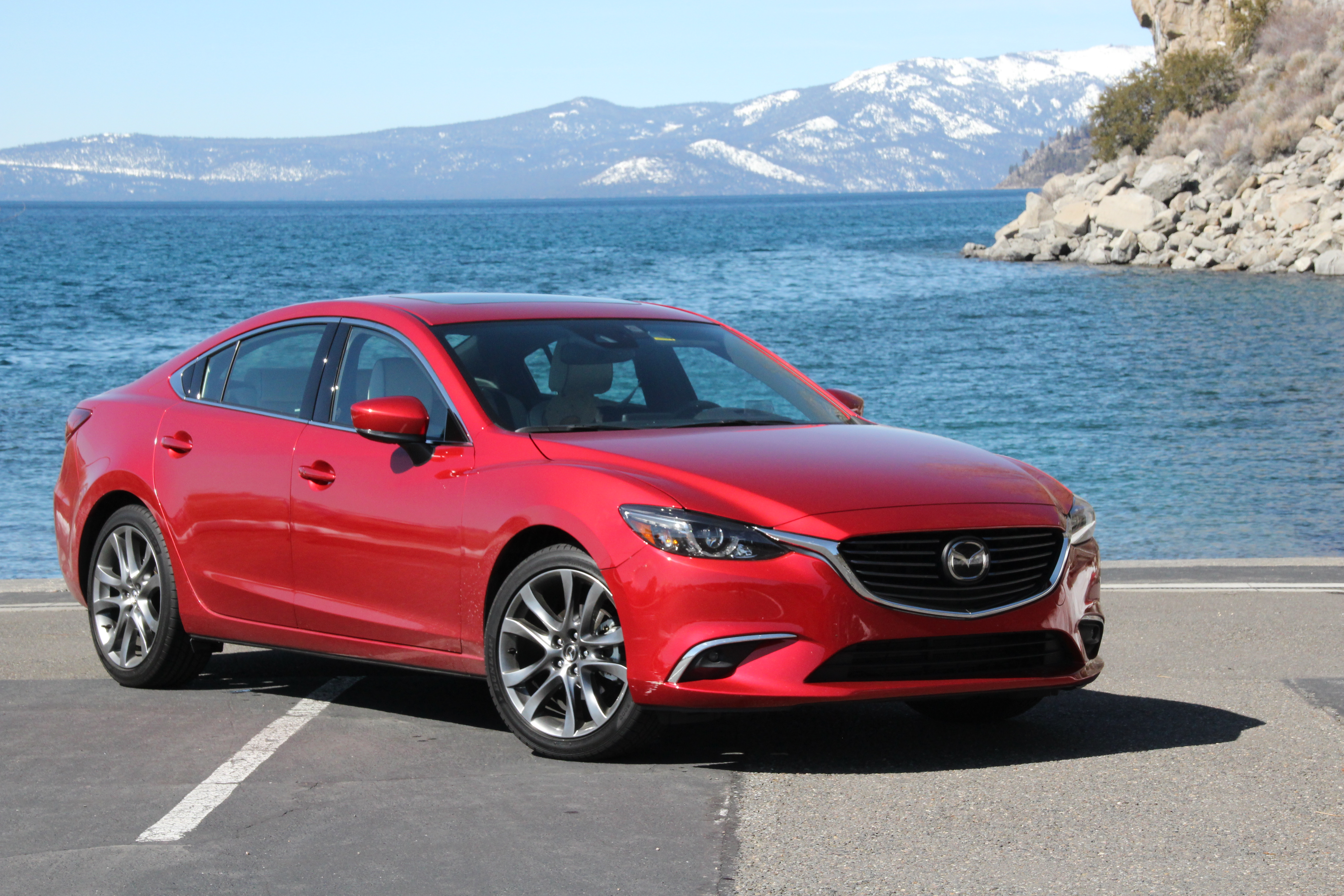
The Mazda 6 continues to improve with each year. Photos/Larry Weitzman

By Larry Weitzman

Now starting its fifth year of production, the Mazda 6 still reigns supreme among mid-size family sedans, if you could call it that (a family sedan). And this is after the intro of some new heady models from Toyota in the form of the all new Camry and heavy revisions of the Hyundai Sonata and Kia Optima.

The new Camry is a great car. Some will like it better than the Mazda 6 as it is a bit softer, less edgy, but after spending a week in the new Mazda 6, its close, but give me the Mazda 6 six out of seven days a week.

Mazda 6 is just a bit sharper that the competition and when it comes to looks, the Kodo design philosophy remains supreme. It is the best looking of all mid-size sedans with aggressive, curvaceous and muscular lines with perfect proportions that starts with the best looking front end in the business and ends with one of the best looking rear ends in the business that the competition wishes that Mazda get penalized five yards for “backfield in motion.”

While the specs remain the same, for some reason performance has improved and by a significant amount. And, no I am not testing the new turbo model with about 50 additional horsepower that uses the beautiful 2.5L, CX-9 engine that makes 227 hp on 87 octane fuel and a full 250 hp on high test premium. My tester had the normally aspirated 184 hp (at a low 5,700 rpm) version of the 2.5L DOHC, 16 valve, direct injected mill (Mazda calls it Skyactiv) which drove the front wheels via a six-speeder torque converter auto cog-swapper. Shifting can be done through the manual mode floor shifter or steering wheel paddles.

Specifications
Price $22,780 to about $34,695
Engine
DOHC, 16 valve inline 2.5L four 184 hp @ 5,700 rpm
185 ft-lb of torque at 3,250 rpm
Transmission
Six-speed torque converter automatic, with paddle shifters
Configuration
Transverse mounted front engine/front wheel drive
Dimensions
Wheelbase 111.4 inches
Length 191.5 inches
Width 72.4 inches
Height 57.1 inches
Track (f/r) 62.8/62.4 inches
Ground clearance 6.7 inches
Weight 3,305 pounds
Weight distribution (f/r) 58/42%
Fuel capacity 16.4 gallons
Cargo capacity 14.8 cubic feet
Passenger volume 99.7 cubic feet
Steering lock to lock 2.81 turns
Turning circle (curb to curb) 36.7 feet
Wheels 19 x 7.5-inch alloys
Tires 225/45 x 19 all season radials
Co-efficient of drag 0.26
Performance
0-60 mph 6.93 seconds
50-70 mph 3.58 seconds
50-70 mph uphill 5.54 seconds
Top speed 140 mph electronically limited
Fuel economy 27/35/30 mpg city/highway/combined. Expect 32-33 mpg in rural country driving and 40 mpg on a level highway at legal speeds.

Performance is outstanding with this Mazda being the first normally aspirated mid-size car to solidly break into the sixes in its 0-60 mph run averaging 6.93 seconds. And that number is no fluke as it blasts from 50-70 mph in a record 3.58 seconds and up a steep grade (6-7 percent) only slows that time to 5.54 seconds. My last test of this same car resulted in respective times of 7.36, 4.15 and 6.09 seconds. Quite an improvement. Throttle response is stellar and linear and the tranny always picks the correct gear. It’s a beautiful thing. Mazda 6 definitely lives up to the promises of its looks. I can’t wait to test the new turbo model.

Also, with that incredible performance comes guilt free fuel economy. EPA says expect 27/35/30 mpg city/highway/combined and my tester averaged 32.0 mpg for 414 miles of varied driving including all full throttle performance testing and less than 20 percent of the tine spent on a highway. At a constant 70 mph in a 20-mile two way run the Mazda 6 averaged exactly 40 mpg. With its 16.4-gallon fuel tank, your road trips could stretch out over 600 miles. Mazda gives you a delicious, low calorie, big piece of cake that you can eat all the time and never gain weight.

The Mazda 6 driving experience is enhanced by its sophisticated fully independent suspension, the use of subframes and a stiff monocoque body. Add to that 19 x 7.5-inch alloys shod with 225/45 series rubber plus a quick electric power steering rack (2.8 turns lock to lock) and you have the ingredients of a true sporting sedan that delivers on all the perceived promises. It changes direction and carves up corners like a superb Buck knife. It will create new found confidence in handling.

Yet ride quality is especially quiet, smooth, supple and compliant. Perfect for my tastes. And the engine only spins 1900 rpm at 70 mph, part of the reason for its quiet and fuel economy. There is no wind, tire or road noise.

Safety is enhanced with all the acronyms including lane keep assist and strong four-wheel disc brakes. Headlights are superb LEDs with standard automatic high beam control plus adaptive front lighting that follows your steering inputs.  

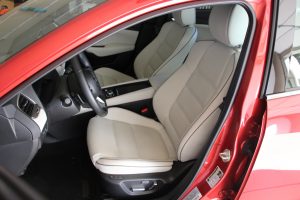
We are not done yet as the interior needs special mention which comes with standard leather and it is nice. Even nicer and making the Mazda 6 into a premium or near luxury vehicle is the optional super soft Nappa leather which comes with the GT Premium Package which also adds the i-Eloop regen engine system which reduces the engine’s electrical load, heated rear seats and steering wheel and some other goodies for $2,500.

Instrumentation is complete along with a heads-up display and two trip computers. It is all beautifully done except for the radio controls which require too many steps and an imprecise knob which is an anomaly in this most precise of mid-size sedans.

I could go on waxing poetic about this Mazda, but it still retains its title as the best in the mid-size arena, although it’s a very close call. It stickers for $30,695 plus $875 for the boat from Hofu, Japan. My tester had the GT Premium Package four other small options including $300 for the much-complimented Soul Red paint bring the total price of admission to $34,695. That very competitive in the family of mid-size rides, but this Mazda 6 just delivers a bit more in performance, fuel economy, looks and handling. Classic Kodo styling doesn’t seem to get old. I can hardly wait to test the turbo model followed by the new RX-9. Mazda is known as a bunch of cowboys. It seems that other manufacturers should take up riding and roping, too.

Larry Weitzman has been into cars since he was 5 years old. At 8 he could recite from memory the hp of every car made in the U.S. He has put in thousands of laps on racetracks all over the Western United States.


Airbnb to collect TOT for El Dorado County

El Dorado County has worked out a deal with Airbnb for the short-term rental company to collect transient occupancy tax.

This is something the city of South Lake Tahoe has been trying to do to no avail.

Airbnb will start doing this for the unincorporated area of the county starting Aug. 1.

Jurisdictions prefer rental platforms collect the tax because then they don’t have to rely on the renter to fill out what is usually a quarterly form, and then having the individual send in the necessary payment. This is an issue everywhere with renters not paying the tax.

Airbnb now has agreements with more than 400 municipalities to collect TOT.

— Lake Tahoe News staff report


Tahoe Tails — Adoptable Pets in South Lake Tahoe

Midas

Midas is a Labrador/Anatolian shepherd puppy, who is about 8 months old. He is house trained and has good manners. He likes to play with other dogs and did not chase the cats that he met at the shelter. 

He is a smart boy who would love to go to training classes.
 
Midas is neutered, microchipped, tested for heart worm, and vaccinated. He is at the El Dorado County Animal Services shelter in Meyers, along with other dogs and cats who are waiting for their new homes. Go to the Tahoe animal shelter’s Facebook page to see photos and descriptions of all pets at the shelter. 

Call 530.573.7925 for directions, hours, and other information on adopting a pet. For spay-neuter assistance for South Tahoe residents, go online

— Karen Kuentz


‘Solid Gold Soul’ — a jewel of a show

Bobby Brooks Wilson, center, et al will be at Harrah’s Lake Tahoe through Labor Day. Photo/Kathryn Reed

By Susan Wood

STATELINE – A new summer show at Harrah’s Lake Tahoe not only returns audiences to the roots of soul with rhythm and blues, but it even takes back the performers.  

“Solid Gold Soul” staged in the South Shore Room features an ensemble of accomplished singers accompanied by a five-piece band of highly-skilled musicians.

Leading the pack is Bobby Brooks Wilson, who is the son of the late soul-singing star – Jackie Wilson. This is something the younger Wilson found out later in life. He was given up for adoption before landing in South Carolina foster care homes in a Dickens-style account of his childhood.

While he was entering the music industry, those working with him couldn’t help but notice his moves and voice resembled his father in an uncanny way. That’s what led him to discover his roots.

The music industry often comes full circle.

Bobby Brooks Wilson is singer and showman in “Solid Gold Soul.” Photo/Kathryn Reed

The young Wilson recounted being assigned to a doo-wop group called The Love Notes by the father of blockbuster singing sensation Bruno Mars.

Wilson consequently signed with Motown Records.

“That gave me my chops,” Wilson told Lake Tahoe News during a media event last weekend.

The record label welcomed the young Wilson to the world chosen by his father, who he credits for building Motown’s stellar reputation. 

“It was 1959. It all started that year,” Wilson said during the opening of the Harrah’s show. About 100 people were clapping and cheering as he appropriately opened with his father’s mega hit “(Your Love is Lifting Me) Higher and Higher.”

“Welcome to the show. We’re here to have a good time,” Wilson declared. Even though he has his own music — most recently recording his “It’s About Time” compilation – one could say he was born to carry on the performances of his legendary father. 

Plus, the audience appeared hungry to return to the days of great dance music, lyrics of innocent love and the aura of the social consciousness of the 1960s.

“This music is a part of our relationship,” Sandy O’Conner told LTN. The Arizona woman, who owns a cabin here, calls the genre “our time,” when the tunes on the radio were “uplifting.” 

Listening to the music it was hard to know these weren’t the “real” Supremes. Photo/Kathryn Reed

Other performers beyond Wilson graced the stage with their renditions of the music by Otis Redding, Diana Ross and the Supremes, Marvin Gaye, Little Richard, Stevie Wonder, Donna Summer, Martha Reeves and Sly and the Family Stone.

Denita Asberry rocked the house with her flattering rendition of Aretha Franklin’s timeless hit “Respect.” No one in the crowd was sitting down.

“I think Aretha was amazing. We liked it all,” Fred Padilla of San Carlos said, while still like his wife Sandy, was grinning from ear to ear afterward. They were bumping during the 80-minute show, which featured some of the biggest hits of Motown producer Berry Gordy’s era from “Sitting at the Dock of the Bay” and “Baby Love” to “Ain’t No Mountain High Enough” and “What’s Going On.”

The 24-karat party will last through Sept. 3.


Opinion: Split the state democratically

By Joe Mathews

All proposals to split California into multiple states share the same defect: a foolish fixation with geography.

The new “Cal 3” initiative, which would create three states, is simply the latest measure (the first was pre-Civil War) to make the mistake of dividing us up by regions.

Joe Mathews

The splitters’ logic is that many Californians are unhappy because we live in a state with too many people who don’t understand us because they’re too different from us. Splitters imagine we’d get more of what we wanted if only we lived in smaller Californias where more people were like us.

But this logic doesn’t apply here because our regions are too much like our state—too vast and too diverse. No matter how you split us, millions of us would remain trapped in states with too many people with whom we don’t agree.

So if you must break up California, do it democratically, geographically. Let every Californian choose their state, based on their dreams not their address. If California is really a state of mind, doesn’t each mind deserve its own state?

The hard part would be figuring out the right categories for division. To start, let’s stipulate that California shouldn’t be divided by age, sex, sexual orientation, national origin, religion or race, since forming states on a discriminatory basis is probably unconstitutional, even under President Trump.

When I pose the question of how best to divide California, the most frequent answer is: by income. Why not give the billionaires their own state, since they like to decide everything? But, sadly, nothing would stop the billionaires from using their money to impose their values on the states for the millionaires, yuppies, the poor, and whatever’s left of the middle class.

Housing might be one basis for a split. We could divide the place up by preference on that most divisive issue—density—with those who like tall buildings near transit no longer forced to share a government with devotees of the single-family home. Or why not exploit the way that Proposition 13 has divided us by property taxes, with new homeowners paying higher levies that subsidize their older neighbors? You could divide the state by the decade your current home was purchased and its tax base set. (You renters could have your own state too.)

Traffic could divide us too, with states for those who drive to work alone, carpoolers, bicycle riders, and scooter enthusiasts? A small state could serve the 5.3 percent of Californians who actually use public transit. Or since the digital word is already polarizing our democracy, we could have states based on preferred social media platform, smartphone brand, or whether you rely on Netflix, Hulu, Amazon Prime, or basic cable.

Health, a serious obsession here, might help break us up. We could divide by exercise (traditional yoga, hot yoga, barre, jogging, walking), smoking (cigarettes, cigars, nonsmokers, potheads, and vapers), food (vegans, vegetarians, meat eaters, faddish dieters), or childbirth method (with competing states of Doula, Midwife and Ob-Gyn).

We could divide by ideology (2nd Wave, 3rd Wave, and 4th Wave Feminism, with a fourth state for those who are pro-woman but just don’t like the word feminist) or energy source (solar, wind, geothermal, fossil fuels, or nuclear, the last of whose residents could leave the AC on to keep their cores cool).

Since Californians take their entertainment very seriously, it might provide a basis for peaceful breakup. Why not four different Californias, each ruled by a stunning musical diva? I’d live in Beyonceland, but would respect those who chose to reside in KatyPerryland, TaylorSwiftopia, or The State of Rihanna. Or we could split into four states called Star Wars, Star Trek, The Matrix, and “Sorry, But I Actually Have a Girlfriend and a Life.”

The fairest way would be to make the split random, with each Californian assigned by lottery to a different state. The downside is that each state would be a smaller version of today’s California.

And if you don’t like any of these ideas, why not try placating Tim Draper, the venture capitalist bankrolling the “Cal 3” initiative?

I saw Draper recently in San Mateo, where he had closed down 3rd Avenue for a “Blockchain Block Party.” Draper, a big believer in digital currency, handed out chocolate Bitcoins and revealed a banner saying “Tim Draper Predicts…. Bitcoin Will Go to $250,000 by 2022.”

Bitcoin trades at $7,000 as I write, but we could still give Draper and his cryptocurrency disciples their own state, while creating separate states for those who pay with phones and with credit cards.

Let’s also maintain one California for those who prefer the security of cash—since they live in a state full of crazy ideas for tearing itself to pieces.

Joe Mathews writes the Connecting California column for Zócalo Public Square.


Staff: EPA mission changing under Trump

By Chris Sellers, Lindsey Dillon and Phil Brown, The Conversation

The Environmental Protection Agency made news recently for excluding reporters from a “summit” meeting on chemical contamination in drinking water. Episodes like this are symptoms of a larger problem: an ongoing, broad-scale takeover of the agency by industries it regulates.

We are social scientists with interests in environmental health, environmental justice and inequality and democracy. We recently published a study, conducted under the auspices of the Environmental Data and Governance Initiative and based on interviews with 45 current and retired EPA employees, which concludes that EPA Administrator Scott Pruitt and the Trump administration have steered the agency to the verge of what scholars call “regulatory capture.”

By this we mean that they are aggressively reorganizing the EPA to promote interests of regulated industries, at the expense of its official mission to “protect human health and the environment.”

How close is too close?

The notion of “regulatory capture” has a long record in U.S. social science research. It helps explain the 2008 financial crisis and the 2010 Deepwater Horizon oil spill. In both cases, lax federal oversight and the government’s over-reliance on key industries were widely viewed as contributing to the disasters.

How can you tell whether an agency has been captured? According to Harvard’s David Moss and Daniel Carpenter, it occurs when an agency’s actions are “directed away from the public interest and toward the interest of the regulated industry” by “intent and action of industries and their allies.” In other words, the farmer doesn’t just tolerate foxes lurking around the hen house – he recruits them to guard it.

Serving industry

From the start of his tenure at EPA, Pruitt has championed interests of regulated industries such as petrochemicals and coal mining, while rarely discussing the value of environmental and health protections. “Regulators exist,” he asserts, “to give certainty to those that they regulate,” and should be committed to “enhanc(ing) economic growth.”

In our view, Pruitt’s efforts to undo, delay or otherwise block at least 30 existing rules reorient EPA rule-making “away from the public interest and toward the interest of the regulated industry.” Our interviewees overwhelmingly agreed that these rollbacks undermine their own “pretty strong sense of mission … protecting the health of the environment,” as one current EPA staffer told us.

Many of these targeted rules have well-documented public benefits, which Pruitt’s proposals – assuming they withstand legal challenges – would erode. For example, rejecting a proposed ban on the insecticide chlorpyrifos would leave farm workers and children at risk of developmental delays and autism spectrum disorders. Revoking the Clean Power Plan for coal-fired power plants, and weakening proposed fuel efficiency standards, would sacrifice health benefits associated with cutting greenhouse gas emissions.

A key question is whether regulated industries had an active hand in these initiatives. Here, again, the answer is yes.

Nuzzling up to industry

Pruitt’s EPA is staffed with senior officials who have close industry ties. For example, Deputy Administrator Andrew Wheeler is a former coal industry lobbyist. Nancy Beck, deputy assistant administrator of EPA’s Office of Chemical Safety and Pollution Prevention, was formerly an executive at the American Chemistry Council. And Senior Deputy General Counsel Erik Baptist was previously senior counsel at the American Petroleum Institute.

Documents obtained through the Freedom of Information Act show Pruitt has met with representatives of regulated industries 25 times more often than with environmental advocates. His staff carefully shields him from encounters with groups that they consider “unfriendly.”

The former head of EPA’s Office of Policy, Samantha Dravis, who left the agency in April, had 90 scheduled meetings with energy, manufacturing and other industrial interests between March 2017 and January 2018. During the same period she met with one public interest organization.

Circumstantial evidence suggests that corporate lobbying is directly influencing major policy decisions. For example, just before rejecting the chlorpyrifos ban, Pruitt met with the CEO of Dow Chemical, which manufactures the pesticide.

Overturning Obama’s Clean Power Plan and withdrawing from the Paris climate accord were recommended by coal magnate Robert Murray in his “Action Plan for the Administration.” Emails released under the Freedom of Information Act show detailed correspondence between Pruitt and industry lobbyists about EPA talking points. They also document Pruitt’s many visits with corporate officials as he formulated his attack on the Clean Power Plan.

Muting other voices

Pruitt and his staff also have sought to sideline potentially countervailing interests and influences, starting with EPA career staff. In one of our interviews, an EPA employee described a meeting between Pruitt, the home-building industry and agency career staff. Pruitt showed up late, led the industry representatives into another room for a group photo, then trooped back into the meeting room to scold his own EPA employees for not listening to them.

Threatened by proposed budget cuts, buyouts and retribution against disloyal staff and leakers, career EPA employees have been made “afraid … so nobody pushes back, nobody says anything,” according to one of our sources.

As a result, enforcement has fallen dramatically. During Trump’s first six months in office, the EPA collected 60 percent less money in civil penalties from polluters than it had under Presidents Obama or George W. Bush in the same period. The agency has also opened fewer civil and criminal cases.

Early in his tenure Pruitt replaced many members of EPA’s Science Advisory Board and Board of Scientific Counselors in a move intended to give representatives from industry and state governments more influence. He also established a new policy that prevents EPA-funded scientists from serving on these boards, but allows industry-funded scientists to serve.

And on April 24, 2018, Pruitt issued a new rule that limits what kind of scientific research the agency can rely on in writing environmental regulation. This step was advocated by the National Association of Manufacturers and the American Petroleum Institute.

What can be done?

This is not the first time that a strongly anti-regulatory administration has tried to redirect EPA. In our interviews, longtime EPA staffers recalled similar pressure under President Reagan, led by his first administrator, Anne Gorsuch.

Gorsuch also slashed budgets, cut back on enforcement and “treated a lot of people in the agency as the enemy,” in the words of her successor, William Ruckelshaus. She was forced to resign in 1983 amid congressional investigations into EPA misbehavior, including corruptive favoritism and its cover-up at the Superfund program.

EPA veterans of those years emphasized the importance of Democratic majorities in Congress, which initiated the investigations, and sustained media coverage of EPA’s unfolding scandals. They remembered this phase as an oppressive time, but noted that pro-industry actions by political appointees failed to suffuse the entire bureaucracy. Instead, career staffers resisted by developing subtle, “underground” ways of supporting each other and sharing information internally and with Congress and the media.

Similarly, the media are spotlighting Pruitt’s policy actions and ethical scandals today. EPA staffers who have left the agency are speaking out against Pruitt’s policies. State attorneys general and the court system have also thwarted some of Pruitt’s efforts. And EPA’s Science Advisory Board – including members appointed by Pruitt – recently voted almost unanimously to do a full review of the scientific justification for many of Pruitt’s most controversial proposals.

Still, with the Trump administration tilted hard against regulation and Republicans controlling Congress, the greatest challenge to regulatory capture at the EPA will be the 2018 and 2020 elections.

Chris Sellers is a professor of history and director of the Center for the Study of Inequalities, Social Justice, and Policy, Stony Brook University (State University of New York); Lindsey Dillon is an assistant professor of sociology, UC Santa Cruz; and Phil Brown is a university distinguished professor of sociology and health sciences, Northeastern University.


5 rescued from capsized boat in Washoe Lake

By Sam Gross, Reno Gazette-Journal

First responders rescued five people Saturday night after their boat capsized in Washoe Lake. 

Truckee Meadows Fire Protection District Chief Charlie Moore told the Reno Gazette Journal Sunday that they found five people “clinging to the sides of a capsized watercraft” roughly a half-mile from shore. 

Read the whole story


Lake Tahoe sailing clinic for all levels

The Tahoe Windjammer’s Yacht Club is having its annual Community Sailing Clinic on July 14.

This event includes classroom instruction on basic sailing and boating safety in the morning and on-the-water instruction as a guest on a member’s sailboat in the afternoon. The clinic is open to men and women of all experience levels.

The club tries to match participants to boats according to abilities and interests to ensure the best sailing experience.

The cost of the clinic is $45 for the day and includes morning coffee and lunch. Applications are available online. Advanced registration is required. Space is limited. For more information, call Debbie at 530.318-0223 or Lynn at 530.544.1482.

The club is based out of the Tahoe Keys on the South Shore.