Nev. ground zero in gun background check fight

By Kurtis Lee, Los Angeles Times

As law enforcement continues to gather details on how Stephen Paddock obtained the rifles he used in Sunday’s mass shooting on the Las Vegas Strip, elected officials are using the incident to again call for stricter gun laws.

Nevada is no stranger to gun law reform efforts and the political battles that ensue.

Last year, voters in the state narrowly passed Question 1, an initiative that required most private buyers and sellers of guns to conduct a background check through a licensed dealer. Millions of dollars from national groups supporting and opposing the law poured into the state.

Read the whole story


Tahoe Donner Giving Fund fundraiser this month

The Tahoe Donner Giving Fund will host its third annual dinner and silent auction on Oct. 14 at 6pm at the Alder Creek Adventure Center.

Proceeds from the event funds grants supporting local nonprofits in the greater Truckee area, and scholarships to local high school graduates.   

Stay Caldwell, CEO of the Tahoe Truckee Community Foundation, will present the evening’s dinner topic — Beyond Philanthropy, Making an Impact in our Community.

The cost to attend the dinner is $100 per person, which includes a hospitality mixer, dinner and dessert. Tickets can be purchased online. To reserve a table, write to tahoedonnercares@gmail.com.  

The Tahoe Donner Giving Fund was created in 2014 to pool contributions from association members to support the work of local nonprofits and provide academic and vocational scholarships to graduates of need.


Juvenile immigration case backlog grows in Nev.

By Jessie Bekker, Las Vegas Review-Journal
 
Nevada is doing better processing immigration cases involving minors than the nation as a whole, but nearly a quarter of all such cases filed in the state since 2009 are still pending, according to federal data released last week.

Much like the general backlog of deportation cases, the large load of cases involving minors continues to grow across the country, including in Nevada, the Transactional Records Access Clearinghouse, a data distribution arm of Syracuse University in New York, reported Thursday.

Of 1,470 immigration cases involving minors filed in the state since 2009, a quarter — 377 — are still pending, according to TRAC, which collects and analyzes data from the nation’s immigration courts. Nationally, about 37 percent of all such cases — 88,069 — have yet to reach a resolution.

Read the whole story


Star Guide: Now is time to see Uranus, Neptune

By Tony Berendsen

Billions of years ago in an outer region of a solar nebula, the one we now call the solar system, gravity formed two large planets of gas, ice, and rock, billions of miles from our star the sun. They were different from the other six planets watched for thousands of years by humans along the ecliptic path of the night sky only in the fact that we didn’t know they existed.

Mercury, Venus, Mars, Jupiter and Saturn were always visible to our eyes with no need to discover them among the starry sky. They were the planets (wandering stars), put there for us to ponder and speculate with stories of creation about their purpose. It was the beginnings of scientific astronomical observation using telescopes that two more planets were discovered — Uranus and Neptune.

Uranus had always been within the light gathering grasp of our eyes, but so close to the limit of visibility, and moving so slowly across the night sky, it wasn’t noticed as a planet. In 1781, William Herschel saw what he thought might be a comet through his small reflecting telescope. Other astronomers examined his find, and it became apparent with its circular orbit and distance, it was a new planet. Two years later the Royal Society deemed it to be the seventh planet giving him credit for the discovery of Uranus.

Voyager II visited Neptune and Uranus. Photo/NASA

Neptune, much more distant from the sun, and too dim to see with the unaided eye was discovered because of Uranus. Scientists studying the seventh planet found irregularities in its orbit and wondered if another object further out could be causing what they were seeing.

Astronomical discovery is a combination of observational and theoretical efforts. At times observations require theorists to explain them, and at times the reverse. In the case of Neptune it was theorists speculating there was an eighth planet because of orbital irregularities of Uranus, and it was the observational astronomers proving its existence by finding it where the theorist predicted it would be found.

On Sept. 23, 1846, Johann Gottfried Galle, using coordinates supplied by Urban Le Verrier, found Neptune in the eyepiece of a telescope.

Uranus is 1.8 billion miles from the sun, and Neptune a billion miles farther. Only one spacecraft has visited either of the two planets: Voyager II. The distance to the outer planets is so great it took nine years traveling at 42,000 mph for the spacecraft to get to Uranus and another three years to pass by Neptune and its largest moon Triton in 1989.

If you would like to try to see the two icy giants, this October is a good time. Uranus will be at opposition on the 19th (opposite the sun from the Earth) and Neptune is just past opposition making both of them about as bright as they get.

Both planets can be seen with binoculars, but the best way to see them is through a telescope. If you don’t have a telescope, the ASN (Astronomical Society of Nevada) holds public viewings in Sparks at the Marina. I’m sure they would be happy to let you take a peek at Uranus and Neptune. Information about the ASN and public viewings can be found online. http://www.astronomynv.org/

Tony Berendsen runs Tahoe Star Tours. He may be reached at 775.232.0844 or tony@tahoestartours.com.


NDOT essentially rebuilding slope above Hwy. 50

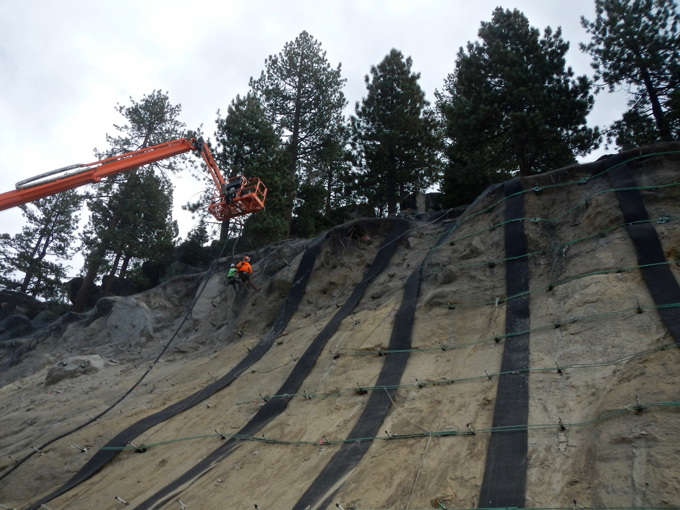
Men in climbing harnesses secure a wire mesh to the hillside above Highway 50 near Logan Shoals. Photo/Kathryn Reed

By Kathryn Reed

LOGAN SHOALS – While it looks like NDOT is building a climbing wall along Highway 50 on the South Shore, the reality is workers are attempting to stop Mother Nature.

Boulders, some the size of trucks, repeatedly tumbled down last winter onto the road. No cars were hit; no one was injured. The highway – the main artery from the South Shore to Carson City as well as the fastest route to Kings Beach and Incline Village – was closed for weeks, then reduced to one-lane in each direction as it is now.

While the work will not be done this construction season, the plan is to have all the lanes open before winter. Crews are expected to complete the project next year. As long as temperatures don’t get too cold, work will continue this month.

By the time it’s finished, the goal is the average motorist won’t know that the hillside has essentially been rebuilt. Concrete will be contoured to look like natural Sierra granite boulders. “Cracks” will be added to resemble authentic fissures. The stain will also be slightly varied to complement Mother Nature.

Touching a sample, it feels a bit like granite and not like typical concrete. It looks real as well.

The contractor had to pour 4-inch and 12-inch deep samples, as well as provide a test of the finished product for Nevada Department of Transportation officials.

“The design is considered to be a permanent fix. Drainage features let the water in if there is any,” Shawn Paterson, designer with NDOT, told Lake Tahoe News.

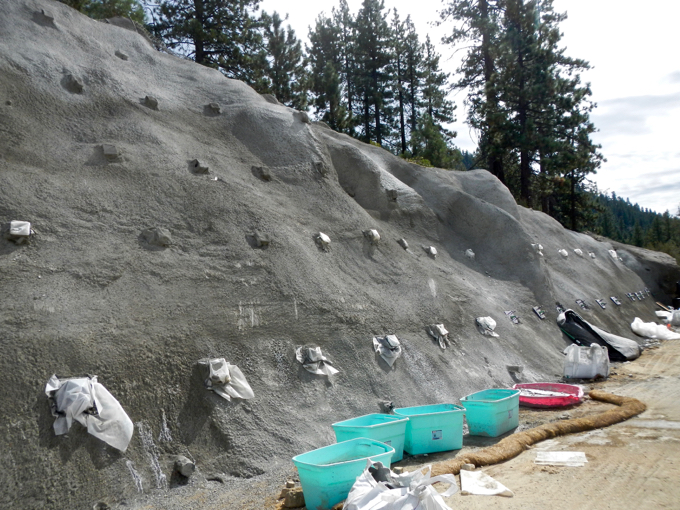
A section of the hillside with the 4-inch concrete spray and limited contouring. Photo/Kathryn Reed

There will be multiple layers of reinforcement applied to the hill.

John Angel, resident engineer with NDOT, said the only thing that could pose a problem is road salts because “that degrades concrete.” Still, the state officials are confident the materials will last essentially forever unless there is a catastrophic event like a major earthquake – then all bets are off.

It’s water that brought down the gargantuan boulders – specifically the unusual amount of rain the basin received last winter.

Geo-textile fabric has been laid on the slope from the top to the bottom. Corrugations on the inside will help push the water away. It is designed not to freeze.

PVC pipe is attached at the bottom to let the accumulated water drain.

John Bradshaw, an NDOT designer, explained that the rain washes away the dirt that is the natural interlocking mechanism between the rocks. This makes for a precarious situation, where the stability of neighboring rocks is questionable.

With the assistance of a geotechnical engineer, NDOT studied the whole area. Soil nailing is the solution that the department settled on. This same technology has been used on Highway 28 where the bike trail in Incline Village is being built.

At the steepest, the crews go up 70 feet to the end of NDOT’s right-of-way. The length is more than 1,300 feet. Above their responsibility the land is either private or owned by the U.S. Forest Service.

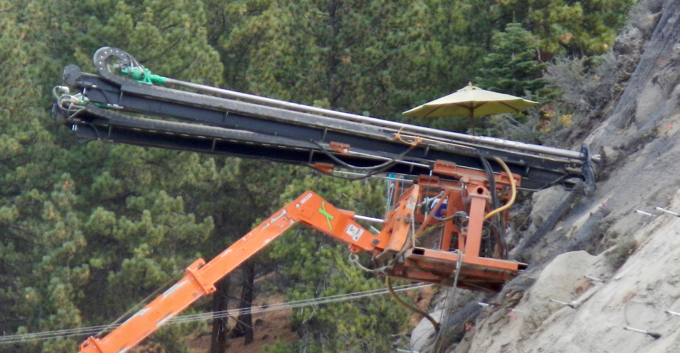
The drill used to bore 20-foot holes into the hillside that will be filled with concrete as a stabilizer. Photo/Kathryn Reed

To essentially rebuild the slope requires men to be in climbing harnesses eight hours a day. They dangle above the asphalt grouting the holes.

Six-inch-wide holes have been drilled 20-feet-deep into what was described as good soil, and granite so it will be stable. They are spaced 5 feet apart in height and width in a grid pattern. They are filled to become the anchors. They are encapsulated in cement grout, with triple corrosion protection.

Wire mesh is draped over the surface to help hold any loose rocks. It’s then connected to the steel rods.

Shotcrete has already been blown onto a section on the west end of the construction site. This is the 4-inch layer. Anchors protrude from this layer of concrete. On top another 12-inches of shotcrete will be sprayed on. This is similar to what took place on Cave Rock recently when NDOT contractors secured that rock structure.

By next summer NDOT hopes it will be hard to tell crews were ever out there.


Opinion: What a true progressive city looks like

By Joe Mathews

Adjust your California maps: The little dot marking Santa Rosa needs to be a lot bigger.

Dramatic changes in housing, aging, transportation, and criminal justice are altering the Golden State’s geography, and no place in California stands to benefit more than Santa Rosa.

Joe Mathews

The Sonoma County seat seems poised to become the most successful example of a type of urban center—the rapidly growing midsize city that serves as a crossroads between major regions. The city’s current motto—“Out There. In the Middle of Everything”—encapsulates the new and paradoxical centrality of edge cities, from Fairfield and Santa Clarita to Riverside and Escondido. In an era when California’s coastal regions have soured on motherhood (by making children and housing prohibitively expensive) and apple pie (too much sugar and not locally grown), these edge cities are bastions of hoary traditions like economic growth and middle-class opportunity.

“We’re on the move and we’re interested in growing,” says Santa Rosa city councilmember Julie Combs of her town.

As the fifth-largest city in the Bay Area, Santa Rosa, population 175,000, plays many roles. It’s the northern spillover area for people and businesses seeking refuge from the closer-in Bay Area’s higher costs. Employers like it too; the city now boasts 88,000 jobs, its highest employment level ever.  

And by dint of geography and deliberate strategy, the city is emerging as California’s weed crossroads—or, in the words used by the city, the “farm-to-market” center for medical and recreational marijuana, connecting the cannabis growers of the North State with the retailers and consumers of the Bay Area and points south.

While many other California cities have decided to limit the marijuana industry, Santa Rosa has rapidly issued permits for cannabis operations, creating a run on warehouse space. What the city wants is higher-wage professional jobs—in sales, finance, distribution or lab testing—that the newly legal $22 billion-a-year industry will require.

And while Marin County to the south is famously anti-growth, Santa Rosa has been busily preparing for the new people heading its way. In downtown Santa Rosa, there are plans for taller buildings, including a hotel. Santa Rosa’s once-tiny airport is expanding to handle double its number of travelers by the end of the next decade. The first 43 miles of a new 70-mile commuter rail line, the SMART train, opened this summer, connecting Santa Rosa to San Rafael, and, eventually, the ferry to San Francisco.

The City Council has distinguished itself by making housing its top priority, with a multi-phase plan that promises more housing both for younger families and seniors. The city has put its own money into affordable housing, is working with the county to establish a housing trust, and is encouraging denser, taller construction—while still preserving its urban growth boundaries. Santa Rosa also has responded aggressively to rising homelessness—declaring a local state of emergency that allows for flexibility in zoning to help house people quickly.

All of this progress has been helped by a series of inclusive community conversations, some called Santa Rosa Together, in recent years. The community’s cohesion opened the door to an extraordinary step: absorbing Roseland and other poorer communities on the city’s southwest side, with the goal of giving them a greater political voice and better services. Expected to be complete by November, the annexation, which includes 715 acres and 8,000 people, is billed as the largest such expansion in the city’s history.

All this change can be jarring for some Santa Rosans, particularly longtime residents accustomed to a smaller town that identified itself with the cartoon strip Peanuts. Its author, Charles M. Schulz, spent much of his adult life in the area, which named the airport after him. Santa Rosa still remains home to a Charles M. Schulz Museum, part of a complex that includes an ice rink.  

But the world is changing. MetLife last year fired Snoopy and the Peanuts gang after 30 years of sponsorship, and the Peanuts brand was sold off to a Canadian company. And Santa Rosans will soon have to adjust to living in a city of 200,000, rather than the 1970 town of 50,000. 

Next year, Santa Rosa will celebrate the sesquicentennial of its incorporation it’s also the 75th anniversary of Santa Rosa’s most famous star turn, in Alfred Hitchcock’s classic “Shadow of a Doubt.” Hitchcock—who would recognize the old train station, but not much else about the city now—portrayed Santa Rosa as such a small, out-of-the-way place that the serial killer played by Joseph Cotton could hide there without fear of detection.

Today, the geography of 21st-century California makes Santa Rosa inescapable.

Joe Mathews writes the Connecting California column for Zócalo Public Square.



EDC man killed in Las Vegas mass shooting

By KCRA-TV

A Cameron Park man died and two of his family members were wounded Sunday night when a gunman opened fire at a crowd in a Las Vegas music festival, family members told KCRA 3.

Kurt Von Tillow

Kurt Von Tillow, 55, died in the mass shooting. His sister was hit by shrapnel in the thigh and was treated at a local hospital, and his niece was shot in the ankle but had surgery today and is expected to recover. His wife and daughter, who were also with him, managed to escape unharmed.

His family members had to flee the venue and leave Kurt’s body behind. A moment that was devastating for his wife, who had tried to revive him.

Read the whole story


Pac-Man arcade classic being adapted as a casino game

By Las Vegas Sun

Pac-Man could be munching through gamblers’ cash next year, after interactive slot manufacturer Gamblit Gaming announced today it signed an agreement with Pac-Man’s creator, Bandai Namco Entertainment Inc., to design a casino version of the arcade classic.

In a news release, Gamblit said it plans to unveil the game, called Pac-Man Battle Casino, this week at the Global Gaming Expo, one of the gaming industry’s biggest conventions, at the Sands Expo.

Two to four people will be able to play each other for a cash prize in a contest that keeps the game’s familiar maze and much of its original look and feel.

Read the whole story


Douglas County employees accused of theft

By Lake Tahoe News

Douglas County officials are not being very forthcoming with information about employees stealing from the public works department even though they admit they were first made aware of the thefts in March.

The Nevada Division of Investigation and Douglas County District Attorney’s Office have been investigating the thefts since they were first reported more than six months ago.

“The criminal investigation will be made available once the investigation is completed and the matter is reviewed for prosecution,” the county said in a press release.

The investigations involve “allegations of thefts of tires and other possible improprieties within the public works department.”

County spokeswoman Melissa Blosser would not tell Lake Tahoe News if anyone has been placed on leave, removed from the department or fired. She also wouldn’t say how long people had been stealing, how many people were involved, or the value of what was taken.

For the past several months the county said it has conducted an internal audit and inventory of purchased tires, strengthened internal financial controls to provide additional security, retained an accounting firm to conduct a complete inventory of tires and other supplies used in the operations and maintenance of county vehicles and to assist in determining the amount of the frauds committed against the county, which also should identify ways to prevent similar types of fraud in the future.

The county says it plans to use the IT department to better track inventory.

The county plans to change its policies when it comes to the public and staff being able to report suspected fraud. With the county only talking through press releases, it is not known what the policy was before or what it will be in the future. It is in the process of revamping the Whistleblower Protection Program.

All staff will be given ethics training as well.


Plant daffodils now for added spring beauty

By Melinda Myers

Daffodils have a cheery presence in the spring garden and are a surefire way to chase away the winter blues. These fall-planted bulbs are also reliable perennials that require no maintenance and are not bothered by deer or other pests. The National Garden Bureau has declared 2017 the Year of the Daffodil, and with the fall planting season upon us, now is the time to choose your favorites.

Yellow trumpet daffodils are classics, but there are many other flower styles and colors to choose from. Double-flowering types like white and yellow Lingerie and long lasting lemon-yellow Sherbourne feature multiple rows of petals and some varieties look more like peonies than daffodils.

Multi-flowering varieties like Beautiful Eyes, display several flowers on each stem. This variety’s white and orange blossoms have a gardenia-like fragrance. Miniature daffodil Baby Boomer has five to ten flowers per stem. After blooming, the grassy foliage quickly fades away, allowing nearby perennials to take center stage.

Unique daffodil varieties like Lingerie offer double flowering. Photo/Longfield-Gardens.com

Split corona daffodils have an unexpected beauty and are lovely cut flowers. The cups on these daffodils are divided into segments that are pressed back against the petals. Narcissus Cassata has a ruffled yellow split cup and white petals. Lemon Beauty’s shorter split cup is adorned with a yellow star.

These are just a few of the many choices that are available for gardens, containers and spring bouquets. Most daffodils are hardy in growing zones 3 to 8. In warmer zones, look for heat tolerant varieties such as Thalia and Silver Smiles.

Mix daffodils into shady gardens filled with hostas, ferns and other shade-loving perennials. As the daffodil blooms fade, the perennials will grow, mask the foliage and provide beauty throughout the remainder of the season.

Plant daffodils on a hillside, woodland border, beside a pond or under trees and shrubs. Over time, the bulbs will grow and multiply with minimal care from you. Choose cultivars with different flower styles and bloom times, and plant in drifts to create an attractive display.

Can’t decide? Consider one of the many pre-mixed packages such as Longfield Garden’s Fragrant, Double, Miniature or Multi-flowering daffodil collections. Or, create your own long-lasting display by combining early, mid and late blooming varieties.

Get your daffodils off to a great start with proper planting. Order the bulbs early for best selection, and plant them in mid to late fall, any time before the ground freezes. Dig a hole and position the bulbs 6-inches deep with the pointy side up. Cover with soil, apply a low nitrogen slow release fertilizer and water thoroughly. Once in the ground, the bulbs can remain in place for years to come.

Reserve a few daffodil bulbs for your containers and window boxes. Pot them up in the fall and make sure they get at least 15 weeks of chilling at 40-45 degrees. In mild climates, the containers can be left outdoors. In zones 6 and colder, they should be stored in an unheated garage where they will be cold, but won’t freeze.

Start now and enjoy a brighter beginning to next year’s garden season. The daffodils you plant this fall will delight you year after year as their carefree blooms announce winter’s end and spring’s return. 

Melinda Myers has written numerous books, including S”mall Space Gardening.” She hosts the Great Courses “How to Grow Anything” DVD series and is a columnist and contributing editor for “Birds & Blooms” magazine.