Calif. regulator admits to anxiety as legal pot nears

By Michael R. Blood, AP

California’s emerging marijuana industry is being rattled by an array of unknowns, as the state races to issue its first licenses to grow and sell legal recreational pot on Jan. 1.

“We all have anxiety,” top state pot regulator Lori Ajax told an industry group Thursday. “It’s not going to be perfect.”

California voters in 2016 approved Proposition 64, which legalized recreational pot use for adults in the nation’s most populous state. It takes effect in 2018, when the new economy will unite recreational sales with the state’s two-decade old medicinal pot market.

Read the whole story


Caesars emerges from bankruptcy with $2B in cash

By Thomas Moore, Las Vegas Sun

Caesars Entertainment has completed the bankruptcy process, the company announced Friday, ending two-plus years of legal and financial uncertainty.

As part of the post-bankruptcy restructuring, Caesars Entertainment has finished its merger with Caesars Acquisition Company and has announced a new board of directors.

Caesars is the parent company of Harrah’s Lake Tahoe and Harveys in Stateline.

Read the whole story


Snippets about Lake Tahoe

·      Tahoe Regional Planning Agency is asking for the community’s help identifying transit needs throughout the region. Provide feedback by taking this survey or interact with officials at a public workshop on Oct. 12 at 1pm at the Tahoe City transit center, Oct. 17 from 5-7pm at Raley’s at the Y in South Lake there will be an informational booth, and another booth on Oct. 24 from 3;30-5:30pm at the Stateline transit center.

·      Here are the El Dorado-Tahoe and Sierra roadwork schedules from Caltrans for the coming week.

·      Katie Meyers has been hired by Lake Tahoe South Shore Chamber of Commerce to be the membership services director.

·      Eldorado National Forest fire managers plan to burn approximately 16,140 acres of national forest land this fall, winter and spring using a combination of understory and pile burning techniques.

·      Lake Tahoe Unified School District is looking for public participation in the Wellness Committee – specifically nutrition, and physical education and activity; and the Renewable Energy and Sustainability Committee. People interested in serving on a committee, should speak with the school site principal or site secretary.


Submissions sought for national parks book

Bona Fide Books in Meyers is looking for submissions for the second addition of its popular “Permanent Vacation” book that came out in 2011.

The publishing house is seeking literary essays for the second collection about life and work in U.S. national parks. It could be about time building trails or alligator-proofing a cabin or something else.

The deadline to submit works is Dec. 1.

For more details, go online.


Kokanee putting on a show at Taylor Creek

Kokanee salmon are filling the channel of Taylor Creek. Photo/Kathryn Reed

By Kathryn Reed

CAMP RICHARDSON — They’re baaaacccckkkk – the Kokanee salmon that is.

With more water in Taylor Creek than in recent falls, the fish are spawning in good numbers this year. While it’s likely the run has not peaked, the die-off is already evident.

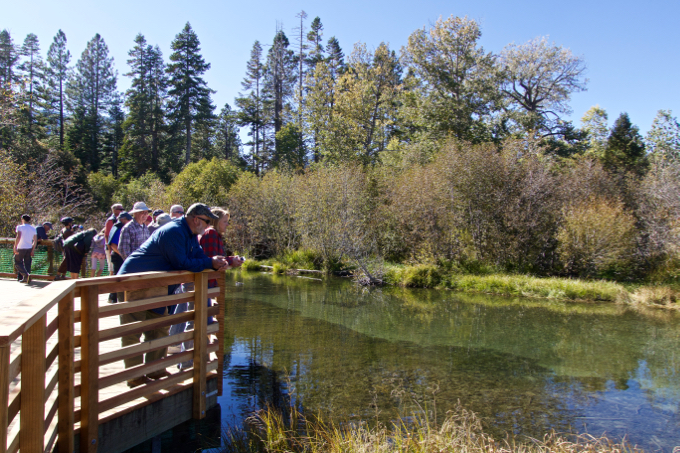
A platform separates people from wildlife. Photo/Kathryn Reed

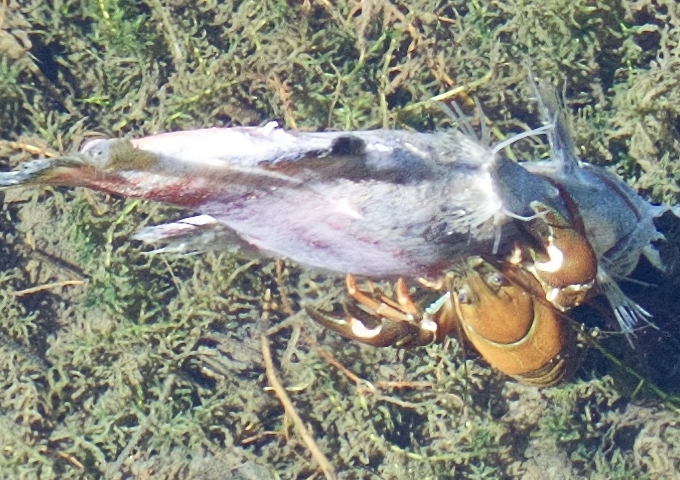
On Friday a crawdad was gnawing away on a submerged carcass, with his friend crawling slowly to join in the feast.

For people, it’s really a feast for the eyes. These non-native fish to Lake Tahoe are a colorful spectacle as they make their way from the lake up Taylor Creek. The whole point is for the females to lay eggs – from 200 to 1,800 per fish — and the males to fertilize them. Both then die. Their offspring are born in the spring and then make their way to the lake.

It is smell that brings them back to Taylor Creek – their birthplace.

A duck on Oct. 6 successfully goes fishing for Kokanee at Taylor Creek. Photo/Kathryn Reed

The female and male’s scales turn red as they spawn. The males’ jaws become hooked.

New this year along the Rainbow Trail at Taylor Creek Visitors Center is a viewing platform that in large part was paid for by the Tahoe Fund. It had to be built after too many people thought it was a good idea to take selfies with bears in the background.

For some reason people treated this wild, natural event like it was some controlled scene at Disneyland. Their behavior was putting their lives as risk and potentially the bear’s.

Under water a crawdad digs at the flesh of a decaying Kokanee. Photo/Kathryn Reed

The wood deck doesn’t take away from seeing this annual ritual. It just means the creek is no longer accessible. In a wet year like this, it actually makes it less muddy and gives a wider area to see things.

What some people were treated to on Oct. 6 were ducks racing up and down a small stretch of the creek, then diving, swimming a ways underwater all in the quest to dine on Kokanee. It was working. A blue heron was also spotted.

This weekend is the annual Fall Fish Festival at the visitors center off Highway 89 on the South Shore. It is from 10am-4pm Saturday and Sunday. The free event gives people a chance to learn about all the fish species in Lake Tahoe.


Opinion: Trump’s staff could save him from himself

By Drew Mendelson

The stupefying deeds of the Trump White House are passing in such a blur these days that it is hard to parse the incompetence. From policies foreign and domestic that churn without solidifying, to presidential tweets that seem the products of insult comedians, to an obsession with fixing blame before even knowing results, this seems more a Three Stooges comedy than a functional administration.

One piece that is driving me absolutely nuts is the complete lack of any coherent White House staff structure. I spent nearly five years as a deputy communications director on the staff of California Republicn Gov. Gray Davis. Despite turmoil, I happen to think we did pretty well in the middle of a political shooting gallery.

Whatever our administration’s faults, we had a well-ordered staff structure of the sort that a governor or a president needs. The required elements include a specific set of duties for everybody, an efficient process for analyzing and guiding legislation, smooth information dissemination, a polished rapid response system, and a smooth flow of staff internal communication.

Davis was accessible to all of us on staff. But you knew damn well you’d better not skip steps in moving a piece of the agenda. Any competent high-level elected official’s staff works the same way. I’ve experienced as much working for others.

Trump’s staff, by contrast, has no visible structure that I can discern. On Davis’s team we had a chief of staff, Lynn Schenk, who was tough, decisive, and stood just below the governor in the command structure. She was absolutely in charge as far as we were concerned.

If she issued a directive, it was as if it came from Gov. Davis himself. We could discuss it, even offer suggestions. But when the decision was made, we carried it out to the letter. It was not just that people had job titles; Trump’s staff have titles. It was that each of us was an expert in her or his field, and the staff stayed within its assigned parameters. The communications department, where I worked, dealt with press relations, speechwriting, op-ed writing, and public relations—period. I was not assigned unexpectedly to vet potential judicial appointments, or construct an economic policy.

Nor did we get assignments because we were cronies of the governor. Yeah, we respected him; we worked there because we believed in his philosophy of governing. We were trusted because we did our jobs, not necessarily because we were friends.

Harry Truman supposedly said, “If you want a friend in Washington, get a dog.” We weren’t the governor’s or the chief of staff’s friends. But we were collegial. So, despite the insanity of the energy crisis of 2000-2001, and the subsequent recall election, we accomplished a lot.

As to leaking—we didn’t. Why would we? Leaks were unauthorized information going out before it should be released. All that would do would be to sow seeds of disruption for our policies. My boss, the communications director, who had a long history as a news reporter, said that on his first day at the governor’s office he found himself with information on so many policies that he was in agony over not being able to write about them. He joked that he spent his whole first week just leaking stories to himself.

What did we do then in emergencies? For most, we had prep already in place. Part of my job was to run our rapid response system. That didn’t mean having a line of bull ready to release. It meant learning of dangers before the fact and preparing. I ran a call every morning with staff statewide to learn about potential issues. We then informed appropriate responders and prepared an action plan.

Sometimes we were slow off the mark, because complex issues, even when learned about early, take time to respond to. For this we got accused of being slow or too careful. But we were thorough, consulted subject experts, and looked for the best plan. The announcement of our actions always followed our consideration. We didn’t rant first and act later, if at all.

And we didn’t act in secret or hide the ball. We didn’t act vindictively. You can’t govern that way. At least not for long. Sadly, Davis got tagged with being reluctant to act and got thrown out for it in the recall. In truth, he and the rest of us were simply careful and deliberate. 

Trump’s operation (I hesitate to call it a staff), appears to be a collection of yes men and women, who in his presence answer to him only, but who, away from Trump, conduct their business as if they were ministers without portfolio, doing and saying as they please until they get caught at it. You are Trump’s trusted dog’s body until he tires of you or needs a patsy, then off with your head.

One thing striking to people who work in an office environment is how various officials, including the short-lived Anthony Scaramucci, got a license for direct access to Trump. In any sane organization, there is a chief of staff who is the gatekeeper to all. Nobody (absolutely nobody) should have such special access. Such arrangements smack of mafia dons giving access to a secret consiglieri. Who else has secret access? Well, it’s a secret, so we don’t know.

I have long thought that Trump to be mentally unstable. His paranoid Twitter rants, his attraction to conspiracy theories, his attachment to unsavory characters with no business in politics, his love-hate affiliation with Vladimir Putin, his sudden shifts of temper against China and NATO and many other allies, his belief (real or purported) that all news and news sources are fake, all point to mental instability.

What to do in this case? There is, of course the complicated process of impeachment. But if the president is incapacitated, the 25th Amendment to the U.S. Constitution provides a well-defined replacement structure, empowering the vice president and the majority of cabinet or congressional leaders to remove the president. No impeachment needed.

Angry tweets may be red meat to your base. But they mainly signal turmoil. A leader can only be as effective as the information he/she receives. And that comes from a trusted and well-ordered staff that works as a team, especially in troubled times. 

Drew Mendelson is a Sacramento-based political speechwriter and novelist. 



Video games in the Olympics?

By Alexander Vershinin and James Ellingworth, AP

ASHGABAT, Turkmenistan — The future of the Olympics may just be in a basement in Turkmenistan.

With leading Olympic figures considering a possible role for competitive computer games — known as esports — at the 2024 Games in Paris, a pan-Asian competition in the ex-Soviet state offers a possible vision of the future.

Including esports could give the Olympics a younger audience and a huge revenue boost from a rapidly growing market, but would be deeply controversial.

Read the whole story


‘Bachelor’ being filmed in Lake Tahoe

Film crews from “The Bachelor” have been spotted around the South Shore.

Crews were at the Hard Rock Lake Tahoe on the night of Oct. 2.

This is the third time the television show has filmed here. Twice the crew stayed at the Black Bear Inn, now called the Black Bear Lodge, on Ski Run Boulevard. The last time was in 2007.

Mum is the word on where else filming has taken place and what the contestants have done in Tahoe.

Lake Tahoe Visitors Authority has helped defray some of the expenses with an initial commitment of $10,000. The board next week is being asked to contribute another $10,000 toward production expenses.

The Tahoe episode is expected to air in early 2018.

— Lake Tahoe News staff report


Letter: Explaining SLT’s money for roads

To the community,  

I am writing this letter to the editor in response to the Lake Tahoe News editorial publicized Oct. 2, 2017.

Jim Marino

First and foremost, I am writing this letter outside of my position of assistant director of Public Works of the city of South Lake Tahoe. I have always trusted and admired the straightforwardness and factual information provided in your articles/editorials, and will continue to do so.

The information you provided in your editorial against Measure C was factual though perhaps unintentionally misleading. Please allow me the opportunity to provide my perspective.

1.     “When looking at the city’s budget for this fiscal year, which began Sunday, there are zero dollars for roads.” This is typical. The city’s annual roadway rehabilitation appropriation is usually accomplished at mid-year budget adoption.

2.     “Still, from 1995 to today the city has spent $11,792,473 on pavement rehabilitation. That is an average of $512,716 in each of the last 23 years.” The amounts are correct, though we should associate the appropriation toward the total value of the asset. We currently value the roadway network as is at roughly $119 million to $127 million. So an $11 million investment over a recorded 23-year period represents less than 11 percent of total asset value that has been maintained over a span of 23 years. As roadways age and if not maintained, the deterioration increases rapidly after a certain point. In most cases, a roadway that has not received adequate preventative maintenance will begin to deteriorate three times faster after 15 years of life.

This rapid deterioration curve is what we are experiencing now and is occurring over roughly 62 percent of the roadway network.

3.     “That is an average of $512,716.22 per year in each of the last 23 years.” While the average of $512,716 is accurate, it is a bit misleading as it clearly does not define an amount appropriated by year. Each fiscal year had varying appropriation amounts, thus dictating the rehabilitation productivity by year. Furthermore, from 2012 to 2017 the City’s General Fund contribution was $6,215,942, indicating that 52 percent of the entire appropriation over the 23-year period has occurred during the last five years. From 2012–2017 the city averaged $1,243,188 toward roadway rehabilitation. As reported many times to City Council and the public, approximately $2.5 million to $2.9 million is required annually to slow the deterioration curve and begin the process of stabilizing the network. Over time, this annual funding will raise the overall network condition. Even though the last five years of funding averaged $1,243,188, it represents only 42 percent of what is actually required annually to stop the network decline.

4.     “Measure C on the November ballot is projected to bring in $2.5 million annually. The proposal would have money going toward complete streets – meaning more than an overlay. It would include curbs, gutters and striping for bike lanes where appropriate.” Would Measure C funds be utilized to fund complete streets? Possibly, but not likely. Approximately 62 percent of the roadway network is in serious decline. Most of the 62 percent comprises of collector and residential class roadways. Funds would go straight to correcting this category of the network, with the premise being to rehabilitate the roadways in poor condition to gain the most productive increase in network condition over the shortest time period possible. What this means is most, if not all, of the funds would go to directly working within the asphalt travel way.

All of the city’s complete streets projects to date have been funded primarily through state and federal transportation grants. Ski Run Boulevard, Al Tahoe Boulevard, Pioneer Trail from Highway 50 to Larch; were all built with very minimal General Fund dollars (typically 11 percent of project). The city’s next project; Sierra Boulevard is at this time 100 percent funded through outside fund sources.   

Thank you for allowing me to provide some clarification to the figures provided within your editorial.  I appreciate and understand your opinion.

Sincerely,

Jim Marino


SLT pot shop owner faces felony tax fraud charges

By Kathryn Reed

Cody Bass, the owner of Tahoe Wellness Cooperative, is accused of felony tax fraud.

A criminal complaint filed in El Dorado County Superior Court alleges Bass filed false income tax returns with the California Franchise Tax Board for calendar years 2012 and 2013, and that he failed to file a personal state tax return in 2014. Those are felony offenses. A misdemeanor allegation is for failing to pay state income tax in 2011.

Cody Bass has been a controversial figure in South Lake Tahoe since opening his medicinal marijuana shop. Photo/LTN file

Bass did not respond to an inquiry from Lake Tahoe News.

His medicinal marijuana shop in the Bijou Center of South Lake Tahoe was raided in June 2015.

At the time El Dorado County Assistant District Attorney Jim Clinchard told Lake Tahoe News, “The investigation relates to tax evasion and possession of marijuana for sale.”

On Oct. 6 Clinchard said, “As this is a pending case, we have no further comment.”

Even though marijuana of any kind is not recognized by the federal government to be legal, the IRS still mandates taxes be paid. It has strict regulations as to what can be taken as a deduction, which can result in businesses needing to pay a higher percentage of taxes than other industries.

What happened to the “marijuana for sale” part of the investigation is unknown.

For years the city has alleged Bass was doing more than providing medical marijuana, saying that millions of dollars in weed are filtered through the Tahoe shop that have nothing to do with medicine.

While South Lake Tahoe police detectives were integral to the case, the police chief did not respond to an inquiry from LTN. Nor did the city manager or city attorney.

Assisting with what was described as a long and ongoing investigation were the now defunct South Lake El Dorado Narcotics Task Force, El Dorado County Sheriff’s Department, state Board of Equalization and the Employment Development Department.

For now, the shop remains open and Bass is not behind bars.