Water rights could drown 3-Calif. idea

By Dale Kasler, Sacramento Bee
 
Splitting California into three new states would scramble nearly every segment of government that touches residents’ lives, from taxes to Medi-Cal to driver’s licenses.

New agencies would have to be created to operate prisons, highways and universities. CalPERS, CalSTRS, Cal Fire and the California Highway Patrol, to name a few, would have to be reconfigured and replaced.

But of all the gargantuan tasks facing Californians should they choose to divide themselves by three — a proposal that has qualified for the November ballot — none is arguably more daunting than carving up the state’s water supply.

Read the whole story


Snippets about Lake Tahoe

·      Placer County Supervisor Jennifer Montgomery is having a coffee chat session on June 28, 9am at Customs House – Placer County Administrative Office, Tahoe City.

·      There will be a bluegrass concert at Sugar Pine Point State Park on July 27 from 5-9pm. Tickets are $20 in advance, $25 that day. Doors open at 5pm, concert at 6pm. For more info, email dtran@sierrastateparks.org.

·      Snowboarder Jamie Anderson of Meyers has been nominated for an ESPY in the categories of Best Female Olympian and Best Female Action Sports Athlete.

·      Skier David Wise of Reno has been nominated for an ESPY in the category of Best Male Action Sports Athlete.

·      Douglas County Public Library will be hosting a coffee tasting on July 16 at the Minden Library from 2-4pm. DST Coffee Company will give a presentation and provide free coffee samples. Baked goods will also be provided by the Main Street Baking Co.


Interacting with wildlife subject of talk

Learn how to handle wildlife encounters, whether it be while camping, hiking or in your own backyard during a talk by a Nevada Department of Wildlife’s urban wildlife coordinator.

This will be a lesson on what to do and how to react to wild animals; from raccoons and coyotes to bears and mountain lions.

This family-friendly event is free. Park entrance fees will be waived for attendees. The program will be at Spooner Lake State Park on July 7 at 7pm. Sign-ups are encouraged, but not required, by calling 775.749.5980.


Immigration dominates Sessions’ talk in Reno

Protesters almost canceled Attorney Jeff Sessions’ talk on June 25 in Reno. Photo/Linda Fine Conaboy

By Linda Fine Conaboy

RENO – Attorney General Jeff Sessions stayed true to the party line Monday as he defended the president’s policy on immigration saying children are the target of MS-13, an international criminal gang that originated in Los Angeles in the 1980s.

Sessions gave the keynote address June 25, opening the national gathering of school resource officers who are in Reno this week attending their convention. NASRO, the National Association of School Resource Officers, evidently approved and appreciated that Sessions was at their meeting, handing him two standing ovations.

As the gathering of more than 1,000 got under way inside, a group of protesters loudly showed their disapproval outside. Horns honked, a group of Native Americans chanted and drummed, and a mariachi band in full regalia added their support to the protest.

Jeff Sessions

Not to be deterred by protesters, the keynote address proceeded as scheduled with Sessions’ opening remarks giving a nod to his audience as he mentioned that research shows many young people are turning to the law now as a profession.

Why? “Because they know someone in law enforcement and consider it a noble profession, just like in the Department of Justice,” he said. “When there’s a tragedy, we believe it’s important to be there and have your back.”

He also announced that the DOJ was allocating $2 million for Las Vegas after the October shooting and $1 million to officers in Broward County, Fla.

Although he was expected to stick to the topic of school safety, this was not the case. Reading from his prepared speech, he minced no words as he got right to immigration, saying children bear the burden of a broken immigration system. Safety of children is important, he said, adding that our government spends large amounts of money on children brought to the U.S. illegally.

“If we refused to prosecute adults, it would be a disservice to people in the U.S. It will also encourage people to bring more children illegally.” He also stated that the president advised that “we will avoid separating families. It’s a great effort .…”

Moreover, he added, adults are being arrested because they refuse to enter the United States at a port of entry. “There would be no crime or arrests if they entered at ports of entry. This should not be happening in the U.S.” He said he has spent days, months and years trying to develop ways to enforce these laws, but he said Congress needs to help.

He said the United States is seeing an increase in children coming here alone. Sessions said often they’re watching as adults get involved in drugs; he added that the vast majority of drugs come here across borders, which are not secure. Open borders are radical and dangerous and not good, he declared.

“The president has made it clear that we need a relationship with our partners in the south. Think about this. In just four days at the end of March, Customs and Border Protection apprehended five juveniles who were allegedly smuggling fentanyl. The killer drug. Between the five of them, they allegedly had more than 35 pounds of fentanyl—enough to kill millions of people.”

He said MS-13 is a particularly violent group, adding that if someone unlawfully comes into our country who committed acts against children, they should be deported, not protected by sanctuary policies. He highlighted what he said were examples of children being victimized by undocumented immigrants already in the U.S.

He also said MS-13 is recruiting children who were sent here as unaccompanied minors, saying some are brought to help replenish the gang and that they are terrorizing immigrant schools and communities all across the country.

Sessions said free speech and assembly rights will be protected, but criminals will be prosecuted.

“We will invest and continue to invest in law enforcement.”

He offered kudos to what he called the unsung heroes and thanked them for committing their lives to protecting the most vulnerable among us.


Opinion: Time for a new approach to travel

By Randy Malamud, The Conversation

When I overcame a flying phobia, I resolved to make up for lost time by visiting as much of the world as I could.

So in the course of a decade, I logged over 300,000 miles, flying everywhere from Buenos Aires to Dubai.

I knew intuitively that my travels would “make me a better person” and “broaden my horizon,” as the clichés have it. But I’ve come to believe that travel can, and should, be more than a hobby, luxury or form of leisure. It is a fundamental component of being a humanist.

At its core, humanism is about exploring and debating the vital ideas that make us who we are. We study music, film, art and literature to do just that. And while it’s important to explore these ideas in our own communities, people and places that are not like us have a role to play that’s just as crucial.

This is where travel comes in. It’s what sent me packing to see some of the places I have spent so long reading about. And it’s what compelled me to write “The Importance of Elsewhere: The Globalist Humanist Tourist,” in which I wanted to make a case for a new approach to travel.

The imperialist tourist

In academia, travel studies have long looked at the intersection between imperialism and tourism, describing how they flourish in tandem.

From the 16th to 19th centuries, European empires gobbled up territories around the world, planting their flags and building embassies, banks, hotels and roads. Imperialists traveled to collect cinnamon, silk, rubber and ivory, using them, upon returning home, for pleasure and profit.

The golden age of travel roughly coincided with that period. Not long after the military and commercial incursions began, tourists followed imperialists to these far-flung locales.

Both tourism and imperialism involved voyages of discovery, and both tended to leave the people who were “discovered” worse off than they had been before the encounters.

Globalism’s impact on the way we travel

Over the last century, globalism – a vast and daunting concept of transnational corporate and bureaucratic systems – has replaced imperialism as the dominant network of international relations.

Globalism can be overwhelming: It involves billions of people, trillions of dollars, innumerable inventories of goods, all ensconced in a technocratic vocabulary of geopolitics and multinationalism that’s anathema to those of us who approach the world on a more human scale.

It has also made travel much easier. There are more airplane routes, more ATMs on every corner and international cellphone service. You can travel elsewhere without ever leaving the comforting familiarities of home, with McDonald’s, Dunkin Donuts and Holiday Inns now dotting the globe.

But why bother traveling if you want familiar comforts?

I would argue that we need a new travel guide that acknowledges the sweeping interconnectedness of globalism, but balances this with a humanist mindset.

Because beneath the innocuous activities of visiting cathedrals, lounging on the beach and collecting souvenirs, travelers can still harbor selfish, exploitative desires and exhibit a sense of entitlement that resembles imperial incursions of yesteryear.

In a way, globalism has also made it easier to slip into the old imperialist impulse to come with power and leave with booty; to set up outposts of our own culture; and to take pictures denoting the strangeness of the places we visit, an enterprise that, for some, confirms the superiority of home.

The right way to be a tourist

Humanism, however, is proximate, intimate, local. Traveling as a humanist restores our identity and independence, and helps us resist the overwhelming forces of globalism.

There’s nothing wrong with going to see the Colosseum or the Taj Mahal. Sure, you can take all the same photos that have already been taken at all the usual tourist traps, or stand in long lines to see Shakespeare’s and Dante’s birthplaces (which are of dubious authenticity).

But don’t just do that. Sit around and watch people. Get lost. Give yourself over to the mood, the pace, the spirit of elsewhere. Obviously you will eat new and interesting foods, but think of other ways, too, of tasting and “ingesting” the culture of elsewhere, of adapting to different habits and styles. These are the things that will change you more than the view from the top of the Eiffel Tower.

Psychologists have found that the more countries you visit, the more trusting you’ll be – and that “those who visited places less similar to their homeland became more trusting than those who visited places more similar to their homeland.” Immersion in foreign places boosts creativity, and having more diverse experiences makes people’s minds more flexible.

With the products and conveniences of globalism touching most parts of the world, it simply takes more of a conscious effort to truly immerse yourself in something foreign.

My own empathy, creativity and flexibility have been immeasurably enhanced by such strange and fascinating destinations as a Monty Python conference in Lodz, Poland; a remoteness seminar near the North Pole; a boredom conference in Warsaw; Copenhagen’s queer film festival; Berlin’s deconstructed Nazi airport; a workshop in Baghdad on getting academics up to speed after Iraq’s destruction; and an encounter as an ecotourist with Tierra del Fuego’s penguins.

There’s an especially vital argument to make for travel in these fractious times of far-right ideologies and crumbling international alliances, burgeoning racism and xenophobia. The world seems as if it’s becoming less open.

A trip is the greatest chance you’ll ever have to learn about things you don’t experience at home, to meet people you wouldn’t otherwise encounter. You’ll probably find that, in many important ways, they are the same as you – which, in the end, is the point of doing all this.

Humanists know that our copious insights and deliberations – about identity, emotions, ethics, conflict and existence – flourish best when the world is our oyster. They dissipate in the echo chamber of isolationism.

Randy Malamud is a regents’ professor of English, Georgia State University.


Why turning homelessness into a crime is cruel and costly

By Joseph W. Mead and Sara Rankin, The Conversation

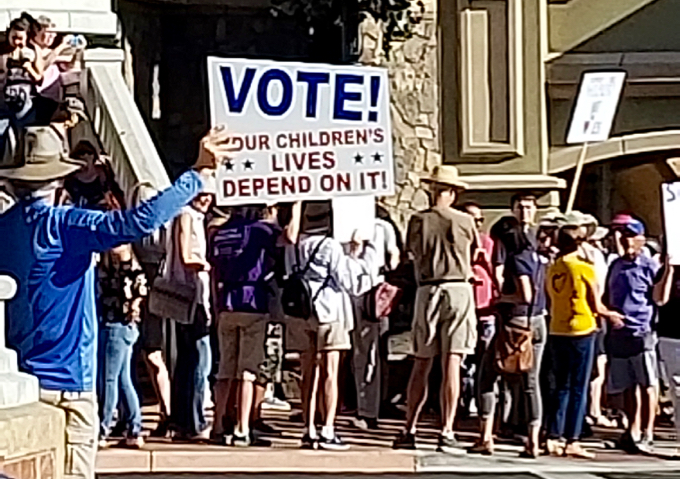
Increasingly, local laws punish Americans who are homeless.

By severely restricting or even barring the ability to engage in necessary, life-sustaining activities in public, like sitting, standing, sleeping or asking for help, even when there’s no reasonable alternative, these laws are essentially persecuting homeless men, women and children.

As law professors who study how laws can make homelessness better or worse, we encourage cities, suburbs and towns to avoid punishing people who live in public and have nowhere else to go. One big reason: These “anti-vagrancy laws” are counterproductive because they make it harder to escape homelessness.

Many paths to not having a home

Why do at least half a million Americans experience homelessness at any time?

Researchers find that most people who become homeless have nowhere to live after being evicted, losing their jobs or fleeing an abusive partner.

Many emergency homeless shelters are perpetually full. Even those with beds to spare may enforce rules that exclude families, LGBTQ youth and people with pets.

And when homeless people can stay in shelters, often they may only spend the night there. That means they have to go somewhere else during the daytime.

More laws

As the number of people facing homelessness increases, local residents are demanding that their elected officials do something about the homeless people they encounter in their daily lives. The leaders of cities, towns and suburbs are often responsive.

But more often than not, municipalities don’t address the underlying problems that cause homelessness by, say, providing sufficient permanent housing, affordable housing or shelters with minimal barriers to entry. Instead, criminalizing homelessness is growing more popular.

Over the last decade, citywide bans on camping in public have increased by 69 percent while citywide panhandling bans rose by 43 percent, according to the National Law Center on Homelessness and Poverty.

Advocates such as the American Civil Liberties Union frequently challenge these laws in court. Judges often strike down such laws on the grounds that they violate constitutionally protected rights, such as the freedom of speech or due process.

Still, more and more communities keep trying to outlaw homelessness.

Criminalizing homelessness is ineffective

Not only do we and other legal experts find these laws to be unconstitutional, we see ample evidence that they waste tax dollars.

Cities are aggressively deploying law enforcement to target people simply for the crime of existing while having nowhere to live. In 2016 alone, Los Angeles police arrested 14,000 people experiencing homelessness for everyday activities such as sitting on sidewalks.

San Francisco is spending about $20 million per year to enforce laws against loitering, panhandling and other common conduct against people experiencing homelessness.

Jails and prisons make extremely expensive and ineffective homeless shelters. Non-punitive alternatives, such as permanent supportive housing and mental health or substance abuse treatment, cost less and work better, according to research one of us is doing at the Homeless Rights Advocacy Project at Seattle University Law School and many other sources.

But the greatest cost of these laws is borne by already vulnerable people who are ticketed, arrested and jailed because they are experiencing homelessness.

Fines and court fees quickly add up to hundreds or thousands of dollars. A Sacramento man, for example, found himself facing $100,000 in fines for convictions for panhandling and sleeping outside. These costs are impossible to pay, since the “crimes” were committed by dint of being unable to afford keeping a roof over his head in the first place.

And since having a criminal record makes getting jobs and housing much harder, these laws are perpetuating homelessness.

Joseph W. Mead is an assistant professor at Cleveland State University and Sara Rankin is a professor of lawyering skills at Seattle University.


Initiative to repeal Calif. gas tax qualifies for Nov. ballot

By Melody Gutierrez, San Francisco Chronicle

California voters will decide whether to repeal newly enacted gas taxes and vehicle registration fees that fund road repairs under a ballot initiative that will appear on the November ballot.

Proponents of the repeal turned in more than the 585,407 valid signatures needed to qualify for the November ballot. The measure would remove the transportation taxes and fees approved by the Legislature last year under SB1, which is expected to raise $5 billion a year to pay for the state’s roads and bridges.

The ballot measure would remove the 12 cent per gallon increase in the state’s gas excise tax and the added 20 cent per gallon increase in the excise tax on diesel fuel, which is used by the commercial trucking industry. Vehicle registration fee increases that began in January would also be repealed. Those fees raised registration costs by $25 to $175 depending on the value of the vehicle.

Read the whole story


DUI suspected in midday rollover on South Shore

A driver for Boulder Exterminator was arrested on charges of driving under the influence after crashing a company truck on North Upper Truckee Road in Meyers.

Joseph Toller, 50, of Gardnerville sustained moderate injuries in the June 25, 1:15pm accident. He as transported to Barton Memorial Hospital.

“He was going too fast and left the side of the road,” CHP Officer Mike Brown told Lake Tahoe News. He wasn’t sure how many times the truck rolled. It ended up landing on the roof.

— Lake Tahoe News staff report


Opinion: An answer to Truckee’s Soaring Ranch litigation

By Art Chapman, Moonshine Ink

In the litigation against the Town of Truckee over the approval of the Soaring Ranch project, anchored by a Raley’s grocery store, a new development has recently come to light, therefore I want to provide your readers with an update.

Art Chapman

As you may know well, we have been working diligently to make the new Soaring Ranch development project come to fruition. This project will satisfy many needs in our community including a flagship Raley’s grocery market and achievable housing (housing options for residents covering a broad range of income levels, from low to above moderate). In late April, a lawsuit was filed against the town by nonprofit Protect CEQA and local business owner Stefanie Olivieri, which we believe is motivated by interests tied to downtown Truckee. After thoughtful consideration of concerns expressed in the lawsuit, JMA Ventures has proposed what we believe to be a meaningful settlement offer.

Read the whole story


Time to plan for school immunizations

El Dorado County Health and Human Services Agency, Public Health Nursing is reminding parents to plan now for the coming school year by ensuring their children are up-to-date on required immunizations.

For families without a health care provider, Public Health Nursing offers low-cost back-to-school immunizations for eligible children. Public Health can provide all childhood vaccinations required for school entry, and other vaccinations recommended to keep children healthy. 

For an appointment call Public Health Clinic at 530.621.6100 in Placerville or 530.573.3155 in South Lake Tahoe. Public Health does not bill private insurance and vaccinations are charged at full cost for those with private insurance. Children on Medi-Cal, or who are uninsured, are eligible for Public Health’s low-cost immunization services; a $10 administration fee is charged per shot, though no child is refused a vaccination due to inability to pay. 

Public Health Nursing also offers free, walk-in vaccination clinics for uninsured children or those on Medi-Cal at designated locations in El Dorado County from July through November each year. For dates and locations of the free walk-in vaccination clinics, go online.