State aging commission to meet in EDC

The California Commission on Aging will be visiting El Dorado County for a special public meeting on Aug. 1 focused on services for older adults.

It will be from 9am-5pm at the El Dorado County Government Center, Building A, located at 330 Fair Lane, Placerville.

Members of the California Commission on Aging will be on hand to participate in presentations and discussions highlighting local programs, including: Senior Services Programs, Senior Peer Counseling, and an Elder and Dependent Adult Abuse Project.

The primary purpose of the commission is to advance issues fundamental to ensuring healthy, purposeful and dignified longevity for all Californians.  

For questions regarding the meeting, contact Yasmin Hichborn at 530.642.4833.


Letter: Soroptimist give kids A Fighting Chance

To the community,

During the month of May, Soroptimist International of South Lake Tahoe brought their program, A Fighting Chance, to our South Lake Tahoe elementary schools.

This program was developed shortly after the kidnapping of Jaycee Lee Dugard. It trains children in our elementary schools to avoid being abducted.

The program starts in the third grade with lessons about how to be safe, and progresses through fourth, fifth, and eventually sixth grade, where techniques are provided to avoid abduction and get away from possible abductors.

Over the years, SISLT has brought this program to 22,000 kids, and in our latest set of trainings, SISLT trained 700 children at Bijou Elementary, Sierra House Elementary and Tahoe Valley Elementary.

Many thanks to the teachers at these schools for allowing us to teach these kids.

Colleen Manzer, SISLT


Road Beat: Genesis G90 V-8, best sedan

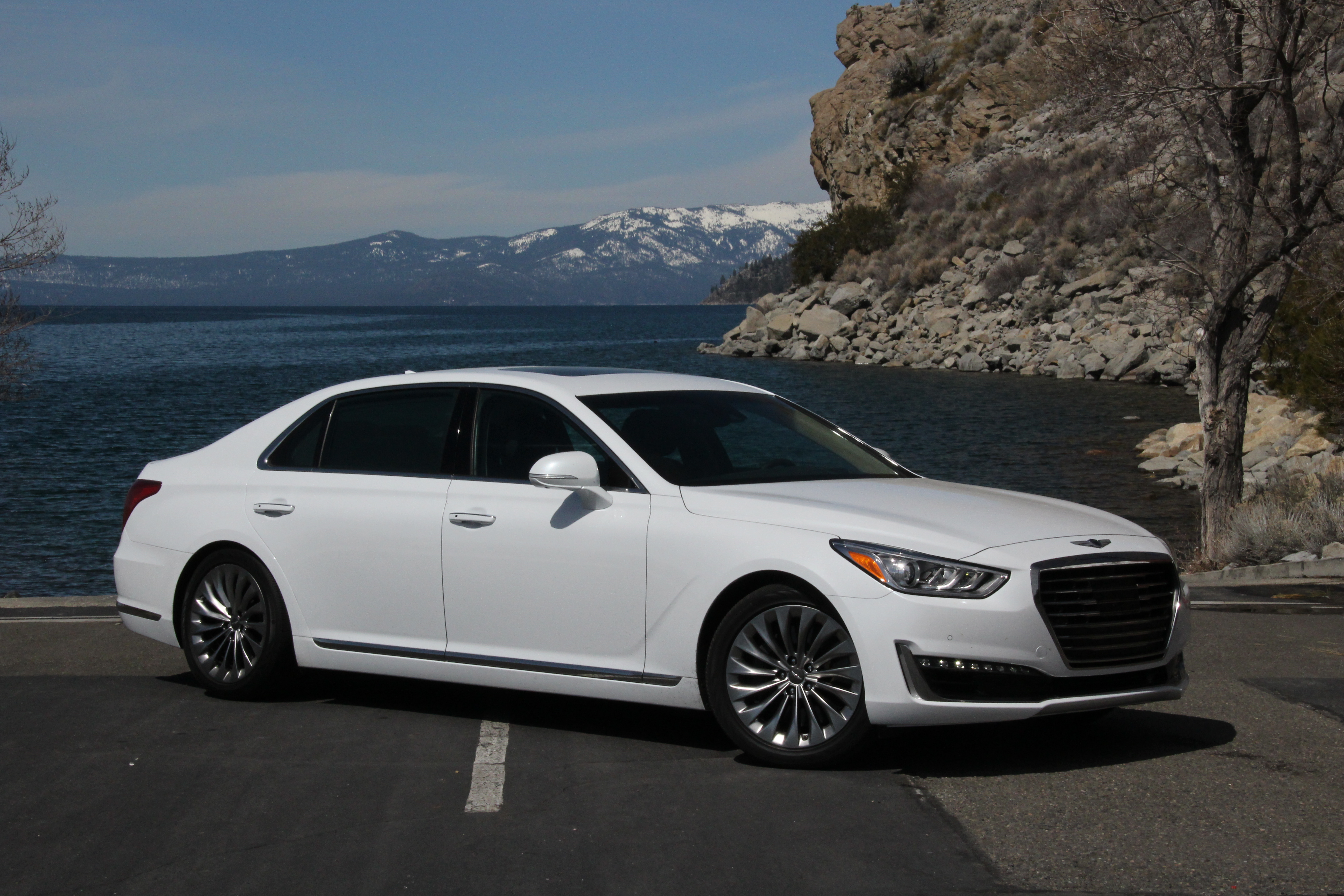
The Genesis G90 V-8 is worth every penny. Photos/Larry Weitzman

By Larry Weitzman

I won’t call the Genesis G90 V-8 the best car ever as I would currently give that title to the Lexus LC500 sports coupe which lists for about 30 large more. But the Lexus is basically a two plus two and not a super luxury sedan. Genesis G90 is designed to compete with other luxo sedans like the MBZ S550, BMW 7, Lexus LS500, Audi A8 and it not only succeeds, but when price is factored in, the G90 blows the other sedans away.

It’s the best sedan, two door or four door, I have ever driven. It’s a close call, between the G90 V-6 turbo and the V-8, but my preference goes to the V-8. Here’s why.

Genesis G90 is a big, beautiful, stately car with a more formal rear roof line. By big, wheelbase stretches out to 124 inches and its length is 205 inches, bigger than most of the competition. Yet it is svelte at 75 inches of width. Front end styling is aggressive with a big, mesh grille dominating and sleek fabulous multi headlamps. There is almost no chrome as it would only clutter and detract from its flowing shape. And it does flow as its co-efficient of drag is a low 0.27.

Powering this magnificent vehicle is a wonderful 5.0L DOHC, 32 valve V-8 that pumps out 420 hp at 6,000 rpm and a prodigious 383 pounds of twist at 5,000 RPM. The 365 hp G90 3.3 V-6T comes standard at a slightly lower price ($3,500 less) and without the rear entertainment system in the G90 5.0L V-8. But herein lies an interesting conundrum. Even though the 3.3L turbo V-6 has 55 less hp, it’s performance is virtually the same and that is because while the 3.3L turbo loses in the horsepower race, it actually makes more hp than the V-8 at lower rpms because it makes peak torque of 376 pounds at just 1,300 rpm and holds that number until 4,500. And while in my Road Beat on the G90 V-6 turbo was full of superlatives calling it the best sedan I had ever driven, and the best V-6 in production, there is just something about this incredibly sweet V-8 that adds something to the Genesis experience. But this is not the best V-8 in production as that would go to the Lexus LC500 471 hp 5.0L V-8. Also, normally aspirated.

Specifications
Price
$69,050-$72,150 with destination
Engine
3.3L turbocharged, direct injected, DOHC, 24 valve V-6 365 hp @6,000
376 lb.-ft. of torque from 1,300-4,500 rpm
5.0L normally aspirated DOHC, 32 valve direct injected V-8 420 hp @ 6,000 rpm
383 lb.-ft. of torque @ 5,000 rpm
Transmission
Eight-speed torque converter automatic with paddle shifters (on a limousine?)
Configuration
Longitudinal front engine/RWD/AWD
Dimensions
Wheelbase 124.4 inches
Length 204.9 inches
Width 75.4 inches
Height 58.9 inches
Track (f/r) 64.5/64.5 inches
Weight 4,630 pounds
Fuel capacity 21.9 gallons
Trunk capacity 15.7 cubic feet
Passenger capacity 113.2 cubic feet
Wheels (f/r) 19X8.5/19X9.5 inches
Tires 245/45X19/275/40X19 inches
Brakes (f/r) 14.2/13.4-inch diameter; ventilated
Steering lock to lock 2.55 turns
Turning circle 39.2 feet
Co-efficient of drag 0.27
Performance
0-60 mph 4.85 seconds
50-70 mph 2.15 seconds
50-70 mph uphill 2.98 seconds
Top Speed Perhaps escape velocity?
Fuel economy EPA rated 16/24/19 mpg city/highway/combined. Overall in rural and suburban driving expect 22-23 mpg and on the highway at legal speeds 31 mpg.

Genesis performance numbers are absolutely world-class with 0-60 mph coming up in just 4.88 seconds. And this Genesis tips the scales 4,751 pounds which makes its performance all the more gravity defying and remarkable. Passing times are also world class with a 50-70 mph runs on the level and up a 6-7 percent grade of 2.15 and 2.98 seconds respectively. The 3.3L turbo times were 4.81/2.48/3.19 seconds respectively. Almost virtually no difference. The V-6 eight-speeder is geared slightly lower than the V-8’s eight speeder, which could explain the two tenths of a second difference in the passing times. But make no mistake, these are among the quickest cars on the planet, not just sedans, I am talking about all motor vehicles.

While the EPA fuel economy is rated at 16/24/19 mpg city/highway/combined, my testing showed much higher numbers. Overall in rural country, suburban driving the G90 V-8 averaged 22-23 mpg with significant use of that delectable throttle including all testing which included dozens of full throttle applications. It’s a tough job, but someone has to do it. In a 20-mile two-way run on a level highway, the big G averaged 31 mpg with the engine spinning just 1,750 rpm. In a 260-mile round trip to Reno via Highway 50, the Genesis averaged 28.7 mpg. This Genesis is surprisingly economical, especially considering its size, performance and weight. It returned slightly better fuel economy than the V-6 turbo tested about a year ago. Fuel tank is a large 22 gallons so range extends out to 600 miles, a piece of cake in this vehicle, especially with a Motorman’s Friend.

While the ride is on the softer side of life, handling it quite impressive with things like Dynamic Stability Damping Control, huge staggered wheels and tires (19 x 8.5 inches up front and 19 x 9.5 inches in the rear shod with 245/45 and 275/40 series rubber respectively), a wide track of 65 inches and quick is not slightly numb steering at 2.55 turns lock to lock. Grip is amazing and while there is some body roll, its cornering power will amaze you. Turning circle is 39 feet.

Ride quality is superb. Even abrupt speed bumps do little to intrude on comfort. It is just extremely smooth and quiet, although it lets you hear some of that beautiful V-8’s music when you get your foot into it. This is a sublime automobile. I would expect nothing less from the best in class.

As to safety, this vehicle leaves nothing on the table with every acronym known to mankind. Brakes are large and very strong. Headlights are fabulous LED with auto high beams and dynamic bending, meaning they follow steering wheel inputs.

Inside is an interior bathed in soft, Nappa leather. It is simply elegant and sublimely comfortable. Mentioned must be made of the mammoth rear seat leg room. It could double for a limo. Instrumentation is complete and well-designed including the heads-up display. You want for nothing.

The trunk is huge at 16 cubes.

The price of admission is almost reasonably and a bargain when compared to the competition at $72,825 including $975 for the boat suite from Ulsan, Korea. If you want all-wheel drive instead of rear-wheel drive, add $2,500. Everything else is standard down to dual 10.3-inch, rear entertainment system. I spent some time looking for the hot and cold running water, I guess they left that off. This is a fabulous motor vehicle and when you factor in its incredible value, you have the best of the best. It doesn’t get any better.

Larry Weitzman has been into cars since he was 5 years old. At 8 he could recite from memory the hp of every car made in the U.S. He has put in thousands of laps on racetracks all over the Western United States.


Snippets about Lake Tahoe

·      One of two free fishing days being offered by California Department of Fish and Wildlife is July 7 (the other is Sept. 1). While all fishing regulations – such as bag and size limits, gear restrictions, report card requirements, fishing hours and stream closures – remain in effect, anyone can fish without purchasing a fishing license.

·      The Mountain Housing Council will give an update about what it’s doing regarding affordable housing during the Truckee Chamber of Commerce meeting on July 10 from 7-8:30am at the Truckee Airport. Tickets are available online.

·      Liberty Utilities is planning outages on June 27 from 8am-4pm in the Kings Beach area along Dolly Varden and on June 29 from 8am-4pm in the Tahoma area along McKinney Creek. 

·      Marine Band San Diego Marching Band will be in the 4th of July parade in South Lake Tahoe; it starts at 10am.

·      Minden Library is showing family movies every Saturday in July at 2pm. The movies and popcorn are free. Movies are:  July 7, “Tarzan” (rated G); July 14, “The Wizard of Oz” (rated G); July 21: “The Aristocats” (rated G); and July 28, “Monsters, Inc.” (rated G).


SLT woman reveals connection to serial killer

By Kathryn Reed

Fear. It’s a sensation that has defined a large extent of Laurie Ault’s life. Fear of an unknown killer. Fear another family member would become a victim. Fear she would be a target if she spoke out.

The South Lake Tahoe woman’s life was rocked in 1980 when her aunt and uncle were murdered. Ault was 23. Nothing has been the same since then.

The arrest this spring of Joseph DeAngelo on multiple murder charges has brought some peace. But it has also produced more unanswered questions for Ault and presumably all the family members whose lives were upended by the man known as the original Night Stalker, the East Area Rapist and the Golden State Killer.

“How many other people did he murder or rape?” Ault asks.

That’s a question for law enforcement. Or maybe the suspect himself will confess. For now, he is alleged to have committed 12 murders, 45 rapes and more than 150 break-ins from 1976-86. The 72-year-old was arrested at his Citrus Heights home in April.

Ault also wants to know why her relatives, Lyman and Charlene Smith of Ventura, were targeted. At the time, her 43-year-old uncle was expecting to be appointed to a judgeship by Gov. Jerry Brown. Semen found on her aunt was consistent with DNA found at the site of the Contra Costa County crimes, according to court records. However, it wasn’t until 2000 that detectives started linking many of crimes.

The 48-page arrest warrant says, “Lyman was found nude lying face down on the right side of the bed. Both his hands and feet had been bound. Charlene was found nude from the waist down, lying face up with her hands bound behind her back. Her ankles were also bound. Both victims died as a result of blows inflicted to their head by a wood log the offender had procured from the firewood pile outside the house.”

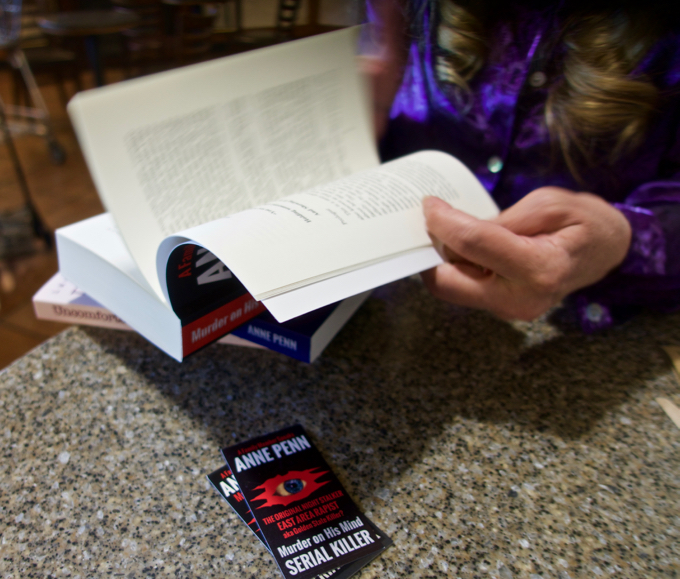
Laurie Ault thumbs through her book “Murder on His Mind” about the serial killer known as the Golden State Killer. Photo/Kathryn Reed

Ault only shared her family’s secret with the men she married and her sons. That is until now. Now she is ready for the world to know what it is like to live with such sadness, such uncertainty for decades.

Lyman Smith was her grandfather’s son, her mom’s step-brother. Family was family no matter the exact connection. Her grandparents were incredibly close to her – almost like second parents.

It was Ault’s grandparents who introduced her to South Lake Tahoe. They had a cabin here. She has been a full-time resident since 1985.

Some of the anxiety that had gripped her when she lived in the Sacramento area evaporated after moving to the lake. Still, though, an uneasiness prevailed, as did a sadness for those close to her.

Watching her grandfather suffer was emotionally overwhelming.

“I was a shy, naïve 23-year-old. You didn’t talk about it. You stocked it away as far away as you could,” Ault told Lake Tahoe News. “I never said a word in 35 years. I kept it to myself.”

With the silence came a form of post-traumatic stress. Feelings range from grief to depression to anger.

She tried to blend in, to not call attention to herself.

“I tried to make myself not be a target,” Ault said. “I was always on guard.”

Not knowing why her aunt and uncle were killed created an uneasiness. She was living in a perpetual state of anxiousness. Blinds were closed at dusk. Parking garages were avoided whenever possible. Her behavior went beyond the normal safety precautions. The killings weren’t something she could overcome.

“I had let fear interfere with some of my freedoms,” Ault said.

Ault was living blocks from where the suspect lived when he started his crime spree. She was 19 when he first struck. People were scared. They didn’t know who would be next. He terrorized the area for a good two years.

“My gut told me he was always there,” Ault said. “There were so many red flags on this guy. The whole time he attacked he was a cop. Back in the day they didn’t look at their own in the same way.”

In January 2017, Ault published a book about the case under a pen name. Cops warned her not to reveal her connection to the case. Her desire was to stir memories in others in hopes a new piece of evidence would lead to an arrest.

Getting her thoughts down on paper as well as facts helped Ault get a handle on her fear.

Then in November 2017 she released a different version. “Murder on His Mind” was published under the name Anne Penn. She admits in that book to being a family member of a victim.

Part of the reason to write it was to honor all the victims.

Ault wishes the suspect were younger so “he’d be punished longer.”

Today Ault continues her investigation as she writes another book about this man who she consistently refers to as a “creep.”


Opinion: Traveling without killing the planet

By Jill K. Robinson, San Francisco Chronicle

They come in the form of small cards, rocks or pieces of wood — the hotel reminders that guests can choose to skip having their towels and sheets washed every day, in a bid to save water and energy. Over the years, they’ve become expected as a base level for a hotel or lodge to show that it’s interested in being environmentally responsible.

Guests even notice when, after they have hung their towels to avoid daily washing, they’re still replaced with fresh ones.

How much effect do these hotel linen programs really have?

Read the whole story


Misinformation and biases infect social media

By Giovanni Luca Ciampaglia and Filippo Menczer, The Conversation

Social media are among the primary sources of news in the U.S. and across the world. Yet users are exposed to content of questionable accuracy, including conspiracy theories, clickbait, hyperpartisan content, pseudo science and even fabricated “fake news” reports.

It’s not surprising that there’s so much disinformation published: Spam and online fraud are lucrative for criminals, and government and political propaganda yield both partisan and financial benefits. But the fact that low-credibility content spreads so quickly and easily suggests that people and the algorithms behind social media platforms are vulnerable to manipulation.

Our research has identified three types of bias that make the social media ecosystem vulnerable to both intentional and accidental misinformation. That is why our Observatory on Social Media at Indiana University is building tools to help people become aware of these biases and protect themselves from outside influences designed to exploit them.

Bias in the brain

Cognitive biases originate in the way the brain processes the information that every person encounters every day. The brain can deal with only a finite amount of information, and too many incoming stimuli can cause information overload. That in itself has serious implications for the quality of information on social media. We have found that steep competition for users’ limited attention means that some ideas go viral despite their low quality – even when people prefer to share high-quality content.

To avoid getting overwhelmed, the brain uses a number of tricks. These methods are usually effective, but may also become biases when applied in the wrong contexts.

One cognitive shortcut happens when a person is deciding whether to share a story that appears on their social media feed. People are very affected by the emotional connotations of a headline, even though that’s not a good indicator of an article’s accuracy. Much more important is who wrote the piece.

To counter this bias, and help people pay more attention to the source of a claim before sharing it, we developed Fakey, a mobile news literacy game (free on Android and iOS) simulating a typical social media news feed, with a mix of news articles from mainstream and low-credibility sources. Players get more points for sharing news from reliable sources and flagging suspicious content for fact-checking. In the process, they learn to recognize signals of source credibility, such as hyperpartisan claims and emotionally charged headlines.

Bias in society

Another source of bias comes from society. When people connect directly with their peers, the social biases that guide their selection of friends come to influence the information they see.

In fact, in our research we have found that it is possible to determine the political leanings of a Twitter user by simply looking at the partisan preferences of their friends. Our analysis of the structure of these partisan communication networks found social networks are particularly efficient at disseminating information – accurate or not – when they are closely tied together and disconnected from other parts of society.

The tendency to evaluate information more favorably if it comes from within their own social circles creates “echo chambers” that are ripe for manipulation, either consciously or unintentionally. This helps explain why so many online conversations devolve into “us versus them” confrontations.

To study how the structure of online social networks makes users vulnerable to disinformation, we built Hoaxy, a system that tracks and visualizes the spread of content from low-credibility sources, and how it competes with fact-checking content. Our analysis of the data collected by Hoaxy during the 2016 U.S. presidential elections shows that Twitter accounts that shared misinformation were almost completely cut off from the corrections made by the fact-checkers.

When we drilled down on the misinformation-spreading accounts, we found a very dense core group of accounts retweeting each other almost exclusively – including several bots. The only times that fact-checking organizations were ever quoted or mentioned by the users in the misinformed group were when questioning their legitimacy or claiming the opposite of what they wrote.

Bias in the machine

The third group of biases arises directly from the algorithms used to determine what people see online. Both social media platforms and search engines employ them. These personalization technologies are designed to select only the most engaging and relevant content for each individual user. But in doing so, it may end up reinforcing the cognitive and social biases of users, thus making them even more vulnerable to manipulation.

For instance, the detailed advertising tools built into many social media platforms let disinformation campaigners exploit confirmation bias by tailoring messages to people who are already inclined to believe them.

Also, if a user often clicks on Facebook links from a particular news source, Facebook will tend to show that person more of that site’s content. This so-called “filter bubble” effect may isolate people from diverse perspectives, strengthening confirmation bias.

Our own research shows that social media platforms expose users to a less diverse set of sources than do non-social media sites like Wikipedia. Because this is at the level of a whole platform, not of a single user, we call this the homogeneity bias.

Another important ingredient of social media is information that is trending on the platform, according to what is getting the most clicks. We call this popularity bias, because we have found that an algorithm designed to promote popular content may negatively affect the overall quality of information on the platform. This also feeds into existing cognitive bias, reinforcing what appears to be popular irrespective of its quality.

All these algorithmic biases can be manipulated by social bots, computer programs that interact with humans through social media accounts. Most social bots, like Twitter’s Big Ben, are harmless. However, some conceal their real nature and are used for malicious intents, such as boosting disinformation or falsely creating the appearance of a grassroots movement, also called “astroturfing.” We found evidence of this type of manipulation in the run-up to the 2010 U.S. midterm election.

To study these manipulation strategies, we developed a tool to detect social bots called Botometer. Botometer uses machine learning to detect bot accounts, by inspecting thousands of different features of Twitter accounts, like the times of its posts, how often it tweets, and the accounts it follows and retweets. It is not perfect, but it has revealed that as many as 15 percent of Twitter accounts show signs of being bots.

Using Botometer in conjunction with Hoaxy, we analyzed the core of the misinformation network during the 2016 U.S. presidential campaign. We found many bots exploiting both the cognitive, confirmation and popularity biases of their victims and Twitter’s algorithmic biases.

These bots are able to construct filter bubbles around vulnerable users, feeding them false claims and misinformation. First, they can attract the attention of human users who support a particular candidate by tweeting that candidate’s hashtags or by mentioning and retweeting the person. Then the bots can amplify false claims smearing opponents by retweeting articles from low-credibility sources that match certain keywords. This activity also makes the algorithm highlight for other users false stories that are being shared widely.

Understanding complex vulnerabilities

Even as our research, and others’, shows how individuals, institutions and even entire societies can be manipulated on social media, there are many questions left to answer. It’s especially important to discover how these different biases interact with each other, potentially creating more complex vulnerabilities.

Tools like ours offer internet users more information about disinformation, and therefore some degree of protection from its harms. The solutions will not likely be only technological, though there will probably be some technical aspects to them. But they must take into account the cognitive and social aspects of the problem.

Giovanni Luca Ciampaglia is an assistant research scientist at Indiana University Network Science Institute, Indiana University; Filippo Menczer is a professor of computer science and informatics, director of the Center for Complex Networks and Systems Research, Indiana University.

Groups pursue increase to education funding in Nev.

By Meghin Delaney, Las Vegas Review-Journal

A campaign aiming to force the Nevada Legislature to put more money into the state’s schools is ramping up its efforts.

Fund Our Future Nevada, which launched in February, wants lawmakers to dedicate more money for Nevada schools by increasing the state’s per pupil spending. The coalition — which includes parents, teachers and community activists — is spearheaded by Educate Nevada Now, an education-focused nonprofit, and Hope for Nevada, a parent advocacy group.

Read the whole story


Letter: EDC Charter should not be changed

To the community,

On June 26, the Board of Supervisors forwarded for voter approval several proposed changes to the County Charter. One change would eliminate the voters’ right to elect the positions of recorder-clerk, treasurer-tax collector, surveyor, and auditor-Controller, and instead leave the decision to the board. These positions would not be vetted by the people, but would be selected by only a handful of people.

In 1994, the voters overwhelmingly approved the County Charter to ensure that they would have effective input in their local government. In essence, the County Charter is a local version of our nation’s Constitution. It is our responsibility as citizens to stay informed and vigilant, to ensure that our rights stay intact.

Fortunately, the County Charter can only be amended by the people of El Dorado County. If our county doesn’t have elected department heads with the knowledge and background necessary to fight for the rights of the people, then we may end up with a local government that is controlled by the select few.

Sincerely,

Todd White, Pollock Pines


Opinion: Don’t let distracted boating get you

By Scott Croft

Just like Americans’ hectic Thanksgiving Day holiday travel habits, July 4 is recreational boating’s biggest holiday of the year. The nonprofit BoatUS Foundation for Boating Safety and Clean Water predicts crowded launch ramp and marina facilities with significant recreational boat traffic congestion on lakes, rivers and coastal waters. Operator inattention, improper lookout, operator inexperience, machinery failure, and alcohol use rank as the top five primary contributing factors in accidents according to the U.S. Coast Guard, and each could come into play on boating’s biggest time of the year.

Here are five July 4 safety tips from the BoatUS Foundation:

1. Stop the distractions: Being distracted — even for an instant — can make a good day go bad. Before you head out on the water, learn how to use your GPS at the dock, rather than with your head down, trying to figure out how to toggle between screens while underway. Can you move your hand between the throttle and wheel without looking? Do you know the locations of the trim switch, running lights or bilge switch by feel? If not, spend some time memorizing the locations of your boat controls. When running, try to zone out of unnecessary conversations that are going on around you, with the exception of valuable input from a helpful lookout. Texting and boating is a dangerous activity, just as it is in a car.

2. Hold off on the alcohol until you’re safely ashore or tied up for the night: Added to the effects of sun, wind and waves, alcohol lowers situational awareness. Bring lots of water and other nonalcoholic beverages.

3. The best life jacket is the one you will wear: Spending the extra money on a comfortable life jacket means your chances of wearing it greatly increase. Check out the newer, small lightweight inflatable-style life jackets that are nothing like the uncomfortable life jackets of old. And it’s also always wise to have everyone aboard in life jackets when going to fireworks shows – accidents can happen very quickly, especially after the shows end and the mad dash for home begins. If you need a right-sized kids life jacket, you can borrow one for free from one of 550 locations by going online.

4. Some help just for paddlers: Paddlers should understand all of the nautical rules of the road, practice defensive paddling and assume no one can see you. At night, show a white light (glow sticks hung around the paddler’s neck do not qualify). Avoid crowded anchorages and congested ramp areas.

5. About that broken down boat: The nationwide TowBoatUS on-water towing fleet traditionally reports hundreds of requests from boaters needing assistance with battery jumps and anchor-line disentanglements over the July 4 holiday. To avoid having to contact BoatUS 24-hour dispatch (BoatUS.com/App) monitor your boat’s battery drain during the long day on the water, go slow while hauling your anchor line, watch for wakes, and be super vigilant so you don’t run over someone else’s anchor line after the fireworks show ends.

Scott Croft works for BoatU.S.