Snippets about Lake Tahoe

·      Harveys will host a World Series of Poker circuit event Oct. 26-Nov. 6. For more info, call 775.586.4949.

·      Rotary Club of Truckee’s 39th annual Cadillac Ball at the Resort at Squaw Creek will be Oct. 28 at 6pm. For more info and to buy tickets, go online.

·      South Tahoe High School will be putting on “Thoroughly Modern Millie” in January.

·      Jennifer Scharp is now senior human resources manager for Squaw-Alpine ski resorts.

·      The Nov. 2 Douglas County Board of Commissioners has been canceled because multiple members would be absent.


Tahoe Activist Artists’ exhibition to benefit wildfire survivors

“Remember, remember the 5th of November” is a slogan commonly heard on the streets of London at this time of year. It refers to the tradition of Bonfire Night, in celebration of the foiled gunpowder plot in 1605 by the revolutionary Guy Fawkes, who tried to blow up the Houses of Parliament. However, some call him “the last man to enter Parliament with honest intentions.”

The Tahoe Activist Artists had decided on this theme before the devastating fires started ravaging California.

Rising from the Fire is a continuation of the Tahoe Activist Artists’ mission to bring an empowering message to the community

The artists are building on the success of their first exhibition, We the People: Tahoe Artists Visualize a World of Conversation and Connection, which took place at Tahoe Mountain Lab in September. The artists raised more than $2,500 for local and national charities.

There will be an opening night reception on Nov. 5 from 5pm-midnight, with live music, fire dancers, food and beverages from MoonHouse Brewhouse. Admission is free with tickets from Eventbrite and child-friendly. It will be at High Vibe Society on Third Street in South Lake Tahoe.

The artists will be donating proceeds of their sales to help relief efforts for the Northern California wildfires, Live Violence Free, and Bread and Broth 4 Kids.


2 Truckee men accused of having sex with minors

Two Truckee men were arrested this month for allegedly having unlawful sexual relations with minors under the age of 16.

An ongoing investigation led to the arrests of Christopher Anthony Renai, 23, and Skyler William Ford, 21.

Placer County sheriff’s deputies with the assistance of the Truckee Police Department, arrested Ford at his home in Truckee on Oct. 16. Renai was arrested Oct. 5 near his work site in Truckee.

Renai’s bail was set at $100,000 and Ford’s at $305,000.

— Lake Tahoe News staff report


NOAA: La Niña an uncertain forecast for Tahoe

By Susan Wood

The National Oceanic and Atmospheric Administration on Thursday released the U.S. Winter Outlook, which calls for La Niña. For Lake Tahoe it’s a wild card with equal chances for above- and below-normal precipitation and temperatures.

The outlook encompasses December through February.

La Niña, a weather phenomenon originating off the western shores of South America, is more than halfway developed and could influence the West Coast in its predictable ways – if there is such a thing.

Typically, La Niña brings on a warmer and drier Southern California, while giving the northern end cooler temps and more precipitation. El Niño, which formed two years ago, results in the opposite. Lake Tahoe is on the cusp for both, which strengthen in varying degrees.
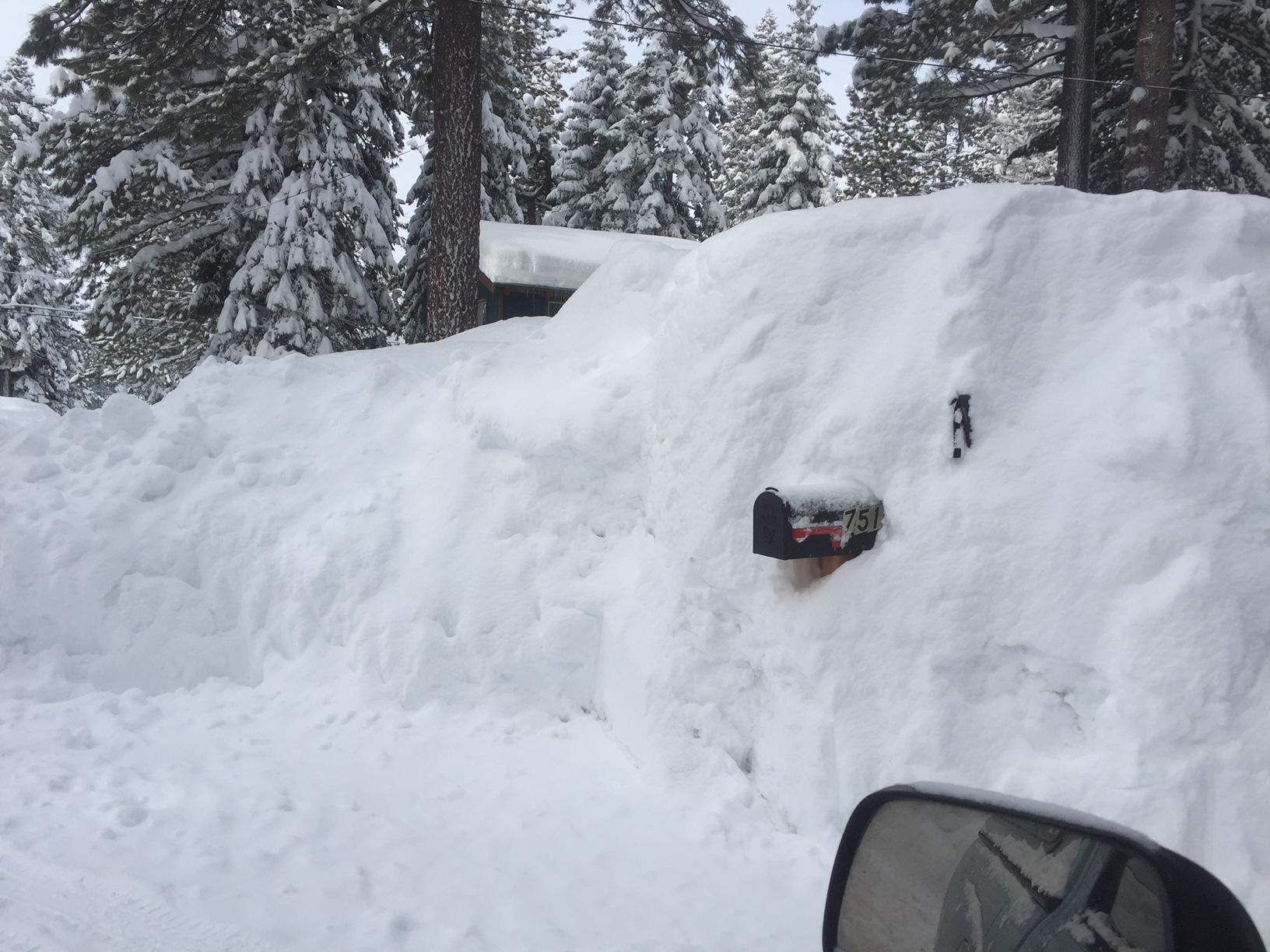
Buried mailboxes were the mild inconveniences of last winter. Photo/Susan Wood

“The reality is, the storm tracks don’t come out the same each time, and we don’t know in advance,” NOAA’s Climate Prediction Center Deputy Director Mike Halpert told Lake Tahoe News on a media conference call Oct. 19. “It’s a tricky one. I would plan for it all.”

Certainly, last winter’s deluge has shown a need for the Tahoe-Truckee-Reno area to be prepared.

Halpert said he doesn’t expect “such an extreme event, especially with La Niña (conditions)” because “that wouldn’t favor it.” But Northern California could see “any one of three outcomes” meaning above, below or equal chances.

NOAA will provide an update on Nov. 15.

The climatologist called last year “a rare event” that had “less than a 5 percent chance” of forming.

That rarity coming off four years of drought provided a huge crop of fuel for exploding wildfires this summer and fall that marked some of the hottest days recorded.

The winter of 2016-17 prompted many closures in government offices as well as private sector companies. Lakes formed in South Lake Tahoe where none had been seen before. Roads crumbled and shut down. Blizzards blinded commuters on the mountain passes. Sandbagging was all the rage. And while skiers rejoiced, commuters experienced nightmarish driving conditions.

“We were shaking our heads a little bit,” Halpert said in discussing the extremes.

Within its models, NOAA’s Climate Prediction Center studies factors that influence the precipitation and temperatures across the United States. But gusty winds that turn wildland fires into raging infernos and snowstorms into blizzards are “something to look at,” Halpert told LTN. NOAA is in the process of developing a “hazards product” that can more closely evaluate and account for risk of the
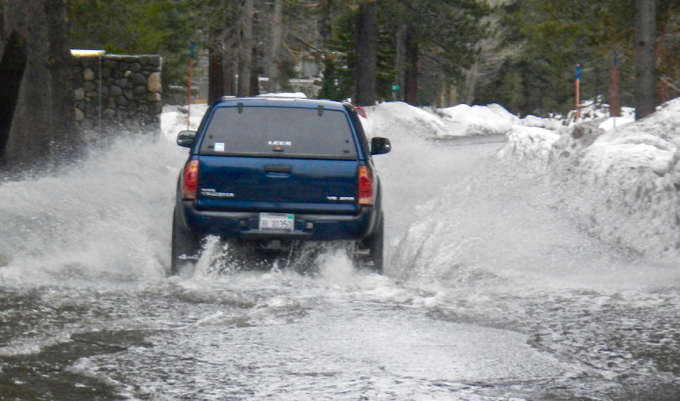
Flooding in the Tahoe Keys and state street areas of South Lake Tahoe was normal last winter. Photo/LTN file

nation’s communities.  

The “2018 Farmers Almanac” calls for “above normal snowfall” in the California mountains and characterized the zone where Lake Tahoe falls as “cold and wet.”

Last winter’s severe storms produced quite a quandary, as water managers celebrated an end of the long-term drought in California. But there is such a thing as too much, too fast.

Reno had its wettest water year on record. Tahoe’s seasonal snowfall last winter measured 248.5 inches between November to April, dwarfing the average of 184.9, according to the National Weather Service. And some ski resorts topped 400 inches. But that wasn’t the whole story. It was particularly wet.

“The difference is the precipitation. This was the biggest winter we’ve had since 2010-2011. Then we had the drought,” Weather Service meteorologist Scott McGuire said from his Reno office. “Atmospheric rivers” became a part of our vernacular.

From Reno to Carson City to Gardnerville to Lake Tahoe, much of that water flowed everywhere and flooded areas not accustomed to seeing water. In the North State, the Oroville Dam was breached.

And so begins our water season, according to the California Department of Water Resources. DWR ranks the 2017 water year as second only to 1983 as the state’s wettest. That was an El Niño year that flooded large swaths of Southern California and caused bluffs to collapse.

Last year, 52 counties declared states of emergency due to January’s sequence of storms. There are 58 counties in California.
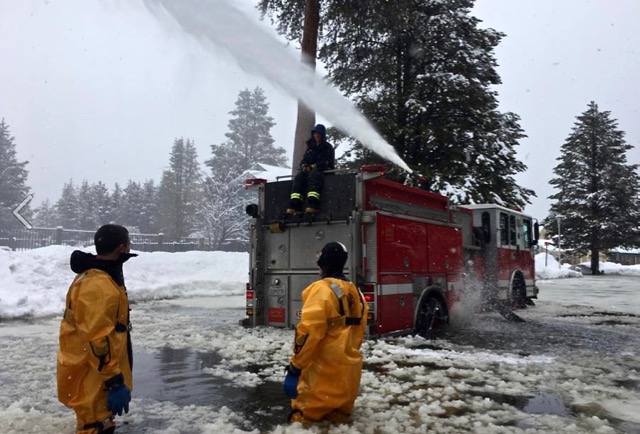
South Lake Tahoe fire crews in February get rid of ice and water on city streets. Photo/SLTFD

The phenomenal wet winter has resulted in residual effects. Mice have taken up residence in homes at abnormal rates because their ground holes were filled in.

The impact of last winter could linger into this year. Standing water dots the landscape of South Lake Tahoe.

Where does that water go? The thought of this may keep engineers and storm water gurus up at night.

“If we end up having an above average winter or even an average winter this year, it could be challenging,” South Lake Tahoe storm water program coordinator Jason Burke told Lake Tahoe News.

It’s a perfect storm of reasons.

The lake level is up, the groundwater is high and an already moist soil can’t absorb as much.

Crews are out now using the hydro vac truck to clean the pipes in anticipation. Like last winter, the city will avail sandbags at its yards and stations.

“People should be prepared for a hard winter,” Burke said.

In particular, Burke said homeowners in low-lying areas such as Tahoe Island, Tahoe Keys, Glenwood, Al Tahoe, the state streets, and Bijou Meadow should be on the lookout. The city just completed Phase 3 of its $3.4 million storm water project at Sierra Tract.

The problems lie in drainage systems, which have public works staffers hopping. The city was laid out with minimal thought to storm water placement and channeling. Now retrofitting that backward infrastructure is an expensive endeavor. For example, Sierra Tract’s entire project cost about $15 million just for that neighborhood.




Liberty improves online info for customers

Liberty Utilities has made two new improvements to its website to benefit customers.

The company said the real-time outage map has been improved to show greater details so customers have more information about unplanned and planned outages. The map will show if a crew has been dispatched or if they are assessing/working on the problem. Customers can also zoom in to see the outage area, including nearby streets. Specific addresses affected by an outage are not shown for security reasons.

Estimated restoration times will be shown. The website is also accessible via portable devices.

Information about Liberty Utilities’ efforts to reduce its carbon footprint is also online.


SLT Chateau site to finally be filled in

By Kathryn Reed

While driving by on Highway 50 it’s hard to know the hole still exists, going down one of the side streets in the state line area reveals concrete and rebar are very much a part of the landscape.

The owners of this much maligned piece of real estate in South Lake Tahoe hope to start filling in the back portion next summer.

“It will be consistent with the prior approvals, with changes to where the convention center was to go,” Gary Midkiff with Midkiff and Associates told the City Council on Oct. 17. “We anticipate we will come to staff soon for design changes.”

The goal is for construction to start in 2018.

Long called the Chateau project, the more than 11-acre site was at one-time going to be the largest redevelopment project in the city’s history; a decade ago the price tag was more than $400 million.

Bankruptcy and the dissolution of the state’s redevelopment agency have the future less definitive now.

On Tuesday, though, the council approved the final subdivision map. According to the staff report, this affects the “14 original pre-redevelopment lots, portions of the abandoned pubic rights-of-way, and parcels located within the Chateau at the Village footprint.”

Midkiff said the owner is in preliminary discussions with city staff as to what the future holds. Lodging – 387 units – will still be a substantive component. Whether it’s full ownership, operated like a hotel, condos or something else remains to be seen.

Tahoe Chateau Land Holding LLC, a Chinese-American investment group, earlier this year bought the property from Tahoe Stateline Venture LLC, a subsidiary of Owens Realty Mortgage Inc., for $45.5 million.

A press release in May said, “The original convention center plan will be eliminated and replaced with smaller meeting rooms targeting incentive and group events.”

The goal is that the new development will complement the existing condos – called Zalanta – and retail that fronts the highway. Zalanta opened earlier this year. It is full ownership condos, with the assumption most will be put into a rental pool for tourists.

“As the property manager of Zalanta, Vail Resorts will operate a 24/7 front desk and ski valet for the property in addition to managing both the homeowners’ association and vacation rental program on behalf of owners,” Kevin Cooper with Heavenly Mountain Resort told Lake Tahoe News. “Vail Resorts is well-versed in property management and homeowners’ association operations in seasonal mountain resort destinations throughout Lake Tahoe at Heavenly, Northstar and Kirkwood as well as its resorts in Vail, Beaver Creek, Breckenridge and Keystone in Colorado and Park City in Utah.”

A second phase of Zalanta is in the works as well, which will be more lodging.

The entire site will include open spaces, being walkable, and more retail.


Chief: Wine Country fire could happen in Tahoe

By Kathryn Reed

The 2007 Angora Fire was devastating. Compared to the Wine Country fires, though, it was nothing.

For starters, there was no loss of life in the Tahoe blaze. The toll today stands at 43 for this October’s blazes, but that number could increase.

Jeff Meston

Angora was out in a matter of days. Wine Country is still burning.

And while 254 houses were destroyed, no commercial structures were lost. In the Wine Country, more than 5,700 structures have been reduced to ash.

“The real question is could it happen here in South Lake Tahoe. Yes,” South Lake Tahoe Fire Chief Jeff Meston said.

He spoke briefly at the Oct. 17 City Council meeting.

With winds reaching 70 mph that first night, there was only so much firefighters could do. Meston called this an “unprecedented” time, noting how firefighters from Australia were flown in to help.

Meston’s duties aren’t just relegated to the basin. He is the president-elect of the California Fire Chief’s Association. He is a board member on statewide mutual aide.

If a statewide commission is formed to study this fire, Meston would be on it.

On Tuesday he stressed that the best thing local residents can do is to make sure they have their defensible space.


Red flag fire warning for Tahoe-Truckee

Don’t let cool temperatures fool you, the Tahoe-Truckee area is in a high fire danger on Thursday with the winds that are preceding the storm front.

A fire that starts today could quickly get out of control, warn fire officials. They are saying to avoid activities that could spark a fire. This includes open burning, campfires, chain saws, and weed eating.

Prepare for an evacuation. Think about what you will take with you, have it ready, set a meeting location for your family. Park cars facing out, have garden hoses spread out and ready to knock down embers.


Styrofoam ban possible in South Lake Tahoe

By Kathryn Reed

South Lake Tahoe is contemplating regulating the type of to-go containers restaurants use, whether retail outlets can sell Styrofoam and plastic utensils, the packaging of meat in grocery stores, and what egg cartons are made of.

The elected officials on Tuesday gave staff direction to come back with verbiage for a ban on polystyrene. Having the Sustainability Commission do the research was suggested as a way to free up staff time.

The idea to essentially rid the city of Styrofoam was brought to the council by members of the public. The electeds on Oct. 17 supported  investigating the idea further, but no formal vote was taken.

“I’m not opposed to a ban on take-out because there are a lot of alternatives for them to use,” Councilman Tom Davis said.

What he is worried about is if something like Cup-of-Noodles would be banned. He sits on the board of Christmas Cheer and that food item is a staple for those clients.

Many restaurants in South Lake Tahoe already use environmentally friendly to-go containers. Photo/LTN

Putting in this type of ban was broached when the city was talking about the plastic bag ban in 2013. It never gained traction.

It was pointed out this week that the material is not biodegradable and has no value when it comes to recycling and weighs so little.

The council was curious to know what impact the product has on South Tahoe Refuse.

Jeff Tillman, president of South Tahoe Refuse, would not talk to Lake Tahoe News about the issue.

Councilwoman Wendy David, who sits on the Waste Management Authority JPA, said she would like that board to discuss polystyrene so perhaps El Dorado and Douglas counties might be part of the ban.

There are many restaurants in the area that already use a disposable product for leftovers.

Marilee Movius with the League to Save Lake Tahoe spoke in favor of a ban, citing statistics about how bad the product is for the environment and animals.

About 100 cities in California have some sort of ban on the product.


Opinion: Calif. needs to import German transparency

By Joe Mathews

California could use a concert hall like Hamburg’s Elbphilharmonie. The signature structure of 21st century Germany features performance space for the philharmonic, a dramatically curved escalator, and a dozen different public spaces for people to gather and enjoy city views.

But what California needs more than this stunning new piece of architecture is the scandal that built it. Originally planned in 2007 as a 186 million Euro project, with 77 million Euros from taxpayers, the Elbphilharmonie was so dogged by delays and overspending that its price tag approached 1 billion Euros, with taxpayers paying 789 million.

Joe Mathews

The good news: the resulting scandal produced one of the world’s most advanced government transparency laws. And that law, unlike the hall itself, could be transported to California, where transparency laws typically produce frustration.

In our state, open records laws often require citizens to bear the burden and expense of requesting documents, fighting for access, and paying for copies. And open meetings laws restrict our government representatives – we dictate when they can meet and talk to each other. These restrictions on citizens and their representatives often produce conflict between the two.

Hamburg’s transparency law works differently because it empowers both citizens and government officials. The law sets a default of openness by requiring government officials to make their work – contracts, memos, deliberations — viewable on the internet, almost as soon as they produce it. Knowledge is thus open to all, inside and outside government.

I recently visited Hamburg as the guest of journalist Angelika Gardiner and farmer Manfred Brandt, who let me sleep in his barn. Twenty years ago, Gardiner, Brandt and other citizens began using direct democracy to bring transparency to Hamburg government. In 2011, spurred by the troubled Elbphilharmonie construction, citizens’ groups organized a ballot initiative campaign to create an information register online where the government would publish its documents and where citizens could search them, anonymously and free of charge.

The initiative attracted support so quickly that the Hamburg parliament adopted their proposal before a public vote could be held. Today, Hamburg’s online portal offers contracts, reports, plans, grant awards, proposed resolutions, spatial data, permits, even payments and benefits for senior officials.

The law guarantees “immediate” access, which usually means documents are published within a week of their creation. The transparency has not been total. Smaller contracts (those less than 100,000 Euros) are sometimes excluded, and an expansive exemption for personal privacy requires redaction of some information that might seem relevant for holding local officials accountable.

But an evaluation of the law, required after five years, just concluded that both law and portal are working as intended. Among the most intriguing findings: Hamburg’s government officials, who once worried about the logistics of transparency, are now some of its biggest fans, using it to monitor what other Hamburg departments are doing. In this way, the transparency law has been most effective as a force for efficiency within government, breaking down bureaucratic silos. The links hand now knows what the recht hand is doing.

That’s the lesson of Hamburg: with people so consumed with their own work and lives, the best check on government abuses and corruption are city officials themselves.

On a visit to the Rathaus, I asked Andreas Dressel, who leads the governing Social Democrats in the Hamburg parliament, how the transparency law might be adapted for a California city.

“The best thing to do is to translate it into English – and put it right directly into your law,” he said adding, “You need it not just in California, but for the entire United States.”

Certainly, a law that makes disclosure an automatic online default should be more effective and produce less fighting that our current records and meetings laws, which create conflict between public demands for access and government desire for secrecy.

Such transparency would jumpstart the nascent open data movement, which has seen some California governments put up data sets so that tech-savvy citizens can help solve government problems. And it’s not hard to see how Hamburg-style transparency might make government responses to crises faster and more effective.

In San Diego, officials in different city and county departments failed to communicate effectively for months earlier this year as a deadly hepatitis epidemic spread, according to the nonprofit Voice of San Diego. If officials could have seen their separate work and information online, it’s quite possible that a fuller response – which included a declaration of emergency – might have come earlier and saved lives. So far 17 people have died.

Of course, such transparency would be opposed by government contractors, public employee unions, and the local governments over which they exert too much control. But it is for situations like this that we have direct democracy in California. And in Hamburg.

Joe Mathews writes the Connecting California column for Zócalo Public Square.