Nevada pot sales reach $32.4M in August

By Jenny Kane, Reno Gazette-Journal

Nevada’s marijuana sales are getting higher in its second month of sales. 

Nevada dispensaries raked in $32.4 million in recreational and medical marijuana sales altogether in August, the state Department of Taxation reported late Monday. 

The department, which oversees the state’s marijuana programs, made $4.86 million from the sales statewide.

Read the whole story


Money Matters: Financial mistakes to avoid

By Rick Gross

Even people who are financially secure can fall into money traps that put their future at risk, or miss out on opportunities to further strengthen their financial position. Here are several common mistakes made by financially accomplished people — along with a few tips to counteract them.

Overspending. You’ve worked hard to get where you are. Don’t abandon the budgeting strategies that helped you come this far. Give your discretionary fund a boost if you must, but continue to keep an eye on what you spend each month. You can easily fall behind in your financial goals by consistently overspending in small amounts, which add up to large sums over time.

Rick Gross

Not having an emergency fund. If you earn a healthy sum each month and have money set aside in investments, you may not think you need other savings. However, having a workplace plan like a 401(k) or 403(b) plan or an IRA is not an emergency fund. Withdrawing funds earmarked for retirement prematurely can incur costly tax penalties, and make you lose out on potential future earnings. Instead, store away three- to-six months’ worth of income in liquid savings to provide a cushion in the event of job loss, natural disaster, illness or another unexpected event.

Prioritizing saving for college over retirement. As the cost of a four-year degree in the U.S. continues to rise, it may be tempting to put your child’s tuition ahead of your own future. Yet, boosting your retirement savings should take priority. Your child has an array of options to finance college tuition, including job earnings, merit-based scholarships, and various loan options. When you retire, you simply won’t have access to these external sources of funding if your retirement savings come up short. If you are on track with your retirement savings and want to set aside funds for your budding student, be strategic and diligent about creating a plan to achieve both goals.

Being underinsured. Take a critical look at what you own. How easily could you replace those items if an unexpected event occurs? Standard policies may not cover as much as you think, especially if you’ve recently upgraded your home or added to your art collection. Check in with your insurance agent and upgrade your coverage as needed. If you live in an area prone to severe weather, you may be able to add a rider for flood or storm damage. Bump up your life insurance if it makes sense and review your potential need for disability income and long-term care coverage.

Failing to diversify. You heard it a million times growing up — don’t put all your eggs in one basket. If your money is tied up in your home, or if your investments are over- or under-weighted in one sector of the market, you may be on risky ground. Work with your financial advisor to evaluate your level of diversification within the context of your goals. Annual or more frequent reviews are recommended to help ensure a productive portfolio that’s within your tolerance for risk.

Rick Gross is a financial advisor and private wealth advisor with Ameriprise Financial Services Inc. in South Lake Tahoe.


Squaw-Alpine gondola possible in 2 years

By Ed Fletcher, Sacramento Bee

The operator of Squaw Valley and Alpine Meadows on Wednesday will formally announce plans to link the two North Lake Tahoe area ski resorts with a base-to-base gondola starting with the 2019-20 season, a proposal that faces significant opposition from environmental advocates.

The newly named California Express gondola would allow skiers and snowboarders to take advantage of different terrain and amenities on both mountains without having to drive or take a bus between them. But the project must first survive an environmental review by Placer County and the U.S. Forest Service.

The gondola would shave 10 minutes or more for skiers, creating a 13-16-minute ride from the base of one resort to the other, according to the plan. About 37 lift towers would transport passengers the length of the roughly 13,000-foot line.

Read the whole story


K’s Kitchen: Fall delight in one bowl

By Kathryn Reed

Fall – that’s what this tastes like.

It is so hearty that this dish is a meal unto itself. I was full and wanted more. The next day the flavor profile was even better.

On top of that, it’s pretty. Don’t hesitate to serve this to guests.

While it will seem like there are a lot of ingredients, most of it is spices. And many of these the average cook will have on hand. A trick I do now with tomato paste is to freeze what I don’t use. A tube is another solution, but even then I wasn’t using it fast enough.

The only thing that takes any real time is peeling and cutting the squash, but you’ll be glad you did.

Butternut Squash and Chickpea Stew

1½ T olive oil

1 medium red onion, chopped

6 garlic cloves, minced

½ tsp kosher salt

½ tsp paprika

½ tsp cumin

¼ tsp ginger

¼ tsp cinnamon

¼ tsp black pepper

1  T tomato paste

3  C butternut squash, peeled and diced

1 15-ounce can chickpeas, drained

1 15-ounce can diced tomatoes

1½ C vegetable stock

2 C cooked quinoa

2 C spinach

¼ C Greek yogurt, plain or vanilla

Cook quinoa according to directions.

In large pan, heat oil over medium-high, then add onion and garlic. Cook for about 5 minutes. Add the spices. Stir. Add tomato paste, cook another minute. Stir in squash and chickpeas. Add tomatoes and stock. Simmer for about 20 minutes, or until squash is tender.

Divide quinoa into four bowls. Top with squash concoction, then spinach. Place dollop of yogurt on top. Sprinkle with fresh pepper.


Ice shelf collapse topic of lecture

Catastrophic scenes of ice shelves collapsing are powerful evidence of climate change. These ice shelves create epishelf lakes, a rare lake system where freshwater overlies seawater.

Assistant Professor Alex Forrest will present on his team’s usage of autonomous robotics to explore an epishelf lake in the remote Canadian Arctic and discuss how these “last of their kind” water bodies and ice shelves are rapidly melting. Understanding melting events in these locations is critical in predicting how the environment will react as our climates continue to change.

The talk is Nov. 9 at the Tahoe Environmental Research Center in Incline Village.

Registration for this event is required. The program will begin at 6pm with refreshments and no-host bar from 5:30-6pm. Seating is open at 5:30pm to guests who have preregistered, open seating starts at 5:50pm. A $5 suggested donation will be collected at the door.


SLT limits VHRs; issue may go to voters

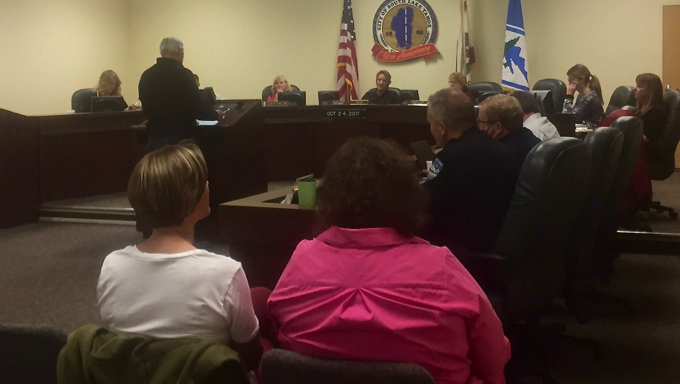
A few dozen people listen to the VHR discussion Oct. 24 at Lake Tahoe Airport. Photo/Susan Wood

By Susan Wood

After intense deliberation and public pleading on both sides, the South Lake Tahoe City Council on Tuesday night temporarily closed the door on new vacation home rentals.

The 4-0 vote, with Councilman Tom Davis having to recuse himself, came on the same day an intent to petition for a ballot measure against VHRs made its way to the city clerk’s office.

The council wants to return on Nov. 7 for a first reading on a new ordinance the members can all agree on and the public can stomach. A second reading that would enact the law would take place the following month.

The new ordinance would go over points in need of addressing from bear boxes and allowable caps to limits on distance between them and three-strike warnings to violators.

Vacation home rentals have become a hot topic since 2002, with councils talking about and tweaking regulations in order to keep the peace and keep an industry rolling in a tourism-based economy. The City Council alone has hosted 42 public meetings on the issue.

Vacation home rentals are divisive and contentious.

To prove that point, two citizens – Ken Weitzman and Daniel Browne – delivered their intent to circulate a petition outlawing VHRs in residential neighborhoods. The document encourages “the expansion of vacation rentals in our tourist and commercial zoned areas.” The bold petition could make its way to the November 2018 ballot Mayor Austin Sass announced during council and staff reports at the end of the meeting. Most of the 35 people in attendance had already cleared out.

Naysayers to the practice of renting homes for income claim it changes the profile of their neighborhoods and creates a nuisance. Those in favor of them insist there are but a few bad seeds, and the level of enforcement needs to rise.

To that, city Police Chief Brian Uhler retorted his department conducts a good job in “difficult circumstances.” When Uhler arrived in 2010, he “hardly ever heard of vacation home rentals being an issue,” he told the council. But that changed in the last few years as it’s “demonstrated a serious issue.”

Granted, complaints called in because of unruly behavior from properties do not necessarily end up as citations on vacation home rentals, City Manager Nancy Kerry pointed out.

VHR advocates dominated the public comment period Oct. 24 by quadrupling those who support the moratorium. Property managers, private homeowners and even a ski resort employee seeking housing for her international workers lined up to speak in favor of VHRs, hoping the council members would change their minds about stopping the permitting process for now.

Currently, there are 3,398 VHR listings representing 2,067 rental properties in South Lake Tahoe, according to a consultant that made a presentation to the council last month. Like statistics on complaints and citations, these numbers show growth but fluidity. Meanwhile, the city shows 1,847 have secured permits, with 1,397 being outside the tourist core areas. The tourist area not affected by the VHR ordinance changes.

The urgency ordinance freezes the number of VHRs for 45 days. It can be changed between now and then or extended at that time for a year.

Time and time again, Councilwoman Brooke Laine returned to the fairness issue while attempting to find a way to exempt those with scheduled hearings from the moratorium. But City Attorney Nira Doherty noted that type of change constitutes a “substantive” change that would require a rewrite of the rules.

Marlena Freitus appealed to the council’s sense of fairness. She had a hearing slated for next week on her vacation home rental she uses for necessary income. It will go on hold until the moratorium is repealed.

“I’ve already invested $1,200, and it’s been three months,” she told the council.

Sierra-at-Tahoe ski instructor Victoria Lynn turned her plea to others.

“The housing market is already tough enough for permanent residents,” she said. Sierra needs to find homes for its ski season workforce.

Many who spoke in opposition to the moratorium wondered “why the urgency?” The discussion turned philosophical in trying to define and constitute the “public health, safety and well-being” of a community.

The issue was even debated in the non-agenda item portion of public commentary. It included an adversarial longtime property manager Jim Morris claiming not “everyone is breaking the law” and Weitzman suggesting the police department use a volunteer enforcement division like El Dorado County’s STAR force.

By the end of the evening, Councilwoman Wendy David admitted to feeling sad over “the loss of community” in testimony she’s heard from residents complaining about their “quality of life.”

“We want to be fair. But maybe we should take a break. It’s a good reason to pause till we figure this out,” David said.




Opinion: Taking action against sanctuary state

To the community,

The State of Jefferson joins the California Sheriff’s Association and National Sheriff’s Association, in their call for Congress to “take action and pass sensible legislation that doesn’t hamstring law enforcement.”

The citizens of the 21 counties that encompass the State of Jefferson have long supported their county sheriff’s who have declared they will comply with federal immigration law, should the Governor sign SB54. The Jefferson leadership has been outspoken about Brown and his administration, putting the needs of illegal aliens (criminals) before that of the health and safety of American citizens.

They stated that SB54 not only bars sheriff’s and police from asking people about their immigration status or participation in most federal immigration enforcement activities, but also would largely prohibit school and security officers, from using money or staff to investigate, question, hold or arrest people for immigration violations.

State of Jefferson also supports efforts by Republican Congressman Tom McClintock  and others who are looking at ways to intervene, to include; that cities and counties who are within a sanctuary state would be able to file and be awarded federal grant monies. The counties of Tehama, Siskiyou and cities of Anderson and Lincoln, have already adopted resolutions, declaring they will comply with federal immigration laws.

Efforts continue by residents in many of the northern rural counties, requesting that their county supervisors also take a stand, adopting similar resolutions, and also officially support their county sheriffs who have taken a vow to uphold the laws of our U.S. Constitution.

Those of Jefferson are not alone in their opposition of sanctuary counties and cities. In a recent poll by the University of California, Berkeley, 74 percent of Californian’s opposed sanctuary jurisdiction.

The passage of SB54, is  just another example of Brown and his cohorts ignoring the voice of the people, just as with the passage of the recent gas tax increase, along with the lack of representation that exists for rural residents  in the California Legislature. It is time that Brown and his administration, start respecting California citizens and our law enforcement officers, who everyday risk their lives, diligently doing their jobs to protect their communities.

Terry Gherardi, State of Jefferson


Landmark Calif. plan puts floodplains back in business

By Matt Weiser, Water Deeply
 
Something monumental happened on Aug. 25 in California water management that received almost no media attention: It became official policy to reconnect the state’s major rivers with their floodplains.

The action by the Central Valley Flood Protection Board, an obscure panel appointed by the governor, clears the way for the state to embrace projects that allow floods to recharge groundwater. This could include projects like breaching levees, building setback levees and creating flood bypass structures so rivers can inundate historic floodplains for the first time in a century.

In short, it means rivers must no longer be confined within levees as a standard practice.

Read the whole story


Nev. went 60 years without official flag

By Guy Rocha, Reno Gazette-Journal
 
For more than 60 years beginning in 1929, Nevada’s state flag had a design that the Legislature did not adopt.

Legislative sessions sometimes exceeded the then-constitutional provision for 60 days in which the legislators would be paid. A hurried amendment to the bill changing the position of the name “Nevada” on the proposed flag was misplaced in the final hours of the session.

Apparently nobody knew of the snafu until researcher Dana Bennett of the Legislative Council Bureau, State Archivist Guy Rocha and staff at the State Library and Archives made the discovery in advance of a bill modifying the design of the flag in 1991. SB396 sponsored by Washoe County Sen. Bill Raggio for the Director of General Services Terry Sullivan and signed by Gov. Bob Miller, finally provided for an official state flag.

Read the whole story


Wild horses and the inmates who ‘gentle’ them

By Steven Kurutz, New York Times

There’s a term in the horse world known as “gentling.” It refers to working with a wild horse until it becomes responsive to a trainer’s commands, meaning that it no longer wants to kick you in the face. If handled properly, it even bonds with its trainer.

Gentling happens every day at the Silver State Industries ranch in Carson City, a 1,100-acre property east of the Carson Range in the vast, harsh high desert south of Reno. Up to 2,000 wild horses are corralled there at any time; a good number are trained for adoption.

The ranch is part of the Northern Nevada Correctional Center, a medium-security prison that also houses minimum-security inmates. Twelve to 15 inmates, most of whom have little or no experience with horses, work under the instruction of a cowboy named Hank Curry. It is the inmates who do the gentling.

Read the whole story