Toxic runoff continues to pollute EDC waters
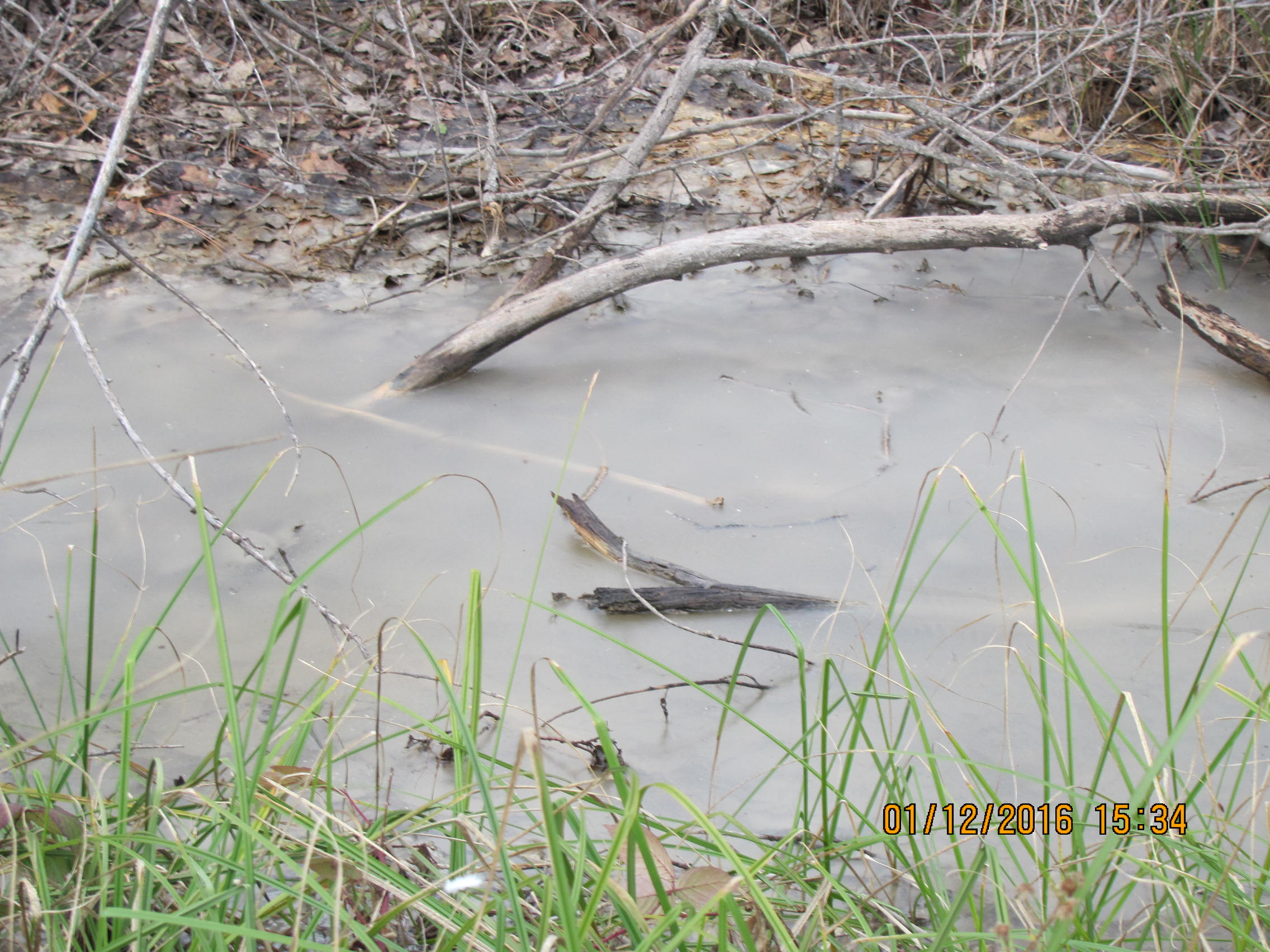
Rainyseasons bring murky water flowing into public right-of-ways. Photo/George Turnboo
By Joann Eisenbrandt
There is still no permanent solution to the high pH storm water runoff from the site of the former Diamond Lime Plant just west of Placerville. For the third winter in a row, concerns have been raised on the county’s West Slope about the potential public health threat this poses.
The Diamond Lime Plant was a lime processing plant that operated from the 1920s until the late 1970s. When it closed, remnants of its lime processing operations remained on the site—the residue of crushed lime rocks and limestone settling ponds.
The plant was situated above the El Dorado Trail, a popular local hiking and biking trail. The wet El Nino winter of 2015-16 awakened concerns about the toxicity of the highly alkaline runoff from the site running beneath and alongside the trail.
Greg Stanton, director of El Dorado County’s Environmental Management Department, told Lake Tahoe News back in June 2017, “El Dorado County has taken proactive measures to ensure the (El Dorado) trail is safe. Storm water staff has monitored the discharge points. The results have been as anticipated. We will continue to monitor it in the next wet weather season.”
The storm water runoff enters seasonal streams and tributaries along the El Dorado Trail. These drain into Weber Creek and eventually into the American River. A pH of 12.5 is defined as hazardous under federal guidelines. The water quality standard is a pH of 8.5. Soil samples and storm water runoff from the former lime plant have tested at and above these levels with readings of pH 14 recorded in two monitoring wells. The pH scale runs from 0 to 14. A reading of 7, the pH of water, is neutral. Above 7 is alkaline and below 7 is acidic.
Where the Diamond Lime Plant once stood are vacant parcels owned by Michael Lindeman and Lawrence Abel and the Material Recovery Facility operated by Waste Connections. Other properties adjacent to the site and along Highway 49 have commercial or industrial uses; some were developed using fill soil from the former lime plant property. The Diamond Springs Parkway Project, an extensive county Department of Transportation roads project designed for that area has been years in the planning. Both the Lindeman and Abel properties are in its construction footprint.
When asked by Lake Tahoe News this month if the pH 14 readings required immediate action, the county said, “Based on data collected so far, the high pH groundwater is localized and does not appear to be migrating vertically or laterally. If there is a need for immediate remediation, the Water Board, as the lead agency, would make the determination.”
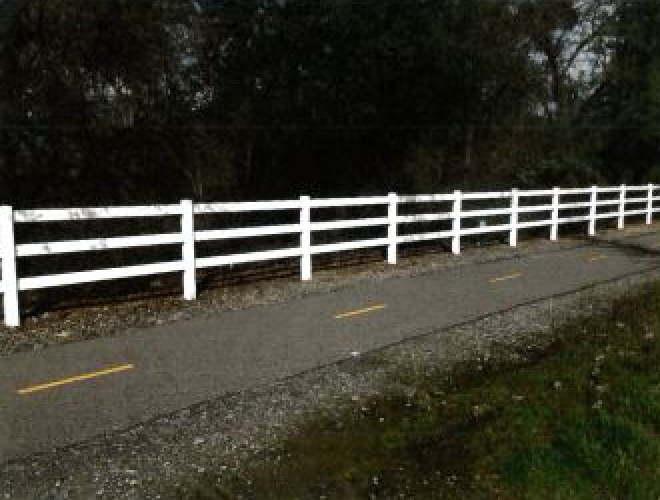
This is the fence officials believe will keep people away from the toxic water. Photo/State Water Board
Who’s in charge?
Local, state and federal agencies all have some jurisdiction. This includes El Dorado County’s Department of Transportation and its Planning and Building, and Environmental Management departments. The California Department of Fish and Wildlife, the Army Corps of Engineers and the California Regional Water Quality Control Board have water-quality based regulatory authority. Water quality is controlled at the federal level by the Environmental Protection Agency (EPA) under the Clean Water Act. The Central California Regional Water Quality Control Board oversees water quality issues in California for the EPA.
In June, county staff presented the Board of Supervisors a memo updating them on enforcement and remediation efforts at the site. “The Water Board,” it emphasized, “is the lead agency regarding the investigation of elevated pH soil and impact to surface and groundwater in the affected area.”
Some have criticized the county for always putting ultimate responsibility on the Water Board while failing to do all they could to assist in these efforts at the local level.
Lake Tahoe News asked the Water Board for clarification of the regulatory “pecking order.” Marie McCrink, senior engineering geologist, said, “The CVWB is the lead agency for characterization and remediation of soil, surface water, and groundwater quality issues associated with the former Diamond Springs Lime Kiln Site. El Dorado County, Environmental Management Division, (EDC EMD), is lead agency for public health matters. Both the CVWB and EDC EMD work together on matters regarding the site and surrounding area. We keep each other informed of our planned activities and comments and responses to documents submitted for review.”
A push for action
Local residents and grass-roots organizations are frustrated that after years of investigation and testing, no significant remediation has taken place.
Walter Floyd, engineering geologist, and Stewart Black, Water Board site cleanup program manager, told Lake Tahoe News, “A significant amount of time was taken to allow local enforcement actions to run their course. Since that time, Water Board staff believe that the project is proceeding at a pace that is consistent with an environmental investigation and remediation project of this type.”
In August, El Dorado Progressives (EDP), a 501(c)4 West Slope political action nonprofit, along with Save Our County and Access El Dorado, sent a letter to the Water Board urging them to take some immediate actions.
“The (storm water) discharge is located next to a public paved bike trail where children, pets and adults ride, walk and run. Presently, there is an inadequate so-called barrier that would not prevent wildlife, pets, children and adults from entering the spring area and associated pond. We are deeply concerned that someone could be seriously burned. We have been frustrated from the inaction from other governmental agencies, specifically El Dorado County Environmental Management.”
The county installed 120 feet of fencing and warning signs in early 2016 along the portion of the El Dorado Trail where the highest pH readings were taken and posted advisories on the county website.
The attachment to EDP’s letter, prepared by Victor Izzo, a registered geologist who worked for the Water Board for 27 years, insisted, “… this discharge is a threat to public health and the environment … the remedial investigation and future remedial action may take years and therefore isolation to the discharge area, containment or treatment of the discharge and a deed restriction to prevent disturbance of the partially capped lime waste on the south side of the El Dorado Trail is required. No construction on the Diamond Springs Lime Company Plant facility area should be allowed until remediation is completed.”
As part of its solid waste removal contract with the county, Waste Connections agreed to construct a new MRF on its existing site by October 2019. Investigations into lime waste contamination have pushed back this schedule.
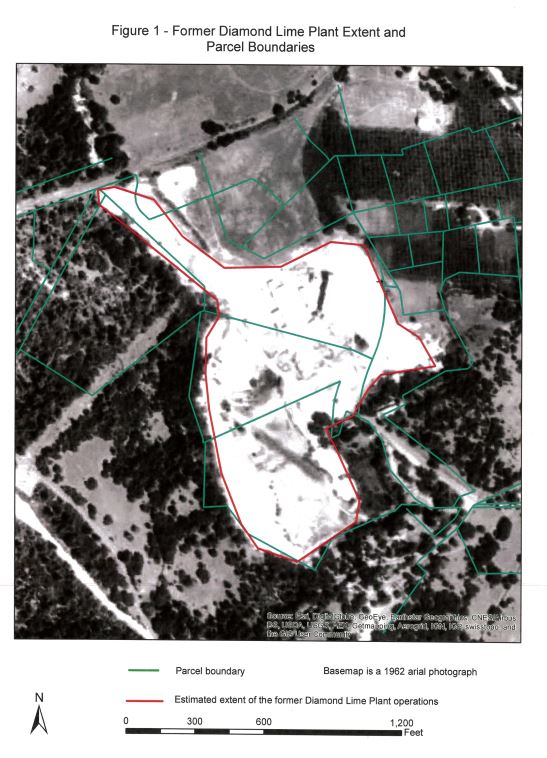
The 1962 map of the plant site. Photo/State Water Board
A long history
Public complaints and reports to local, state and federal agencies regarding the high pH runoff go back years. A string of citations has been issued to property owners, cleanup and mitigation plans ordered and soil and water testing reports written.
(Lake Tahoe News first reported on this issue nearly a year ago with a two-part series: story one and story two. This was followed up another article in June.)
Early enforcement efforts were centered on the Michael Lindeman property. Many complained that it made no sense to exclude the Waste Connections property from such investigations as it too was part of the Diamond Lime Plant site. High pH readings in soil samples taken in July by Walter Floyd on the Lindeman property where it adjoins the MRF convinced the Water Board that additional investigation of the Waste Connections property was warranted. The Lawrence Abel property was later included in the high pH investigations as well.
Waste Connections, Lindeman, and Abel have now been tasked by the Water Board to test for high pH water and lime residue and to come up with alternatives on how to remediate them. Test wells were drilled, soil and water samples taken and analyzed, reports and work plans submitted. The Abel Trust is still in the process of preparing a work plan to identify the extent of lime waste on their property.
Within the last several weeks, Waste Connections submitted their report on remedial alternatives to the Water Board and Holdrege & Kull turned in their proposed winter mitigation measures work plan for the Lindeman property. These both await the Water Board’s review and approval.
How high is too high?
Cheryl Bly-Chester, a professional engineer and environmental engineering consultant, has been asking the county and the Water Board to take stronger action for some time. She recently called the Water Board, El Dorado County Environmental Management and county Public Health to express her concerns.
In a letter to the Water Board on Oct. 13 she wrote, “For years now, inexplicably high pH (exceeding pH 13, too high to be merely lime kiln waste) has been measured in surface water near the El Dorado Trail, down-gradient from the Waste Connections site. Little has been done to protect human health and the environment. … Last summer, it was reported that groundwater was sampled at pH 14 in multiple wells at the Waste Connections Facility on Throwita Way in El Dorado County.” This refers to pH readings contained in the Second Wuarter 2017 Monitoring Report presented to the Water Board by the Waste Connections consultants.
Bly-Chester called that report’s failure to discuss the implications of pH 14 “an egregious omission” by the consultant. “I reported that the failure had the appearance of hiding facts from the public.” She believes the Water Board is also at fault for not correcting this reporting lapse and, “has itself engaged in obscuring the extreme pH 14.”
Bly-Chester told Lake Tahoe News that calcium hydroxide (lime) alone cannot drive a pH reading as high as 14. She says this indicates there are other toxic compounds or factors such as underground pressure involved. She performed soil testing herself in the area in September. It showed the presence of calcium hydroxide, sodium and potassium, but not in high enough concentrations she believes to drive readings as high as pH 14.
She is most disturbed that neither the Water Board nor the county is asking why such high readings are occurring. “They should be asking this question themselves. It should not be up to the public to ask these questions. We have to know why we are getting these readings because the answer could be something dangerous.”
Lake Tahoe News asked the county to respond. They said that pH readings “can be affected by temperature and other factors. Laboratory analysis of solids indicate that the material is Ca(OH)2 (calcium hydroxide); no other high pH materials have been detected from the data collected thus far. As the lead agency, the Water Board would make the determination for additional investigation for other constituents of concern, if warranted.”
The Water Board was asked why their people had not mentioned the pH 14 readings in their response letter to El Dorado Progressives. They told Lake Tahoe News, “Monitoring documents were neither requested in the El Dorado Progressives letter, nor provided in the Water Boards response letter.” Their Sept. 25, response to EDP stated, “Staff shares your concerns with many of the issues, and have directed responsible parties to collect data about which you may not have known.”
Is the El Dorado Trail safe?
El Dorado Progressives and Bly-Chester among others insist the existing fencing fails to provide enough protection for users of the trail or for the area’s wildlife. The Water Board told El Dorado Progressives, “The barrier erected (by the county) by the bike path appears to be adequate.”
“The fencing by the El Dorado Trail is believed to be sufficient to prevent accidental encounters with the alkaline water,” they told Lake Tahoe News, “as might occur with an out of control bicyclist or an errant roller-skater and to deter most community members and recreational users from entering the area. A person determined to access the alkaline water will likely find a way to climb the fence and access the alkaline water. Recent investigation activity has discovered that the areas with alkaline surface water occur on private property, where the general public would not be expected to trespass. Water Board staff will continue to work with property owners to address wildlife issues in their mitigation measures work plans.”

Popular trails boarder the contamination site. Photo/George Turnboo
Proposed changes
The Sept. 25 Holdrege & Kull Winter 2017-18 Mitigations Measures Work Plan for the Lindeman property includes proposals to enhance the fencing. This includes installing 15-foot-long T-post fences with wire mesh backing on both the east and west ends of the existing county safety barrier fence. They also propose an approximately 170-foot-long T-post fence with wire mesh backing along the northern portion of the Lindeman property line and warning signage on both fences on the north and south sides of the walking path “to inform pedestrians of the potential health hazards of coming in contact or drinking the potentially high pH waters flowing in the creek.”
The county’s response
El Dorado County originally told Lake Tahoe News, “The county and the Central Valley Regional Water Quality Control Board believe that the existing permanent fence installed in 2016 provides an adequate barrier to prevent accidental public access to the area impacted with high pH water. The county will be issuing a press release similar to last season reminding the public to avoid contact with storm water. No other additional mitigation measures are anticipated at this time.”
When asked about the more recent proposals in the Holdrege & Kull plan, the county responded, “The county believes the proposed fencing is an adequate barrier to deter a reasonable person.”
(Responses from El Dorado County were all provided by the public information officer.)
Is just monitoring the problem good enough?
Both the county and the Water Board say they will be “monitoring” the high pH runoff over the next wet season. Many believe this is not a sufficient response. El Dorado Progressives would like to see a temporary collection system for the high pH runoff put into place now. Izzo explained to Lake Tahoe News how a temporary collection system would work. “The high pH water is running down all the time during the winter. You would put in a sump to collect the water. It would be automatically pumped out when it reached a certain amount. Temporary collection is not impossible. It just comes down to cost.”
The Water Board responded that they are “considering requiring an interim remedial measure such as a collection system, but at this time, has opted not to.” The reasons given were that field measurements had indicated “areas with high pH surface water have a limited extent. Field data indicate the alkaline surface water has historically been neutralized approximately 100 to 200 feet downstream of the source.” Additionally, they felt there was, “no evidence to indicate that people are being exposed to alkaline groundwater.”
Where is the high pH groundwater going?
Bly-Chester and Izzo point to the difficulty in telling exactly where high pH groundwater is going due to the geologic nature of the area. “There are fractures in the rock,” Izzo noted. “You never have enough data with groundwater. You can’t see it all. You have monitoring wells scattered around and make interpretations based on those wells. From what I’ve seen in general, once you get down into the fractured rock, the water is OK. It’s the upper groundwater. When it rains, the level of the groundwater comes up. It is running down and along the surface of the bedrock and springing out from the other side of the bike trail … if it were contained, it wouldn’t be springing out on the other side of the bike trail.”
Bly-Chester agrees. “It’s well known that the El Dorado County rock basement is highly fractured and water goes everywhere. How can it be contained in this instance?”
Deed restrictions
El Dorado Progressives also wants deed restrictions on parcels that were part of the former Diamond Lime Plant site. The Residual Lime Material Remedial Alternative Evaluation Report just presented to the Water Board by Waste Connections evaluated three remedial alternatives for the property. Their consultants determined the best alternative would be partial source removal along with excavation/treatment and source isolation.
The Water Board told EDP they will “review and comment on all proposed remedies for the site. If the selected remedy entails leaving highly alkaline soils at the site, all waste left in place will be secured so that it does not pose a risk to human health, the environment or waters of the state and deed restrictions will be required.”
Determining the extent of the problem
El Dorado Progressives questioned whether the full extent of the Diamond Lime Plant operations has been determined. “The overall extent of the lime kiln waste has not been defined. A parcel by parcel investigation has been done instead of an evaluation of the total extent of lime plant operation. The aerial extent appears larger than the parcel presently under investigation.”
This refers to aerial photos taken in1962. The Water Board says that the1962 aerial photos were georeferenced using the geographic information system (GIS). They point to the evaluation of these photos as part of the historical use of the site report by Holdrege & Kull in June for Michael Lindeman which indicates that 1962 was the year in which the maximum historical limits of operation took place. Property owners, the Water Board told EDP, have all been asked to determine the full lateral and vertical extent of lime waste and its impacts on surface water and groundwater on their property.
What would Erin Brockovich say?
The presence of chrome 6, the hexavalent chromium made famous by Erin Brockovich, was also raised by El Dorado Progressives. They say that additional sampling for chrome 6 (Cr+6) and other heavy metals still needs to be done. They pointed to samples in which heavy metals exceeded the acceptable MCL (maximum contaminant level) for drinking water as established by the EPA.
Chrome 6 is a common byproduct of lime kiln operations. “They know lime kilns convert chromium,” Bly-Chester said. “They only sampled for it in one or two places and called it good.” When chromium is heated up, she explained, it oxidizes as other heavy metals like arsenic do. When they are oxidized, it changes their chemical composition and they get extra icons which makes them reactive. “Chrome 6 is a toxin.”
The Water Board told EDP that the water samples they referred to were from a 2016 Well Monitoring Report and should have been filtered by the analytical laboratory. “However, due to a miscommunication between the consultant and the laboratory, three of the samples were not filtered.” These were the ones with the high concentrations. “The data from these three borings are therefore considered suspect and biased high due to the presence of suspended solids in the samples.”
No additional sampling from these borings was done. The Water Board concluded that, “hexavalent chromium is not a chemical of concern at the Site.”
The responsibility puzzle
Assigning blame for the fact that toxic impacts of the Diamond Lime Plant remain 40 years after it closed is not that easy. While Victor Izzo affirms, “The whole site is a threat,” his years with the Water Board give him insights into why the process often takes so long.
“The problem from the Water Board’s perspective,” he told LTN, “is that they often don’t know (about a problem) until someone reports it.” Once the extent of the problem is identified, he adds, there are three steps: selecting the remedial process, designing how it will be done, and then cleanup. Once the remedial design is in place it can be implemented. Right now, he said, “They are only at the selection stage.”
Next steps
While some things are known, many more are not. The Water Board is still waiting for the final work plan for the Abel property. It will need to review it and those recently presented by Waste Connections and Michael Lindeman. What actions it and El Dorado County will ultimately take and which, if any, of El Dorado Progressives suggestions could be implemented prior to the rainy season remains unknown.
Three years ago, frustrated local residents asked the 2013-14 El Dorado County Jury to conduct an investigation of the continuing high pH runoff. The Grand Jury concluded, “Nobody is doing anything to stop it. Not the owner, not the county and not the state.” Despite actions taken since then, the grand jury’s conclusion that “the last vestige of the Diamond Lime Plant may be the lime waste that today continues to contaminate the property, surrounding area and adjacent waterways,” remains true today.