Calif. taxes on legal pot could boost black market

By Patrick McGreevy, Los Angeles Times
 
State and local taxes on marijuana could surpass 45 percent in some parts of California, jeopardizing efforts to bring all growers and sellers into a state-licensed market in January, according to the global credit ratings firm Fitch Ratings.

“High tax rates raise prices in legal markets, reinforcing the price advantage of black markets,” the firm said in a report Monday. “California’s black markets for cannabis were well established long before its voters legalized cannabis in November 2016 and are expected to dominate post-legalization production.”

The report said that increased enforcement may blunt the illegal market, “but high taxes may complicate such efforts by diverting in-state sales to the black market.”

Read the whole story


Class all about search engine optimization

Smart SEO Tactics for Local Businesses will be the subject of a class on Nov. 16.

Kevin Wallner with First Chair Digital Marketing and Brandi Brown with Tahoe Production House are putting on the course from 8-10:30am.

This is for people who want to be found by more customers. SEO (search engine optimization) is the key to getting in front of people when they’re searching for your products or services online.

They will go over what you can do to improve Google’s understanding of your business, which will help more of the right people find you by improving your visibility in the search results.  

Cost is $20 for Truckee Chamber of Commerce members, $30 for others. Register online.


DC’s assistant county manager out after 6 weeks

Bradley Hurley didn’t last long as Douglas County assistant county manager. He was hired Sept. 13 and his last day was Oct. 31.

It is not known if the county didn’t want him or he didn’t want the county.

“Probation periods are an opportunity for both the employee and the employer to determine if the relationship is a good fit,” County Manager Larry Werner said in a press release.

This was the first time the county had the sole position of an assistant county manager. In the past the ACM and CFO were the same person. Hurley’s salary was $105,000 a year.

Prior to joining the county, Hurley had been the information technology officer for the Marine Corps Mountain Warfare Training Center located at Bridgeport.

The other finalist for the job was Philip Ritger, Genoa town manager.

Melissa Blosser, county spokeswoman, told Lake Tahoe News there has been no decision as to the process for looking for another ACM.

— Lake Tahoe News staff report


Letter: Time to fix South Lake Tahoe’s roads

To the community,

As a proud longtime resident of South Lake Tahoe, I find it embarrassing that our community has not been able to take care of our roads. From a lack of sidewalks to enormous potholes and cracks, our roads are dangerous and need to be fixed.

Measure C is the right way to finally address the repairs that our roads desperately require. Measure C will ensure that, for the first time in our city’s history, there is dedicated, stable funding that can only legally be spent improving our roads. Visitors to South Lake Tahoe will pay their fair share for the use of our roads, and every penny would remain local. By keeping pollution out of Lake Tahoe and ensuring that emergency vehicles can respond quickly and efficiently to emergencies, Measure C will go a long way toward fixing the dilapidated roads that are blight on our community.

The choice is clear – a vote for Measure C is a vote for better roads and improved public safety. Our roads have been a problem for far too long, and these necessary repairs are only going to get more expensive as times goes on. I have returned my vote-by-mail ballot with a yes on C vote, and I hope you will do the same.

Cheryl Caplan, South Lake Tahoe


Snippets about Lake Tahoe

·       South Tahoe High School’s second community meeting about Viking Vision 2020 will be Nov. 6 from 5:30-6:30pm at the school’s student union.

·      Crowbar, with support from Tombs, Incite, and Tricountry Terror, comes to Hard Rock Lake Tahoe’s Vinyl Showroom on Nov. 17. Show starts at 7:30pm. Tickets are $17 pre-sale and $20 at the door. Must be 21 or older.

·      South Lake Tahoe Recreation Department is offering an American Red Cross certified lifeguard training course Nov. 3-18. For more info, call 530.542.6056.

·      Douglas County and Nevada are hosting an educational event to inform citizens on flood preparation and safety on Nov. 14 from 3-6pm in the dining room of the Douglas County Community and Senior Center in the valley.

·      The Gene Upshaw Memorial Fund’s Super Bowl raffle is going on. Only 300 $100 tickets will be sold, raising $30,000 for the fund that supports programs and services for cancer patients and families at the Gene Upshaw Memorial Tahoe Forest Cancer Center and traumatic brain injury research through the Tahoe Institute for Rural Health Research in Truckee. To purchase a ticket, call 530.582.6277.


Proposed bill would block utilities from passing wildfire costs to customers

By David R. Baker, San Francisco Chronicle
 
Four California legislators on Monday said they plan to introduce a bill that would bar electric utilities from passing on to their customers the costs of wildfires caused by the companies’ negligence.

The move comes as investigators are exploring whether Pacific Gas and Electric Co. power lines played a role in starting last month’s Wine Country wildfires, which killed at least 43 people. And San Diego Gas and Electric Co. has asked state regulators for permission to make its customers pay some of the costs of settling lawsuits triggered by a deadly series of fires in 2007.

In response, PG&E issued a statement that did not directly address the proposed legislation itself but called dealing with wildfires a statewide safety issue.

Read the whole story


Statewide gaming win up, down in Stateline

While statewide the boost in gaming revenue is being attributed to wagers on football, that was not enough to keep Stateline numbers in the black for September.

Overall, Nevada’s sports books set a record at $558.4 million. This bested the record of $557.4 million set in November 2015.

According to the Nevada Gaming Control Board, the numbers in Stateline were down about 3 percent compared to September 2016 at $21,084,873. North Shore casinos were up 16.53 percent. Statewide, the win was up 3.25 percent, at $979,859,876.

— Lake Tahoe News staff report


Letter: Homeless Coalition gives thanks

To the community,

Thank you to our community of supporters for making the 2017 Homebrew for the Homeless a successful fundraiser. The Tahoe Coalition for the Homeless event at the DDRC Ranch was supported by over 60 individual and business sponsors.

A special cheers to major donors: Hops Envy, Reliapro Painters, darke. Marketing, Tahoe Mountain Lab, Law Office of Scott Weavil, Heatherton Agency, Barmhouse, Tahoe Best Friends, Tiffany Hetherton Grimes of Chase International, and South Tahoe Association of Realtors. This year’s event raised a record amount of donations.

The chili cook-off, face painting, horseback riding, music, and homebrew from local brewers and Hops Envy on the ranch made for a fun afternoon.

Beer winners were:

1st – Joe Reyna with his Forest Gose

2nd – Shawn Gearlds and Shell Ford with their Pale American Ale

3rd – Mike Thicke with his Puck Hog American Porter

People’s choice: Glenn Simpson.

Chili winners were:

1st – Daniel Solgado, HAMS Chili

People’s Choice: Katie Shea, First Snow Chili. 

Marissa Muscat, Tahoe Coalition for the Homeless


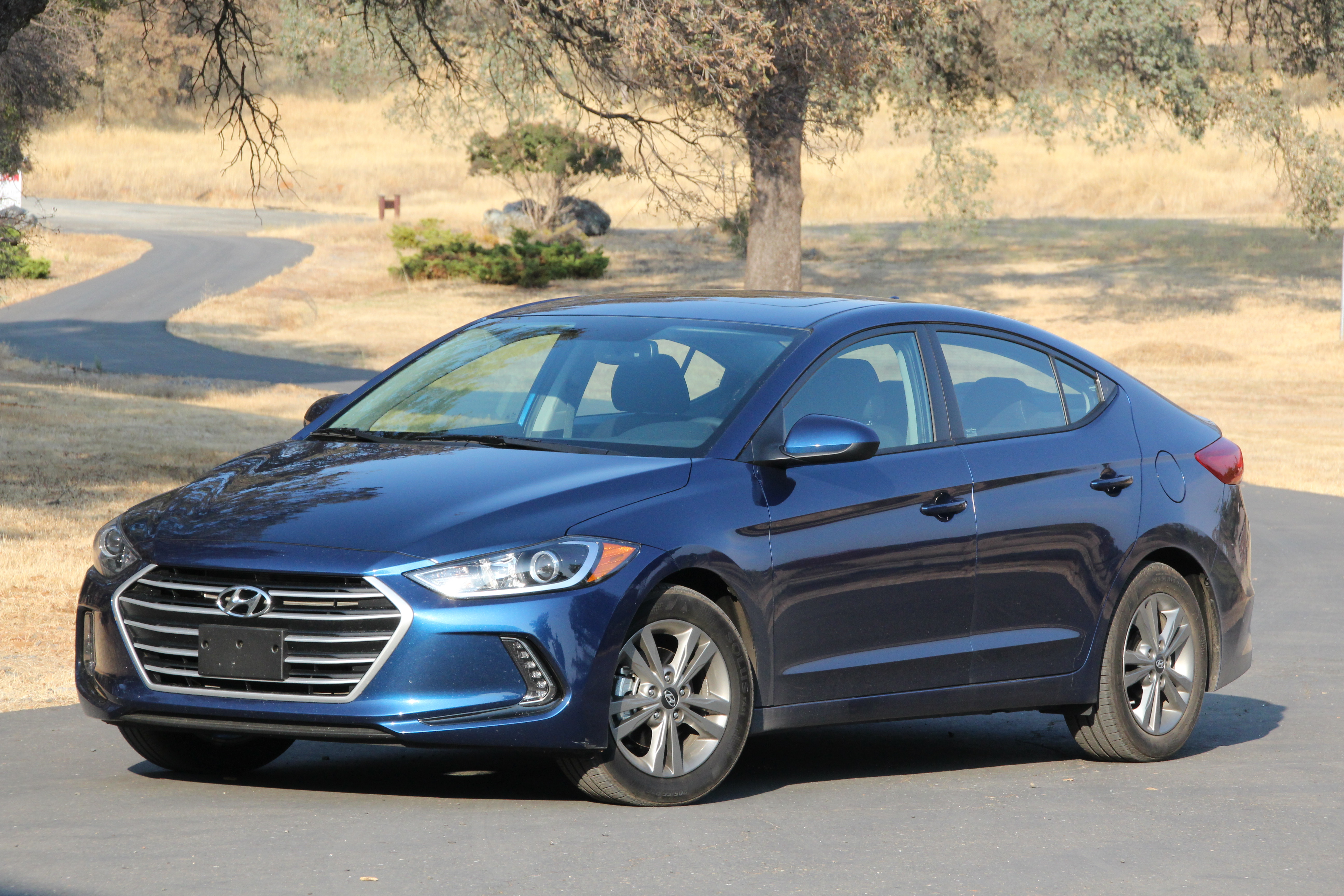
Road Beat: Hyundai Elantra Value Edition, a super deal

The Hyundai Elantra Value Edition is priced for most wallets. Photos/Larry Weitzman

By Larry Weitzman

Hyundai has in the past few years taught the Japanese manufacturers a thing or two, doing what I refer to as out Japaneseing the Japanese. They make high quality cars that perform well in all categories, becoming an almost default brand. In other words, it’s a brand you buy without even thinking about it as you know you just can’t go wrong. This new Elantra Value edition is one of those very few, special cars.

First it stickers for $20,000 plus $835 for the train from its Montgomery, Ala., assembly plant. But this is no bare bones ride. It comes with full power including the drivers’ seat. It even has auto dimming headlights, heated front seats and blind spot detection, all standard.

And being an Elantra it comes with honest good looks. A great looking, hexagonal aggressive grille, slick LED parking lights, a great window line and a strong appearance. It is one good looking ride. It is 180-inches long and rides on a long 106-inch wheelbase. At 71-inches wide and a 56-inch height just add to its strong, aggressive nature.  At 0.27 co-efficient of drag, it is also a wind cheater.

Under the bonnet is Hyundai’s 2.0L DOHC, 16 valve direct injected Atkinson cycle engine, meaning higher compression and late closing intakes valves which improve engine efficiency at a small loss in overall hp. But it still pumps up 147 hp at 6,200 rpm and 132 pounds of twist at 4,500 rpm. It drives the front wheels via a very smooth six speed automatic torque converter cog-swapper. It hunts a bit when driving aggressively and that’s understandable when applying the whip to all those horses.

At full tilt boogie this Elantra will scamper from 0-60 mph in 8.91 seconds, an above average time for an inexpensive compact. Passing times are also above average with a level 50-70 mph simulated pass of 4.95 seconds and the same test up a steep grade slows that time to 9.16 seconds. All good times for compact, especially when considering how it sips fuel. Throttle response is quite lively giving the driver a fun, guilt free time behind the wheel.

Specifications
Price $21,210 about $21,210
Engine
2.0L DOHC, 16 valve direct injected inline four 147 hp @ 6,200 rpm, 132 lb.-ft. of torque @ 4,500 rpm
Transmission
Six speed torque converter automatic
Configuration
Transverse mounted front engine/front wheel drive
Dimensions
Wheelbase 106.3 inches
Length 179.9 inches
Width 70.9 inches
Height 56.5 inches
Track (f/r) 61.2/61.6 inches
Ground clearance 5.3 inches
Fuel capacity 14.0 gallons
Trunk capacity 14.4 cubic feet
Passenger cabin volume 95.8 cubic feet
Weight 2,811-2,976 pounds
Steering lock to lock 2.7 turns
Turning circle 34.78 feet
Wheels 16-inch alloys
Tires 205/55X16
Coefficient of drag 0.27
Performance
0-60 mph 8.91 seconds
50-70 mph 4.95 seconds
50-70 uphill 9.16 seconds
Top speed Well into triple digits
Fuel economy EPA rated at 28/37/32 (automatic) mpg city/highway/combined. Expect 33-34 mpg in rural country driving with some stop and go. 43-48 mpg on the highway at legal speeds.

Fuel economy is EPA test rated at 28/37/32 mpg city/highway/combined. But the Elantra did even better than those numbers in my testing. At a constant 70 mph in a two-way 20-mile run, the Elantra averaged 47.8 mpg or a solid 10 mpg more than the EPA test. They must have forgot to release the emergency brake. In my 210-mile run to Carson City and back averaged 40.6 mpg with only 10 miles of that trip spent on a constant speed multilane highway. At least 30 miles were spent in Carson City and South Lake Tahoe stop and go traffic and the rest of the time was spent going up and down the Sierra on two lane roads with at least a dozen full throttle passes. Overall fuel economy was about 36-37 mpg in the 500 miles of testing.

And instead of the usual 13.2-gallon fuel tank, Hyundai has a larger 14-gallon unit. Kudos, Hyundai. That means an easy 500 miles and I suspect even 600 miles, if your tank can last that long.

Suspenders are MacPherson struts up front and a semi-independent torsion beam in the rear with gas shocks and coils in all four corners. Steering is a quick (2.7 turns lock to lock) electric power rack. Wheels are 16 inch alloys shod with 205/55’s a mid-size handling tire so the Elantra is a bit more playful although in aggressive driving in the twisties it had gobs of grip and it was a no brainer to push it hard as it was very benign and extremely predictable. It just followed my input perfectly without complaint. Nicely done Hyundai, and this is supposed to be some super economy budget sedan. Not hardly. Let me turn on the seat heater.

Ride quality is even better. This Hyundai is smooth and quiet. No road, wind or tire noise. Even coarse roads are quiet. Ride is slightly less than firm, meaning its very compliant, nicely controlled and bank vault solid. Coast to coast would be no issue and as cheap as a super cut rate discount airline fare even if doing it solo and no need to rent a car when you get there. Just might take a day or two longer. But if you are doing 400-500 miles, the Hyundai will be within an hour in the time department and cost you much less, never mind the need to rent a car. I know I have done it several times driving to L.A. and to Portland.

Safety is all there including standard blind spot detection and a big screen rear view camera. All the acronyms are present and the brakes are strong (four-wheel discs, ABS, etc.) and the headlights very good, especially with the aforementioned auto dimming. All standard equipment.

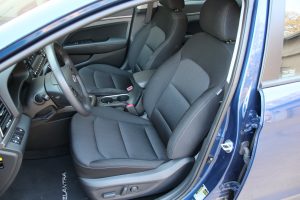
Inside is a quality interior, no cheaping out here, all first quality. The cloth seats are surprisingly comfortable and with power in the driver’s seat, infinitely adjustable and on those cold mornings, just turn on the butt warmer, passenger too. Soft touch materials abound and the instrument panel is perfect. Large tach and speedo left and right flanking the center trip/info computer with easy to use steering wheel controls for the sound system, bluetooth and cruise as well. This could be a model for how to do a center stack. There is nothing lacking.

Rear seating is roomy for two and OK for three. The trunk is huge (for a compact) at 14.4 cubes. When you add the cabin volume of 95.8, it puts the Elantra into a midsize car category in a compact size.

Pricing for this ride as said above totals $21,210 with the train ride from Alabama. And the engine and tranny are manufactured here in the USA. The only extra or up charge on this ride are the perfunctory embroidered floor carpets/mats ($125). When are manufacturers going to throw them in for free? Hyundai throws in what would be about a $2,000 up charge their 10 year/100,000-mile powertrain and a five year/60,000-mile whole car warranty for free, why not the floor mats? Notwithstanding, this Elantra is the real deal in a compact, just buy the dang floor mats, they look good and fit perfect.

Larry Weitzman has been into cars since he was 5 years old. At 8 he could recite from memory the hp of every car made in the U.S. He has put in thousands of laps on racetracks all over the Western United States.


Affordable housing runs gamut in Tahoe-Truckee

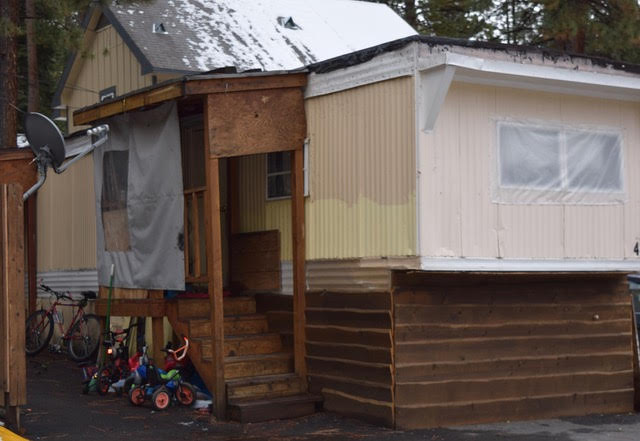
Housing, while it may be affordable, isn’t always ideal. Photo/Heidi Hill Drum

Publisher’s note: This is one in a series of stories about affordable housing in the Lake Tahoe-Truckee region. All articles may be accessed via the home page under Special Projects, 2017 Affordable Housing.

By Linda Fine Conaboy

Few things are more important than a roof over our heads—preferably one that doesn’t leak.

But as the price of housing, especially affordable workforce housing, continues to escalate within the Tahoe basin and Truckee, many are finding it more and more difficult to obtain a suitable place to live. According to research, this problem is having an affect not only locally, but also nationwide, especially for those on the lower end of the income scale.

In an attempt to make sense of the local housing scene, Lake Tahoe News talked to local area experts to try to quantify the extent of the situation, which continues to spiral out of control. Communities around Lake Tahoe and the town of Truckee are all feeling the economic pinch that a lack of accessible housing brings.

Workers find themselves burdened not only by not having places to live near their jobs, but also, because many must commute miles and miles just to get to work, they must dig deeper to afford the high price of transportation costs.

As an example, one family consisting of mom and dad who work in Truckee, and three kids who attend Truckee schools, now commutes every day to work and to school from Reno, where they were lucky enough to find a home to suit their paychecks.

Their story is not atypical—many individuals and families around the lake are struggling, some even to a much greater degree.

Affordable housing. Workforce housing. Low-income housing. Section 8, below market rate, deed restricted and extremely low-income are a few of the names used to indicate various income groupings.
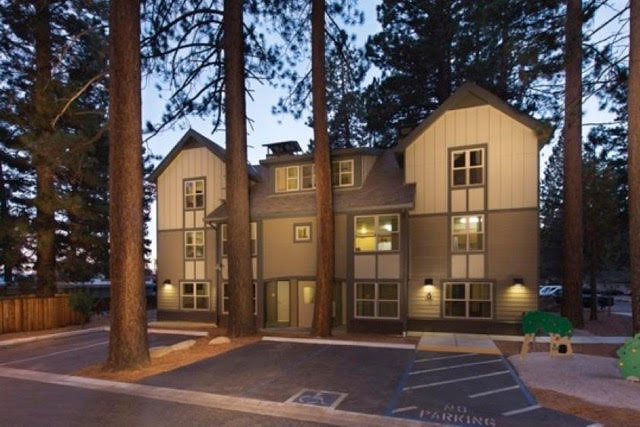
An example of an affordable housing project in Kings Beach. Photo/DOMUS Development

What do these classifications mean? A brief summary is in order before we can even begin to take a look at what housing is available within the assorted categories.

·      Affordable housing: Under federal statutes, housing is considered affordable when it requires the dedication of no more than 30 percent of gross household income, including rent or mortgage payments, utilities, taxes and insurance, homeowner’s association fees and other related costs.

·      Area median income: The median household income for an area. Usually household size is considered when designating this term.

·      Below market rate housing: Refers to properties that are leased or sold at prices that are below the current market value.

·      Deed restriction: A requirement recorded at the sale of the property that ties the current or future owners to the specific use of the property.

·      Extremely low-income: This grouping includes those with annual incomes that are equal to 30 percent or less of the area median income of an area.

·      Workforce housing: Targeted to be accessible to households that include members of the local workforce. However, the income levels targeted for workforce housing are often limited to those who do not otherwise qualify for subsidized rental or for-sale housing, but who may still have a hard time affording market-rate housing.

·      Subsidized housing: Housing that utilizes some sort of rental assistance. For example, housing where all or a portion of the monthly housing costs are paid directly by the government. A good example of this is Section 8 housing where a renter pays only a portion of the rent determined by the household’s income.

An article from the website, Realtor.com, written by Lisa Johnson Mandell, stated that unfortunately, being eligible for affordable housing doesn’t mean you will actually get the help you need. Under current funding levels, affordable housing programs can assist only approximately 4.8 million low-income families—that’s about 1 in 4 eligible households, and the waiting lists in some communities are extremely long. Cities such as Los Angeles have an estimated waiting list of more than 10 years.

Research also shows that the situation around Lake Tahoe is not as extreme; however, there are waiting lists in some locales as long as four years.

It is important to note that 1) there is a housing crisis at Lake Tahoe and Truckee, and 2) this is not a new crisis. However, it is also important to note that this near-catastrophe has come to the fore and is being addressed by civic and community leaders.

For example, Heidi Hill Drum, the CEO of Tahoe Prosperity Center, said, “It is difficult to build affordable housing in the Lake Tahoe region because the projects often don’t pencil for a developer. Most affordable housing projects that have been completed were done when the state of California had redevelopment funds. Those funds are no longer available and local government jurisdictions do not have many options to bridge that gap.”

DeDe Cordell, Placer County’s director of public affairs and communications, concurred with Drum, also noting the demise of California’s redevelopment agencies.

A document highlighting the history of RDAs in California says the death of this government-based entity will surely reduce the number of new affordable housing developments in the foreseeable future.

This forecast is now coming to fruition, and as the document says, no approved measures currently allow for an equivalent statewide set-aside fund exclusively for providing future affordable housing after all existing obligations are met by other agencies.

Affordable housing is a high priority for Placer County, Cordell told Lake Tahoe News. “We are looking at a lot of different possibilities to determine the best approaches to tackling this challenge. It’s a challenge countywide (Placer County encompasses not only Auburn, but also Tahoe City, Kings Beach and Tahoe Vista), but it’s especially challenging at Tahoe because it’s such a tourism/service-based economy, and with so many people opting to use their homes as short-term vacation rentals, it’s significantly reduced the available housing stock, making the problem that much worse. We are even considering ways to encourage/incentivize owners to rent their properties seasonally or long-term to create additional housing stock that can be affordable to people in a variety of income levels.”

A report (The Regional Housing Study) from the Tahoe Truckee Community Foundation backs up Cordell’s statements. In fact, the report says, 65 percent of the homes at Tahoe and Truckee sit vacant most of the year because they are vacation houses. Consequently, in order to stay close to their workplace, locals spend a huge chunk of their incomes on housing, some of it without adequate space or heating.

And from Drum, “There are some federal programs that help subsidize building affordable housing projects, but without local government funding, they often aren’t enough. And given how expensive land is at Lake Tahoe, it makes it even more challenging here. Add to that the additional regulations we have due to our environmental protections, Tahoe is a challenging place to build any housing in the affordable and mid-ranges.”

TTCF’s Regional Housing Study’s further examination of housing within the Tahoe basin, including Truckee, reports that the region’s median housing price far exceeds the prices considered affordable for the area’s median incomes, pricing a significant portion of the workforce out of the housing market.

To make matters worse, Drum said, there is little affordable housing in the pipeline or in the planning stages in any location around the lake. “But that doesn’t mean there’s no effort in getting that pipeline full,” she told Lake Tahoe News, referencing another task force spearheaded by Sue Novasel, county supervisor for district 5 in El Dorado County.

“One of the things that’s come out [talks about affordable housing] is that every jurisdiction has specific problems and needs and that trying to embrace the entire lake is difficult. We decided we need to get specific about the South Shore,” Novasel told LTN.

Additionally, with a consultant’s help, the group decided to work with Tahoe Prosperity on a pilot project. Novasel said, “Tahoe Prosperity will take the lead to develop a pilot project to redevelop an area, maybe a motel for low income people. We need to develop a tool box and we hope to get some of the fees lowered. The need is immediate. Private business needs to be a part of this.

“If we as a group can come up with a blueprint; if we can put a dent in this by getting people working together, we can at least start on the problem.”

As to the question of how many more units are needed throughout the basin to meet demand, Placer County’s Cordell said there is no simple answer to this conundrum. “Our county is in the process of preparing the Economic and Housing Needs Analysis for Placer County,” she said. “This is anticipated to be completed by the end of the year and will provide us a better understanding of what the needs are in the area.”

Following is a fairly comprehensive list of the housing available now for moderate to low-income families and individuals. Although there may be other existing data, that information was not readily available to Lake Tahoe News at press time. The information was gleaned from the May 2014 Tahoe Regional Housing Needs Report compiled by BAE Urban Economics and, also assembled by BAE, from the North Tahoe Regional Workforce Housing Needs Assessment as well as from conversations with representatives from Tahoe Regional Planning Agency, Placer County, Douglas County, El Dorado County and South Lake Tahoe.
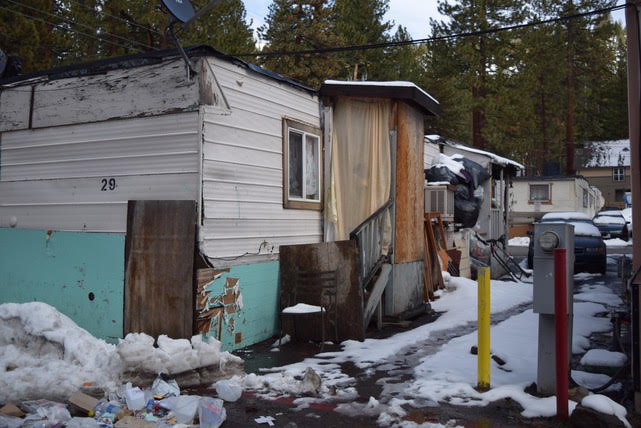
Landlords in the Tahoe-Truckee area don’t always care about providing quality housing. Photo/Heidi Hill Drum

Complex name: 

California side

·      Bijou Woods Apartments/South Lake Tahoe/92 units low or very low income

·      Evergreen Apartments/South Lake Tahoe/26 units low or very low income

·      Kelly Ridge Apartments/South Lake Tahoe/30 units very low income/2 units 62 or older

·      Sierra Garden Apartments/South Lake Tahoe/76 units low or very low income

·      Sky Forest Acres/South Lake Tahoe/17 units very low income/1 unit for disabled

·      Tahoe Pines Apartments/South Lake Tahoe/26 units low or very low income

·      Tahoe Senior Plaza/South Lake Tahoe/45 units very low income

·      Tahoe Valle Townhomes/South Lake Tahoe/70 units low or very low income

·      The Aspens/South Lake Tahoe/56 units

Nevada side

·      Lake Vista 1/Stateline/24 units low or very low income

·      Lake Vista 11/Stateline/40 units low or very low income

·      Meadowbrook Apartments/Stateline/30 units low or very low income

·      Aspen Grove Apartments/Stateline/39 units low or very low income

North Lake Tahoe area

·      Kings Beach Housing Now/Kings Beach/77 units low or very low income

·      Corda/Tahoe City/1 unit

Truckee area

·      Frishman Hollow/Truckee/32 units very low income

·      Henness Flats/Truckee/92 units low or very low income

·      River View Homes/Truckee/38 low or very low income homes

·      Sawmill Heights/12 low income (this is a mixed-income property containing 96 units, 12 of which are low income)

·      Sierra Village/59 low or very low income

·      Truckee Donner Senior/60 low or very low income

·      Truckee Pines/104 low or very low income

·      Martis Valley/4 units.

Douglas County Community Development Director Mimi Moss advised that Douglas County’s 2011 Housing Element suggests that to meet historic population growth over the next 20 years, there will need to be 1,258 additional new low or very low income housing units, and an additional 700 new rental spaces. These figures represent the need for the entire county and not just the areas within the Tahoe basin.

In Placer County, Cordell reported several new housing projects are in the development stage, although no specific build-out data is now available.

As for easing some of the obstacles faced by potential developers, Tom Lotshaw, the public information officer for TRPA said, “Affordable, multi-family housing projects (serving people with 80 percent or less of county median income) are exempt from the need for the normal residential building allocations.

“Hundreds of bonus units are available for these types of projects at no cost from TRPA based on project need. Unfortunately, while these bonus units are readily available, we have not seen them requested or used much at Lake Tahoe.”

He added that the 2012 Regional Plan included a number of land-use planning incentives including height, density, coverage and provisions for mixed-use development for affordable multi-family housing units in town centers, in close proximity to the places where people work, shop and go to school.

As discussed earlier, the Lake Tahoe Basin is not unique in its need for housing that will meet the requirements of all of its citizens and employees. However, there are statistics compiled by the Tahoe Prosperity Center that indicate the area may have some additional hurdles to jump before the housing basics of everyone can be met. Consider these statistics:

·      Tahoe has higher than average unemployment and poverty rates

·      More than 60 percent of the children are on subsidized meal programs at their schools

·      Only 18 percent of residents can afford the median-priced home at Lake Tahoe

·      Lake Tahoe includes two states, six local governments and 198 plan areas making economic progress challenging.

Despite the challenges, there may now be enough people willing to confront the barriers and see that the forward momentum stays in place.

“As in many other parts of the country, a major shortage of affordable housing is a critical issue for the Tahoe region, and one that many partners must work together to address. It’s an issue for families and their finances; it’s an issue for community health and vitality; and it’s an issue for the environment, with many people forced to commute long distances to or from work at Tahoe,” Lotshaw told Lake Tahoe News.