Overhaul of look, functionality of SLT’s Sierra Blvd.
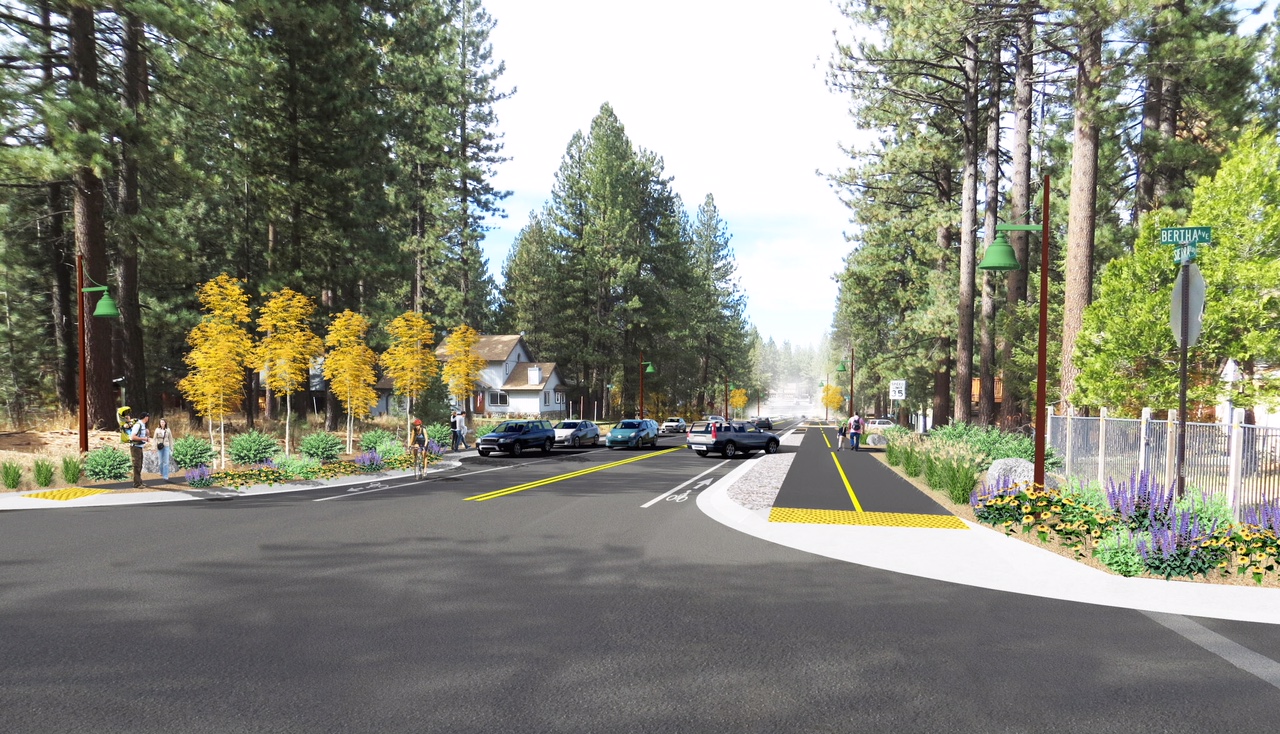
Sierra Boulevard in South Lake Tahoe is soon to be completely renovated. Rendering/Provided

By Susan Wood

One of South Lake Tahoe’s main crosstown arteries is getting a face lift.

Once the design process is wrapped up, the city expects to begin construction on Sierra Boulevard’s complete street plan – which should be next year.

The extensive transportation project driven primarily by human power is now in the environmental review phase. It heads to the city Planning Commission upon completion.

The plan would essentially represent a complete overhaul of the thoroughfare running from Highway 50 to Barbara Avenue. At the end is where the trucks dump their snow loads.  

South Lake Tahoe Public Works – joined by Tahoe Transportation District and NCE design representatives – on Thursday provided about 30 people a glimpse of the design. The meeting at the recreation center was the last scheduled community input meeting.

Many in the audience seemed heavily invested in the approximately $6 million plan that spun out of Phase 4 of the Sierra Tract Erosion Control Project. The “boulevard” plan, which has been in the works for years and stalled in 2008, is a little more than halfway in the process.
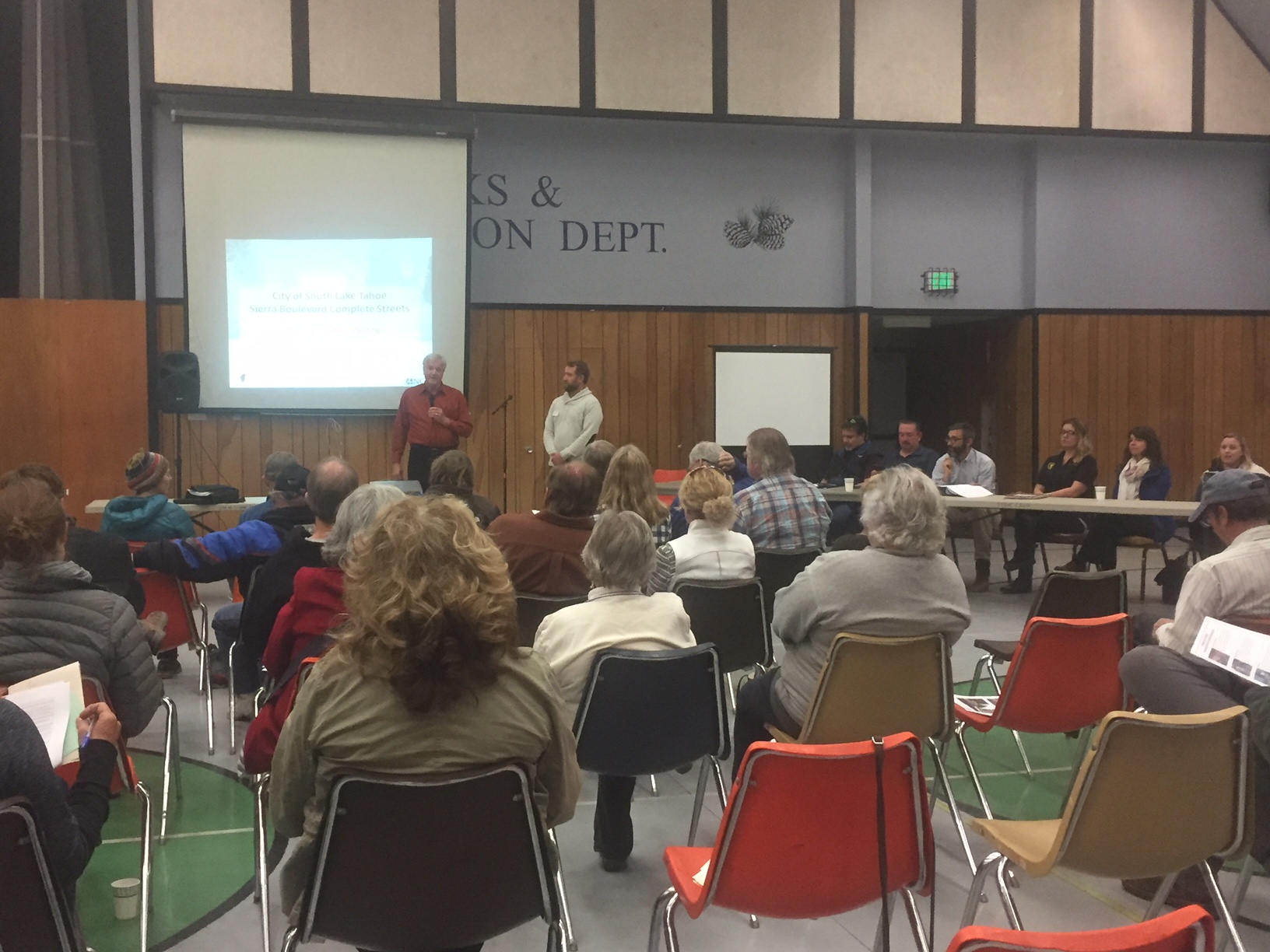
More than two dozen people listen Nov. 2 to plans for Sierra Boulevard. Photo/Susan Wood

It calls for curbs and gutters with storm water drains to channel the runoff that collects in mini lakes and ponds on the side of the street. Landscaping and lighting are set to illuminate a Class II bike lane, Class I 10-foot shared use path, as well as a 5-foot sidewalk for pedestrians. A crosswalk is slated to go in near Sierra Community Church, a quasi-anchor of the street. 

Money is coming mostly from an Active Transportation Project grant.

And beyond the strip, a crucial component to the bicycle-friendly improvements is the connection between an improved Highway 50 and the Greenway bike project.

The city sought to cover all bases with this project – from air quality and water quality to active transport and safety. The latter led to the city’s intention to install road features called “bulb outs.” These bulbous sidewalk extensions are used to reduce the pedestrian crossing distance and to slow down traffic.

On most days, motorists drive down the road “like a drag strip,” NCE senior engineer Christian Heinbaugh told attendees Nov. 2. The thought is the extensive width of the street gives the driver a fast, open-road feel.

But these road-narrowing features brought up questions from the group whether they would pose a hindrance to snowplowing operations – which dominated the discussion.

“Why so narrow?” a community member asked.

To that, Heinbaugh reminded those in attendance that the features were added because of public concerns expressed over the safety of the boulevard. The “bulb outs” in the street prompt motorists to slow down as they approach encroaching road features.

“It’s going to feel like a 35mph road,” he said of the current speed limit. New to the transportation planners’ vernacular is the term “traffic calming,” as if motorists need to take a chill pill.

Some attendees couldn’t quite grasp where the snow would go if the boulevard and multi-use path are due to be cleared of the white stuff in winter. They treated the quizzical type of features set to go in as something abnormally excessive, except they represent what one would find in any progressive, bike-friendly town. That conversation resulted in a more far-reaching chat about what constitutes a right-of-way and what is deemed an easement in respect to tossing the snow.

Transportation planners and engineers have learned a lot over the years about how to make these street features durable, the crowd was assured. For one thing, the separation between sidewalk features and roads are curvy in nature to where it’s easier for trucks to roll over them without destroying them.

Probably the most biting part of the question-and-answer segment came up when resident Mark Cutright asked who was going to pay for the maintenance. The accusation of missing funds from recreation-oriented Measures S and R prompted Bicycle Advisory Committee member and advocate Peter Fink to insist that at least now funding is thoroughly watched and scrutinized.

Cycling advocates have long waited for improvements to make South Shore roads friendly, safe and inviting to negotiate.

Motorists have long wanted to keep their oil pans on their vehicles as they take the boulevard, which is substantially beat up by truck traffic.

Residents have long wanted relief from flooding roads in big winters like last year.

When asked by Lake Tahoe News if NCE has witnessed whether these types of improvements in other communities prompt street-side property owners to make upgrades of their own, Heinbaugh was undecided but called it “logical.”

If anything, the city is going for a more pleasing look.

“It’ll definitely spruce up the neighborhood,” city engineer Stan Hill told LTN before the meeting.


Opinion: How to stop fighting the Civil War

By David Goldfield

It began as a loving effort to heal the South’s wounds, to properly mourn the young men who gave their lives for a lost cause, and to extract dignity from the humiliation of defeat. 

Immediately after the Civil War ended, the white women of the South went to work. They tended graves, erected modest monuments, and followed former President Jefferson Davis’ plea to “keep the memory of our heroes green.” The South had lost one-third of its white male population between the ages of 20 and 45. Its economy was shattered, its fields were desolate; and starvation was not uncommon. It was more fulfilling to commemorate the past than to dwell on the present.

While the white South settled in the past, the black South looked toward the future. To the former slaves, the result of the war was cause for jubilation. Reuniting families, consecrating churches, securing an education and gainful employment, migrating to Southern cities, and engaging in political activity consumed their lives. There was no compulsion to continue fighting the Civil War. They had won.

These perspectives on the war and the future were irreconcilable. The result was escalating racial conflict in the decade after the war.  White Southerners won that battle, attaining a measure of redemption for their defeat in the war. In fact, those white leaders who wrested control of their state and local governments from aspiring African Americans and their white allies were known forever as “Redeemers.” 

By the time the last Federal troops left the South in 1877, the Redeemers, along with their allies of the pen and in the pulpit, had made a religion of their history. Stonewall Jackson’s last words — “let us pass over the river and rest under the shade of the trees”—became a Methodist hymn. As Southern novelist Thomas Nelson Page wrote in 1880: “The South was dead and buried, and yet she rose again. The voice of God called her forth; she came clad in her grave-clothes, but living, and with her face uplifted to the heavens from which had sounded the call of her resurrection.” 

Civil War heroes became saints, memorialized in stone and marble. The statues that inhabit the South today, then, are more than historical commemorations; they are religious devotions; they are the icons of a redeemed race. The fierce battles over their continued public existence reflect what these images symbolize.

The symbols also reflected white supremacy. In the 1890s, the first postwar generation of Southern whites and blacks came of age. For whites, the task was to rededicate the South to what they saw as the righteous path set down by their parents. At the same time, young African Americans contested strictures on their work, education, and political activity. Their aspirations challenged the belief that whites were indeed the superior race and that African Americans lacked the capabilities to accrue education and participate in the political process.

The white South responded to black aspirations by legislating disfranchisement and racial segregation, and policing transgressions, real and imagined, by forced labor and lynching. These tactics effectively swept African Americans from any visible participation in Southern life. It was also the era, not by coincidence, that organizations such as the United Daughters of the Confederacy and the Sons of Confederate Veterans helped to erect a second wave of memorials, statues that populate most Southern towns and cities.

The saga of the Confederate battle flag highlights the close connection between such symbols and white supremacy. Mississippi and Alabama, for example, redesigned their state flags to more closely resemble the Confederate battle flag in the 1890s. The Alabama state flag is the same as the battle flag except in color: It has a red cross on a white field, a scheme consciously employed to evoke white supremacy. As a historian of the Alabama flag wrote, its purpose was “reminding white people of their common nationhood and common ethnicity,” a purpose “identical with the writing of segregation into statute books.” Once the racial lines were set in law and symbols, the old Confederate rebel flag receded as a public emblem. Only in the late 1940s, with the beginning of the Civil Rights movement, did the Civil War standard reappear as a symbol for white power.

Those who claim that Confederate symbols represent heritage not hate, and that states’ rights not slavery propelled the Union’s dissolution, have an increasingly difficult time refuting the historical record that stretches from the 1850s to the present. They claim that extremists like the Ku Klux Klan and the neo-Nazis have hijacked their symbols. In fact, it was the other way around. The Lost Cause was so larded with white supremacy that it became a natural attraction for these groups. 

But today’s controversy over Confederate symbols reflects less a battle over historical interpretation, than a loss of power. Power, specifically white power over blacks, propelled the erection of the statues and the unfurling of the battle flag. Those white Southerners who still care deeply about this legacy feel under siege. African Americans hold political offices across the region, textbooks matter-of-factly identify slavery as the primary cause of the Civil War, and millions of people from other parts of the country and the world have moved into the   region. And, frankly, they don’t give a damn—about the symbols, the Lost Cause, the old historical controversies, and the war itself.

The South’s economic leaders view these symbols as liabilities. The diversity of large professional and corporate organizations has rendered them more sensitive to racial, ethnic, and gender controversies. Given the abundance of alternatives for holding a convention, it became easier to select a site less likely to generate controversy. When South Carolina removed the battle flag from its statehouse grounds in Columbia, for example, the decision ended a nearly 15-year boycott by major conventions and NCAA championship tournaments that had cost the state more than $16 million. 

Still, the Civil War and its aftermath remain deep in the cultural sinews of the South. I know people who are not in the heritage groups, but who have affection for their ancestors and their sacrifices, even if they condemn their racial views. Hodding Carter III, the courageous journalist who stood up to the white supremacists of Mississippi in the 1960s—and later served as assistant secretary of state for public affairs in the Jimmy Carter administration—acknowledged that opponents of the rebel flag are right but confessed, “It still grabs me …. Right or wrong, our ancestors fought, suffered, retreated, died, and were overcome while sustained by those same symbols.”

True, but as the philosopher George Santayana stated, “loyalty to our ancestors does not include loyalty to their mistakes.”

Whatever communities decide concerning their Confederate icons—to dispatch them to a museum, to add explanatory tablets, to erect statues honoring the contributions of Southern blacks—they should not disappear. Their educational value more than transcends their hurtful implications.

There are already templates for coming to terms with the Southern past. Today, if you go to Thomas Jefferson’s home at Monticello; to colonial Williamsburg; or to the National Museum of African American History and Culture in Washington, D.C.; or the Levine Museum of the New South in Charlotte; or the Civil Rights museums in Memphis, Birmingham; Greensboro, North Carolina, or Jackson, Mississippi, you will find that African American history is no longer invisible. The black story does not negate the white story of the South; it serves both as a complement and a corrective to an interpretation that has prevailed in marble, stone, and fabric for 150 years.

Such inclusion may not result in reconciliation. But for many Southerners (both native and adopted), inclusion will likely generate greater understanding of our history and maybe even tolerance. 

If the white South can give anything to the nation from its experience in the Civil War, it is the knowledge that war generates untold death and destruction—and that what good may come from war is often long delayed. African Americans would wait 100 years after this war of liberation to win their basic rights of citizenship. Their struggle did not end at Appomattox. It continued through Selma and Charlottesville, and the broken bodies and shattered lives in between. 

What Southern whites and blacks ultimately share, then, is this sense of war’s unintended and tragic consequences, the most tragic of which is that it has kept apart two peoples who have shared the same soil for four centuries. It is the common ground of a common heritage.

David Goldfield is the Robert Lee Bailey professor of history at the University of North Carolina, Charlotte and the author of “Still Fighting the Civil War” and the forthcoming “The Gifted Generation.” This essay is part of What It Means to Be American, a project of the Smithsonian’s National Museum of American History and Arizona State University, produced by Zócalo Public Square.


Invention lets skiers wear snowboard boots

By Sawyer D’Argonne, Denver Post

Hate ski boots? You’re not alone.

A new company called Envy Snow Sports is about to roll out a line of ski frames, which allow skiers to strap into their bindings while wearing snowboard boots.

After four years of development, the Envy Ski Frame will finally be available this winter.

The frame will fit any of the top manufactured snowboard boots, and can then snap into existing bindings on alpine skis, according to Chris Schroeder, co-founder of Envy Snow Sports.

Read the whole story


Legendary climber Beckey dies at age 94

Fred Beckey

By Phuong Le, Associated Press

Legendary mountain climber Fred Beckey, who wrote dozens of books and is credited with notching more first ascents than any other American mountaineer, has died. He was 94.

Megan Bond, a close friend who managed his affairs, told the Associated Press that Beckey died of natural causes in her Seattle home Monday.

“He was an extraordinary mountaineer. He also had a personality and humor that almost dwarfed the mountains around him,” Bond said. “He was a brilliant writer. He was a scholar. He lived based on what was important to him, and he was not going to sell out.”

Beckey gave a talk in South Lake Tahoe in 2009.

Read the whole story


Fallen firefighter from Zephyr Cove honored

A section of Highway 140 on Thursday was dedicated in memory of two fallen U.S. Bureau of Land Management firefighters who lost their lives in a 2016 traffic crash, one of whom was from Zephyr Cove.

On July 10, 2016, BLM wildland firefighters Jacob O’Malley, 27, and Will Hawkins, 22, of Reno died in a single-vehicle rollover crash on Highway 140 while on routine patrol for lightning-sparked fires. Highway 140 extends northwest from U.S. 93 north of Winnemucca to the Oregon state line.

On Nov. 2, Gov. Brian Sandoval, Nevada Department of Transportation representatives and the firefighters’ families and friends gathered at a ceremony to dedicate 12 miles of the state route in the firefighters’ names. The segment between the Highway 95/Higway 140 junction and 12 miles northwest of the junction was dedicated, with one 4  by 6 foot sign installed in each direction to read “Highway Segment Dedicated to BLM Firefighters Will Hawkins and Jacob O’Malley.”


Calif. planning for raging fires, extreme heat

By Christopher Cadelago, Sacramento Bee

As massive fires that would kill more than 40 people ravaged his state last month, Gov. Jerry Brown met with state emergency officials, jabbing at culprits of the latest disaster.

“That’s the way it is with a warming climate, dry weather and reducing moisture,” Brown warned. “These kinds of catastrophes have happened, they’ll continue to happen, and we have to be prepared to do everything we can to mitigate.”

California efforts to prepare for climate change already have begun.

In the Sierra Nevada, scientists and forestry management experts burn and thin acres of forest to cut back on fuel for intensifying wildfires. Down south in San Diego County, they replenish beaches, repair sand dunes and plant thousands more shade trees.

Read the whole story


West Shore roads to benefit from state gas hike

Placer County already knows how it is going to spend its share of California’s new gasoline tax revenues — on the weather-beaten West Shore roads.

An increase in gas taxes tat took effect Nov. 1 are expected to generate $3 million in revenues for the county, and an estimated $7 million to $10 million a year after that.

Statewide the bill is predicted to generate $5 billion a year for road repair and maintenance, with approximately $1.5 billion of that to go to cities and counties for local road work.


Snippets about Lake Tahoe

·       Live Violence Free is looking for financial donations in order to provide its clients with the fixings for a Thanksgiving meal. To donate, go online.

·      Tahoe National Forest fire managers plan to implement more than 5,000 acres of prescribed fires now through June 2018 using a combination of understory and pile burning.

·      Carson Valley Inn’s annual free spaghetti lunch for all veterans and active military – plus one guest – is Nov. 11 in the Valley Ballroom from 11am-2pm. Simply present your military ID and lunch for you and your guest is on the Carson Valley Inn.

·       Granlibakken’s Wellness Weekend is Nov. 11-12. For more info, go online.

·      Rotary Club of Tahoe City is having a free document shredding event on Nov. 10 from 11am-3pm in the parking lot of the Tahoe City Post Office.


Guided hike through Van Sickle Park

Tahoe Rim Trail Association is giving people an alternative to Black Friday shopping by offering a family-friendly guided hike through Van Sickle Bi-State Park.

TRTA guides will lead the trek, passing through a regenerating, wildfire burn zone on the way up to panoramic vistas of Lake Tahoe and the Sierra and Carson mountain ranges.

Along the way hikers will encounter the famous “Mailman of the Sierra” aka Norwegian-American John “Snowshoe” Thompson. It’s 1871 and historical character re-enactor Steve Hale of Comstock Characters will join the hike as “Snowshoe” and describe what it’s like to carry the 60-100 pounds of U.S. mail 90-miles each way over the snowy Sierra between Genoa and Placerville.

The hike on Nov. 24 will be from 10am-1pm. It’s about 2.5 miles, with 800 feet of elevation gain.

It is free, but registration is required. Do so online.


Seasonal forecasts unreliable indicators

Long term forecasts are not all that reliable, according to experts. Photo Copyright 2017 Carolyn E. Wright

By Benjamin Spillman, Reno Gazette-Journal

Skiers and snowboarders struggling with the decision to buy a season pass or book a destination shouldn’t expect much help from seasonal weather forecasts.

That’s because forecasts that lay odds on temperature and precipitation months in advance are notoriously unreliable.

Just look back to November of 2016 when the forecast map for December through February, the heart of the ski season, showed “EC” over much of California and Nevada, representing an equal chance for greater-than-normal or less-than-normal precipitation.

“Another way you could put that is equally clueless,” said Chris Smallcomb, warning coordination meteorologist for the National Weather Service in Reno.

Read the whole story