As wildfires raged, insurers sent in private firefighters

By Leslie Scism, Wall Street Journal
 
During the worst of last month’s wildfires in Northern California, Dick Fredericks got a phone call that passed on “some magical words”: His house was safe.

The message from a private firefighting service hired by his home insurer, Chubb Ltd., was accompanied by an email with some two dozen photos, including one of the service’s firefighters pumping water from Fredericks’s swimming pool to extinguish a brush fire on his Sonoma Valley property.

Increasingly, insurance carriers are finding wildfires, such as those in California, are an opportunity to provide protection beyond what most people get through publicly funded fire fighting. Some insurers say they typically get new customers when homeowners see the special treatment received by neighbors during big fires.

The services are complimentary to policyholders in certain ZIP codes or states that are prone to wildfires. Some insurers require policyholders to enroll in the programs in advance, to give permission for workers to access the property and to obtain contact information.

Read the whole story


5 Lakes Trail in Squaw-Alpine ski gondola battle zone

The gondola’s impacts to the adjacent wilderness area are being questioned. Photo/LTN file

By Tom Stienstra, San Francisco Chronicle

From a Sierra crag at north Tahoe, with one sweep of the eye you can look across towering peaks and down into a valley — and take in a landscape shaping up as the next big turf battleground in California.

On one side are the world-renowned Squaw Valley and Alpine Meadows ski areas and their lodging, restaurants and shops. On the other side is the Granite Chief Wilderness, which abuts land where a contested 13,000-foot gondola is proposed to rise up to the ridge and link the ski areas.

In the middle, the Five Lakes Trail rises through a section of Alpine Meadows, including one stretch in which hikers walk beneath a ski lift trolley line and base. The trail then tops the ridge at 7,400 feet, passes the wilderness boundary and feeds hikers to a mosaic of five lakes, small and jeweled. It is one of the best short hikes in the High Sierra. For extended trips, the trail then connects a few miles beyond to the Pacific Crest Trail.

Read the whole story


Letter: Heavenly continues to give to B&B

To the community,

“It is a great feeling to know I work for a company that enjoys giving back to the community,” commented Chris Barbar.  

Barbar is the assistant manager for ticket sales at Heavenly Mountain Resort and on Oct. 23, through Heavenly’s Adopt A Day of Nourishment sponsorship, spent another Monday helping Bread & Broth volunteers feed a tasty and filling spaghetti dinner to the evening’s 95 dinner guests.

Barbar was joined by fellow Heavenly team members Meghan Madrid, product sales and services senior manager, and Kellie Rochioli, assist manager for ticket sales. Thanks to Vail Resorts commitment to encouraging their team members to support and be involved in nonprofit organizations that enhance of the quality of life for members of the local community. Through Vail’s Epic Promise grant program, Heavenly and Kirkwood mountain resorts each sponsor six B&B Adopt A Days annually and always send outstanding sponsor crew members to participate in the meals setup, serving and cleanup.  

The three Heavenly sponsor crew members on Oct. 23 were no exception. They were helpful, hardworking and fun to work with.  B&B is truly thankful for their partnership of over 8 years with Vail Resorts and its outstanding team members from Heavenly and Kirkwood.

Carol Gerard, Bread & Broth


Ballinger to talk about Everest without oxygen

“Everest No Filter 2.0” documents Adrian Ballinger and Cory Richard’s second attempt to summit the 29,029-foot-tall Mount Everest without supplemental oxygen.

The duo originally set out to conquer this peak in 2016, and while Richards made it to the top with no supplemental oxygen, Ballinger was forced to turn just hours from the summit. This year, the pair set out once more, determined to get Ballinger to the summit sans oxygen. After significant preparation and acclimatization, the pair began their 43-hour summit push. This time, both Richards and Ballinger achieved their goal, joining the elite few who have summited Mount Everest without oxygen tanks.

Ballinger will give the inside scoop into what this year’s trek meant to him, and how it felt to finally experience the summit of Mount Everest, unfiltered.

Ballinger will be the star Dec. 7 for the next installment of Alpenglow Sports Winter Film Series. The free event starts at 7pm at Squaw Valleys’ Olympic Lodge. Doors open at 6:15pm. Fireside Pizza Co. will be on-hand with dinner offerings.


Snippets about Lake Tahoe

·      California Conservation Corps members from Meyers are in Texas for the next month helping clean up the destruction Hurricane Harvey left behind.

·      The gates to Van Sickle Bi-State Park are closed for the winter season. However, the grounds remain open year-round.

·      Assemblyman Kevin Kiley and Clayton Markin, representing Travis Allen, candidate for governor, will be the guest speakers at the El Dorado County Republican Central Committee meeting Nov. 13 at Park Community Church, 3901 Wild Chaparral Drive in Shingle Springs. The meeting begins at 6:30pm and is open to the public.

·      Every Saturday from Nov. 11-Feb. 24 FNCTN, Sierra-at-Tahoe, and Lake Tahoe AleworX will provide the community a free opportunity to gather and watch a movie under the stars at the Crossing in South Lake Tahoe. Entertainment starts at 5pm and movie screenings begin at 6:30pm.

·      Sorensen’s Resort in Hope Valley is having a wreath making class on Dec. 9 from 9am-noon. Cost is $60 for guests, $90 for others.


Study: Climate change sucks moisture from West

By Stuart Leavenworth, Sacramento Bee
 
The Trump administration released a sweeping report Friday that pegged man-made climate change to droughts and wildfires in California and the West, but for reasons one may not expect.

Scientists have uncovered little evidence that climate change is a driver of reduced rainfall and snowfall in the region, including during the drought of 2001-2015. But studies have found strong links that higher temperatures, caused by climate change, have reduced soil moisture in California and other states. That in turn has affected farm operations and dried out vegetation, creating fuel for wildfires.

“Much evidence is found for a human influence on surface soil moisture deficits due to increased evapotranspiration caused by higher temperatures,” said the congressionally mandated National Climate Assessment, an annual review of scientific literature on climate change affecting the United States.

Read the whole story


Placer County to take over some TRPA permitting

The Tahoe Regional Planning Agency Governing Board voted unanimously to increase the number of permit types Placer County can process on the bi-state regulatory organization’s behalf.

This should help people in terms of time and with transportation costs.

Beginning in spring 2018, the county Community Development Resource Agency in Tahoe City will offer a one-stop shop to customers requiring TRPA permits for certain commercial, tourist and mixed-used projects located in the Tahoe basin. The move will allow county staff to shepherd projects through the entire project review process – from conceptual project design, permitting and inspections – priming staff for the busy summer construction season.

Under a new memorandum of understanding between Placer and TRPA, the county will now be able to issue “TRPA qualified exempt” permits for simpler commercial, tourist- and recreation-related projects as well as continue to issue permits for residential projects from new construction to additions and remodels.

TRPA continues to process permits for lakefront developments, projects requiring scenic analysis or projects requiring an environmental impact statement.


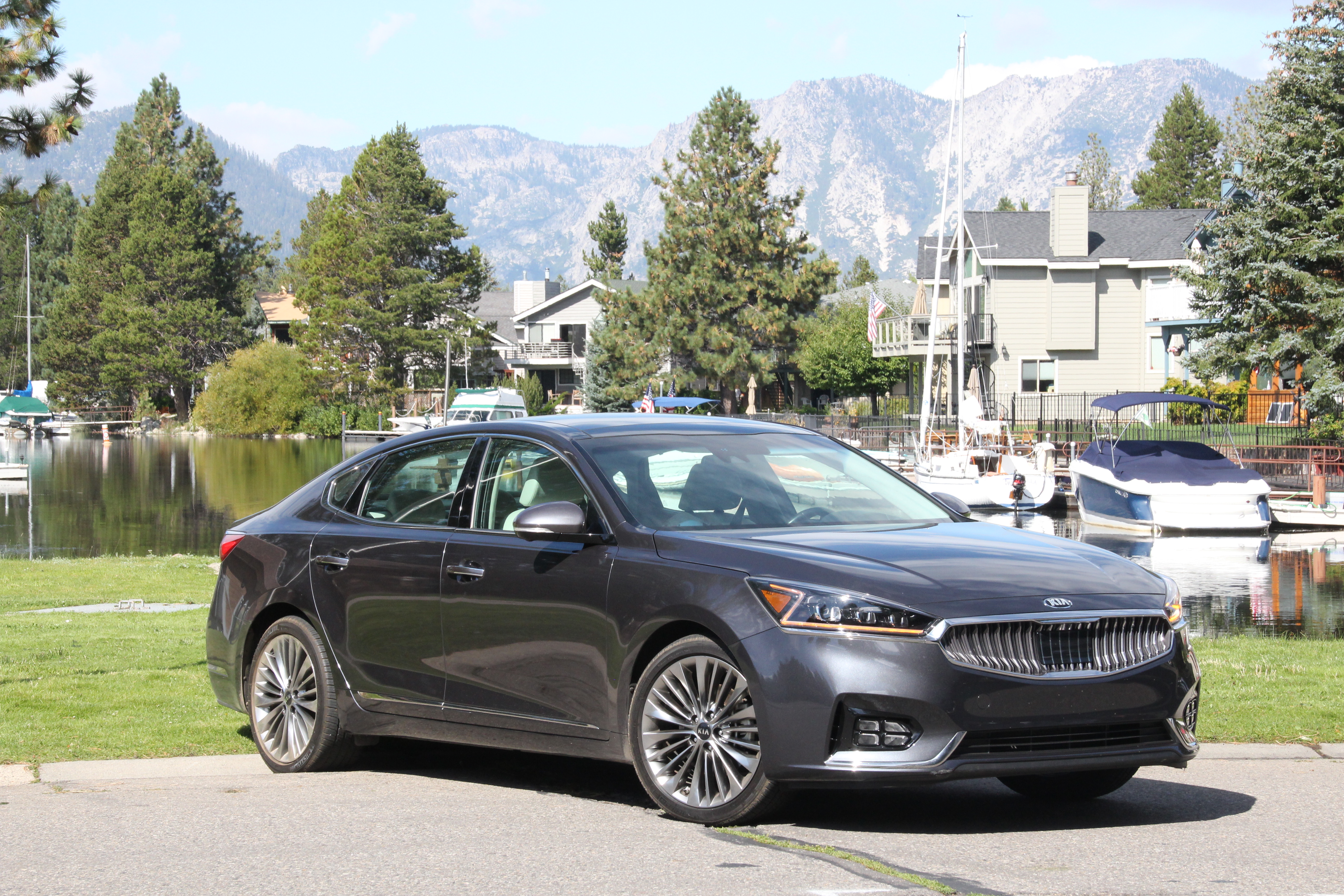
Road Beat: Kia Cadenza, near luxury super value

The Kia Cadenza is comfort and performance in one. Photos/Larry Weitzman

By Larry Weitzman

A year ago, I sampled the new Kia Cadenza. I proclaimed that the Koreans are now out Japaneseing the Japanese in the car business, building cars of incredible quality and value, with super styling, comfortable interiors, astounding performance and remarkable fuel economy. While this all sounds like a puff piece for the Kia, it’s not. The numbers and pictures prove me right and their standard 100,000-mile powertrain warranty demonstrates their commitment to quality.

Nothing has changed with the Cadenza and that’s a good thing, as there would be nothing to change. That’s how perfect is the design of the Cadenza, which is a bit of an unknown in the marketplace and that’s too bad as it’s a beautiful ride. During my testing, anyone who sees it has extremely positive comments, like, “wow, what a beautiful interior” or “that car is really pretty.” It pretty well sums up the Cadenza, with its perfect proportions and tasteful, quality appointments. It’s a super midsize at 196-inches long, 74-inches wide and 58-inches tall while riding on a long 112-inch wheelbase. Inside is a full size 124 cubic foot interior with a massive 16 cubic foot trunk.

Under the Cadenza’s beautiful hood is a beauty of an engine, the 3.3L DOHC V-6 that belts out 290 hp at 6,400 rpm and 253 pounds of twist. It sends the power to the front wheels via an eight-speed cog-swapper. Usually with that kind of thrust you get torque steer and plenty of it, but not here. I don’t know how Kia does it, but this Cadenza drives so good, it almost feels like a rear wheel drive car, most people would never know. And the addition of paddle shifters hints of its sportiness.
Specifications
Price (with destination) $32,890 to about $45,290
Engine
3.3L DOHC, 24 valve V-6 290 hp A 6,400 rpm
253 ft.-lbs. of torque @ 5,200 rpm
Transmission
eight speed torque converter automatic with paddle shifters
Configuration
Transversely mounted front engine/front wheel drive
Dimensions
Wheelbase 112.4 inches
Length 195.7 inches
Width 73.6 inches
Height 57.9 inches
Track (f/r) 63.1/63.4 inches
Weight (18”/19” wheels) 3,633/3,799 pounds
Ground clearance 5.4 inches
Fuel Capacity 18.5 gallons
Cabin interior volume 107.8 cubic feet
Trunk volume 16.0 cubic feet
Turning circle 37.2 feet
Steering lock to lock 2.71 turns
Wheels (std/opt) 18X7.5/19X8.0-inch alloys
Tires (std/opt) 245/45X18/245/40X19 inch radials
Performance
0-60 mph 5.94 seconds
50-70 mph 3.15 seco9nds
50-70 mph uphill 4.71 seconds
Top speed Way beyond sanity
Fuel economy EPA rated at 20/28/23 mpg city/highway/combined. Expect 34 mpg in highway driving at legal speeds and 25-26 mpg overall in suburban/rural driving.

And the performance is world class with a 0-60 mph time of 5.99 seconds. Passing times also reflect world-class performance with a level simulated pass taking 3.02 seconds and the same run up a grade only slowing that time to 4.66 seconds. This Cadenza flies.

Fuel economy is also remarkable. While the EPA numbers are 20/28/23 mpg city/highway/combined, in the 400 miles of varied driving the Cadenza averaged 26.8 mpg with just 20 percent spent on a four-lane highway. At a constant 70 mph, the Cadenza averaged 35.8 mpg and in a 210-mile run over the Sierra to Carson City the average was 30.1 mpg. Part of this is due to the eight-speed tranny keeping engines speeds low, just 1,900 rpm at 70 mph. And with its 18.5-gallon fuel tank (another bonus), 600 miles nonstop is in the ball park, depending on your range.

Suspenders are state of the art four wheel independent and the electric steering rack is a quick 2.7 turns lock to lock. Add to that 19 x 8 inch wheels shod with wide 245/40 series rubber and you have a handler as well as a magic carpet ride. Yes, it is sprung a little less than firm, but in sport mode it is amazing with crisp turn, accurate steering and amazing grip. It does exhibit some body roll but not significant as this Cadenza will exceed most all driver’s abilities except for maybe Jeff Gordon at Laguna Seca but then he would effectively demonstrate just how good the Cadenza can perform. Turning circle is good at 37 feet.

Yet it rides like the aforementioned magic carpet with exceeding quiet and comfort. This is a think in a whisper car. It has a super compliant ride and no float.

Braking is strong and every acronym is present down to lane departure warning. LED headlights are very good. A special mention needs to be made about the surround view monitor. It is amazing, at speeds below about 10-15 mph it displays a 360-degree view of what’s around your vehicle. In tight parking situations, nothing should ever touch this vehicle and the beautiful finish should always remain perfect.

Inside is another area where the Cadenza shines. The Nappa leather interior is not only butter soft, but spectacular. The quilted bolsters are Ferrari like and the comfort would make me want to have this seat as my office chair. And while they are, of course, heated and cooled, the leather is perforated as well, for added style and comfort, as if they weren’t comfortable enough. It’s one of the inviting interiors of any car. Rear seating is also spectacular. Leg room would fit a giraffe, never mind the front line of the June Taylor dancers.

Instrumentation is also excellent with a tasteful binnacle with all the right gauges and a center info display that has three trip meters, a nice feature for a techno and data junkie like me. It also has a beautiful center stack with enough buttons and knobs without being cluttered and make controlling all its HVAC and sound system functions easy. And what a sound system it is. If you can’t get to Carnegie Hall, just sit in this Cadenza. And I guarantee the seating will be much more comfortable.

So where does that leave us. Here’s the amazing deal as Cadenza’s start at just over $32,000 and they are beautifully equipped including leather in the base car. If you are thinking any upgraded midsize sedan, you have to look at Cadenza. The base model will blow you away. But my super luxo SXL model stickers for $44,390 plus $900 for the luxury suite on the boat from Hwaseong, Korea. This is a vehicle that is not advertised heavily, if at all and should not be overlooked by any midsize car buyer. It is an incredible value.

Larry Weitzman has been into cars since he was 5 years old. At 8 he could recite from memory the hp of every car made in the U.S. He has put in thousands of laps on racetracks all over the Western United States.

Wilderness waterfall worth the walk

Galena Creek falls in September. Photo/Kathryn Reed

By Kathryn Reed

INCLINE VILLAGE – Waterfall season is usually a late spring ritual. Not this year.

With the abundance of snowfall last winter in the Sierra, it meant water flowing long past when it normally would be a trickle.

Taking advantage of a Sierra Club hike, I ventured with a group to the Galena Creek waterfall in the Mount Rose Wilderness several weeks ago. What a treat. I didn’t even know this 60-foot high waterfall existed until then.

In mid-September it was more like summer hiking. With this weekend’s storm, it’s hard to know what the access will be like or if snowshoes would be the better choice of footwear.

Part of the hike is along the Tahoe Rim Trail. From here it’s also possible to get to the summit of Mt. Rose.

Lake Tahoe is visible near the start of the hike. Photo/Kathryn Reed

It didn’t take long for expansive views of Lake Tahoe to come into view, along with the meadow that spans both sides of the highway. Winding around, the south part of Reno then comes into view.

The guide points out Tamarack Lake to our right, which through the trees could easily be missed. Tamarack Peak (9,897 feet) is nearby, though Mt. Rose (10,776 feet) is the most dominate feature as it looms large for much of the walk.

It’s a single-track trail that at times is wide-open and other times is closed in by the forest.

While beauty is everywhere, the waterfall really is what makes this hike so outstanding. Looking at the rocks, it’s easy to imagine how thundering the water must have been in the summer. It makes me want to return next year, closer to peak flow.

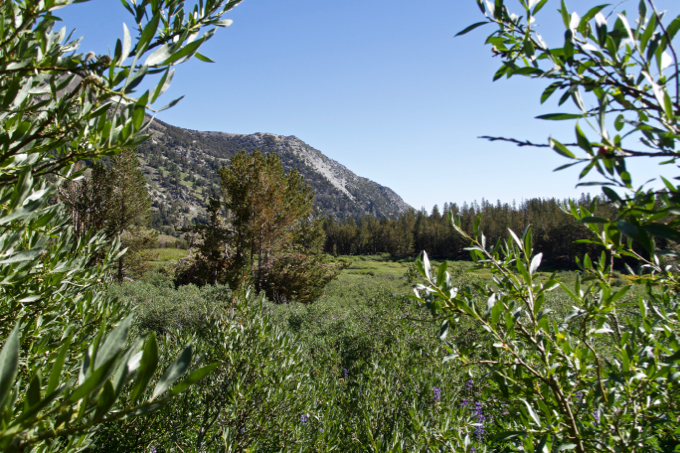
Looking in the other direction is a lush, verdant meadow fed by these waters.

To the waterfall it was 2.4 miles, a 557-foot elevation gain, and 328-foot elevation loss. Our guides took us a bit farther, through the meadow with its gentle creek and wildflowers still vibrant. This added about another mile to our trek.

It had been a while since I had hiked with a group of mostly strangers. On the one hand it’s nice to meet others and be led, on the other hand the pace is inevitably slower and dogs are less likely to be allowed off leash. Still, the Sierra Club is to be commended for offering these free hikes and allowing non-members like myself to participate. All that’s asked is a $1 donation that goes for the guides to get first aid training without out-of-pocket costs.

A lush meadow is fed by Galena Creek. Photo/Kathryn Reed

—–

Getting there:

From South Lake Tahoe, go east on Highway 50. Go left onto Highway 28 at the top of Spooner Summit. At the roundabout in Incline, go right onto the Mount Rose Highway. Park at the summit on the left. The trail starts to the left. The starting elevation is 8,911 feet – the highest year-round pass in the Sierra.


Opinion: EDC may oppose federal tax plan

Publisher’s note: On the Nov. 7 El Dorado County Board of Supervisors agenda is a recommendation from CAO Don Ashton for the board to consider sending a letter similar to the one below to representatives opposing the House-passed federal budget resolution that would allow Congress to use a simple majority vote to eliminate the State and Local Tax (SALT) deduction on federal tax returns.

Dear Members of the California Congressional Delegation:

As Congress considers options for comprehensive tax reform, the California State Association of Counties (CSAC) urges you to preserve the tax exemption for municipal bond interest, as well as the state and local tax (SALT) deduction. These essential and longstanding components of the tax code support vital investments in transportation, water, housing, and other public works projects.

Municipal bonds are the single most important tool for financing public capital improvements and critical infrastructure projects such as roads, bridges, schools and hospitals. Under current law, investors are not required to pay federal income tax on interest earned from most bonds issued by state and local governments. The effect of this tax exemption is that local governments receive a lower interest rate on their borrowing than they would if their interest was taxable to investors. Over the past decade, municipal bonds have helped local governments finance more than $3.8 trillion worth of projects nationwide. Last year alone, over $445 billion in municipal bonds were issued to fund projects across the country.

Any proposal to cap, or even eliminate, the exemption on municipal bond interest would, if enacted, result in higher borrowing costs for local governments. At a time when infrastructure demands are great, increasing the cost of financing could have serious impacts on state and local economies.

Furthermore, as the nation’s largest issuer of municipal bonds, California would be disproportionately impacted by any such changes.

Another priority for counties in tax reform is protecting the SALT deduction, which allows taxpayers to deduct state and local taxes from their federal taxable income. This benefit, which has been in place since 1913, provides counties with some measure of autonomy over their own tax systems and also incentivizes local investment in long-term infrastructure projects and various county services.
Similar to the tax exemption for municipal bonds, the loss of the SALT deduction would be particularly detrimental to California, where more than 6 million households claimed the deduction in 2015. It should also be noted that nearly 83 percent of those who benefit from this deduction in the state are families earning less than $200,000 in annual household income. CSAC is concerned that eliminating this deduction would increase the tax burden on middle-class families and hurt our local economies.

Again, CSAC urges you to reject any proposal that would alter the tax‐exempt status of municipal bonds and the deductibility of state and local taxes. Any such change would have ramifications for both California taxpayers and local governments.

Sincerely,

Matt Cate, CSAC executive director