Lake Tahoe’s history can never be history

By Susan Wood

“Neither the life of an individual nor the history of a society can be understood without understanding both,” wrote C. Wright Mills, an American sociologist and intellectual.

Mills, who taught at Columbia University right up to his death in 1962, was concerned with the citizens’ responsibilities in post-World War II society – a milestone in the modern world. Knowledge and power: He believed that knowledge was the crucial element to social change, and critical thinking was the means of obtaining this crucial knowledge.

In other words, introspection can help us learn from our mistakes, advocate for what worked and know more about ourselves in the given time period. 

It’s the reason preserving our history is critical.

And in our little microcosm of a world in the Sierra Nevada, it’s the reason to support the Lake Tahoe Historical Society in its quest to hold onto the artifacts and writings of the region.

This year, the society celebrates a half century of peering through that looking glass. For the monumental occasion, a major fundraiser called Chautauqua at Lake Tahoe featuring Duane L. Bliss, George Whittell and Lillian Virgin Finnegan is slated for 7pm Aug. 18 at Lake Tahoe Community College.

“We all want to know where we came from, and why we’re here,” said South Lake Tahoe resident Carol Olivas, who’s lived here for about five decades.
Diane Johnson is key to preserving South Shore’s history through the Lake Tahoe Historical Society. Photo/Susan Wood

Truckee historian Chaun Mortier agreed.

“As a people, we are curious about our roots. A vast majority of Americans are American because they were born here, but their ancestors are from many other countries. We can understand our bloodlines because of preservation,” she said.

Mortier believes preserving history is “preserving a timeline of our own selves and those that came before us.” 

The evidence can be good and bad.

Our history is everywhere

Still standing are murals dotting the landscape, tables and shelves holding hundreds of books about Tahoe and walking tours provided by curators of oral history. At the museum off Highway 50, there’s the Osgood Toll House marking the oldest commercial building in South Lake Tahoe.

And still around is a founding board member, 96-year-old Betty Mitchell.

Mitchell believes wholeheartedly in the mission to preserve the history of her town, her region and her country. 

“The simple way to put it is: If you don’t know where you’ve been, how will you know where you’re going?” she asked Lake Tahoe News while relaxing on the deck of her home with a million-dollar view of Heavenly Mountain Resort.

“I don’t know if we do, as I look back. We seem to make the same mistakes as we go to war. Taking up arms I guess is the easy way out,” she said. “Those things are important, but I’m reminded, the nonsensical things are important.

“I’m proud of the Lake Tahoe Historical Society. There was probably a lot more we could have done, and they had a lot they wanted to do,” Mitchell said, declaring she got involved because she was “a history buff.”

“I just stuck my nose in there,” she said with a giggle. She sat back in the lounge chair, gazing over the landscape with a pensive glance.

What was the memorable time relative to the preservation of Lake Tahoe’s history – redevelopment, political climate, tourism?

“Those early years,” Mitchell said, not missing a beat.

The South Shore has endured and conquered its share of challenges during its evolution. The city, for one, celebrated its own 50th anniversary a few years ago. So did Barton Health. Lake Tahoe Community College (not quite 50) started in a hotel room – appropriate for a tourism-based place. The winter of 1951-52, in which residents were snowed in up to their second-story windows, became the testament to a community banding together.  

There was something about the 1950s leading into the civil uprising of the 1960s. The nation tried to regenerate after a civilization-defining war that preserved our way of life, only to enter into another that divided us and challenged our trust in government.

To the society’s Executive Director Diane Johnson, our history is the best learning tool. It grounds us and forces us to evaluate the vehicle that delivers our chronology.

A reference for the ages

What’s important is more than a reference. It’s a reference we can believe in.

 “Everybody has a voice now. Some have a megaphone, but does that make it right?” she asked.

When someone brings in a piece to donate to the museum, Johnson finds she studies it with a more discriminating eye. She’s part historian, part administrator, part fact checker. 

“I don’t know who would use it in the future. I don’t make that assumption. Still, to actually have it as a source (is necessary) because you never know when possibly we need it again,” she said.

The museum is filled from floor to ceiling with valuable artifacts and writings that define us as a people.

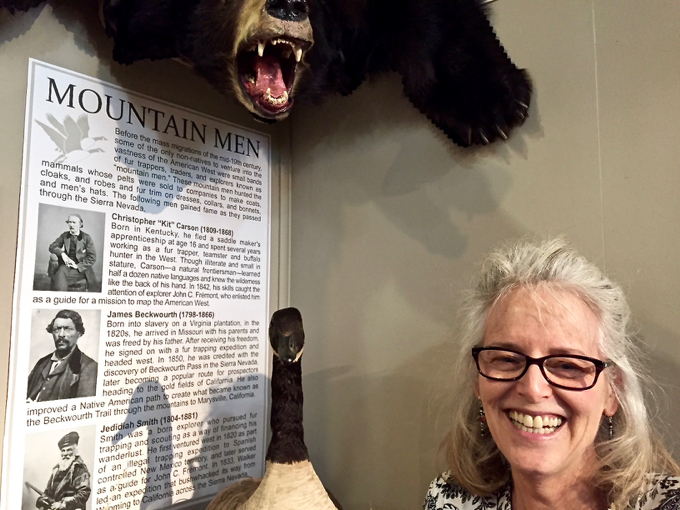
Johnson recoiled as she was reminded one man came into the museum and questioned whether James Beckwourth (who happens to be black) should be taking his place alongside the likes of Jedidiah Smith in the display commemorating notable mountain explorers. The notion of singling out a minority stuck with her.

What does this say about us?

“I’m concerned we’re leaving people out and creating a one-sided history,” she said, referring to the disenfranchised.

Truth in diversity is not always shared.

She applauds activists preserving the online pages taken down by the federal government because it doesn’t suit the current agenda.

“Our history is in danger. For example, will we ever return to common decency and compassion?” she questioned.




Opinion: Colluding with California’s Russian

By Joe Mathews

Take my guilty plea, Mr. Mueller. Because this Californian is colluding with a Russian.

Specifically, that most alluring of Russians, the Russian River, which seductively winds through Mendocino and Sonoma counties to the Pacific. Traveling the length of the Russian—as I recently did—reminds you that California and Russia are too intertwined for scandal to keep us apart.

Joe Mathews

Russian interference in California is older than the state itself. Our state’s top industries, entertainment and technology, have been defined by Russian emigres from songwriter Irving Berlin to Google’s Sergey Brin.

Then there is the mystical connection between California and Russia, two of this planet’s greatest puzzles. Each territory is considered too vast, and its people too strange, to ever be truly understood. Winston Churchill famously called Russia “a riddle wrapped in a mystery inside an enigma”; anyone familiar with California’s governing system knows that those words apply to the Golden State too.

On my excursion, I stopped at Fort Ross, a Russian settlement established in 1812, an eventful year for invasions, with Britain attacking the United States, and the Russians repelling Napoleon—a victory so great that Tchaikovsky’s overture about it is performed each summer at the Hollywood Bowl. The Russians’ presence gave the river its name.

The Russian-American Company, which established Fort Ross, constructed the first windmill and first ship ever built in California. But like so many California arrivals, the Russians found the cost of living was high, and business ventures unprofitable. So in 1841 the Russians sold off Fort Ross, like a failed startup, to John Sutter, who had all the assets hauled to Sacramento.

Ever since, the cover story has been that the Russians abandoned California to Mexicans and then the Americans. But California actually made the fort larger and turned it into a state park. In recent decades, with tens of thousands of tourists visiting from the motherland, Fort Ross sees far more Russians than it ever did under Russian rule.

From Fort Ross, I drove back to the river in tiny Jenner. There, the Soviet Union’s hammer-and-sickle flag flies over a restaurant, Russian House #1.

The restaurant’s founders, Tatiana Ginzburg and Polina Krasikova, are Russians, who split time between Sonoma County and St. Petersburg. Ginzburg, a psychologist, explained that the restaurant is really “a space for dialogue between two great cultures and peoples.”

It also challenges capitalist thinking. There is no menu, no prices, and no bill—you pay what you think is right, in a bowl by the door.

Ginzburg’s work draws from the 20th century Russian mystic G.I. Gurdjieff, who taught that many humans are “asleep” and thus behave as unconscious automatons who are easily manipulated into thoughtless horrors, like world war. But through dedicated work, humans can ascend to a higher state of consciousness and become more fully human.

Gurdjieff was a composer as well as a spiritual master, and the restaurant has a piano and a harp, and hosts events. It also contains puzzles of various kinds. The word for puzzle in Russian is “Golovolomka,” she noted, “which means something that will break your head.

“Our intention is to create a new type of being,” she said, adding as she left for a rebirthing: “There is a connection here on the river, between Russia and this place.”

After perusing the restaurant library, with titles from Le Carré to Dostoyevsky, I thought about connections as I continued my river trip. There is a magic in the scale of the Russian landscape or the giant trees of the Redwoods State Natural Reserve. The dachas there might be the large Wine Country estates here. And then there’s the joy of carousing. Russia runs on vodka, and the Russian River on wine.

As I drove, the radio was full of reports on Russian interference in American democracy. The maddening news put me in mind of Leo Tolstoy’s “War and Peace,” the massive Russian novel of that 1812 French invasion. “Those whom God wishes to destroy he drives mad,” Tolstoy wrote.

He also wrote about love and enemies: “Someone dear to one can be loved with human love; but an enemy can only be loved with divine love.” When we see God in those we fight, Tolstoy explained, we achieve a love that, “nothing, not even death” can shatter.

I don’t love authoritarians who attack democracy and innocent people.  But Putin is not Russia, and America is not Trump. And at least I was questioning my consciousness, as the women at the Russian House #1 advise.

I don’t know what I was thinking when I reached Healdsburg and walked to a beach beside the river. But for some reason I removed my shoes and waded into the Russian.

The water was warmer and deeper than I had expected.

Joe Mathews writes the Connecting California column for Zócalo Public Square.


DUI checkpoint Saturday on South Shore

The California Highway Patrol will be conducing a sobriety checkpoint on the South Shore on June 30 from 8pm-2am.

The sobriety checkpoint will be staffed by a team of CHP officers who will be controlling traffic, evaluating driver’s sobriety, and hand out literature warning of the dangers of drinking and driving. Driver’s license checks will be conducted and appropriate enforcement action will be taken.

Approximately two hours prior to the implementation of the checkpoint, officers will reveal the exact location.


Travel industry rolling out the rainbow carpet

By Elaine Glusac, New York Times

Once the LGBT Memorial in New York City opens, which is expected this month, its designer, the multimedia artist Anthony Goicolea, plans to offer personal tours of the site in Hudson River Park through Airbnb’s Experience tours, exploring its composition of nine stones, some bisected by prismatic glass that radiate the colors of the LGBT flag.

“I’ll go over aspects of it that are not readily visible,” said Goicolea, including the fact that is it oriented toward the Statue of Liberty in a salute to equal justice.

This month is Pride month, a celebration of the gay, lesbian, bisexual and transgender communities, and a time when the travel industry rolls out the rainbow carpet in special hotel and travel-related packages.

Read the whole story


Douglas County manager calling it quits

Larry Werner

Douglas County Manager Larry Werner is resigning effective Aug. 31.

Last September the board on a 3-2 vote extended his contract to Dec. 31, 2019.

Werner has been at the helm of the county since February 2016 when Jim Nichols and the commissioners parted company. Werner’s stint was originally supposed to be an interim appointment, but evolved into something more. He also served as interim in spring 2014.

In a statement he said, “I know that it is time for me to pursue retirement and family, but I will miss working with the great people in this community in this capacity.”

Commissioners on July 5 are expected to discuss what to do next. 

— Lake Tahoe News staff report


List of reported victims at SLT child care center grows

More children have come forward alleging they were sexually assaulted at a South Lake Tahoe child care facility.

Since David Rodriguez-Flores’ arrest on June 20 police officers said more victims have been identified. How many has not been released. Nor have their ages or genders. Police said the new information points to “a pattern of abuse dating back at least two years.”

The initial charge pertained to what police described as an “on-going possible child sexual assault that had occurred at the Pequenos Rascals Learning Center located at 3336 Sandy Way.”

The California Department of Social Services’ Community Care Licensing Division has closed the facility.

The SLTPD is requesting anyone who has concerns that their child may be a victim to contact SLTPD at 530.542.6100.

— Lake Tahoe News staff report


10 gallons of sewage reaches Fallen Leaf Lake

By Kathryn Reed

Precautionary signs are up at Fallen Leaf Lake after 10 gallons of raw sewage entered the lake early Friday morning.

“The signs will be removed once the water quality at the spill site is at the same baseline level as water found at other points around the lake,” South Tahoe Public Utility District lab director Dan Arce told Lake Tahoe News.

Fallen Leaf Mutual Water Co., which supplies the drinking water to the South Shore enclave, did not return calls. Lahontan Regional Water Quality Control Board, which oversees water issues, also could not be reached.

At 4:40am June 29, the district’s lab took water samples at the point of entry, 60 feet into the lake, and 60 feet east and west along the shore of the spill. All four samples resulted in no detectable levels of ammonia.

STPUD confirmed a sewer blockage at 369 Fallen Leaf Lake Road after getting a call from a customer at 7:44pm June 28. District personnel found a sewer blockage on the private sewer lateral with some spilled sewage pooling around the private manhole.

The plan was to work until the block was cleared in order to minimize damage. At midnight, the blockage was cleared and the backed up sewage gushed downhill through the sewer lateral. The rupture overloaded the district’s vactor truck, which was at the downhill manhole to suction out the overflow. This is when the 10 gallons reached the lake.

“Our crew realized that once the line was unplugged, a freight train of sewage would flow downhill and surcharge the district’s manhole at the bottom of the hill. This particular manhole sits only 10 feet from the edge of Fallen Leaf Lake,” district General Manager Richard Solbrig said in a statement. “The crew’s foresight to station the district’s vactor truck at the downhill manhole, resulted in 99 percent of the sewage overflow to be captured.”

The district predicts if a private plumber had unblocked the clog, that the manhole cover would have been blown off and 1,800 gallons of sewage would have inundated the lake.

“When a sewage blockage is cleared, a rake is put into a downstream manhole to try and catch whatever was causing the blockage and prevent further issues. In this case, a chunk of asphalt the size of a golf ball was removed,” Shelly Thomsen with STPUD told LTN. “There may have been more that got past the rake. We don’t know how the asphalt got into the private sewer lateral. It could have been vandalism, as most manhole covers aren’t locked.”


Gear and beer talk in South Lake Tahoe

Tahoe Rim Trail Association is partnering with Sidellis of Lake Tahoe for an afternoon of gear and beer.

The July 15 event will be from 2-5pm at the South Lake Tahoe brewery..

It’s an opportunity to check out a variety of different gear options for camping, backpacking, and day hiking while sipping on a beer. 

Sidellis is donating a dollar from every (non-specialty) pint to the TRTA.

For more info, go online.


USFS has plenty of rules for July 4 period

The Fourth of July holiday period signifies the busiest time of year in the Lake Tahoe Basin.

The U.S. Forest Service Lake Tahoe Basin Management Unit is instituting the following annual alcohol bans:

·         Nevada Beach on July 4, from 6am until midnight.

·         Zephyr Cove Resort and Zephyr Shoals (former Dreyfus Estate) from June 30 through July 8. This prohibition has been extended for public health and safety and resource protection.

·         Chamber’s Landing Beach from July 1 through July 6.

To ensure compliance, these areas will be patrolled by law enforcement personnel from the Forest Service, state and local law enforcement, and private security staff. 

Possession of fireworks of any kind, including firecrackers and sparklers, is illegal in the Lake Tahoe Basin. Campfires and charcoal fires are only allowed in metal fire rings or stand-up grills provided at developed recreation sites. Campfires, bonfires and portable charcoal grills are not permitted on National Forest beaches, in Desolation Wilderness, Meiss Country or along Genoa Peak Road and the Tahoe Rim Trail. Gas or propane stoves are allowed in all areas with a free, valid California Campfire Permit, available at any Forest Service office.

Expect extremely crowded conditions on local roads, highways, parking lots and around restrooms and portable toilets.

Due to the influx of visitors, mobile device networks may be overwhelmed and mobile phones and other devices may not work in some areas. Develop an alternate plan to contact family and friends and have an emergency plan in place in case you cannot call for help.

Expect Lake Tahoe beaches to be much narrower than in previous years. Some beaches with vegetation or rocky shoreline may be inaccessible.

Consider public transportation, or walk, carpool, or bicycle to avoid limited parking in crowded recreation areas, heavy traffic and delays after the firework displays. At developed recreation sites, such as Kiva, Tallac Historic Site, Taylor Creek Visitor Center, Echo Lake and Angora Lake resorts parking is allowed only in designated parking spaces inside the parking lots, not along the roadway.

Day-use parking fees for July 4 at Pope, Baldwin, and Nevada beaches will be $30 and at Zephyr Cove Beach $40 to cover increased security and facility maintenance costs of the holiday.

Dogs are not allowed on National Forest designated swim beaches including Nevada, Pope, Baldwin, Meeks Bay, and William Kent. Leashed pets are welcome at Kiva picnic area from the Valhalla Boathouse/Pier to Tallac Point and Echo Lakes on the South Shore; Zephyr Shoals, Hidden and Chimney beaches on the East Shore; Coon Street Beach (at the boat launch) in King’s Beach; Kaspian and 64 acres beaches in Tahoe City.

Trash cans will become full, so plan ahead and keep in mind that Forest Service staff will be handing out trash bags at many recreation sites. Become part of the solution by packing out your own garbage.


Incline prepping for busy holiday week

The Washoe County Sheriff’s Office and the Incline Village General Improvement District are warning people that Incline Village will be crowded Fourth of July, plus there will be temporary road closures.

The following traffic and parking controls are planned for June 30-July 5:

  • Road closures on July 4: Lakeshore Boulevard will be closed on July 4 between Village and Country Club from 8pm until after the fireworks display.
  • One-way traffic on July 4, 5am-11pm: Lakeshore Boulevard from Village Boulevard to Country Club Drive (west to east). One lane will be used for loading and unloading only. Incline Way from Country Club Drive to Southwood Boulevard (east to west).
  • No parking areas: There will be no parking on Village Boulevard (Southwood Boulevard to Lakeshore Boulevard) and Lakeshore Boulevard (Village to Country Club) from June 30-July5. There will be limited handicap parking available on Lakeshore Boulevard in front of Incline Beach gate.

Don’t want to hassle with parking? Ride the free shuttle to the IVGID beaches: July 3: 10:30am-9:40pm; July 4: 10:30am-11:40pm. Must have valid beach access to use the shuttle service.

Access to all IVGID beaches is restricted to valid IVGID beach access to picture pass holders and their guests only.