Snippets about Lake Tahoe

·       Truckee Planning Commission will have a public hearing on Nov. 21 at 6pm on the proposed Capitol Avenue Grocery Store development permit. The meeting will be at the airport.

·      The Community Christmas Concert is Dec. 21 at 6:30pm at Olympic Valley Lodge.

·      Hard Rock Lake Tahoe is planning to have a New Years’ Eve Countdown Party on Dec. 31 from 9pm-12:30am out at Guitar Plaza.

·      State Sen. Ted Gaines, R-El Dorado, earned an A grade for the 11th year in a row on the Howard Jarvis Taxpayers Association’s 2017 Legislative Scorecard, which grades lawmakers on their votes on issues related to taxpayers.

·      Bread & Broth’s annual free Thanksgiving dinner will be Nov. 20, 4-6pm at Grace Hall at St. Theresa’s Catholic Church in South Lake Tahoe.


Storm affects Incline schools; flood warning in Tahoe

Incline Village schools are on a two-hour delay Thursday morning because of a power outage and slick roads.

The National Weather Service in Reno has issue a flood watch for South Lake Tahoe, Stateline, Incline Village, Truckee, Portola, Susanville, Bridgeport, Mammoth Lakes, Sparks, Gardnerville, and Virginia City through Nov. 16 at 10pm.

“Periods of moderate to heavy rain will continue today as an atmospheric river system moves through the region,” weather officials said.

A winter storm warning for the region is in effect until 4am Nov. 17.

“Plan on difficult travel conditions. Expect damage to trees and power lines as well. Additional snow
accumulations of 1 to 3 feet above 7,500 feet. Accumulations below 7,500 feet are more uncertain due to variations in snow levels today, but accumulations up to 6 inches are possible this morning near 6,500 feet, with 6 to 12 inches between 6,500 and 7,500 feet,” the Weather Service said.For road conditions, click on the state icons on the home page of Lake Tahoe News.

— Lake Tahoe News staff report


Lakefront home demand alters building schedule

By Susan Wood

In a matter of minutes, the Douglas County Planning Commission took a 15-year concept and paved the way for more lakefront property to be sold at Stateline – a rarity in Tahoe that could be a reflection of a flourishing housing market.

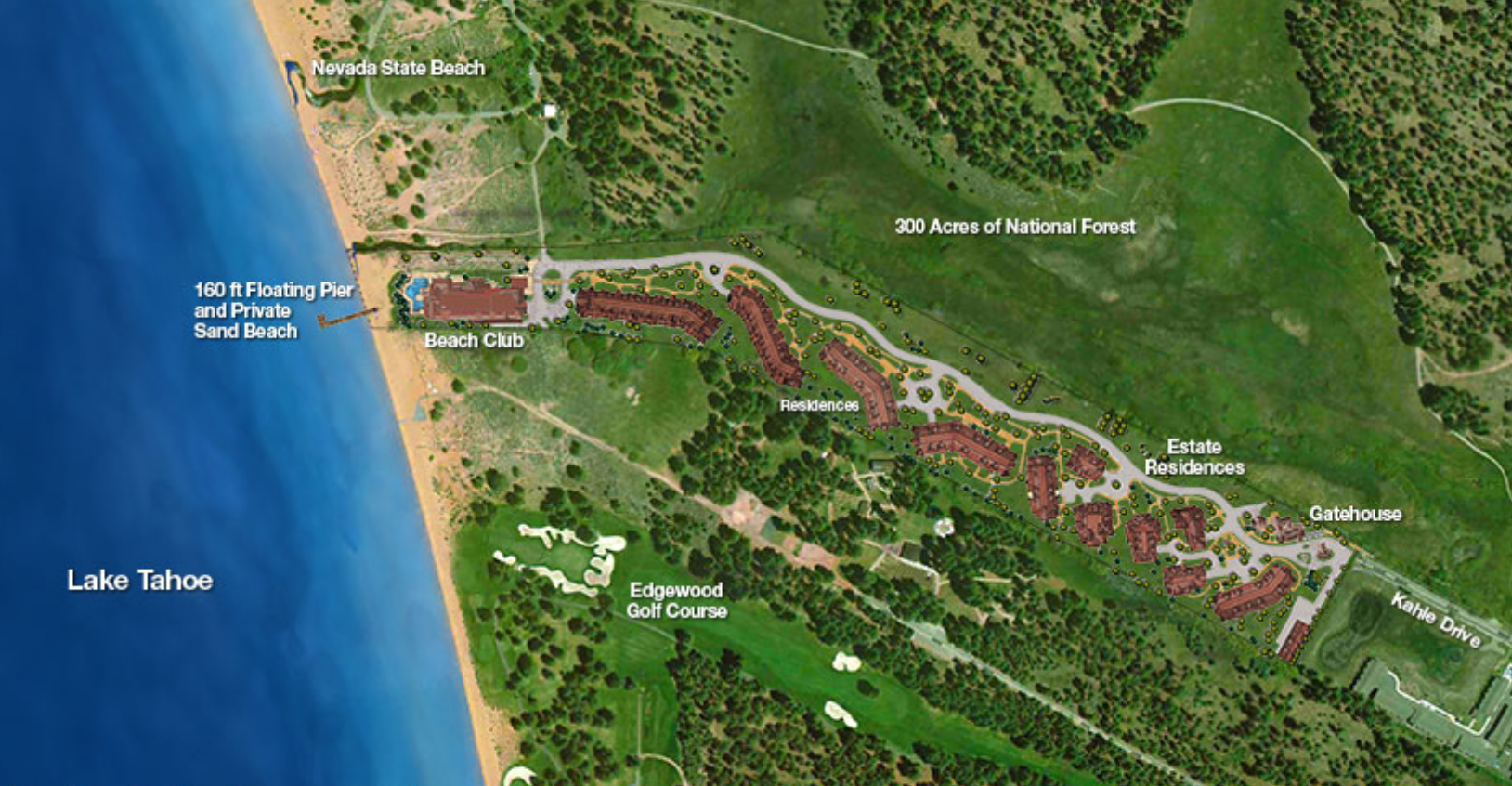
The first of three phases of the Tahoe Beach Club condominium project envisioned in 2002 had called for 46 units where the Tahoe Shores Mobile Home Park once sat at the end of Kahle Drive.

While anticipating the county Board of Commissioners will accept planning’s recommendation in December to change the tentative map, the Beach Club is set for the number of units to increase to 101 in the current phase. The total number of 143 as well as the footprint of the project approved by the Tahoe Regional Planning Agency did not change with the Nov. 14 Planning Commission approval.

This plan revision is “something that can be done at staff level,” TRPA spokesman Tom Lotshaw pointed out.

Sales have been robust – with 37 of those first 46 one- to six-bedroom units already under contract with owners. Albeit considered a technicality in satisfying a Nevada Real Estate Division rule, the tentative map change allows more of two- to four-bedroom units to be built sooner. The units span from about 1,100- to 4,000-square-feet.

Tahoe Beach Club will be high-end housing designed as second homes.

More than $80 million in sales have been racked up since the whole-ownership condo concept started selling at $1.3 million and up. The overall 13-building project broke ground in August 2016. Looking ahead, owners are expected to occupy the five structures in the first and second phases by next fall, with reservations on Phase 2 opening near Thanksgiving, project developer Tom Castaneda told Lake Tahoe News on Wednesday.

The nearly 20-acre project also lists a clubhouse with athletic amenities, a swimming pool and stormwater treatment facilities. Two acres have been set aside for a stream environment zone. Scenic enhancements include the burying of power lines.

The project has come a long way since Castaneda and co-developer Bob Mecay invested in the property – one which may define location, location, location.

The land transformation brought a flurry of controversy to Douglas County over a decade ago because low-income residents were displaced and well aware of the bargain they had in the haven nestled between the pristine Nevada Beach on one side and the swank Edgewood Tahoe Golf Course on the other.

In looking back, Castaneda said he was glad the development team got through that process. Meeting after meeting was filled with crying residents. But a lot has happened since then. Some of the changes are reflective of a blossoming economy.

For one thing, Edgewood erected a hotel along the lake’s South Shore, complete with a patio and restaurant overlooking the lake.

Castaneda commended Edgewood for the development and sees no competition there when asked if having lakefront rooms in the same neighborhood deters his sales in any way. 

“I think they’ve done a wonderful job. The location is el primo, but it’s a whole different thing. Do you want to live in a hotel room or do you want to own a piece of real estate? And, you can’t leave a hotel room as a legacy for your kids,” he said, adding: “There are a lot of reasons to wanna own in Lake Tahoe. It’s a lifestyle, and we’re creating a lifestyle.”

The entire length of Kahle Drive is expected to be overhauled in what planners call a complete street. Douglas County commissioners have an item on their agenda today about that project. They meet this afternoon in Stateline.


Opinion: It’s not safe to hide from the world

By Brie Loskota

In the midst of the Second Intifada, in summer 2001, I was living in the dorms at Hebrew University in Jerusalem. Normally bustling streets were nearly empty. Signs in store windows offered discounts for the “brave tourists” who ventured inside despite the growing violence and tension. Being constantly on alert exhausted me, a short-term visitor insulated from many of the complexities of what was unfolding.

So I was relieved when I left the escalating tensions in Israel in August for the relative tranquility of Spain. And a week later, on the TV in my hotel room in Madrid, I saw a Jerusalem neighborhood I knew well turned into a chaotic mess by a suicide bomber.

I felt like I had dodged a bullet. 

A month later, I was back in the United States, living in Los Angeles, a place that feels safe to me, when terrorists crashed planes into the World Trade Center towers, the Pentagon, and a Pennsylvania field. Those attacks breached many Americans’ sense of national security in a way not known since Pearl Harbor. I had that same feeling I felt in Madrid a month earlier: A place I knew, New York, and buildings that I had been in, the Twin Towers, had been converted into a site of destruction and death.

Since 2001, I’ve felt this sense of dread and insecurity again and again. My work and research—understanding how religious communities are responding to the rapidly changing world—continue to take me across the globe, sometimes to violence-stricken locales.

I have traveled under armed guard with the Asia Foundation in Mindanao, Philippines, where a centuries-long conflict involving the Moro people in the Southern Philippines fighting against foreign governance later turned into a nearly 50-year-long separatist battle with different factions, bringing with it violence and terror attacks. On the first day of a trip to Nairobi in 2012, pregnant with my third child, I saw news of a shooting at a Sikh Gurdwara in Oak Creek, Wis. In 2014, my flight from Amman, Jordan, to Frankfurt, Germany, was loaded with refugees who had fled ISIS’s grotesque violence in Iraq.

As often as I travel abroad, it seems as if there are more and more attacks closer to home. At a school in Connecticut, a nightclub in Orlando, a work party in San Bernardino, and last month a music festival in Las Vegas, individuals or small groups have murdered scores of innocent people. It seems as if this sort of exceptional violence is no longer exceptional, whether you’re overseas or in relative safety at home.

My travels have taught me another thing: not to retreat. Yes, after a trauma like the massacre in Las Vegas, it’s tempting to run away from other people and the places where they gather. But through experience, I’ve learned that living in fearful isolation is actually far scarier than moving through potentially hazardous places where I am challenged to confront the unfamiliar and my own assumptions about safety and security.

My family has constantly worried about my travels since I went to Jerusalem in 2001. But I’ve come to worry just as much about them. When I went to Uganda in 2015 with the U.S. Institute of Peace’s Generation Change program, it was a few weeks before the fifth anniversary of the Al-Shabaab attack on a soccer stadium in Kampala where hundreds were killed and maimed. Several of the young Ugandans we were training as peace-builders had survived that attack.

But after a long day of training in Uganda, news jarred me from back in the United States. A young white man had slaughtered nine souls in a black AME church in Charleston, S.C. And that church violence wasn’t new. Three of my colleagues at the Center for Religion and Civic Culture at the University of Southern California are ordained AME pastors, including the Rev. Cecil L. “Chip” Murray, who was once so reviled by white supremacists that that they plotted to blow up Los Angeles’ First AME Church, where he was senior pastor.

Thankfully, the FBI foiled their plan, and Murray remained undeterred in confronting the perpetual sources of violence that his community faces. But that connection, as I sat in my Uganda hotel room taking in tragic news, made the attack on the Charleston AME seem more worrisome than any potential violence I faced overseas.

Of course, my worries are part of the problem. The violence we experience through the media often feels immediate and visceral, making our own surroundings feel unsafe. Thanks to our access to news around the globe, we can empathize with the victims of the shooting in Las Vegas and the truck bombing in Mogadishu, Somalia. And that is a critically important thing for all of us to do. The focus on unimaginably terrible mass casualty news events also distorts our ability to assess our own risk. It makes every place feel unsafe at all times.

Violence is too much a part of human lives, particularly in places that lack economic and other resources, when people do not feel like they have access to power or where they are excluded and targeted because of their racial, ethnic, gender, political, or religious identities. It is this everyday violence that truly plagues us.

But it is obscured by exceptional violence—the type where individuals wreak carnage on a large group of bystanders—which truly is exceptional even if it feels as though it is ever-present.

It’s easy to forget the many hundreds of days before and after my visit to Uganda when there was no major terrorist attack in Uganda.    

And even though it is exceptional, it is still far too frequent in the United States. There have been nine mass shootings in 2017 where a gunman indiscriminately killed four or more people in public. [BJL1]

Yet this exceptional violence can’t be allowed to control our actions. Threats and terror spread by white supremacists should not keep us from visiting black churches or standing with Muslim communities in the United States, just as fear of terrorist violence is no reason not to travel to Kampala, Jerusalem, Brussels, or Paris. And for people like me, whose work involves building peace and aiding people’s efforts to become architects of their own societies and to change the conditions that create violence, showing up is essential.

Human fears, of course, are no less real for being irrational. In my experience, I’ve found that preparing for the worst helps—getting trained for events, like how to respond to an active shooter, or learning vital skills like CPR or emergency first aid. I always know where my exits are. Preparedness goes hand in hand with the obligation to help, and a key way I navigate the world, not as an afterthought and not out of fear. I am more likely to use those skills to help someone having a heart attack or choking than to help a victim of exceptional violence.

When I returned home from my 2012 trip to Nairobi, during which a white supremacist killed six and wounded four others at a Sikh Gurdwara in Oak Creek, Wisconsin, I met with the leaders of a Sikh congregation in Los Angeles. We ate in the langar hall, where Sikhs prepare free meals daily as a service to those in need, a beautiful part of the Sikh tradition. I kept an eye on the door just about every second, trying not to be disrespectful to my hosts, who were eager to talk about how Sikhs could contribute to L.A.’s disaster response because of their daily mass meal preparation tradition. My hosts were alert, too, not only because of the Oak Creek massacre but because Sikhs have been targeted in violent attacks in the United States for decades. They also are prepared because their faith obliges them to help.

For those who aren’t in immediate danger, the point is not to ignore your fear but to put it into context, develop a sense of agency over it, and use that agency to fight the sources and conditions which bring about violence. Above all, we cannot let fear stall our progress, collapse our communities, or keep us at home. This is not tough talk. It is a vital strategy for a safer, saner world.

Brie Loskota is the executive director of the USC Center for Religion and Civic Culture.


Tipping not the norm for hotel housekeepers

By Tammy La Gorce, New York Times

 The tip does not have to be big — $1 to $5, says the American Hotel and Lodging Association. But less than a third of hotel guests leave any money for the housekeepers.

The hotel association publishes a gratuity guide on its website that offers suggestions for tipping everyone from valet attendants to bellhops.

But why are housekeepers often forgotten? A common explanation is that they are out of sight — that travelers are likely to tip only employees they directly interact with. But another cause may be a simple lack of awareness.

Read the whole story


Meston receives statewide firefighter award

Jeff Meston

South Lake Tahoe Fire Chief Jeff Meston earned the the Ed Bent Training Excellence Award in recognition of being the Outstanding Fire Instructor of the Year.

Each year during the California Training Officers’ Fall Training Symposium a fire service instructor is honored. The award was created many years ago on behalf of Ed Bent for his contribution as a founding father of statewide training and curriculum for the California Fire Service.

South Lake Tahoe City Manager Nancy Kerry stated, “I am not surprised Chief Meston was nominated and chosen for this award. Chief Meston has a rich history as an instructor, both with those in the fire service and citizens, throughout his career. Under his leadership, South Lake Tahoe Fire Rescue developed the city’s STAT program which trains our local citizenry on disaster response. He’s an exemplary leader and trainer and we are fortunate to serve alongside him here at the city.”


Powerful weather satellite will improve forecasting

The Joint Polar Satellite System 1 spacecraft is designed to ensure accurate weather forecasting. Photo/NOAA

By William Harwood, CBS News

The current three- to seven-day forecasts Americans have come to rely on for planning everything from weekend picnics to hurricane evacuations rely heavily on constant updates from satellites that orbit Earth’s poles measuring temperature, moisture and a host of other variables that define the planet’s ever-changing weather.

Early Tuesday, NASA launched the first of four state-of-the-art polar orbiters for the National Oceanic and Atmospheric Administration, a $1.6 billion weather satellite that will monitor the entire planet as it rotates below, feeding computer models the data they need to make increasingly accurate predictions.

Forecasters and climatologists say it is difficult to overstate the importance of the new satellite, which will join a once experimental and now aging weather station already in polar orbit to ensure uninterrupted service.

Read the whole story


MontBleu to be transformed into winter wonderland

The Barton Foundation’s ninth annual Festival of Trees and Lights is Nov. 30-Dec. 3 at MontBleu in Stateline.

Proceeds from the festival will benefit mental and behavioral health services.

Trees and wreaths will be decorated by local artists, there will be a children’s crafting area, photos with Santa, Teddy Bear Hospital, a gift shop, raffle prizes, and live entertainment.

The public viewing will be Dec.1 from 9am-1:30pm, and Dec. 2 from 10am-2pm.

Events include:

  • Nov. 30:  Seniors ages 55 and over may view the trees at no cost from 2-4pm.
  • Dec. 1: Family Night offers a viewing from 5-9pm, $25 for up to six people (children ages 2 and under are free), which includes a photo with Santa.
  • Dec. 2: The Gala is a black tie soiree including a five-course meal, a signature cocktail, dancing, plus silent and live auctions.
  • Dec. 3: Teddy Bear Brunch from 10am-noon; write a letter to Santa (who will be sure to write back), and make a visit to the Teddy Bear Hospital.

For more information or to purchase tickets, go online.


NDOT prepares for winter conditions in N. Nevada

Nevada Department of Transportation has been prepping since August to be ready for winter, which arriving this week.

NDOT begins annual winter preparations by readying more than 80 snowplows and other pieces of snow and ice equipment.

Approximately 40,000 cubic yards of salt and sand has been stockpiled in the area, ready to be spread for increased traction and safety. The sand is combined with salt and wetted with brine to create more dense sand that keeps roads ice-free at lower temperatures and will not as easily bounce off roadway surfaces. NDOT sand trucks calibrate the amount of salt and sand, spreading the mixture on roadways with extreme precision and efficiency.

The brine is a water solution of 23 percent salt that is produce in-house.

During major winter storms, crews work in 12-hour shifts, rotating personnel to provide 24 hour-a-day snow removal.

Officials report more than 2,000 crashes occur statewide every year due to unsafe driving in snow, ice and other wet conditions, such as driving too fast for conditions, following too closely, or failing to maintain a lane and overcorrecting.


Speaker to talk about Leadership Across the Mountains

Squaw Valley Institute in partnership with Squaw Valley Alpine Meadows presents Leadership Across the Mountains with Retired Rear Admiral Scott Moore and the Karakoram Group.

Scott Moore

Moore has overseen more than 2000 Navy seal combat missions worldwide. He also served as director of the Counterterrorism Division within the White House National Security Council and deputy director for Special Operations and Counterterrorism on the Joint Staff. He is the co-founder and a senior partner of the Karakoram Group, which focuses on coaching leaders, changing cultures and solving global security problems.

The Karakoram Group is comprised of former leaders from every level of our nation’s elite special operations units. Learn how to identify ways in which local businesses and leaders can optimize their operations and develop culture and collaboration across all levels of staffing.

Moore will speak Dec. 14 at 7pm at the Olympic Valley Lodge. Cost is $10, free to SVI members. Doors open at 6pm.