3 Dems tout reasons to represent Tahoe in DC
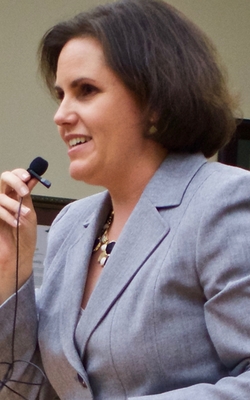
Regina Bateson has a doctorate in political science from Yale and was most recently teaching at MIT.

By Kathryn Reed

Flip the district blue. That is the goal of the three Democrats running for the 4th Congressional District, which includes the California side of Lake Tahoe and Truckee.

Candidates Regina Bateson, Roza Calderon and Jessica Morse spent more than two hours Nov. 16 sharing with more than 100 people at Lake Tahoe Community College why they should be elected next year to represent this area in Washington.

Roza Calderon is a refugee form El Salvador, and works as a geo-scientist for state and federal agencies specializing in agricultural and environmental land management.

Republican Tom McClintock has had the seat since 2009. Prior to him, Republican John Doolittle was in the office from 1993-2009.

The challengers have an uphill battle in a predominantly Republican district. But they have done something their predecessors have not done in previous election cycles, and that is to get the attention of the Democratic Party. It’s possible there will be state and national money flowing to the campaign to unseat McClintock, who in the past had not appeared to be vulnerable enough for those dollars.
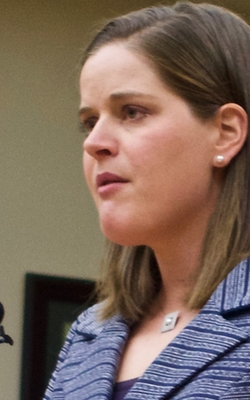
Jessica Morse is a fifth generation Northern Californian who has worked as a national security stategist for the U.S. State Department, Department of Defense and USAID.

Still, they offer voters much more than a change in party and gender. One is an immigrant who is a geo-scientist, one has taught at MIT, one worked as a national security strategist.

They were each asked what their plans are to flip the district.

Calderon: A strength is being a community organizer. She’s going after the Latinos who often don’t vote. She wants the money out of politics.

Bateson: A strong grass roots campaign is her strategy. She wants a pragmatic, practical approach to solving issues, and is visiting groups who are not allies.

Morse: She comes from a Republican family, so has started with a listening tour; she is addressing issues from a community perspective, not a partisan one.

The three agree on a few things:

·      They support the Second Amendment. They don’t want to take guns away. They do want stricter background checks.

·      They want a clean Dream Act to pass.

·      All believe more needs to be done to combat climate change.

·      None will take money from big corporations.

·      All mentioned fire and preventing one are two of the most serious issues facing this area.

·      Changing Citizens United is a goal.

·      The federal government needs to catch up with the states where cannabis is concerned; and rules need to be created so the marijuana industry can be part of the banking community and not just a cash business.

·      All will support the other to beat McClintock.

Then there are the differences:

·      Calderon and Bateson support a carbon tax.

·      Calderson does not support a total ban on fracking.

·      Morse believes broadband and vocational training will help with rural poverty.

·      Bateson and Calderon believe health care is a right.

·      Bateson wants to save and improve the Affordable Care Act.

·      Morse supports a single payer model for health care.

·      Morse believes teachers should be treated like doctors, paid six figures, there should be investment in vocational education and early education.

·      Calderon doesn’t want public funds to be used to compete against public education.

·      Bateson does not support public charter schools.

·      Calderon wants to strengthen unions and increase minimum wage.

·      Bateson says to expand the earned income tax credit, invest in smart infrastructure and be business friendly.

·      Morse advocates for broadband, green jobs, and access to vocational training.

·      Bateson would like to be on committees dealing with immigration, natural resources, and education and workforce.

·      Calderon wants to be on the education and workforce committee.

·      Morse is interested in the national resources, appropriations and intelligence committees.



Opinion: Can Calif. adopt Korea’s nuclear cool?

By Joe Mathews

Can Californians learn to be as cool as Koreans in the face of nuclear annihilation?

Visiting Seoul this month, I asked people how they stay sane while living within range of North Korea’s weapons. Kim Jong Un’s capital, Pyongyang, is 120 miles from Seoul—the same small distance protecting San Diego from Los Angeles.

Joe Mathews

Of course, South Koreans have been living productively under North Korea’s threats for six decades. For Californians, being North Korean targets is disorientingly new—because of the regime’s advances in nuclear warheads and intercontinental ballistic missiles.

North Korean propaganda has sown fears with specific threats against California and even animations of nuking San Francisco. The L.A.-area Joint Regional Intelligence Center last summer urged state and local officials to update nuclear attack response plans.

Talking to Seoul locals eased my nuclear jitters. “Keep calm and drink beer,” I was advised, in an alcohol-friendly Korean twist on the World War II-era British advice to “Keep calm and carry on.”

Indeed, the deepest worries I heard from South Koreans involved the reliability of President Trump, and whether he was truly committed to honoring the longstanding ironclad American commitment to protect South Korea even if it risked an attack on the United States. The North Korean escalation—through nuclear and missile tests—is often seen as posing a question to the United States: “Are you willing to trade Los Angeles for Seoul?”

But that question, while frighteningly linking the fates of California and Korea, is seen as mostly rhetorical in Seoul, a city so vital that its destruction is unthinkable.

Instead, South Koreans see the current conflict cynically—as a contest between a dictator, Kim Jong Un, and a reality TV-authoritarian, President Trump, who both use threats to rile people up and preserve their power—which they, in turn, use to enhance their personal wealth. One Korean scholar, boasting that his country had impeached its own corrupt president, Park Geun-hye, in March, asked me if the United States might do the same.

Rather than give in to authoritarian madness, locals say, it’s better to behave nonchalantly. That’s what South Korea’s new president Moon Jae-In did when he went on vacation after a North Korean missile test last summer. The news media reinforces such sanguinity; last week, stories about Korea’s business world, rising housing prices, and the upcoming Winter Olympic Games here in February got more notice than the possibility of a nuclear exchange. During a daylong conference I attended on the future of Korean democracy, North Korea got mentioned exactly once.

Yes, South Koreans are making defensive preparations, and discussing the possibility of acquiring their own nuclear weapons. In August, the government conducted a large-scale civil defense drill. And I met a few Koreans who admitted to keeping bags packed with the same items—cash, identification, water, food, first-aid—that Californians assemble in their own earthquake kits.

One afternoon, I had coffee with Leif-Eric Easley, who grew up in Long Beach and lives with his family in Seoul, where he is a professor at Ewha University. An expert on international relations and Northeast Asia, Easley argues that North Korea’s provocations are meant to divide its neighbors, so not rising to the bait is a good strategic response.

Easley says that Koreans stay cool in the face of threats because they understand the situation well, and knowledge reduces fear. But the risk of war is not zero, and he sees a certain desensitization to the war threat. After North Korea’s nuclear test in September, the parks were so full of Koreans enjoying good weather and beer that his family found it hard to find a place to picnic.

After our conversation, I walked by the U.S. Embassy, where I encountered competing protests—one a “No Trump Zone” that called

for the pursuit of peace with the North, and the removal from South Korea of an American missile defense system known as THAAD (Terminal High Altitude Area Defense).

The smaller counter-protest urged a pre-emptive American strike on the North: “You Bomb North Korea. We Support You.”

Both protests were tiny compared to two nearby events. Several hundred Koreans, mostly in their 20s, were attending a job fair, a familiar scene in a wealthy country struggling with high youth unemployment. And a short walk away, in Gwanghwamun Plaza, thousands of young people gathered to watch a rehearsal for an upcoming Olympic-themed concert by the K-pop group Twice.

The nine young women in the group were singing their huge hit, “Cheer Up.” It’s about dealing with an anxious boyfriend who keeps texting his love, escalating in desperation to something that might sound threatening.

But the chorus offers some good advice, to girlfriends and Californians alike: Stay cool and keep the relationship alive. “I’ll act calm,” Twice sings, “as if it’s nothing.”

Joe Mathews writes the Connecting California column for Zócalo Public Square.


Peek at future jobs shows growing economic divides

By Ben Casselman, New York Times

A decade from now, the U.S. economy could look much the way it does today — only more so. More dominated by the service sector amid the continued erosion of manufacturing jobs. More polarized in both earnings and geography. More tilted toward jobs that require at least a bachelor’s degree.

That, at least, is the future foreseen by experts at the Bureau of Labor Statistics. The federal agency on Tuesday released its projections of what the U.S. employment picture will look like in 2026. (The estimates are based on long-term trends, not the short-term strength or weakness of the economy.)

The projections reflect some familiar patterns. Jobs in health care and clean energy will continue to grow rapidly. Manufacturing jobs will shrink, as will occupations involving data entry or other tasks that are increasingly being done by machines or algorithms. Overall job growth will continue to be slow, partly as a result of the aging of the baby boom generation; by 2026, even the youngest boomers will be approaching retirement.

Read the whole story


Liberty repairs damaged substation in Kings Beach

Liberty Utilities’ Brockway substation located in the Kings Beach area was switched back into service this week.

The 50-plus year old substation had been temporarily shut down for repairs due to damage sustained during storms earlier this year. A new transformer was installed to replace equipment that had caught on fire during extreme weather experienced in the Lake Tahoe region in January and February.

While the substation was being repaired, Liberty Utilities’ relied on service taken from NV Energy’s source in the Incline Village area to serve its Kings Beach customers. NV Energy had a major equipment failure of that circuit last week which affected Liberty Utilities’ customers with an extended outage.

These repairs should make outages less frequent and affect fewer customers when an outage does occur.


Time to apply for Calif. State Fair scholarship

The Friends of the California State Fair Scholarship Program is accepting scholarship applications for the 2018-19 academic year.

The program offers 14 categories of scholarships ranging from $1,000 ti $2,500 each with varying eligibility requirements. Categories include: agriculture, art, academic excellence, business, culinary/hospitality/event management, education, international relations, trade school, viticulture and enology.

Applicants may apply for one scholarship category of their choice per year and will be evaluated based on academics, community service, quality of essay and recommendation. Top scholarship winners in select categories may be invited to compete for the $5,000 Ironstone Concours Foundation Scholarship. Scholarships are not renewable; however, students may reapply each year as long as they continue to meet the eligibility criteria.

The deadline to apply is March 2.

For more info, go online.


Barton Health nurses fed up; vote for union

By Kathryn Reed

Nurses from Barton Memorial Hospital and Lake Tahoe Surgery Center have voted to join the California Nurses Association.

The vote this week marks the first time for any group within the South Shore-based health conglomerate to unionize. In a secret ballot conducted by the National Labor Relations Board on Nov. 15 the vote was 123-17 to join CNA. Barton employs 205 registered nurses, with about three-quarters of them working for one of the two entities that elected to join the union.

When the hospital opened 54 years ago this month there were 20 employees besides the 18 physicians and five dentists.

Nurses and other workers throughout the health care system have been disgruntled with their employer for some time, citing work conditions, training and issues with upper management.

Barton Health nurses celebrate joining the California Nurses Association. Photo/Provided

Nurses only had contact with their immediate boss and the nursing director – not upper management. Their concerns were not addressed to their liking, so they opted in late October to call for the vote to unionize.

“I think for every department it was a little bit different issue. But the basic issue was how our problems in each department affected patient care,” Ulla Reinitzer, a registered nurse with Barton for 12 years, told Lake Tahoe News.

The health organization has multiple departments where nurses work, not all are in the hospital. They include labor and delivery, like where Reinitzer works, ICU, emergency room, hospice, clinics and many others.

Reinitzer said the big thing for her department is the staffing shortage. Three of the nurses working nights – which represents half the staff – are traveling nurses who are hired on a short-term basis.

She said there has been an undercurrent of problems at the hospital for years, but recently it’s gotten worse.

Jennifer Lemmon with the California Nurses Association told Lake Tahoe News, “At the end of the day what the nurses are most concerned about is having all the tools they need to provide high quality patient care, appropriate staffing, meals and breaks so have rest periods because that also impacts patient care.”

She added that they are also concerned about training. Nurses often are told to work in a unit outside of their specialty and don’t always have the training to do so, according to Lemmon.

The next step is for the nurses to elect board members and designate a negotiating team. From there, a contract between the nurses and Barton will be created.

“Barton Health respects the nurses’ decision and right to join a union. We remain committed to providing high-quality, compassionate care together,” CEO Clint Purvance told Lake Tahoe News.

What he didn’t answer is: What will this mean for the hospital? Why did the administration oppose the nurses joining the union?

Wages and other benefits will be other items for the two sides to come to agreement on.

California Nurses Association/National Nurses Organizing Committee/AFL-CIO first started in 1903 and now represents nurses in every state.


EDC student arrested after making threats

By Benjy Egel, Sacramento Bee

El Dorado County sheriff’s deputies arrested a student Wednesday evening on suspicion of threatening to cause mass violence throughout Oak Ridge High School in El Dorado Hills.

The threat was allegedly made after classes ended at 2:50pm, negating a need to lock down the school. Campus opened as scheduled Thursday morning after the suspect was booked into El Dorado County Juvenile Hall on a charge of making a criminal threat, according to an El Dorado County Sheriff’s Office media release.

Read the whole story


SLT hospital retains trauma center designation

By Cate Neal

Barton Memorial Hospital is one of four designated Level III trauma centers in California, and the only trauma center in the Lake Tahoe, Truckee, and Carson Valley regions.

Recently, Barton Hospital was recertified as a Level III trauma center.

Below are six ways this designation strengthens health care in South Tahoe.

1. Trauma care starts when the paramedics arrive. Unlike other hospital facilities, trauma team members (emergency medicine physicians, surgeons, nurses, and lab and X-ray technicians) and facilities (operating rooms and life support equipment) are available 24-hours a day. 

2. A trauma center guarantees a team approach to trauma. The trauma team can quickly move a patient through diagnosis and treatment. Personnel work together from arrival through rehabilitation and discharge.

3. Thirty percent of Barton’s emergency visits are trauma-related, illustrating a high community need for trauma services.

4. Injury prevention programs are incorporated into a trauma patient’s treatment plan. Examples: concussion awareness, alcohol prevention outreach, and physical therapy. 

5. A trauma center can help reduce life-threatening incidents. Tools like a personalized follow-up plan and community outreach can decrease the number of injuries.

6. Trauma designation is a choice; the hospital must seek it out and earn it. Verified Level III trauma centers meet more than 160 specific criteria established by the American College of Surgeons and Committee on Trauma. Designations require verification visits, education requirements, and a certification procedure.

Cate Neal is a registered nurse and the the trauma program coordinator at Barton Memorial Hospital.


Nev. health exchange eyes return to state-run site

By Yvonne Gonzalez, Las Vegas Sun

Nevada’s health exchange is looking to once again run its own enrollment site, a move off the healthcare.gov platform that could save the state millions of dollars.

The Silver State Health Exchange is planning to issue a request for information in December and will likely issue a request for proposal in March, said Heather Korbulic, the agency’s executive director. She said the healthcare.gov platform limits the exchange’s access to information and how much time customers can spend shopping for plans.

“We’ll just take the same business processes that we use with healthcare.gov right now and remove healthcare.gov and put in private technology,” she said. “So we limit any kind of disruption.”

Read the whole story


9-month-old, parents found in EDC shed with drugs

By Benjy Egel, Sacramento Bee

Two El Dorado County residents were arrested last week after authorities found them living in a shack with an infant.

The El Dorado County Sheriff’s Office received a complaint of a car parked on private property on Nov. 6. Deputies determined that Steven Izatt, 40, and Kelli Simmons, 26, had last used the vehicle, then found the couple living in a “dangerously unfit” storage shed with their 9-month-old child.

Read the whole story