Local CalFire office transitions out of peak fire season

Recent rains and cooler temperatures across the region have lowered the threat of wildfires allowing CalFire’s Amador–El Dorado Unit to transition out of peak fire season effective today in Amador, El Dorado, Sacramento and Alpine counties.

CalFire will continue to maintain staffing to meet any potential threat, as well as maintaining the ability to strategically move resources to areas that remain at a higher threat level. CalFire will also continue to monitor weather conditions closely and still has the ability to increase staffing should weather conditions change or if there is a need to support wildfires or other emergencies in other areas of the State.

Statewide, CalFire and firefighters from many local agencies responded to more than 6,000 wildfires within the state responsibility area that burned nearly 505,000 acres. In the Amador–El Dorado Unit, CalFire responded to 232 wildfires that charred 2,268 acres.

A leading cause of wildfires this time of year is from escaped landscape debris burning.


Letter: EDC needs to reel in VHRs

To the community,

In writing this letter, I am only expressing my own opinion and not that of any organization or entity.

Vacation home rentals (VHRs) in El Dorado County are out of control. As is evidenced by the number of residents complaining about noise, parking, trash, over-occupancy, etc., it is time for our government representatives to act and change the current ordinance to respect our rights to live in peaceful neighborhoods.

Leona Allen at her parents’ property, which is now a garden in the burn area. Photo/Susan Wood

There are many issues surrounding VHRs that need to be addressed, but I believe public safety should be in the mix. Visitors to our area do not understand our fire danger predicament, and are often negligent when it comes to the use of campfires, charcoal briquet and ash disposal, propane use, discarding of cigarettes, and illegal fireworks. In addition, the overloading of people in homes built for significantly smaller occupancy puts undue stress on our fire and emergency medical systems.

My suggestions for solutions are twofold: require defensible space inspections and compliance of every VHR, and compel them to receive annual fire agency business inspections. Defensible space requirements are already the law (Public Resource Code 4291). All businesses in the El Dorado County portion of the Tahoe basin are required to be inspected annually for safety issues – so why not VHRs?

Until our representatives can work with the community and develop a strict but fair ordinance, we must demand that a temporary moratorium be put in place on all new VHR permits in the Tahoe basin. Please call your Board of Supervisors representative Sue Novasel at 530.573.7955 or bosfive@edcgov.us and let her know that you support the moratorium.

Thank you.

Leona Allen, Meyers


Snippets about Lake Tahoe

·      Both branches of the Douglas County library will be hosting Christmas ornament decorating events. The Zephyr Cove event is Dec. 6, 4-6pm, and the Minden one is Dec. 5, 4-6pm. All crafting supplies will be provided, and adult-level coloring pages will also be available as an extra art project. These crafting programs are drop-in and open to all ages; however, those ages 12 and under must be accompanied by an adult.

·      Tahoe Vista Recreation Area boat ramp is closed for the season.

·      Sierra Nevada College choir’s 32nd annual Holiday Concert is bringing Antonio Vivaldi’s “Gloria” to Incline Village on Nov. 30 and Dec. 2 at 7pm at St. Patrick’s Episcopal Church. Tickets are $20 at the door.

·      On Dec. 16 at 1pm Friends of the South Lake Tahoe Library presents Sierra Strings of Tahoe. This will be an afternoon of music to usher in winter and the holiday season. It is free and open to all ages. The library is at 1000 Rufus Allen Blvd.

·      Verde restaurant in Meyers has closed so the owners can concentrate on their eatery in the Crossings center in South Lake Tahoe.


Math scores fail to impress ZCES, WHS principals

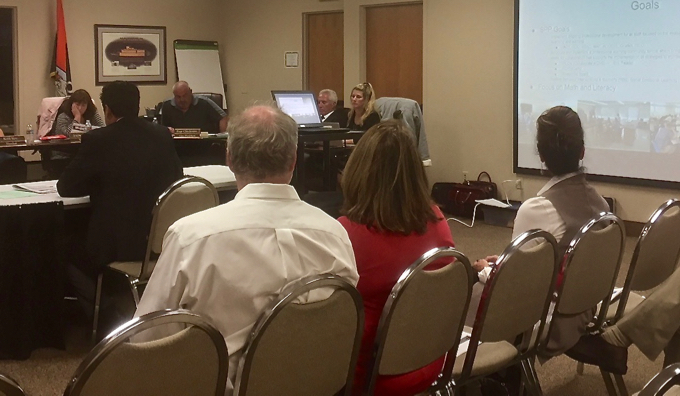
WHS Principal Crespin Esquivel updates the school board Nov. 14. Photo/Susan Wood

By Susan Wood

STATELINE – There’s a memorable scene in the movie “Big” where lead actor Tom Hanks leaves a dinner party table to explain algebra to a boy having trouble with it.

Hanks tells the youngster to forget the X’s and Y’s.

“Let’s imagine Larry Bird is going to score 10 points in the first quarter. How many is he going to score in the whole game?” Hanks asks.

 “That’s easy — 40 points,” the boy answers in a “aha” moment.

 “OK, and that’s algebra,” Hanks says.

With the advent of Common Core, this is where teachers are heading with their math lessons – trying to find new ways to reach children. It’s one thing to know the answer. Now, students need to explain how they got there.

The topic came up at last week’s Douglas County School District meeting in which two principals – Nancy Cauley of Zephyr Cove Elementary School and Crespin Esquivel at Whittell High School – provided their school performance goals.

Both principals painted a pleasant picture on the Nevada side of the South Shore.

Cauley shared her enthusiasm over milestones ranging from the hiring of a reading tutor to the funding of a native plant walk created with 15 species of trees. Esquivel expressed glee over the restoration of the ballfield and with the popularity of the culinary arts classes. 

Both praised their programs in which teachers drop in the classrooms of other instructors to share ideas and gain insight of what works and what doesn’t. Cauley calls hers “peer classroom visits.” Esquivel labels his as the “pineapple board,” named for its hospitality inference.

“It’s helpful for us to get into each other’s classrooms and learn from each other,” Esquivel told the board.

Whatever one calls it, the program has been deemed a success to school head honchos seeking any way to improve scores and livability at school.

What the principals admitted they can’t live with are math scores.

At Zephyr Cove Elementary, math SBAC (Smarter Balanced Assessment Consortium) assessments reveal that 38.2 percent of students in third- to sixth-grade are proficient in the subject. This means most are not proficient.

The older students fared better but didn’t meet their target goals. In 2017, a little less than 77 percent of students met the advanced placement goals outlining college-level curricula. In a five-year summary, Esquivel took solace in the fact his school’s scores are higher than the state’s at 52.5 percent. Plus, there’s an upward trend at Whittell. In 2013, those scores showed 52.5 percent of WHS students got it.

Still, board President Tom Moore warned Esquivel he would “have to get a grip” on declining scores.

Esquivel nodded and insisted “we’re working on it.”

And that’s the challenge of Common Core.

“It’s a different mindset. Now, there’s a formula,” Cauley told Lake Tahoe News, standing with Esquivel after the session. LTN asked them if math is harder these days.

“We have to start them in kindergarten. There’s a multi-step process in which they have to give the rationale to their answer. It’s not enough to have the answer. And that’s Common Core,” Cauley said. “We’re asking students to do more with what they know.”

The U.S. educational standards starting in 2009 define what K-12 students should know in English, language arts and math at the end of each grade. 

Here’s an elementary school example comparing a pre-Common Core question with a post.

Pre: “Each shirt costs $4. How much do three shirts cost?”

The answer “12” can be submitted without knowing multiplication tables.

Post: “Each shirt has six buttons. How many buttons are needed to make seven shirts.”

The answer of 42 relies on a quick recollection of the multiplication tables.

 Think of it this way. Remember those math word problems from days gone by that start with “two trains were traveling in opposite directions…”?

Back then, teachers and tests were seeking one answer. Now, students must explain the process used without derailing the answer.  

This is the subjective problem some students have and parents notice.

“Everyone describes things differently and in a different way. Much depends on how it’s taught,” said Kim Felton, a parent whose son Aubrey attended all Nevada South Shore schools. Aubrey, who graduated from Whittell High a few years ago, learned enough about math to get him into college, but it wasn’t his favorite, his mother said.

Felton laid out the difference in the two teaching styles by declaring traditional math covers one subject at a time. First grade might highlight addition and gradually work up from there in each grade. Common Core demonstrates an integrated method that blends the subjects and jumps ahead before some students grasp it.

Word problems may muddy the process because there’s room for error in interpretation.

“Math is the language of numbers. What Common Core does is make it a language of words,” Felton told Lake Tahoe News.



Editorial: Ways to change how Calif. manages water

Publisher’s note: This editorial is from the Nov. 14, 2017, Water Deeply.

It’s time for California to rethink how it manages water for the environment. Despite four decades of effort, many of the state’s freshwater-dependent native species are in decline. Controversy over water for the environment remains high. The latest drought left lasting impacts on already-stressed species and their ecosystems and highlighted the need for a change of course.

Our new research identifies shortcomings in current practices and lays out three reforms that could reduce conflict while improving freshwater ecosystems.

The first critical problem area is water accounting. During the latest drought, state and federal agencies found their decision-making hampered by gaps in information on water availability and use as well as ecosystem conditions.

Read the whole story


Trump’s environmental rollbacks hit Calif. hard

By Evan Halper, Los Angeles Times
 
When 50,000 acre-feet of water went gushing out of the Sacramento River last month, it fast became a test of California’s ability to protect its environmental policies from an increasingly hostile Trump administration.

The episode proved humbling.

Heeding the calls of big agriculture interests and area congressional Republicans, the administration pumped federally controlled water to Central Valley farms despite protest from the state that the move imperiled the endangered delta smelt. All California could do was temporarily shut its own pumps, which came at the expense of the state’s mostly urban water customers.

It was perceived by some in California as the kind of big agriculture water grab that the state had not seen in years. And it flouted a longstanding water-management partnership between California and Washington, D.C.

Read the whole story


3 Yosemite bears killed by vehicles in 3 weeks

By Guy McCarthy, Union Democrat

Three bears have been killed by vehicles in Yosemite National Park in the past three weeks, and park staff are urging motorists to obey posted speed limits.

More than 400 vehicle-bear collisions have occurred in Yosemite since 1995, according to park staff and the website KeepBearsWild.org. Vehicle-bear collisions are now one of the leading causes of black bear mortality in Yosemite.

There are 300 to 500 black bears in the park and they are especially active near Crane Flat, in Yosemite Valley and along Tioga Road each spring, summer and fall, according to biologists.

Read the whole story


K’s Kitchen: Gyros for vegetarians

By Kathryn Reed

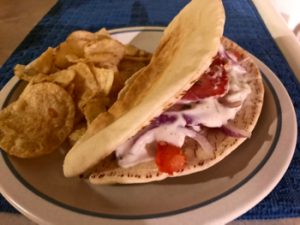
When I was in Greece in my 20s I lived off gyros. They were easy to come by, super cheap – and oh, so incredibly delicious.

They were sold on the street. (Not sure if this is still true.) Vendors would shave off thin slices of lamb from the large spit. The meat was so tender. This was my introduction to tzatziki, which is usually made with yogurt.

This recipe allows the vegetarians and vegans in the world to get a glimpse of what a gyro is all about. I’ll admit the tzatziki with the silken tofu is every bit as good as ones with yogurt.

Vegetarian Gyros

1 8-ounce package tempeh or baked tofu

1 T olive oil

½ C water

¼ C minced yellow onion

2 T sodium soy sauce

1 tsp chopped fresh rosemary

1 tsp chopped fresh oregano

8 garlic cloves, minced and divided

¼ tsp black pepper, divided

1 package silken tofu (about 6 ounces)

½ C peeled and grated English cucumber

1 T fresh lime juice

1 T chopped fresh dill

½ tsp white wine vinegar

¼ tsp kosher salt

4 flatbread wraps

½ C vertically sliced red onion

1 medium tomato, thinly sliced

Cut tempeh or baked tofu lengthwise into 8 slices.

Heat oil in a large nonstick skillet over medium. Cook tempeh/tofu until golden brown or heated through.

In bowl, mix water, onion, soy sauce, rosemary, oregano, 4 minced garlic cloves, and half of the pepper.

Add mixture to tempeh/tofu in pan. Cover, and reduce heat. Braise tempeh/tofu, turning occasionally, until liquid has mostly evaporated.

In blender, combine silken tofu and remaining 4 garlic cloves. Pour mixture into a bowl. Then add cucumber, lime juice, dill, vinegar, salt, and remaining black pepper.

Divide tempeh/tofu evenly among flatbreads, and top each with tzatziki. Divide onion slices and tomatoes evenly among gyros.


Invasive clams tracked by their DNA

By Ben Coxworth, New Atlas

The sooner that you know an invasive species is present in your local environment, the better the chances that you can control it before it becomes unmanageable. It was with this in mind that researchers from the University of Illinois recently detected the presence of a species of invasive freshwater clam, by looking for its cast-off DNA in lake water.

Working in collaboration with colleagues from Rice University, the University of Notre Dame and UNR, the scientists performed an eDNA assay – eDNA stands for “environmental DNA,” and refers to DNA that is passed into the environment in the form of excretions and other biomaterials.

Read the whole story


Molly Mundy — 1992-2017

Molly Matthews Mundy

Molly Matthews Mundy died in a tragic auto accident on Nov. 2, 2017. She was 25.

Molly was born Sept. 2, 1992, and raised in South Lake Tahoe.

She loved the outdoors, soccer, her two dogs and cat, country music, and most of all, family. You could often find her on a local beach with her loved ones, enjoying a beautiful Tahoe sunset. Molly also enjoyed her many trips to the ocean with her husband.

Molly is survived by her husband, Tyler Burton Mundy; mother Jennifer Matthews; sister Andrea; and niece, Emma, who Molly had a special bond with. She is also survived by aunts, uncles, cousins and friends.

She was preceded in death by her father, Rick, and sister Amanda.

Donations in Molly’s name may be made to the Sea Otter Research and Conservation Program at Monterey Bay Aquarium.

A celebration of the life will take place at Valhalla, 1 Valhalla Road, South Lake Tahoe, on Dec. 2 from 1-4pm. Wear teal if possible, as it was Molly’s favorite color.