Utility fire safety rules took 10 years

By David R. Baker, San Francisco Chronicle

For 10 days in October 2007, wildfires riding hot Santa Ana winds swept across Southern California, forcing nearly 1 million people to flee and killing 10. When the ashes cooled, investigators found that many of the blazes had been caused by electrical lines swaying or falling in the wind.

So state regulators resolved to tighten fire safety rules for electric utilities. They quickly passed new regulations for Southern California and began developing rules for the rest of the state.

It would take 10 years.

On Nov. 8 of this year, exactly a month after the most destructive wildfire event in California history began sweeping across the Wine Country, the California Public Utilities Commission finally released its proposal.

Read the whole story


Lakeside employee confesses to embezzling

Brandon J. Probert

A former Lakeside casino employee is likely headed to prison after admitting he stole from his employer.

Brandon J. Probert of Stateline at his arraignment this week in Minden pleaded guilty to embezzling. When he is sentenced in January he could get a maximum of five years in prison.

Probert was using a player tracking card that was only supposed to be used for training and test. Company policy is for any wins during a test to be turned into a casino cashier. Probert was not doing that, and instead kept the credits on the card.

Probert told Douglas County sheriff’s investigators that he collected about $2,000 in slot winnings with the company card.

— Lake Tahoe News staff report


Letter: Squaw helps raise $130,000+ for nonprofits

To the community,

Squaw Valley Alpine Meadows and the Squaw Village Neighborhood Company are proud to have raised over $130,000 with proceeds from the popular summer and fall events held in the Village at Squaw Valley. With the help of over 500 volunteers and the support of over 50,000 attendees, Squaw Valley Alpine Meadows and the Squaw Village Neighborhood Company were able to support many local and regional charitable organizations that promote education, arts, recreation, and community services.
 
Squaw Valley Alpine Meadows is proud to continue its mission to serve as a steward of the legendary Lake Tahoe area. We are dedicated to supporting local and regional organizations that aim to achieve great things in our area. We admire the work that these organizations are doing and are dedicated to helping them support our community.
 
“We work closely with the amazing team at Squaw Valley to plan, organize, and execute two of Tahoe’s greatest summer events—Peaks and Paws and Brews Jazz and Funk Fest—to benefit the Humane Society of Truckee-Tahoe,” said Stephanie Nistler, executive director of the Humane Society of Truckee-Tahoe. “In addition to months of planning, the events require tremendous support from our volunteers. These fundraisers are so important to our organization, both to share our message with thousands of locals and visitors and to raise much needed funds for local homeless pets.”
 
The following are the details of funds raised for each non-profit event hosted by Squaw Valley Alpine Meadows and the Squaw Village Neighborhood Company:

  • Brews Jazz & Funk, featuring breweries and musical performances, and the Peaks & Paws event to celebrate canine friends raised a total of $24,500 for the Humane Society of Truckee-Tahoe, a nonprofit dedicated to saving and improving the lives of animals.
  • The Made in Tahoe event, which features all things made locally and inspired by the Lake Tahoe Basin and Truckee areas, raised $11,000 for the Tahoe Food Hub, a nonprofit organization working to restore local food distribution by building a regional food system for North Lake Tahoe.
  • The Art, Wine and Music Festival, featuring wine tasting from California wineries, local music, art booths, and exhibits raised $13,000 for Achieve Tahoe, whose mission is to provide affordable and inclusive physical and recreational activities that build health and confidence.
  • Guitar Strings vs. Chicken Wings, featuring a chicken wing cooking competition and live music, raised $3,000 in proceeds for the Tahoe Institute for Natural Science, a non-profit dedicated to advancing the natural history, conservation, and ecosystem knowledge of the Tahoe region through science, education and outreach.
  • The annual Foam Fest, an afternoon of beer tasting and live music raised $22,000 for Achieve Tahoe, a non-profit that brings people with disabilities to the slopes.
  • The annual Alpen Wine Fest, featuring wine tasting, live music, and a huge silent auction and raffle raised $25,000 for Can Do MS, a foundation providing wellness and education for people with Multiple Sclerosis.
  • The ever-popular Oktoberfest that transforms the village into a mini-Bavaria, complete with Bratwursts, authentic German beer, music, and entertainment raised $30,000 for the High Sierra Lacrosse Foundation, a nonprofit organization that supports student athletes developing in the sport of lacrosse.
  • In addition, Squaw Valley Alpine Meadows and the Squaw Village Neighborhood Company helped raise an additional $5,000 for various other local and regional organizations including: the Shane McConkey Foundation, Tahoe-Truckee School of Music, Truckee Dance Factory and Arts for the Schools.

Andy Wirth, president and COO of Squaw Valley Alpine Meadows


Essay contest open to young hunters

The California Department of Fish and Wildlife and the California Wildlife Officers Foundation are again co-sponsoring the annual Passing on the Tradition essay contest for young hunters.

The grand-prize winner will receive a lifetime California hunting license that is valued at more than $600. Second and third place winners will also be selected and prize packages will be awarded.

This year’s topic is how hunting has influenced or affected the person’s life.

The contest is open to all junior hunting license holders, as well as youths under 18 who have earned a hunter education certificate.

Essays should be 500 words or less. Email them to john.nores@wildlife.ca.gov by Dec. 15 at 5pm. On the essay, applicants must also provide their date of birth, place of residence and a contact telephone number and email address.

The winners will then be notified by telephone. For additional information, contact John Nores at 408.591.5174.


Angora trail not just for mountain bikers

It didn’t take long for mountain bikers to discover the new Angora trail. Photo/Kathryn Reed

By Kathryn Reed

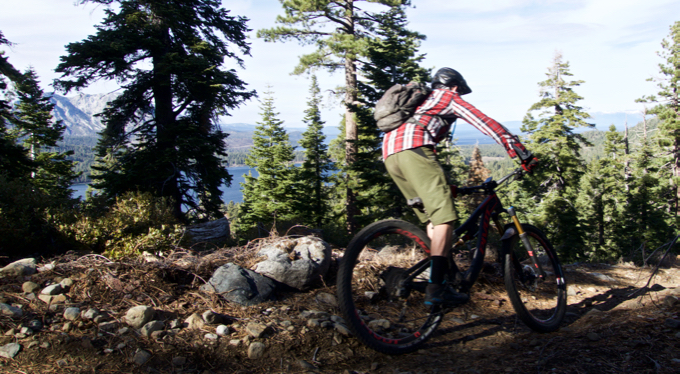
Hiking Angora Ridge just got better thanks to a bunch of mountain bikers and the U.S. Forest Service.

No longer do people have to contend with vehicles or be on pavement to reach Angora Lakes.

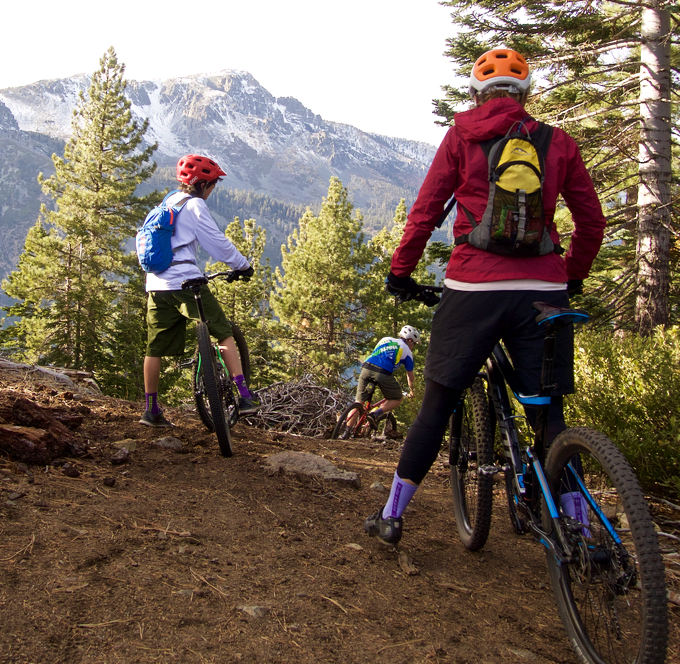
The nonprofit Tahoe Area Mountain Biking Association partnered with the federal land owner to build a trail that basically parallels the road. One of the best parts is the road is not visible much of the time.

I was there after the Angora gate was closed for the season, so I’m not sure what the sound of vehicles will be like in summer.

And while this was built as a single-track mountain bike route, plenty of hikers (some with dogs) were out earlier this month checking out the trail that was completed this year. People seemed giddy about the new trail.

It goes from where Tahoe Mountain Road intersects with Angora Lakes Road and comes out near the fire lookout. That’s as far as we went that day.

It doesn’t take long before Fallen Leaf Lake comes into view. Be sure to turn around to see Lake Tahoe as well.

Fallen Leaf Lake with Lake Tahoe in the background. Photo/Kathryn Reed

Mount Tallac becomes quite a presence as well.

This is what makes this trail so much more scenic than being on the road – the views are stunning most of the way. You don’t have to wait to hit the ridge to get them, which is the case with the road.

Seeing the houses on Tahoe Mountain is something I’ve never noticed from the road.

Being on foot gave me a chance to survey the route to see if I’d want to come back on my bike. Seeing people pushing their bikes oddly made me want to try it. I didn’t want to be the only one possibly not pedaling. It didn’t look technical, just steep (for a bike, not on foot) in places. Families were out – on bikes and walking.

The cyclists can be coming down pretty fast, but all were courteous as we scampered to get out of their way.

It took about 2,000 hours of volunteer labor and thousands of dollars in private donations to make the nearly 5 miles of trail in this area a reality. There is also a connector from the Angora burn area.

More trails are on the drawing board, including extending the Angora trail north to connect with Fallen Leaf Lake.

It’s possible within five years there will be a single track trail to Emerald Bay.

The ultimate goal is to have a mountain bike trail that goes around the lake. Yes, there is the 165-mile Tahoe Rim Trail, but that is for hikers and much of it is off-limits to bikes.

The Angora trail is attracting families. Photo/Kathryn Reed

—–

Getting there:

From South Lake Tahoe, at the Y go on Lake Tahoe Boulevard toward South Tahoe High School or the burn area. Turn right on Tahoe Mountain Road. Go right at the T intersection. Go left at the next T. The road curves a bit. Go slow. Additional parking has been created near Angora Lakes Road. The trail starts to the right of the Angora gate/road. There is no trailhead sign.


Opinion: Don’t rely on politicians to memorialize soldiers

By Kelly Kennedy

Five U.S. infantry soldiers died on June 21, 2007, when their 30-ton Bradley tracked vehicle hit a deep-buried bomb in Adhamiyah, Iraq.

I was embedded as a reporter with their unit when they died, and I watched as the men who served with them rallied.

They reached out to the mothers and fathers and wives, offering and seeking comfort, but also saying what they believed needed to be heard:

It was quick.

We were with them at the end.

We will never forget.

The families often reach back too, spreading wide wings over the men and women left behind in return for stories of their sons and daughters and wives and husbands.

“You can call me ‘mom,’ because he can’t.”

“Tell me again about the time she …. ”

A service member’s bond with a Gold Star family feels profound because it squares so many different contradictions. The relationship is about both loss and presence, about courage and fear, and about a link with the loved one with whom we no longer can connect.

But as the families and veterans wrap around each other, these tight bonds can exclude those in our communities who haven’t served in the military themselves or who don’t know anyone who serves now. Such exclusion may seem a small point in the immediate context of soldiers and families grieving those they loved. And letting a wider group of people into a tragedy may seem like too much for people who already carry a heavy burden of loss.

But exclusion has real-world consequences for families, communities, and the country as a whole.

How can we grieve for service members we don’t know, but who so completely represent us? How can we support families who don’t convey their grief and experiences beyond those tight bonds? And how, without paying attention to more than just headlines, can we feel the weight of a particular family member’s words, while fully understanding the diversity of that community?

If civilians don’t know about, understand, or feel comfortable reaching out to service members’ families, that can lead to those in the military, and their families, feeling isolated, abandoned, and afraid to speak.

We send people to war, but the contract shouldn’t end with their lives.

Renee Wood-Vincent, whose son Sgt. Ryan Wood died that day in Iraq, said she feels that fallen soldiers can be forgotten, and that there’s a lack of respect and knowledge in the public for what families and members of the military experience. But that also creates an obligation to reach out.

“There’s such a focus on what’s happening to us—it’s all about our sorrow, our problems, our military families—and we aren’t letting people in,” she said.

Letting people in can’t be done alone. It requires civilian leaders who can bridge and connect people. And in the United States, the highest bridge is embodied in one office, the presidency.

That’s why it’s so important that the person occupying that office be able to connect with soldiers and their families.

When the president reaches out to Gold Star families, he speaks for the civilians who made the decision with their votes to send service members to war. Even if a letter or phone call does not bring comfort, it is an acknowledgment of sacrifice for country. It’s why scrutiny of President Trump’s calls with Gold Star families is warranted.

But whatever the nature of the president’s words, the most important thing to know is that his words aren’t enough. A president should serve only as a starting point for civilians to reach out. “If I rely on politicians to memorialize Ryan and understand his sacrifice, I’m going to be sorely disappointed,” Wood-Vincent said. “They can empathize, but it’s still a number.”

Wood-Vincent received a letter from President George W. Bush, which she said was enough in a time of war, when the commander-in-chief should be dealing with national issues. So did Shawna Fenison, whose son, PFC Ryan Hill, served with Wood in Charlie Company, 1st Battalion 26th Infantry Regiment. Hill died on Jan. 20, 2007, in Iraq, when a roadside bomb exploded near his Humvee.

But the letter wasn’t enough. “I don’t think the country cares about us and would rather we just go away,” she said.

That feeling represents a failure, and a historic shift. The concept of the Gold Star family began as an invitation for conversation and caring between civilians and military.

During World War I, a family could hang the red-bordered flag with two blue stars in the front window to alert the neighborhood that two sons served overseas.

The neighbors could say, “Heard from your boy?” or “Where’s he fighting?”

If one of those stars turned to gold, the conversation changed.

“I’m sorry for your loss.”

“Thank you for your sacrifice.”

But as wars turned more political and became less of a community effort—during World Wars I and II, most families had relatives or friends serving—the conversation changed again. Some families folded their flags when they felt they brought unwanted attention during the Vietnam War. In recent wars, the rarity of the flags offered reminders of just how few people served. About 7 percent of Americans have served in the military, and less than 1 percent serve now in our all-volunteer armed forces.

Both Fenison and Wood-Vincent were initially showered with gifts: flags. Artwork anonymously sent in the mail. Letters from strangers. “I have a large, supportive family,” Wood-Vincent said. “My neighborhood happens to be very military.” At work, people knew her son and offered condolences. People told her they fly the American flag for her son.

“We had a neighbor who came down every night for two years and prayed over our home,” she said. “I had never met her. I would see her out there in the summertime, in the wintertime, standing in the rain with her little dog.”

People still leave things on her porch.

“It may be the part of the country I’m in, or the neighborhood,” she said. “But part of it is the people I’ve surrounded myself with.”

Fenison had a similar experience, at first. But then, as people moved on with their lives or grew disenchanted with the wars, they encouraged her to stop talking about her son, to take down the “shrine” she’d assembled in her home that included her son’s pictures and the flag from his coffin.

“When I talk about Ryan, many will change the subject or give me the look of ‘Here she goes again,’ so I find myself withdrawing more and more,” she said. “Communities are good about honoring on Memorial Day with their token events, but it pretty much stops there.

“While my world has stopped, the rest has moved on.”

The families ache for the engagement—for someone to care. For someone to mourn their losses. For someone to look up Niger on a map and not only think about what it might have felt like to be doing what you, yes, signed up for and loved—but also to contemplate the terror and heartbreak for service members, friends, and families.

Those flags should serve as a call to action: This family’s sacrifice represents you. Gather them up. Listen to their stories.

“It’s much more complicated than people know,” Wood-Vincent said.

“On one hand, I’m a mother who lost a child no matter how he was taken from the world. I’m not thinking of him as a soldier.”

But then she explains to strangers how he died.

“People will say, ‘Oh, what a shame. What a waste,’” she said. “Don’t assume I feel the same.”

Sometimes, she said, she gets angry and wants to walk away. Other times, she reminds herself that she can’t be mad about people’s ignorance about proper responses or “Gold Star” moms if she’s not helping to educate them.

“I’ll think, ‘That person just made me so angry,’” she said. “Why? Well, my son’s loss was not a waste. Give me 10 seconds in the parking lot to tell you why. If someone sees your Gold Star plate and says, ‘What is that?’, you don’t say, ‘Hey. You’re an idiot. You should know.’”

She sees her personal call to action as part of that big conversation. Every summer, she invites her son’s brothers in arms to a reunion. Her family created a scholarship to celebrate his art—punk-rock drawings that expressed convictions about being different and doing your part to save the world—through the university. And she told his story at several events.

She makes sure people know and remember him, and through that, she closes the divide.

She believes that communities can, too. Local organizations can invite in Gold Star family members. They can form community partnerships—Boy Scouts who adopt families, or Junior Leaguers who organize lunches, or schools that bring Gold Star alumni in as speakers. Communities can organize town halls about what families need—even if that need is simply relaying kind questions to ask. Leaders can ensure families are remembered beyond Memorial Day.

And Gold Star families have to be willing to accept those invitations.

“You’ve got to open yourself,” Wood-Vincent said. “They’ll never completely understand, and thank God for that. But they will never understand if we don’t invite them in.”

Kelly Kennedy is an Army veteran, former USA Today reporter, and author of “They Fought for Each Other: The Triumph and Tragedy of the Hardest Hit Unit in Iraq.” She co-authored “Fight Like a Girl: The Truth Behind How Female Marines are Trained,” which is due out in April.

Study: Dog owners live longer, healthier lives

By Amanda MacMillan, Time

In case you need another reason to snuggle your pup: According to a study of more than 3.4 million people, owning a dog is linked to a longer life. The research, published in Scientific Reports, is the latest in a growing body of research suggesting that canine companions may be good for human health—especially for people who live alone.

To study the link between dogs and longevity, researchers at Uppsala University in Sweden reviewed national registry records of Swedish men and women, ages 40 to 80. They focused on 3.4 million people who had no history of cardiovascular disease in 2001, and followed their health records—as well as whether they registered as a dog owner—for about 12 years. Dog ownership registries are mandatory in Sweden, and every visit to a hospital is recorded in a national database.

They found that dog owners had a lower risk of death due to cardiovascular disease than people who did not report owning a dog, as well as a lower risk of death from other causes. That was true even after adjusting for factors such as smoking, body mass index and socioeconomic status.

Read the whole story


Study: Groundwater recharge an issue with climate change

By Mari N. Jensen, University of Arizona

Groundwater recharge in the Western U.S. will change as the climate warms — the dry southern regions will have less and the northern regions will have more, a University of Arizona-led research team reports.

“Our study asked what will be the effect of climate change on groundwater recharge in the Western U.S. in the near future, 2021-2050, and the far future, 2070-2100,” said first author Rewati Niraula. The research was part of his doctoral work in the UA Department of Hydrology and Atmospheric Sciences.

The study covers the entire U.S. West, from the High Plains states to the Pacific coast, and provides the first detailed look at how groundwater recharge may change as the climate changes, said senior author Thomas Meixner, UA professor and associate department head of hydrology and atmospheric sciences.

Groundwater is an important source of freshwater, particularly in the West, and is often used to make up for the lack of surface water during droughts, the authors note. In many areas of the West, groundwater pumping currently exceeds the amount of groundwater recharge.

Read the whole story


South Tahoe sets record high on Thanksgiving

By Kathryn Reed

If you thought Thanksgiving at Lake Tahoe was hot, you were right. And it had nothing to do with what was going on in the kitchen.

South Lake Tahoe’s high of 65 degrees broke the record of 63 that had been standing since 1995.

People were in shorts, and those at Zephyr Cove Tennis Club were in skirts and short-sleeves.

According to the National Weather Service, the warm temps for Nov. 23 were not out of the ordinary. It all had to do with a ridge of high pressure above the area.

Winter is back in the forecast, though. Expect snow Sunday into Monday, with rain in the valleys. The Sierra summits could see 6 inches of snow.

Snow is expected to start at 9,000 feet Sunday morning, dropping to about 7,000 feet by that night, with white stuff expected at 4,500 later in the evening. Those elevations could change if the storm comes in a bit warmer.

Wind will the precursor to the moisture, with a high wind watch in effect from Saturday evening through Sunday morning. Ridge tops could see 100 mph gusts.


Pressure to be applied to SLT’s top energy users

By Kathryn Reed

In order to become a more sustainable city when it comes to electric and natural gas usage, it’s important to know how much of those products is being consumed.

South Lake Tahoe’s 100 Percent Renewable Committee this week gave an update to the City Council that included data from the free State and Local Energy Data analysis.

The purpose, according to committee members, is to estimate the greenhouse gas reduction potential of the city. The analysis showed commercial properties use the most electricity, then residential and then government. The top commercial user is Barton Memorial Hospital with 11,279 megawatt hours, followed by the 37 lodging properties with a combined use of 5,443 MWh, and 17 food and beverage outlets at 4,968 MWh.

The hospital is also the largest user of natural gas, at 45,790 Mcf. (An Mcf is a thousand cubic feet of natural gas.) The lodging establishments use 9,594 Mcf. The third top users are the three businesses considered waste management and remediation services, with 5,324 Mcf.

Suggestions to lower consumption include:

·      Retrofitting buildings

·      Challenge programs for households, businesses and industries

·      Targeted outreach to neighborhoods

·      Create a one-stop for technical services coupled with utility incentives.

The committee plans to work with the top five users of both categories to work on ways they could reduce consumption.

In April the council passed the resolution to achieve 100 percent renewable energy by 2032. In addition to wanting the city to be using renewable energy, reducing the use is part of the goal.

Lake Tahoe Unified School District was singled out as an entity that has taken great strides to lower its energy use.

Heavenly Mountain Resort was not part of the study because its meters are either in El Dorado or Douglas counties.

The committee plans to come back to the council with recommendations after further analysis is completed.