Talk to detail Tahoe Big Year bird event

South Lake Tahoe Friends of the Library will host an informative bird talk on Dec. 20 at 6pm.

Sarah Hockensmith of the Tahoe Institute for Natural Science will be talking about the 2018 Tahoe Big Year, a yearlong birding event that celebrates the hundreds of bird species that occupy the Tahoe region, and brings together birding beginners and enthusiasts alike.

This presentation will acquaint people with common and unique birds of Lake Tahoe, birding destinations in the Tahoe area, what a bird Big Year is, and how to get involved.

It is free and open to all.

The library is at 1000 Rufus Allen Blvd., South Lake Tahoe.


Center focuses on attaining abilities post-injury

A variety of athletic activities are available at the National Ability Center. Photo/Kathryn Reed

By Kathryn Reed

PARK CITY, Utah – The name of a business can be incredibly powerful; the words that are chosen and the ones left behind.

Such is the case with the National Ability Center in Utah. Disability is hardly in the staff’s vocabulary. They work with people who have orthopedic, spinal cord, neuromuscular, visual and hearing impairments, and cognitive and developmental challenges. It’s all about finding ways to cope under new circumstances.

Founded in 1985, the mission of NAC “is to inspire individual achievement and create a global impact for people of all abilities.”

Brenna Huckaby credits NAC for helping her make the 2018 U.S. Paralympic team. Photo/Kathryn Reed

“I wouldn’t be where I am without NAC. I started there,” Brenna Huckaby told Lake Tahoe News. “They taught me how to snowboard.”

This world champion snowboarder hopes to compete in the 2018 Paralympics in South Korea.

She was a gymnast before osteosarcoma required her right leg be amputated. Huckaby, who hails from Louisiana, had not snowboarded until being invited to NAC for an event for cancer survivors who had lost a limb.

At the Sochi Games in 2014, NAC had 18 athletes representing nine countries.

The Utah nonprofit has 26 acres in Park City. They also have access to Park City Ski Resort. Earlier this year NAC and the ski resort signed a 50-year lease that will allow the center to build a 10,000-square-foot facility and get out of the double-wide trailer they’ve been in for years.

“We’re fortunate to host a facility and team that provides such outstanding services to kids, veterans and families with different abilities and we’re proud to partner with the NAC to make these life changing programs available. This land lease marks the start of an exciting project that will further elevate the offerings to Park City Mountain guests and supports individuals and families not only locally but also from across the country,” Jessica Miller with Park City Ski Resort, told Lake Tahoe News.

Elite athletes are a tiny component of NAC’s clientele.

In the last five years NAC has seen a 96 percent growth rate. On a tour of the facility, CEO Gail Barille explained this is in part because people are living longer with more challenging abilities, the on-going military conflicts, and the increase in awareness of the ability movement.

Equestrian therapy can help build self-esteem and combat PTSD. Photo/Kathryn Reed

The largest population served are active duty, injured military and veterans, as well as children and adults with varying degrees of autism.

Ages 4 to 99 have been helped by NAC, with the center now seeing about 5,500 people a year.

Program fees cover about one third of the expenses, with donations providing the remainder.

Staff starts with working on individual goals. It might be that the person wants to achieve independence. Or maybe they want to be able to ski with a child or grandchild.

Bicycles come in all shapes and sizes for adaptive needs. Photo/Kathryn Reed

A new injury often means redefining their life. That’s why it’s so important to talk to others who understand.

While NAC is known for athletics, that’s not all it offers.

“Part of what we try to do here is give people a place to connect,” Barille told Lake Tahoe News. “We have a support network. They meet others in the program.”

Families, groups and individuals are welcome. Sleeping accommodations are available on site for 52 people. The plan is to build a combination of 12 cabins, yurts or tent platform facilities.

“We use recreation to build cohesion and self-esteem,” Barille said.

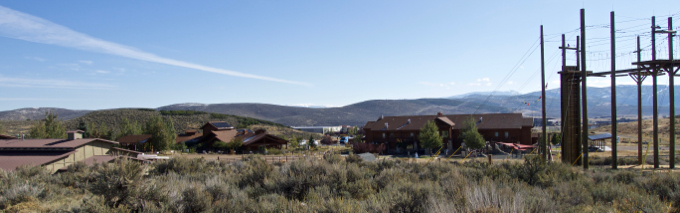
At the main campus, which was built before the 2002 Salt Lake City Winter Olympics, a variety of activities are available.

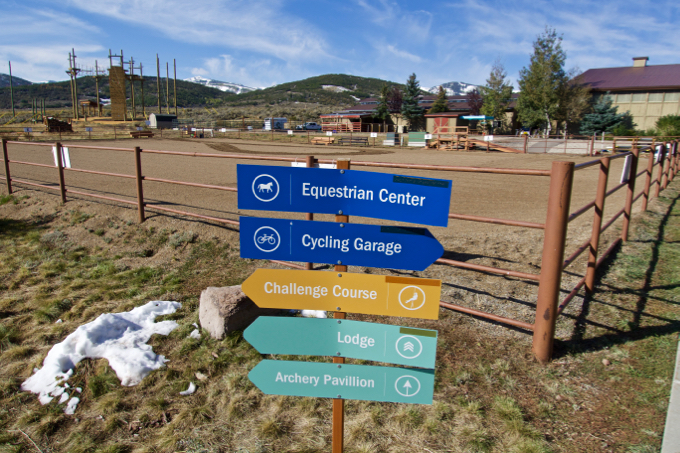
A large garage houses an array of bikes. Adaptive bikes range from about $2,500 to $10,000. NAC is able to fit a bike to a person and maintain it as well.

A challenge course, right, is part of the “back yard” at the NAC. Photo/Kathryn Reed

Duct tape and padding are common components. Some cyclists have used bungee cords to bind their knees for support. Adaptive, it’s the key word.

NAC has 250 partner programs who use the equipment, such as veterans and muscular dystrophy organizations.

The equestrian facility includes an indoor arena. People with post-traumatic stress are known to benefit from working with horses. The outdoor arena will soon be moving behind the bike barn to provide a more isolated environment for people.

A gym, challenge course, indoor rock climbing wall, archery and hiking trails are all right there. The center also works with individuals who are interested in swimming, sled hockey, water skiing, wakeboarding, kayaking, canoeing and paddle boarding — and of course all the snow sports.


Opinion: Another reminder there’s no free lunch

By Dan Walters, CalMatters

It’s doubtful whether more than a relative handful of Californians have heard of the Unemployment Insurance Fund.

It is, however, one of state government’s largest activities – and a case study in political mismanagement.

Dan Walte

Currently, California employers pay about $6 billion in payroll taxes into the UIF each year. And currently, the state Employment Development Department annually pays almost that much to jobless workers.

Superficially, that would appear to be a sustainable equation, but in reality, it’s not.

During periods of high payrolls and low unemployment, such as this one, the UIF should be building reserves that could cope with an economic downturn, when claims for jobless benefits increase.

That’s the way it used to work – until political expediency and recession undid it.

In 2001, the UIF had a $6.5 billion positive balance. But the governor at the time, Democrat Gray Davis, owed big political debts to unions that financed his battle with two very wealthy Democratic rivals in 1998.

Davis repaid his debt to public employee unions in 1999 by sharply increasing pension benefits for state workers – a move later emulated by most local governments – on assertions that investment earnings would pay for them without more taxpayer money.

Similarly, Davis repaid his debt to the private sector unions in 2001 by backing a sharp increase in unemployment insurance benefits on the assertion that the UIF, with its $6.5 billion reserve, could easily afford it.

Both backfired when recession clobbered the state’s economy twice in the new century’s first decade.

Eventually, the California Public Employee Retirement System sharply increased mandatory “contributions” to make up for investment losses and pay the increased benefits.

Meanwhile, the first recession in 2001, coupled with the increased benefits, quickly depleted the UIF and by 2004 the state was borrowing from the federal government to keep checks flowing.

The UIF regained solvency and reached a $3.6 billion reserve as the state emerged from recession, but when the economy declined again with the bursting of the housing bubble, that cushion quickly evaporated.

By 2009, with the UIF once again in the red, the state once again tapped Uncle Sam for loans, and when it could not repay the nearly $10 billion debt, the feds indirectly raised payroll taxes on California employers.

Employers will have paid about $9.5 billion in those extra taxes by next year, when the loans will be retired. A new report on the UIF, issued last month, says it should have a $1.8 positive balance by the end of 2018.

All good? Not by a long shot.

Because payroll taxes are only barely keeping up with unemployment insurance outflows now, during a period of low joblessness, the fund cannot build a healthy reserve. Or as, the new report puts it, “the current financing structure leaves the UI Fund unable to self-correct and achieve a fund balance sufficient to withstand an economic downturn.”

There are four ways to make the UIF truly solvent – raise the payroll tax rate, widen the wage base on which the rate is paid (it’s now $7,000 a year), reduce benefits and/or tighten eligibility for benefits.

The first two draw resistance from employers while labor unions and other employee groups oppose the latter two.

However, as we’ve learned from the pension crisis or the years of neglected maintenance on state highways, there’s no free lunch.

Short-term expediency, such as boosting benefits without putting aside money to pay for them or letting maintenance slide because raising gas taxes is politically difficult, just makes the eventual days of reckoning that much more difficult.


Ski resorts betting big on booze tourism

By Louise Hudson, Dallas Morning News

The bubbly allure of beer and Champagne is being adopted by ski resorts around North America — with an educational twist.

The latest après ski is beer and distillery tours, private in-room liquor tastings, Champagne toasts on the slopes, and beverage and food pairings. 

At Aspen, it’s Vive La Veuve at the Ajax Tavern’s Veuve Clicquot bar. One local throws a 100-bottle Veuve party on the patio on his 100th ski day each season. Dotting the slopes are vibrant Veuve pop-up bars. And at Highlands on sunny afternoons, Cloud Nine is a riot of music, tabletop dancing and Champagne spraying. 

Read the whole story


EDC trying to keep drivers out of neighborhoods

By Lake Tahoe News

As soon as it really starts to snow and the tourists come to the South Shore for winter fun, they are going to realize driving on residential streets is no longer a great option.

This is because El Dorado County Board of Supervisors adopted what’s called a Traction Ordinance. It all came about after last winter when visitors to the basin were driving through neighborhoods to get out of town. While that would not have been welcomed under the best of circumstances, they were doing so in snowy/icy conditions without appropriate tires, chains or four-wheel drive.

Phone navigation apps were directing drivers to what technology said would be a short cut, but what in reality became a bit of a nightmare for all involved.

Locals became trapped in their houses, unable to get out because their once quiet street had become gridlock with cars spun out. That short cut for tourists became an ice rink they didn’t bargain for.

The ordinance mandates drivers have traction control devices when necessary. Warning signs have been installed in the Meyers area. They tell motorists that if they lose traction, impede traffic or contribute to an accident, the driver could be liable or cited for towing costs or other California Vehicle Code violations and fines.

What the county hasn’t figured out is how to keep the tourists on the main roads and out of neighborhoods when the roads are dry.


Pile burning to resume in basin next week

Tahoe Fire and Fuels Team will resume prescribed fire operations beginning Nov. 27. 

Weather permitting, North Lake Tahoe Fire Protection District, California State Parks and the California Tahoe Conservancy will conduct prescribed fire operations above Incline Village, D.L. Bliss and Burton Creek state parks and near the airport in South Lake Tahoe.

Each prescribed fire operation follows a specialized prescribed fire burn plan, which considers temperature, humidity, wind, moisture of the vegetation, and conditions for the dispersal of smoke.  This information is used to decide when and where to burn.

Smoke from prescribed fire operations is normal and may continue for several days after an ignition depending on the project size and environmental conditions. Prescribed fire smoke is generally less intense and of much shorter duration than smoke produced by a wildland fire.


Mardi gras event benefits youth tennis

Sierra Junior Tennis Association — formerly Biggest Little Tennis Association — is having its 2018 annual gala on Jan. 27.

Costumes strongly encouraged for the mardi gras-themed event.

There will be carnival games, photo boot and music for dancing, as well as a live auction.

Money raised supports junior tennis programs for youth in the Lake Tahoe and Northern Nevada area.

The event is from 5:30-11pm at the Atlantis casino in Reno.

Go online to buy tickets.


Snippets about Lake Tahoe

·      Violations of the South Lake Tahoe Vacation Home Rental Ordinance may be reported to 530.542.6100.

·      Help guide the future of Squaw Valley Park by taking a quick online survey.

·      State Sen. Ted Gaines, R-El Dorado, has been named a “champion of manufacturing” by the California Manufacturing & Technology Association.

·      Squaw Valley Alpine Meadows is bringing back the Merry Days & Holly Nights, two weeks of spirited events and activities Dec. 16-31. For details, go online.

·      The annual holiday tree lighting at North Tahoe Event Center in Kings Beach will be Dec. 1, 5-7pm. Santa arrives by firetruck to light the tree and greet attendees. Santa will take photos with kids, music performances by the Boys & Girls Club of North Lake Tahoe, the Children’s Choir, free holiday crafts, soup, hot cocoa and more are part of the festivities.


Comments sought on plans for Hwy. 28

The U.S. Forest Service Lake Tahoe Basin Management Unit is seeking public input regarding a proposal to improve an eight-mile section of the Highway 28 from Spooner Summit to Sand Harbor.

This proposal incorporates the third phase of the Stateline-to-Stateline Bikeway along with a planning effort to improve highway safety and enhance the corridor’s scenic quality, and access to East Shore recreation destinations.

The project proposes the construction of a Class-1 shared-use pathway from Spooner Junction to Sand Harbor, installation of retaining walls and slope stabilization measures and construction of connections from the pathway to parking lots and recreational facilities.

Proposed highway improvements would include expanding the existing parking areas at Secret Harbor and Chimney Beach, constructing two parking areas at Skunk Harbor and the south corridor park-n-ride, creating safe highway pull-outs along the entire corridor that would include cultural, historical and natural resource interpretive signs and vista points for photo opportunities. In addition, new restroom facilities would be constructed at each parking area and bicycle racks and seating would be installed where feasible.

Proposed utility improvements would include relocating electrical and communication utility lines and the current sewer export pipeline, and installing fire hydrant connections at strategic locations.

Comments are being taken until Dec. 23. The scoping letter and proposed plan is online.


Calif. lawmakers operate under separate set of rules

By Laurel Rosenhall, CalMatters

With a declaration that “public servants best serve the citizenry when they can be candid and honest without reservation in conducting the people’s business,” lawmakers passed the California Whistleblower Protection Act in 1999.

The idea was to protect workers who report misconduct, so that they can blow the whistle on bad actors without losing their jobs. The bill at that time covered workers at state agencies and California’s two public university systems. Lawmakers expanded it in 2010 to cover employees of the state’s courts.

But one group of California government workers has never had whistleblower protection under the law: those who work for the lawmakers themselves. It’s an example of how the Legislature sometimes imposes laws on other people that it doesn’t adhere to itself.

“Lawmakers make laws that affect all of us, including them, and they are softening the blow of regulations for themselves,” said Jessica Levinson, a professor at Loyola Law School who chairs the Los Angeles Ethics Commission.

“It feels like double talk.”

The Legislature’s exemption from the Whistleblower Protection Act has garnered attention in recent weeks, as a groundswell of women complaining of pervasive sexual harassment in the state Capitol publicly call for such protections for legislative employees.

But the whistleblower act isn’t the only area of the law in which the Legislature has demonstrated a “do as I say, not as I do” mentality:

Public records

Want to know whom government officials are meeting with, talking to or emailing? Or how officials were disciplined after an investigation found them culpable of wrongdoing?

State agencies and local governments must release such information—calendars, emails and disciplinary records—under the California Public Records Act, which the Legislature created in 1968. But the same information is nearly impossible to get from state lawmakers because the Public Records Act does not apply to the Legislature.

Instead, lawmakers are covered by the Legislative Open Records Act, which they passed in 1975 in the wake of the Watergate scandal. The act that applies to them is riddled with exceptions, effectively keeping secret many documents that other branches of government must disclose.

“The Legislature has created in many areas a black box where the public can’t see records it would be entitled to see if the public officials at issue weren’t in the Legislature,” said David Snyder, executive director of the First Amendment Coalition, a nonprofit organization advocating government transparency.

The Legislature’s open-records law allows it to withhold investigations of wrongdoing, even when they led to disciplinary action. It also keeps secret correspondence by lawmakers and their staff, as well as officials’ calendars. The Legislature even refused to give reporters the calendars of two senators undergoing federal prosecution on corruption charges, until media companies sued and won a court order compelling their release.

Another difference: As more government agencies began storing information electronically, the Legislature updated the Public Records Act in 2000 to compel disclosure of digital records. Now state agencies and local governments must provide public records in any format in which they exist. That gives the public access to electronic records, such as databases, in their original digital format.

But the Legislature has never made the same update to its own open-records act. “It was a non-starter,” former Assemblyman Kevin Shelley told the Sacramento Bee in 2015.

Open meetings

The idea that government meetings should be open to the public, and designed to welcome public input, has been enshrined in California law for more than 60 years. In 1953 the Legislature passed the open-meeting law that applies to local governments, and in 1967 it passed a similar one for state agencies.

Yet the 1973 law it passed requiring open meetings of the Legislature does not follow the same rules. One major difference: It allows legislators to gather secretly in partisan caucuses.

When contentious issues hit the floor of the Assembly or the Senate, it’s common for one political party or the other to pause proceedings and call for a caucus. Legislators file out of the chamber and into two private meeting rooms where Democrats and Republicans separately gather for conversations that exclude the public and the press. They can hash out disagreements or craft strategy behind closed doors, then return to the chamber to publicly cast their votes.

Local governments, such as city councils, cannot do this. With a few limited exceptions, state law forbids a majority of a local board from gathering privately precisely because it shuts the public out of the decision-making process.

“I always remember county supervisors being rankled,” said Peter Detwiler, a retired long-time staffer to the state Senate’s local government committee. “‘You guys put these rules on us and you don’t ever put rules like that on yourself.’”

The same laws also slow down decision-making by local governments and state agencies so that the public can weigh in. Local governments must give at least three days’ notice before taking action, while state agencies have to post agendas 10 days in advance.

Legislators, until this year, did not have the same constraints. Though most bills go through a months-long process of public deliberations, a handful of bills each session were written just hours before lawmakers cast votes on them, leaving the public no time to offer their input. Democrats who control the Legislature said the last-minute lawmaking allowed them to put together sensitive compromises that could have blown up with more public scrutiny.

But voters grew frustrated with the secrecy. A Republican donor worked with non-partisan good-government groups to put Proposition 54 on last year’s ballot, requiring that bills be written and posted online for at least three days before lawmakers can vote on them. The result: voters put a rule on legislators that the politicians wouldn’t put on themselves.

Out of state travel

With culture wars raging nationally over transgender rights, California’s liberal Legislature last year passed a law banning state-funded travel to states with laws that discriminate against gay or transgender people. Eight states are now on California’s no-go list. Some have laws that could forbid LGBT people from adopting children or exclude gay students from some school clubs; others have banned anti-discrimination policies that would allow transgender people to use the bathroom that matches their identity.

Yet while legislators have banned state-sponsored travel to Alabama, Kansas, Kentucky, Mississippi, North Carolina, South Dakota, Tennessee and Texas, they haven’t stopped traveling to those places themselves. In June, Democratic Sen. Ricardo Lara traveled to Texas for a conference of Latino government officials. Soon after, Democratic Sen. Bob Hertzberg went to Kentucky to study the state’s bail system.

Hertzberg was working on legislation to overhaul bail in California, and “felt it critical to observe first-hand the impact of bail reform in (Kentucky), which has a very well-established system of pretrial release,” his chief of staff Diane Griffiths wrote in an email.

The travel-ban bill does not exempt lawmakers—a late amendment actually specifies that it also applies to the Legislature—so how are these trips taking place? Lawmakers are getting around the law by using campaign funds (not tax-dollars) to pay for them.

The Legislature’s leaders declined to defend the exemptions, but in the past lawmakers have contended that they are justified because of the unique role of a law-making body and the need to protect legislators’ security. As far as critics are concerned, legislators get away with making exceptions for themselves because their hypocrisy doesn’t attract enough notice to generate mass outrage.

Right now there’s plenty of attention on the Legislature over its policies for dealing with sexual harassment—and some debate about whether extending the whistleblower act would help remedy the problem.

As is, the Legislature has internal personnel policies that forbid retaliation, and legislative employees are also covered by a different state law that prohibits retaliation for complaining about discrimination or harassment. But the whistleblower act goes even further, laying out a process for workers to confidentially file complaints to the independent state auditor.

Lawmakers will yet again consider a bill giving whistleblower protection to legislative staff when they return to Sacramento next year. GOP Assemblywoman Melissa Melendez of Lake Elsinore plans to re-introduce a measure that has stalled in the past. And—in a nod to some who have say that her bill wouldn’t apply to employees reporting sexual harassment—she said she’ll add language explicitly stating that it does.