Squaw-Alpine gondola could be transformative
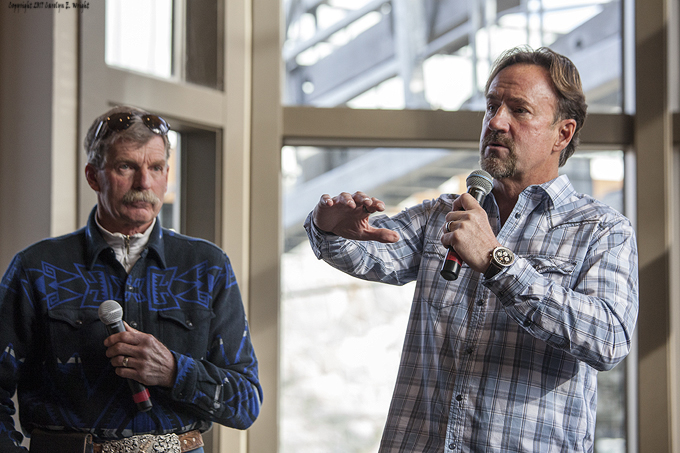
Troy Caldwell, left, listens to Squaw Valley CEO Andy Wirth talk about the proposed California Express gondola. Photo Copyright 2017 Carolyn E. Wright

By Kathryn Reed

OLYMPIC VALLEY – Eighty years after Wayne Paulson envisioned linking Squaw Valley and Alpine Meadows ski resorts, his dream may become a reality.

The founder of Squaw thought he could realize it in his lifetime. Not so. But those falling in his footsteps are now the closest to bringing this to fruition.

The U.S. Forest Service and Placer County are in the throes of the environmental review process. All of the scientists have done their field work. The draft environmental impact statement and draft environmental impact report are being written. They should be released for a 30-day comment period in the first quarter of 2018.

Various routes are being studied, though the exact number has not been released.

The earliest the gondola could be in the ground would be for the 2019-20 season. It will take about 10 months to build.

For years Troy Caldwell has been one of the hurdles that could never be jumped. Now he is on board. He owns the swath of land between the resorts where stanchions for the gondola would have to be placed. He also owns the land KT-22 is on.

Why the change of heart?

He told Lake Tahoe News the ownership changes in the resorts with both now being under the KSL umbrella gave him the confidence it would work in all respects.

“I make a rent check on the gondola going through,” Caldwell added.
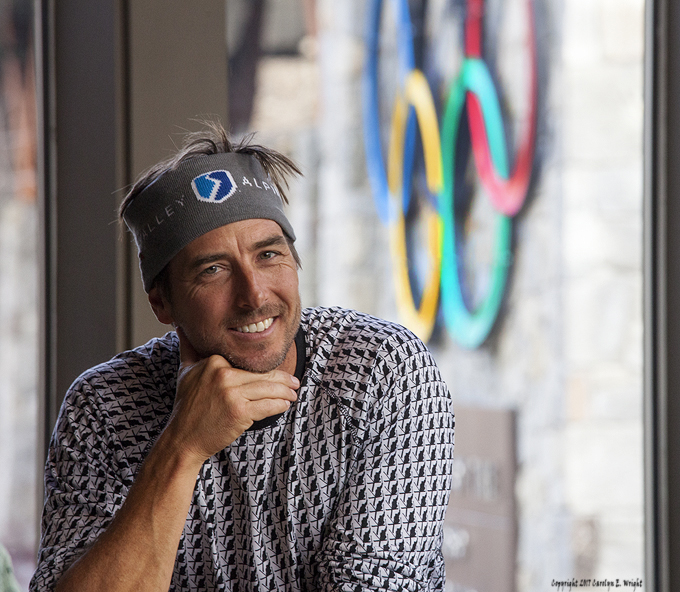
Olympian Jonny Moseley, an ambassador for Squaw Valley, on Nov. 25 talked about how the gondola will be a good thing for both resorts. Photo Copyright 2017 Carolyn E. Wright

Caldwell, along with Squaw Valley Alpine Meadows CEO Andy Wirth, spoke Nov. 25 to a group of about 50 people at Squaw. Based on the questions most seemed to support the concept.

Some were concerned about bringing more people to both mountains. Increased skier visits is not the goal of the $25 million gondola.

“It’s to stay competitive,” Wirth said. This type of infrastructure is becoming the norm in other parts of North America.

The gondola would be similar to what has been done in Utah linking Park City to the Canyons area, as well as at Whistler-Blackcomb in British Columbia.

That is also why a peak-to-peak gondola is not being talked about. That would not solve congestion on the highway or get people to where they really want to go.

A significant number of skiers ride Squaw and Alpine in a single day. To do so requires driving or being bused between them. The gondola would make it so car keys are not part of the equation.

“About 20 percent on a Saturday ski both,” Wirth said, explaining that number is in large part ski team members/parents going back and forth. Getting them and others off the road would remove 18 tons of carbon a year, he said.

The gondola would take 1,400 riders per hour. This compares to a high-speed chairlift that maxes out at about 2,300 riders, and the funitel at Squaw that loads 4,000 people an hour.

“It’s probably one of the single most iconic lifts in California’s history,” Wirth said. That’s why the eight-seat gondola (maybe 10) is going to be called the California Express. It will take people from the base of one resort to the other in about 13 minutes.
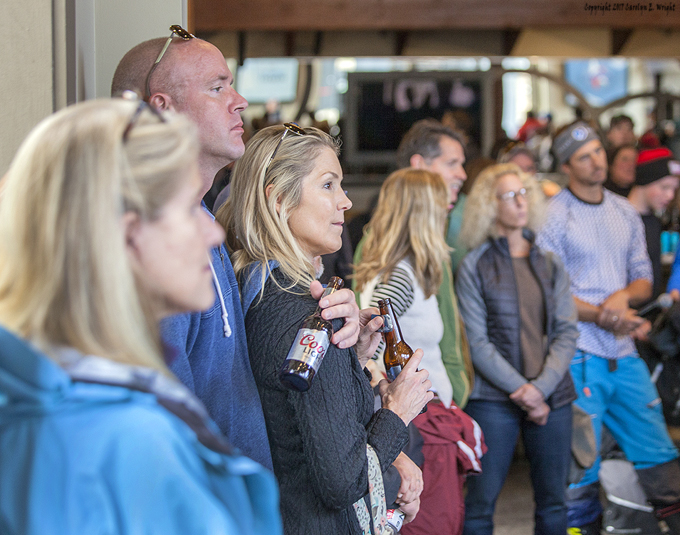
Dozens of people get an update Nov. 25 on the Squaw-Alpine gondola proposal. Photo Copyright 2017 Carolyn E. Wright

One of the biggest concerns people have had since the gondola resurfaced as a viable entity is how it might impact Granite Chief Wilderness Area. Wilderness areas by federal law cannot have any mechanized contraptions (not even a bicycle) in them.

Wirth said everyone involved is cognizant of not wanting to impact the area, and are aware the Sierra Nevada yellow-legged frog has habitat in the region. The gondola cannot and will not be in the wilderness area.

This land is most often used by the public in the summer. That is one reason resort officials and Caldwell are essentially putting it in indelible ink that the gondola will only operate when the resorts are open for skiing – never in the summer.

Creating more skiable terrain is also not an incentive to build the gondola. However, depending on the route that is selected it may be possible to let people out mid-mountain to ski at one or both resorts. This slowing of a gondola would be similar to what Heavenly Mountain Resort has where people can get off at the mid-station to sightsee before going up to the actual mountain.

Another significant issue is wind. Monitors have been placed at varying locations to clock speeds. This will play into what eventually is decided as the preferred alternative.

Admittedly the base of Squaw is already congested. One of the options being talked about would remove Red Dog and put the new gondola there. Wirth said the Squaw terminus will be at or between Red Dog and Cushing Meadow. Wirth said to expect Red Dog to be replaced in the next two years.

At Alpine, the gondola is likely to go between Hot Wheels and Summit chairlifts.

An issue at Alpine is that there is a 22-foot incline to most of the lifts. The goal is to have the gondola on grade so it’s not cumbersome to get to.

Improvements beyond the gondola are slated for Alpine, too. This includes replacing Hot Wheels next summer, most likely with a six-speed lift with a possible angled station that would go to the top of Sherwood.

The EIR/EIS will give the public the opportunity to weigh-in on the gondola – positively or negatively, or just raise questions. It will ultimately be up to the feds and county to approve the project.


Editorial: Fee hikes at national parks would limit access

Publisher’s note: This editorial is from the Nov. 24, 2017, San Francisco Chronicle.

As the Trump administration threatens large cuts to the National Park Service, federal parks officials have an idea: Just charge a whopping $70 to enter some of America’s most beloved national parks, including Yosemite, Joshua Tree, Sequoia and Yellowstone.

The proposed fee increases, which were announced in October, have come under fire by nature enthusiasts, outdoors groups and, now, California Attorney General Xavier Becerra and 10 of his counterparts from other states.

 “For every dollar the punitive fee increase raises from families, the Trump administration intends to cut more than 4 dollars from the National Park Service’s budget — almost $300 million,” Becerra said, in a statement. “That backdoor math simply does not add up. It’s a cruel deception for millions of hardworking families.”

Read the whole story


Shimano wants to make your bike as smart as your car

By Aaron Gulley, Outside

The rise of automatic shifting, integrated computers, lights, power meters, and radar has made us wonder: How much is too much?

I just discovered that the latest road bike components on the market are smarter than I am. Five months ago, Allied Cycles shipped me one of the first test models of its All Road, and though I loved the frame of this carbon shapeshifter from day one, I didn’t comprehend the potential of its components until recently. 

The bike’s Dura Ace R9170 Di2 group set—Shimano’s first-ever, top-level road components with dedicated hydraulic disc brakes—get some improvements over past iterations: the shifters have been pared down to match the size and ergonomics of the mechanical group set; the new Shadow-style rear derailleur allows for a wider gear range, with an 11-30 cassette; the weight difference between them and the mechanical group has narrowed to a mere six ounces; and the aesthetics are sleeker. Nice but negligible evolution, I thought. 

Read the whole story


Bears are reclaiming their historic Nev. territory

By Benjamin Spillman, Reno Gazette-Journal

What’s the difference between bears in Nevada and the Chicago Bears?

Bears in Nevada at least have a chance to recapture their glory days.

That’s according to research that shows black bears are spreading hundreds of miles beyond the Sierra Nevada and into Great Basin ranges they abandoned long ago.

It’s a far cry from less than 40 years ago when bears were thought to have been banished from the entire state.

Read the whole story


Snippets about Lake Tahoe

·      The Beach Retreat in South Lake Tahoe is being transformed into a winter wonderland the month of December. Twinkling lights and holiday decor will cover every inch of the resort and stay on display until mid-January. Go online for event details.

·      Out of the 20 resorts nominated by a panel of pro skiers and snowboarders, USA Today and 10Best readers selected Squaw Valley best ski resort for the third consecutive year.

·      Christmas tree permits in the Lake Tahoe Basin are sold out. Permits may still be available in other locations outside the basin. For more information, go online.

·      Ted Kennedy, who is the main partner in the restaurant group that owns Base Camp Pizza, Azul and California Burger Company in South Lake Tahoe as well as the pizza joints in the Northstar and Squaw Valley villages, now owns X Crows inside Hotel Becket in South Tahoe.

·      Lake Tahoe Shakespeare Festival’s 2018 summer season will feature “MacBeth” and “Beehive: the 60s Musical.”


Brown: Reduce public employees’ pension benefits

By Adam Ashton, Sacramento Bee

Gov. Jerry Brown got most of what he wanted when he carried a proposal to shore up the state’s underfunded public employee pension plans by trimming benefits for new workers.

Five years later, he’s in court making an expansive case that government agencies should be able to adjust pension benefits for current workers, too.

A new brief his office filed in a union-backed challenge to Brown’s 2012 pension reform law argues that faith in government hinges in part on responsible management of retirement plans for public workers.

“At stake was the public’s trust in the government’s prudent use of limited taxpayer funds,” the brief reads, referring to the period when he advocated for pension changes during the recession.

Read the whole story


Santa pictures with pups help Tahoe nonprofit

Wild Blue Dogs, the nonprofit that raises money to help dogs with cancer, is putting on two events in December.

People may have their dog’s picture taken with Santa on Dec. 9 and Dec. 16 from 1-4pm at Tahoe Beach Retreat in South Lake Tahoe. A $10 donation is suggested. (At the same time, Mrs. Clause will be at the hotel making cookies and crafts with kids.)

Canines and Cocktails will be at Sidelines inside Tahoe Beach Retreat on Dec. 18 from 5-9pm. Roast s’mores and bring the furry family members for a 25 percent discount. Dogs are allowed in the hotel lobby or patio area. 


Thieves rob, ransack EDC Christmas tree farm

By KPIX-TV

The search is on for a gang of grinches who robbed and ransacked a family-run Christmas tree farm in El Dorado County.

“They clearly busted in the door, they broke off the steal bar, and huge padlock that was on here,” says Gary Schoennauer.

Gary and Erik Schoennauer are father and son, stunned crooks would target their family’s fourth generation Christmas tree farm. This would have been a milestone a 40th year in business.

Read the whole story


Nevada is a hot springs hotbed

By Benjamin Spillman, Reno Gazette-Journal

I’ve stayed in the luxurious Jacuzzi Suite on the 25th floor of Reno’s Atlantis hotel where from the hot tub you can gaze at the Sierra Nevada through floor-to-ceiling windows.

I’ve also soaked in hot spring-fed stock tanks in remote Nevada valleys where instead of expecting room service people can expect to skim leaves and algae from the surface of the water before sliding in.

While I can’t say which Nevada experience is better for everyone, I can say I’ve only stayed at Atlantis once and I keep heading out to find more stock tanks.

It’s probably because it’s tough to think of an experience more closely connected with the land than soaking alone or with a friend in a remote spring, despite the rustic, um, charms that distinguish a real Nevada hot spring from a fancy hotel room hot tub.

Read the whole story


Multi-car accident temporarily closes Hwy. 50

By Ryan Sabalow, Sacramento Bee

Bill Steacy was driving west on Highway 50 near Shingle Springs Saturday evening with his wife and two young children. Suddenly, up ahead it looked like fireworks erupted over the freeway. Power lines were blocking the path of the Monterey family’s Toyota Tacoma pickup.

“These things were bouncing up and down, and it looked like tentacles on a giant monster,” Steacy said. “There was just no way to slow down in time to miss them.”

The front of Steacy’s pickup was badly damaged, but no one in the Tacoma was hurt in the chaotic 7pm traffic accident that lead to the closure of both directions of Highway 50 for nearly two hours. Nearly 4,000 Pacific Gas & Electric customers in the Shingle Springs area lost power.

Read the whole story