Sale of historic Cal Neva on shaky ground

By Dale Kasler, Sacramento Bee

Tech billionaire and real estate fanatic Larry Ellison might back away from a deal to buy Frank Sinatra’s old Lake Tahoe casino.

Ellison’s $35.8 million purchase of the faded Cal Neva Resort & Casino has been tied up in court for more than a month, and the Oracle Corp. founder isn’t willing to wait much longer, federal bankruptcy officials warned in a court filing last week.

If Ellison drops out, the Cal Neva would be left in limbo. The 91-year-old resort has been a fixture on Tahoe’s north shore but has out of business since 2013 and is decades removed from its glory days.

Read the whole story


USFS seeks comments on Incline land

Lake Tahoe Basin Management Unit is seeking comments on the Incline management plan project. 

The purpose of the project is to incorporate the land acquired in 2011 into the LTBMU Forest Plan and assign it to the appropriate management area. The purpose of this planning effort is also to plan project-specific activities to bring the land up to USFS standards for stream and habitat management, recreation management, and road and trails standards.

According to the Forest Service, the preliminary need to amend and change the Forest Plan is to designate approximately 400 acres of the project area (west of Third Creek) as the backcountry management area to protect water quality, improve habitat, and provide dispersed recreation opportunities. The remainder of the site would remain designated as general conservation (general forest). 

No change to the management area description in the Forest Plan is proposed, only the geographic distribution of the land designated as backcountry management area within the project area.

The proposed action and maps, as well as any project updates, are posted online.

This project is in the scoping stage of National Environmental Policy Act analysis. Send comments to Ashley Sibr, Re: Incline Management Plan Project, Lake Tahoe Basin Management Unit, 35 College Drive, South Lake Tahoe, CA 96150. Comments are due Jan. 5.


Tahoe’s murky near shore getting more attention

By Kathryn Reed

While a uniform strategy is working to bring more clarity to Lake Tahoe as a whole, that is not the case for the water closest to the shore.

That is the conundrum scientists and regulating agencies are finding themselves in. There is no magic solution to clean up, so to speak, the murky, algae-ridden water by beaches. This is in direct contrast to the various initiatives to reduce sediment from the lake that is blamed for the lack of clarity.

The near shore, as those tasked with managing call it, is defined as “the low water elevation to a depth of 30 feet, or to a minimum width of 350 feet.”

Bob Larsen with the Lahontan Regional Water Quality Control Board this month updated the board about what staff and others are doing to improve the quality near the shore.

As has been stated many times, the data is lacking – especially compared to lake clarity. Then there is the quandary of data and anecdotal testimony from longtime locals not being in sync. Data show things aren’t that much different, but those who have lived in the basin for a while or visited the area seem to be a chorus stating things are much different, and not in a good way.

Making things difficult is that conditions vary depending on where on the lake studies are conducted. That requires the need for multiple solutions, which to date have been somewhat elusive. This in part is because studies should involve fish, algae, aquatic invasive species and more.

Money is often a barrier. And then there are competing interests. Plus, it wasn’t until a few years ago that a coalition was put together to tackle near-shore issues.

Algae – some floating, some attached to rocks – is one of the bigger concerns, at least for the public.

At Crater Lake algae has been increasing in the last few years. That body of water in Oregon has similarities to Tahoe.

Larsen said at Crater Lake officials believe crayfish may be responsible for the algae growth. That could be a factor in Tahoe, where the crustaceans were introduced decades ago.

Another concern is there has been an increase of algae in wilderness lakes in Lahontan’s jurisdiction, which goes from the Oregon border to Southern California through the Sierra. There’s the potential to do a peer watershed study. Lake Tahoe, which is a highly disturbed lake when it comes to plant and animal species being introduced, could be compared to a higher elevation lake that has not been artificially changed. Though, there are some lakes that have been stocked with fish.

Lahontan is looking for partners to investigate the ecological change at Lake Tahoe to determine the impacts on native species. Ecological studies would determine biological changes, while climate change has physical drivers.

With the cyanobacteria, or blue-green algae, bloom this summer in the Tahoe Keys, human health concerns at the near shore are now a very real concern. This was the first such outbreak in the basin.

This winter/spring the near shore action plan from 2014 will be updated. Next summer an aquatic plants survey will be conducted, along with a microorganisms and toxin survey pertaining to human health, and further algae research. The plant survey will include marinas – unlike previous surveys, “to understand what is going on with native and nonnative species.”


Opinion: How anthem became central to U.S. sports

By Bryan Armen Graham, Guardian

The playing of the “Star-Spangled Banner” is so familiar and perfunctory a trapping of sporting events in the United States that few Americans even bothered to consider what it means and why it’s a tradition until last year when Colin Kaepernick chose to take a knee in protest of police violence and racial inequality.

The stakes were redoubled this September when President Trump called on NFL owners to fire any players who kneel, recasting Kaepernick’s movement as not a protest of social injustice but an affront on patriotism and an insult to the military soldiers who paid the ultimate price for freedom.

But how did a song about the War of 1812 that wasn’t even adopted as the national anthem until the 1930s become so indelibly bound to the American sporting experience? It didn’t happen overnight.

Read the whole story


The West, when women are telling the story

By Emily Wortman-Wunder, High Country News

For years, starry-eyed initiates to the West’s backcountry have packed along classics like John Muir’s “My First Summer in the Sierra,” Edward Abbey’s “Desert Solitaire,” and the journals of Lewis and Clark. These writers inspire us, open our eyes to the beauty and the fragility of the rugged West, and give this landscape a mythic resonance.

However, much of that myth has been written by men. “Here, in the wilderness, a man could be a real man, the rugged individual he was meant to be before civilization sapped his energy and threatened his masculinity,” writes environmental historian William Cronon, describing the ethos that’s shaped, and misshaped, our understanding of what wilderness is. Even the women writing in this tradition — Mary Austin, Terry Tempest Williams, Leslie Marmon Silko — often write about the struggle to make their way in a world dominated by men.

Recently, though, women have been storming the barricades. From Cheryl Strayed’s best-selling memoir of hiking the Pacific Crest Trail to Claire Vaye Watkins’ myth-busting fable of a waterless California, many of the exciting new names in the literature of the West are women. If the traditional vision of nature is one of struggle and conquest, of man testing himself against solitude and the elements, what does this shift mean for our collective vision of the wide-open spaces of the West?

Read the whole story


Snippets about Lake Tahoe

·      Tahoe Figure Skating Club’s holiday show will be Dec. 9 at 4pm at the South Lake Tahoe Ice Arena. Holiday Show. The show will feature skaters from around the Tahoe area. There will be public skating before and after. The show is free; public skating is at regular rates.

·      Truckee Fire is collecting new toys until Dec. 23 for the local Soroptimist club, which will be distributed to local children in need. Glenshire, downtown and the high school fire stations have bins. 

·      The Minden library is showing classic holiday movies on the big screen – “Christmas in Connecticut” on Dec. 4 and “Holiday Inn” on Dec. 18. Both shows are at 4pm. Free treats, fruits and vegetables (reindeer food), and cozy beverages will be available. A special gift will also be given to all who attend.

·      Barton Memorial Hospital Auxiliary is sponsoring a blood drive Dec. 1 from noon-5pm at the South Lake Tahoe Recreation Center.

·      RejuVenate Sauna and Energy Center is having a grand reopening on Dec. 1 from 3-6pm and Dec. 2, 10am-2pm. The new location is at 124 McFaul Way, Ste. 202 in Round Hill.


Sports leagues hedging bets on nationwide legal gambling

By Ben Nuckols, AP

WASHINGTON — In court, all four major U.S. sports leagues are fighting New Jersey’s challenge to the federal ban on sports gambling, which the Supreme Court will hear next month.

Outside of court, leaders of three of the four leagues have made public comments that suggest they wouldn’t mind losing the case. Only the NFL has been steadfast in its opposition to gambling, a stance that critics see as hypocritical, especially as the Raiders plan a move to a billion-dollar stadium just off the Las Vegas Strip.

As the Supreme Court prepares to hear a case that could lead to the federal ban on sports betting being struck down, the leagues are hedging their bets — preparing for a future of expanded gambling and hoping to have a say in how legalization takes effect.

Read the whole story


Road Beat: Toyota Tundra, getting it right

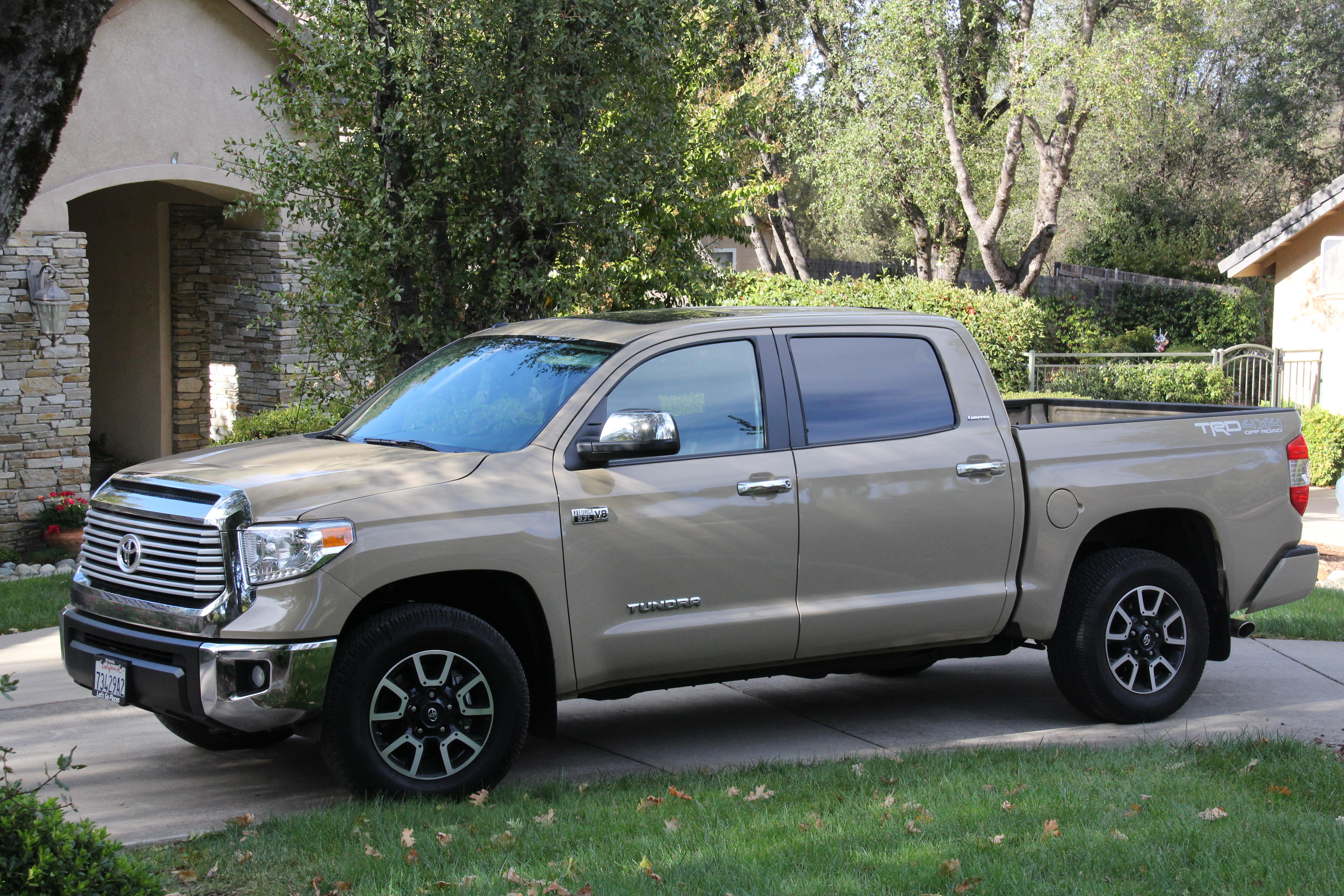
The Toyota Tundra continues to improve in nearly every category. Photos/Larry Weitzman

By Larry Weitzman

It’s been more than three years since my last visit with this third generation Tundra and my last review remarked how Toyota finally made the Tundra into a real “Cowboy Cadillac” with a ride smoother than a baby’s butt. This new Tundra feels even a bit smoother, perhaps a little less jiggly over Caltrans challenged pavement.

While this third generation is now in its third year of production at its new San Antonio, Texas, plant, incremental improvements have been made, small tweaks here and there all to improve the driving experience and what an experience it is.

Outside, the Tundra looks big, almost like a three-quarter, 1-ton truck. It stands tall at 77.2 inches with the TRD equipment. But with the CrewMax you get an extra 8 inches of rear seat room, which makes for limousine proportions out back, but the bed is a shorty with a length of just 67 inches and with a width of 66 inches, it is almost a perfect square. And it is deep at more than 22 inches. Consequently, length is no more than a standard cab long bed Tundra or 228.9 inches or about 10 inches longer than a Suburban. Width however is 80 inches and you can feel that breath when inside. It gives beamy a new definition. Coefficient of drag isn’t as bad as you would think at 0.38.

And with tweaks to the design, Tundra is a great looking ride especially in my Quicksand color. This enamel color looks 5-feet deep.

With its big 5.7L iForce DOHC 32 valve, direct injected V-8 it pounds out 381 very big horses at a low 5,600 rpm and 401 pounds of twist at just 3,600 rpm. It drives the rear wheels and all four wheels via an on demand two-speed system through a six-speed auto cog-swapper. And it rocks as it is a bit quicker than my experience with the top of the line 1794 edition from three years ago, as this beast romps with a 0-60 mph time of under six seconds, posting an average of 5.88 seconds. That is world class. And it is backed up by 50-70 mph passing times of 3.14 seconds on a level highway and 4.95 seconds up a 6-7 percent grade. That’s a half second improvement in the first two parameters and a 0.03 second improvement in the last uphill parameter. Wow.
Specifications
Price (Crew Max 4X4, as tested) $51,488
Engines
4.6L DOHC 32 valve V-8 310 hp @ 5,600 rpm
327 lbs.-ft. of torque @ 3,400 rpm
5.7L DOHC 32 valve V-8 381 hp @ 5,600 rpm
401 lbs.-ft. of torque @ 3,600 rpm
Transmission
Six speed automatic (4.6L, 5.7L V-8)
Configuration
Longitudinal front engine/rear wheel drive/four-wheel drive
Dimensions (as tested)
Wheelbase 145.7 inches
Length 228.9 inches
Width 79.9 inches
Height 77.2 inches
Track (f/r) 67.9/67.9 inches
Ground clearance 10.6 inches
Bed size (l/h/w) 66.7/22.2/66.4 inches
Weight 5,560 pounds
GVWR 7,200 pounds
Tow capacity 9,000 pounds
GCWR (gross combined weight rating) 16,000 pounds
Fuel capacity 38.0 gallons
Steering lock to lock 3.71 turns
Turning circle 44.0 feet
Brake rotor diameter (f/r) 13.9/13.6 inches
Co-efficient of drag 0.38
Performance
0-60 mph 5.88 seconds
50-70 mph 3.14 seconds
50-70 uphill 4.95 seconds
Top speed Without a governor it would probably hit 130 plus mph. It’s got a lot of air to push.
Fuel economy EPA rated at 13/17/15 mpg city/highway/combined. Expect 15-16 mpg in rural country driving and 19-20 mpg on the highway at legal speeds.

Throttle response is extremely strong and immediate, but yet you can baby this unit along with a feather foot as well. Nice throttle.

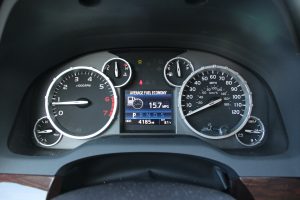
But performance like that out of a big, 5,560-pound vehicle doesn’t come without a price at the pump. EPA fuel economy numbers are 13/17/15 mpg city/highway/combined. But it does a little better on the highway, recording 19.4 mpg at a constant 70 mph which is the exact number from three years ago with the engine turning about 1,850 rpm. In my trip over the Sierra to Carson City, the big Tundra averaged a tolerable 17.2 mpg in aggressive driving. Overall the Tundra averaged 15.4 mpg, but with its huge 38-gallon fuel tank, you can see a huge range of well over 500 miles on the highway. But the fill up of 30 plus gallons (you don’t want to have to push this truck) will approach $75-$80. It runs on regular.

My TRD equipped Tundra came with special double wishbone suspension up front and a live axle suspended by multi-trapezoidal leaf springs with TRD Bilstein’s in all for corners and special coils up front and a 2.5-inch lift. Steering is a bit slow at 3.71 turns lock to lock but its turning circle is remarkably tight at just 44 feet. Tires mounted on huge 20 x 8 inch alloys are 275/55 series rubber which give the big Tundra surprisingly good grip and cornering power. Yes, it has to be guided, but it works pretty darn good. It biggest issue is it feels big. Kind of like seeing the fastest airliner in the sky, a Boeing 747, which appears to look like the slowest, especially on landing, because of its size.

Ride quality is much improved to the point of being ultra-smooth and quiet on smooth roads and comfortable on maintenance challenged roads. It now rides like that aforementioned “Cowboy Cadillac.” Toyota has got it right.

Brakes are huge with four ventilated discs of nearly fourteen inches in diameter with the fronts having four piston calipers. They are powerful. All the safety acronyms are present along with a backup camera, a real necessity, and eight air bags. Headlights are very good.

Here I go again with that “Cowboy Cadillac” stuff as the interior is sumptuous, ready for the opera. Heck, it’s so roomy inside they could hold the opera inside. All kidding aside, the interior is mammoth, a bench seat could hold four abreast with enough seat belts. A good thing it’s really quiet or you would have to shout to your passenger who probably feel like he/she is sitting across a football stadium.

Everything is done with leather and other first-rate materials, and the instrument panel has all the requisite gauges including a volt meter and oil pressure gauge. It’s an easy to read unit as is the simple to use trip computer.

The center stack is fairly easy to use, but it will take some dual of about 15 minutes to master it. Then it’s a piece of cake.

The bed, while short and within about half an inch from being square, is deep like the Marianas Trench in the Pacific. It will pack the cargo and everything you buy at Home Depot.

Stickering at a base price of $44 large, my Limited was loaded up with about $6K in options, all worth it including the $1,100 for the performance dual exhaust which sound fantastic, like a V-8 should. Not obtrusive on the highway, but when you get into the delicious throttle, nothing sounds better. Total for this “Cowboy Cadillac” which remember is made in Texas totals $51,488 including $1,195 for the rail car from near San Antonio. It’s a terrific ride and remember, it’s a Toyota.

Larry Weitzman has been into cars since he was 5 years old. At 8 he could recite from memory the hp of every car made in the U.S. He has put in thousands of laps on racetracks all over the Western United States.


Mountain storytelling podcast to launch in Dec.

Brendan Madigan, owner of 38-year-old specialty retail shop Alpenglow Sports, has launched a podcast initiative featuring intimate conversations with iconic mountain personalities.

Afterglow, a Mountain Storytelling Podcast, travels deep into the mind, heart and soul of world-renowned adventure athletes. The first season is a six-part series with weekly episodes that becomes available on Dec. 1 across multiple podcast platforms.

Afterglow is a series of organic, long-form and intimate conversations that reveal the possibilities, motivations and inspirations of iconic mountain athletes. Every conversation digs deep in the attempt to learn universal truths from the experiences of these athletes including who we are, why we are here and how these answers offer a pathway for the sharing of experiences, emotion and vulnerabilities that can potentially spark change and bridge divides.

Season one  includes conversations with Tommy Caldwell, Will Gadd, Dave Nettle, Brendan Leonard, Doug Robinson and Chris Noble. The series kicks-off is a tandem chat with high altitude mountaineers Adrian Ballinger and Cory Richards, climbers of Everest-No-Filter fame.

Afterglow is entirely free and available on iTunes, Soundcloud, Stitcher, Google Play and more.


Law enforcement targeting seat belt violators

Now through Dec. 2 Douglas County sheriff’s deputies will be looking for motorists and occupants who are not buckled up while traveling.

The department will be joining forces with Nevada Highway Patrol to watch for drivers and occupants in vehicles who are not wearing their seat belts and/or children who are not properly secured in car or booster seats.

According to the National Highway Safety Administration’s, 12,584 lives were saved by wearing seat belts, yet 49 percent of occupants who were killed in 2013 weren’t restrained.